What Is A Dental Implant Locator?
The dental implant locator is a specific type of attachment system used to connect removable overdentures to dental implants. It represents one of the most popular and successful methods for providing stability to removable prostheses. Patients who struggle with loose, uncomfortable dentures often find that a locator-retained overdenture transforms their quality of life. This article explains what a dental implant locator is, how it works, the treatment process, maintenance requirements, and how it compares to other attachment systems.
The Basic Concept of Implant Overdentures
Understanding the locator requires understanding the prosthesis it supports.
From Conventional Dentures to Implant Retention
A conventional complete denture rests on the gum tissue and relies on suction, muscle control, and the contours of the residual ridge for stability. For many patients, particularly those with significant bone resorption in the lower jaw, conventional dentures are loose, uncomfortable, and functionally limiting. Eating, speaking, and socializing with an unstable denture erodes quality of life.
Implant overdentures address these problems by anchoring the denture to implants placed in the jaw. The denture has corresponding attachments on its tissue side that engage the implant abutments. The patient places and removes the denture, but once seated, the attachments hold it firmly in position.
The Role of Attachments
Attachments are the components that connect the denture to the implants. They consist of a male component, usually on the implant abutment, and a female component, housed within the denture. The locator system is one specific design of attachment that has gained widespread adoption due to its versatility, durability, and ease of use.
The Locator Attachment System Design
The Zest Locator system, now manufactured by Zest Dental Solutions, introduced a design that has become an industry standard.
Components of the Locator System
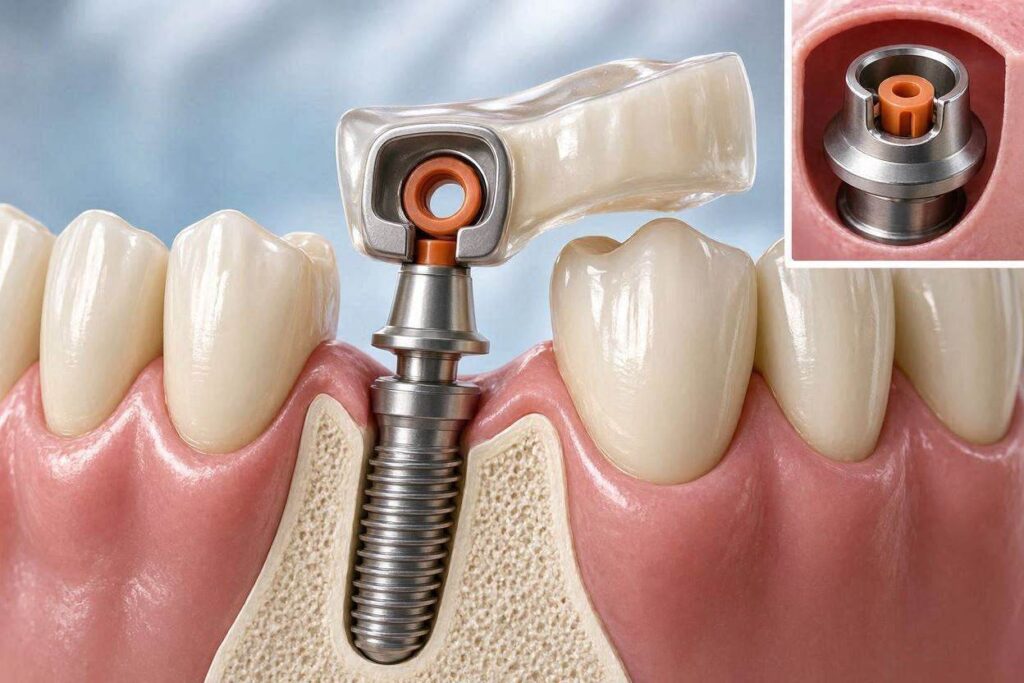
The locator abutment is a low-profile titanium component that screws into the implant fixture. It has a patrix, or male portion, with a specific shape that engages the denture housing. The abutment top features a spherical or slightly tapered shape designed to provide retention while allowing some pivoting movement.
The locator housing is a metal cap that resides within the denture base. Inside the housing sits a nylon insert, which is the female component that snaps onto the locator abutment. The nylon insert is replaceable and available in different retention levels, allowing customization of the force required to remove the denture.
Retention Levels and Color Coding
One of the locator system’s key advantages is the availability of inserts with different retention strengths. These inserts are color-coded for easy identification.
| Insert Color | Retention Level | Recommended For |
|---|---|---|
| Blue | Extra Light | Initial placement, elderly patients, dexterity challenges |
| Pink | Light | Standard initial placement, moderate retention |
| Clear | Medium | Well-healed sites, experienced wearers |
| Green | High | Strong ridge support, patient preference for firm retention |
| Red | Extra High | Maximum retention, very experienced wearers |
The ability to adjust retention by simply changing nylon inserts, without modifying the abutments or denture, gives the locator system exceptional clinical flexibility.
Angulation Correction
Original locator abutments accommodated up to 20 degrees of divergence between implants. The Locator R-Tx, a newer iteration, handles up to 40 degrees of divergence per implant pair. This angulation tolerance is critical because implants are not always placed perfectly parallel to one another. The ability to compensate for angulation without custom abutments simplifies treatment and reduces cost.
How the Locator Functions in Daily Use
Patients interact with the locator system during insertion and removal of their overdenture.
Insertion
The patient positions the denture over the implants and applies firm, even pressure. The nylon inserts snap over the locator abutments with an audible or tactile click. Once seated, the denture is stable and resists dislodgement during speaking, laughing, and eating.
Removal
The patient grasps the denture and applies a controlled removing force. The nylon inserts release from the abutments. A rocking motion typically facilitates removal. Patients with dexterity limitations may find the lowest retention inserts necessary for manageable removal. The removal force is directional, meaning the denture resists vertical displacement during function but releases when the patient applies intentional removal force.
Function
During chewing, the locator attachments resist vertical displacement of the denture. Some rotational movement is permitted, allowing the denture base to contact the underlying tissue comfortably. This resiliency distributes forces between the implants and the edentulous ridge, providing functional stability without overloading the implants.
The Treatment Process for Locator Overdentures
Obtaining a locator-retained overdenture involves several steps.
Implant Placement
The number of implants needed depends on the arch. For a mandibular overdenture, two implants in the anterior mandible between the mental foramina represent the standard of care endorsed by the McGill Consensus and other expert panels. For a maxillary overdenture, four implants typically provide adequate support, though the bone quality in the maxilla is less dense, and more implants may be indicated.
Healing and Osseointegration
Implants require three to six months to integrate with the bone. During this period, the patient continues wearing their existing denture, often modified with a soft liner to accommodate the healing abutments. In some protocols, locator abutments are placed at the time of implant surgery and immediately loaded if primary stability is sufficient.
Abutment Connection
After osseointegration, the locator abutments are torqued to the implants. The abutment height is selected based on tissue thickness. The abutments protrude slightly above the gum, providing the male component for attachment.
Denture Modification or Fabrication
An existing denture can often be retrofitted with locator housings, converting it to an implant overdenture. Alternatively, a new denture is fabricated with locator housings incorporated during processing. The housings are picked up chairside or by the laboratory using a technique that ensures passive fit over the abutments.
Insert Delivery and Patient Education
The dentist delivers the completed overdenture, verifies fit and retention, and educates the patient on insertion, removal, and care. Initial nylon inserts are typically light or medium retention. The patient returns for follow-up to assess tissue response and adjust retention as needed.
Maintenance of Locator Attachments
The locator system requires ongoing maintenance to function optimally.
Nylon Insert Replacement
The nylon inserts wear over time, losing retention. Replacement frequency depends on use, parafunctional habits, and oral environment. Typical replacement intervals range from six to eighteen months. The inserts are inexpensive and can be replaced chairside in minutes.
Abutment Cleaning
Locator abutments accumulate plaque and calculus. The patient must clean them daily with a soft toothbrush. The dentist or hygienist cleans them professionally at maintenance visits, using plastic or graphite instruments to avoid scratching the abutment surface. Scratched abutments wear nylon inserts prematurely.
Denture Housing Maintenance
The metal housings within the denture should be cleaned of debris and checked for integrity. Worn or damaged housings can be replaced by the laboratory or, with some systems, chairside by the dentist.
Implant Health Monitoring
The implants supporting locator abutments require the same periodontal monitoring as any implant. Probing depths, bleeding on probing, and radiographic bone levels are assessed at regular intervals. Peri-implantitis can develop around overdenture implants, particularly if oral hygiene is inadequate.
Comparing Locator to Other Attachment Systems
The locator is not the only overdenture attachment available.
| Feature | Locator | Ball Attachment | Bar Attachment | Magnet |
|---|---|---|---|---|
| Retention | Adjustable nylon inserts | Adjustable by O-ring replacement | Set by bar design and clips | Fixed magnetic force |
| Angulation Compensation | Up to 40 degrees | Limited | Bar design dependent | Some designs tolerant |
| Profile Height | Low | Medium to high | Variable | Low to medium |
| Cost | Moderate | Lower | Higher | Moderate |
| Maintenance | Insert replacement | O-ring replacement | Clip replacement, bar hygiene | Magnet replacement |
| Long-Term Wear | Inserts wear, easily replaced | O-rings wear, easily replaced | Clips wear, bar may need replacement | Magnets corrode, lose force |
Locator attachments have largely superseded ball attachments due to their lower profile, superior angulation tolerance, and adjustable retention. Bar attachments remain popular for complex cases, particularly when implants are malpositioned or when additional splinting of implants is desired. Magnets have declined in popularity due to corrosion issues and lower retention.
Advantages and Limitations of Locator Attachments
Every system has strengths and weaknesses.
Advantages
The low vertical profile conserves space within the denture, reducing the risk of denture fracture. Adjustable retention through interchangeable nylon inserts allows easy customization. Angulation correction accommodates imperfect implant placement. Component replacement is simple and inexpensive. The system is well-supported by implant manufacturers worldwide.
Limitations
Nylon inserts require periodic replacement, representing ongoing maintenance cost and appointments. The metal housings within the denture can debond over time, requiring laboratory repair. Patients with very limited dexterity may struggle with denture removal even at the lowest retention level. Excessive forces from parafunctional habits can accelerate insert wear.
Conclusion
A dental implant locator is a precision attachment system that connects removable overdentures to dental implants, providing stability and retention far beyond what conventional dentures offer. The system consists of low-profile titanium abutments on the implants and metal housings with replaceable nylon inserts within the denture. Retention is adjustable through color-coded inserts. The locator system is versatile, cost-effective, and widely regarded as the standard attachment for implant overdentures. Regular maintenance, including insert replacement and professional cleaning, ensures continued function and implant health.
Frequently Asked Questions
How many implants do I need for a locator denture?
For the lower jaw, two implants are the accepted minimum. For the upper jaw, four implants are typically recommended. Additional implants provide greater support and redundancy.
How often do the nylon inserts need replacing?
Typically every six to eighteen months, depending on wear. Your dentist checks retention at maintenance visits and replaces inserts when they lose adequate holding force.
Can my existing denture be converted to a locator overdenture?
In many cases, yes. The denture must be in good condition, with adequate thickness to accommodate the locator housings. Your dentist evaluates whether your existing denture is suitable for conversion.
Is the locator system better than a fixed bridge on implants?
They serve different needs. A locator overdenture is removable, generally less expensive, and easier to clean. A fixed bridge is permanently secured and feels more like natural teeth. The choice depends on clinical factors, patient preference, and budget.
Additional Resource
For detailed information on implant overdenture options, visit the American College of Prosthodontists at www.gotoapro.org. The ACP provides patient education on removable and fixed implant prostheses.