What Is the Blue Gel for in Teeth Whitening?
You unbox a new LED whitening kit, and alongside the familiar clear peroxide syringes, you find a tube or pen filled with a strikingly blue, almost neon gel. The instructions tell you to apply this blue gel before or after the whitening session, or to mix it with the peroxide formula. The vibrant color hints at advanced science, a secret ingredient that somehow amplifies the whitening power. But what is this blue gel actually doing? Is it a catalyst, a booster, a protective agent, or something else entirely?
The answer reveals a clever intersection of color science, cosmetic formulation, and marketing psychology. The blue gel in teeth whitening is not a bleaching agent. It does not oxidize stain molecules, and it does not chemically whiten your teeth in the way hydrogen peroxide or carbamide peroxide does. Instead, its primary function is optical: it uses complementary color theory to create an immediate, temporary illusion of whiter teeth. This article dissects the exact composition and mechanism of the blue gel, separates the optical effect from genuine oxidative whitening, and explains why it is included in so many modern whitening kits.
The Two Distinct Types of “Blue Gel” in Whitening Kits
First, we must clarify that not all blue gels serve the same function. The term “blue gel” in the context of teeth whitening refers to two fundamentally different products, and the confusion between them is the source of much misunderstanding.
Type 1: The Blue-Tinted Whitening Gel (Active Peroxide with Dye)
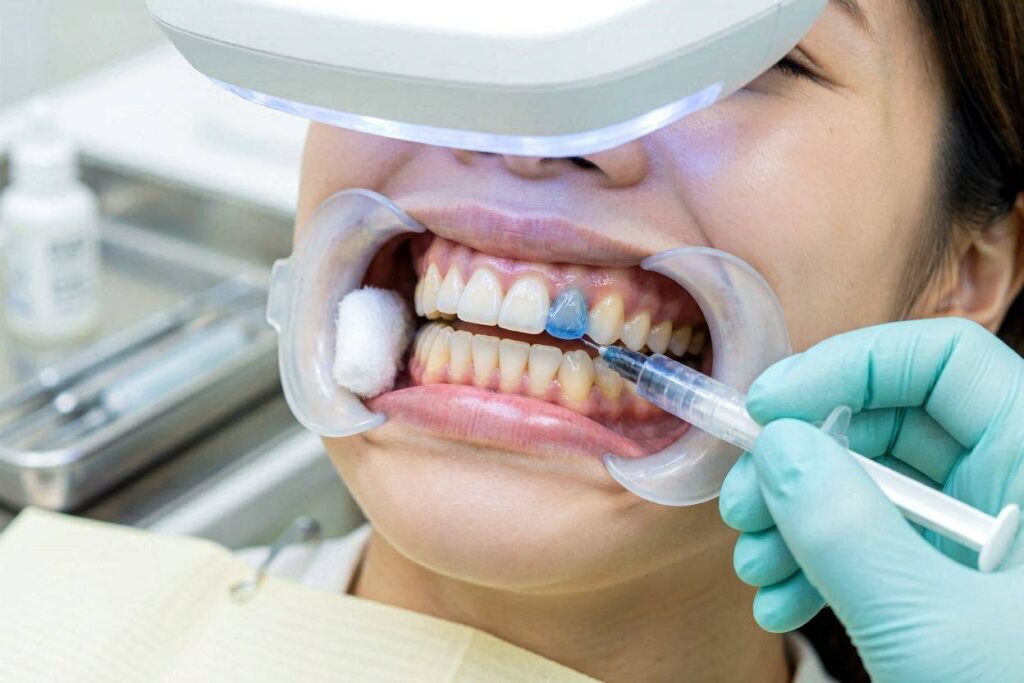
Some manufacturers add a blue or violet food-grade dye directly to the hydrogen peroxide or carbamide peroxide whitening gel. This gel is still chemically active. It contains real peroxide at a functional concentration (typically 3% to 6% hydrogen peroxide). The blue color is a transient visual marker. It helps the user see exactly where the gel has been applied, ensuring even coverage across the dental arch. The color also serves a psychological function; blue is culturally associated with cleanliness, freshness, and clinical efficacy.
When this blue-tinted gel is applied and the LED light is activated, the dye fades or disappears over the course of the session. This fading is not the peroxide “activating.” The blue dye is simply being photobleached—decomposed by the intense blue light of the LED. The disappearance of the color provides a visual cue that the session time is complete. The blue dye itself contributes nothing to the whitening chemistry. It is a colorant and a timer, not an active ingredient.
Type 2: The Blue/Violet Optical Color-Correcting Gel (Non-Peroxide)
This second type of blue gel is an entirely different product, and it is the one that generates the most confusion and skepticism. This gel contains no hydrogen peroxide, no carbamide peroxide, and no bleaching agent whatsoever. It is a non-oxidative cosmetic formulation consisting primarily of water, glycerin, a film-forming polymer (such as PVP or an acrylate copolymer), and a high concentration of blue or violet pigments, often from the CI 74160 (Phthalocyanine Blue) or CI 45100 (Acid Violet) colorant families.
This gel is applied to the teeth after the whitening session and the LED light exposure, or sometimes as a standalone “instant whitening” treatment. It dries into a thin, transparent, colored film that coats the enamel. This is the gel that creates the “instant white” effect. It is, in essence, a temporary tooth makeup—a color-correcting cosmetic layer, not a bleaching agent.
The Color Science: How Blue Makes Yellow Teeth Look White
The mechanism of the non-peroxide blue color-correcting gel is grounded in the physics of light and the opponent process theory of color vision. To understand it, we need a brief primer on the subtractive color wheel.
The color we perceive when we look at a tooth is the light that is reflected back to our eyes. A yellow tooth absorbs blue wavelengths and reflects red and green wavelengths, which our brain mixes to perceive as yellow. Yellow and blue are complementary colors on the subtractive color wheel; they are directly opposite each other. When you superimpose a blue filter over a yellow surface, the blue pigment absorbs the red and green wavelengths and reflects blue. The yellow surface absorbs blue and reflects red and green. The result is a neutralization—the reflected light contains a more balanced spectrum, which the brain perceives as white or a less chromatically saturated off-white.
The blue color-correcting gel deposits a thin, semi-transparent layer of blue or violet pigment directly onto the enamel. This layer acts as an optical filter. It subtracts the yellow wavelengths being reflected by the underlying dentin, shifting the overall spectral reflectance toward a more neutral, achromatic (white) appearance. The tooth has not changed color chemically. The dentin chromophores remain untouched. You are simply viewing them through a blue-tinted window.
This effect is instantaneous upon application and drying. It is also completely reversible. The blue film is water-soluble or mechanically fragile. It begins to dissolve as soon as saliva bathes the teeth, and it is entirely removed by eating, drinking, or brushing. The “whitening” lasts for a few hours at most, until the film wears away.
Why Is This Blue Gel Included in Whitening Kits?
The inclusion of a non-peroxide color-correcting gel in a kit that also contains genuine peroxide whitening gel serves a carefully calculated marketing and user-experience purpose.
The Gratification Gap:
Chemical teeth whitening with peroxide takes time. A typical at-home treatment cycle requires 7 to 14 days of daily sessions before the final shade change is fully expressed. The human brain craves immediate reward. A user who applies a clear peroxide gel for 30 minutes, removes the tray, and stares in the mirror will see a subtle improvement at best during the first few sessions, and the immediate post-session appearance may actually be compromised by the dehydration-induced chalky look.
The blue color-correcting gel bridges this gratification gap. After the peroxide session and the LED light, the user applies the blue gel. Instantly, the teeth appear dramatically whiter. The user feels a rush of satisfaction and confidence that the product is working. This psychological reinforcement is profoundly powerful. It motivates continued compliance with the full treatment cycle. By the time the user has finished the 2-week course, the genuine oxidative whitening has achieved its final shade, and the blue gel’s optical trickery has served its purpose of keeping the user engaged and happy.
The “Before-and-After” Photography Effect:
The blue gel is also a tool for generating compelling marketing imagery. A “before” photo of stained, yellow teeth, followed by an “after” photo taken immediately after the application of the blue color-correcting gel, produces a dramatic, high-contrast transformation that is highly persuasive in advertisements and social media posts. The consumer must be educated to understand that the “after” photo in such cases is showing the combined effect of genuine oxidative lightening plus a temporary optical filter, not the stable, unassisted peroxide result.
The Role of the LED Light: Photobleaching and Curing
The relationship between the blue gel and the LED light in these kits is often misunderstood. The LED light in most consumer whitening kits emits a narrow band of intense blue light, typically around 460-480 nanometers. This wavelength serves two potential functions.
Photobleaching of the Dye:
If the blue-tinted peroxide gel (Type 1) is used, the intense blue light causes rapid photodegradation of the blue dye molecules. The dye breaks down into colorless fragments, and the gel transitions from blue to clear or white foam. This is a visual timer, as discussed. It is not the mechanism of whitening.
Accelerated Decomposition of Peroxide (Theoretical and Minor):
The blue light may also provide some thermal energy to the peroxide gel, modestly accelerating the rate of hydrogen peroxide decomposition into free radicals. However, the clinical significance of this acceleration is heavily debated. The majority of the whitening is achieved by the chemical action of the peroxide over the contact time, not by the light.
Curing of the Color-Corrector Film (Rare):
Some kits instruct the user to apply the non-peroxide blue gel and then use the LED light to “set” or “cure” it. The blue light does not cure the film in the way a dental curing light polymerizes a composite resin, because the blue gel does not contain photoinitiators and monomers designed for polymerization. The light may simply warm and slightly dehydrate the film, making it feel more set, but the film remains water-soluble and temporary.
Is the Blue Gel Safe?
The safety profile of the blue gel, whether Type 1 (tinted peroxide) or Type 2 (color-correcting film), is generally favorable when the product is from a regulated manufacturer. The blue and violet pigments used (phthalocyanine blues, acid violets) are the same colorants approved for use in food, cosmetics, and personal care products globally. They have a long history of safe use and are considered non-toxic at the concentrations present in a topical oral application.
The film-forming polymers (PVP, acrylate copolymers) are similarly well-characterized and inert. They are the same polymer bases used in pharmaceutical tablet coatings and cosmetic skin films. There is no credible evidence that the incidental ingestion of the microscopic amount of blue film worn off by saliva during a few hours of wear poses any health risk to a healthy adult.
The primary safety consideration is not toxicity, but the potential for gum irritation. If the blue gel is applied carelessly and floods the gingival margin, the concentrated pigment and polymer solution can cause a mild, transient inflammatory response. The gum tissue may temporarily take on a bluish tinge, which can be alarming but resolves quickly as the film dissolves. Meticulous application, using a pen tip or a fine brush and keeping the gel strictly on the enamel, prevents this cosmetic nuisance.
Distinguishing Marketing Hype from Genuine Chemistry
Consumers must be literate in the language of whitening kit marketing to avoid being misled. Key phrases and claims should be interpreted critically:
- “Instant White Results!”: This almost certainly refers to the optical effect of a blue color-correcting gel, not the peroxide whitening.
- “Blue Light Activates the Gel!”: The light may photobleach the blue dye, providing a visual timer. It does not “activate” the peroxide in the sense of turning an inert substance into a bleaching agent. The peroxide was already chemically active.
- “Proprietary Blue Complex”: This is often a rebranding of the blue color-correcting gel. It sounds scientifically advanced, but the mechanism is basic complementary color theory.
- “Whitening Booster Gel”: This may refer to a separate desensitizing gel, a remineralizing gel, or the color-correcting gel. Check the ingredient list. If hydrogen peroxide or carbamide peroxide is not listed, the “booster” is not boosting the whitening chemistry; it is providing an optical or remineralization adjunct.
How to Use the Blue Gel Correctly (If You Choose To)
If your kit includes a separate non-peroxide blue color-correcting gel, and you wish to use it for the temporary optical brightening effect, follow this protocol:
- Complete Your Whitening Session First: Perform the full peroxide gel and LED session as directed. Rinse your mouth and dry your teeth gently with a clean tissue.
- Apply a Thin, Even Coat: Use the pen or brush to paint a very thin layer of the blue gel onto the dry facial surfaces of the teeth you wish to brighten. Avoid the gum line.
- Keep Lips Retracted: Allow the gel to air-dry for 30 to 60 seconds. Keeping your lips away from your teeth prevents smudging the film.
- Do Not Eat or Drink: The film is water-soluble. Avoid food and beverages for at least an hour to prolong the optical effect.
- Expect Temporary Results: The brightening will fade gradually as the film dissolves. This is normal. The genuine, stable whitening is the result of the cumulative peroxide sessions, not the blue gel.
Conclusion
- The blue gel in teeth whitening kits primarily functions as an optical color corrector using blue-violet pigments that act as a complementary color filter, instantly neutralizing the yellow wavelengths reflected by the dentin to create a temporary illusion of whiteness, not a chemical bleaching action.
- When blue dye is added to an active peroxide gel, its purpose is as a visual application aid and a photobleaching timer under the LED light, contributing nothing to the oxidative whitening chemistry itself.
- The psychological role of the blue color-correcting gel is to bridge the gratification gap between the slow, cumulative genuine peroxide whitening and the user’s desire for an immediate visible result, boosting motivation and treatment compliance.
Frequently Asked Questions
Does the blue gel work without the LED light?
The non-peroxide color-correcting blue gel works entirely independently of the LED light. The light may be used to speed up the drying of the film, but the optical color correction is a physical phenomenon of the pigments filtering reflected light, not a photo-activated chemical reaction. The film will function whether or not the light is applied.
Can I use the blue gel alone as my primary whitening method?
No. The blue gel provides a cosmetic, temporary masking effect, not genuine stain removal or tooth bleaching. Using it alone will give you a few hours of apparent brightness but will produce no lasting change in your dentin color. It is a supplementary cosmetic product, comparable to tooth makeup, not a standalone whitening treatment.
Why does my gum line look blue after using the gel?
The blue pigment in the gel has wicked onto the gum tissue and temporarily stained the superficial epithelial cells. This is harmless and will resolve on its own within a few hours as the cells naturally desquamate and the film dissolves. To prevent this, apply the gel carefully to the teeth only and wipe away any excess that contacts the gums immediately.
Is the blue gel the same thing as the “purple shampoo” trend for hair?
The principle is identical. Purple shampoos use violet pigments to neutralize brassy yellow tones in blonde or silver hair. The blue whitening gel uses blue-violet pigments to neutralize yellow tones in teeth. Both are applications of complementary color theory to cosmetic appearance, creating an optical neutralization rather than a chemical change.
Can the blue gel stain my aligners or retainers?
Yes, potentially. The concentrated pigments in the blue gel can transfer onto clear plastic aligners, retainers, or trays if the gel is not fully dry before you insert them. Ensure the film is completely dry and set before placing any clear orthodontic appliance over your teeth, or apply the blue gel only at times when you will not be wearing the appliance.
Disclaimer: This article is for informational and educational purposes only and does not constitute medical or dental advice. The specific ingredients and functions of the blue gel in your whitening kit should be verified by reading the product’s ingredient list and instructions. Consult with a dental professional if you have concerns about the safety or suitability of any whitening product for your individual oral health.