What Is The Cost Of Arestin For A Dentist?
Gum disease is one of the most common dental problems in the world. It affects millions of adults and can lead to tooth loss if left untreated. Dentists use many tools to fight gum disease, and one of the most effective is Arestin. This is a local antibiotic that is placed directly into infected gum pockets. It helps kill bacteria and reduce inflammation.
If you are a dentist or a patient, you might be wondering about the cost of Arestin. For dentists, it is a supply cost that affects the profitability of periodontal treatment. For patients, it is an add-on cost that may or may not be covered by insurance.
This guide will focus on the cost of Arestin from a dentist’s perspective. We will explain what Arestin is, how it works, and how much it costs to buy. We will look at reimbursement rates, insurance coverage, and the financial aspects of offering Arestin in your practice. We will also share tips to manage costs and maximize patient acceptance. By the end, you will have a clear picture of the economics of Arestin.
What Is Arestin?
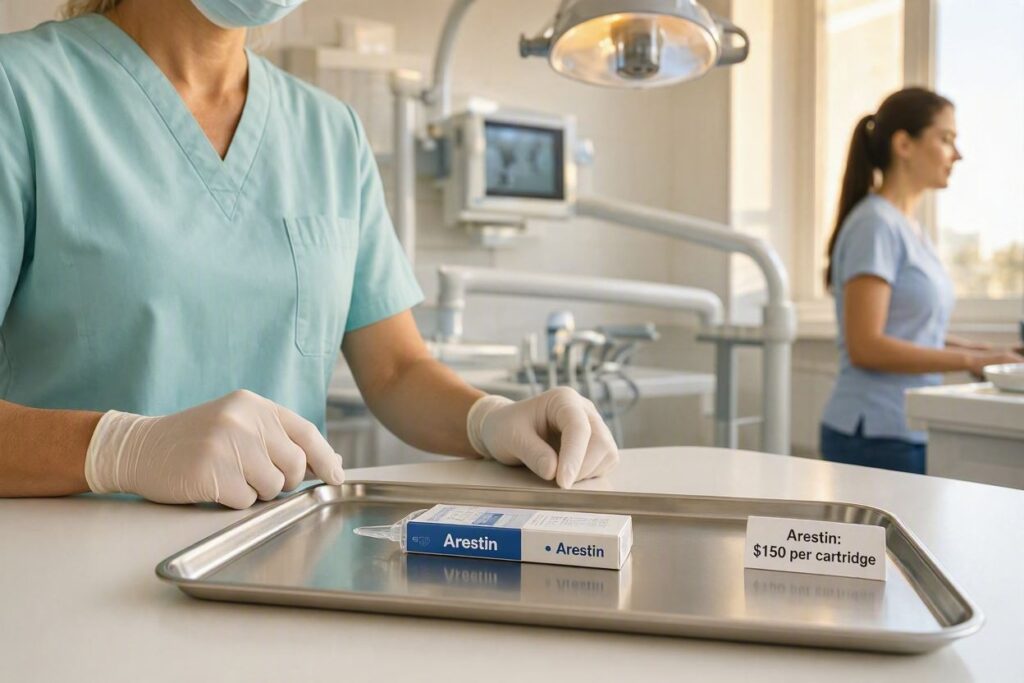
Arestin is a prescription antibiotic product used to treat periodontal disease. Its active ingredient is minocycline hydrochloride. It comes in a powder form that is placed directly into periodontal pockets (the spaces between your teeth and gums).
How Does Arestin Work?
Arestin is a controlled-release antibiotic. Once placed in the pocket, it releases minocycline over a period of about 21 days. This helps kill the bacteria that cause gum disease. It also reduces inflammation and helps the pocket heal.
Why Do Dentists Use Arestin?
Scaling and root planing (SRP) is the standard treatment for gum disease. SRP removes plaque and tartar from below the gum line. However, in some cases, SRP alone is not enough. Bacteria can remain in deep pockets. Arestin is used as an adjunct to SRP. It targets the bacteria that SRP cannot reach.
Who Is A Candidate For Arestin?
Arestin is used for patients with moderate to severe chronic periodontitis. It is typically used for pockets that are 5mm or deeper and that bleed when probed. It is not a replacement for SRP. It is an add-on treatment.
The Cost Of Arestin For Dentists
Let’s get to the numbers. The cost of Arestin for a dental practice depends on several factors, including the quantity purchased, the supplier, and the contract you have.
Average Cost Per Dose
Arestin is sold in boxes of 12 doses. Each dose is a small cartridge that contains 1mg of minocycline powder.
- Average Cost Per Box (12 doses): $250 – $400
- Average Cost Per Dose: $20 – $35
Some suppliers offer discounts for bulk purchases. If you buy multiple boxes at once, the cost per dose can drop to $18 or less.
Factors That Affect The Cost
Several factors influence the price you pay for Arestin.
1. Quantity Purchased
Like most products, buying in bulk lowers the unit cost. A practice that uses a lot of Arestin will get a better price than one that uses it occasionally.
2. Supplier
Different dental suppliers charge different prices. Shopping around can save you money. Some suppliers offer introductory deals or loyalty discounts.
3. Contracts And Group Purchasing
If you are part of a dental group or a purchasing network, you may be able to negotiate lower prices. Group purchasing organizations (GPOs) leverage the collective buying power of many practices.
4. Geographic Location
Prices can vary by region. Practices in the US generally pay similar prices, but international prices may differ.
5. Insurance And Reimbursement
The cost of Arestin is only one side of the equation. The other side is how much you can charge for it and how much insurance will reimburse.
Comparison Table: Arestin Cost Per Dose
| Purchase Type | Cost Per Dose | Cost Per Box (12 doses) |
|---|---|---|
| Single Box | $30 – $35 | $360 – $420 |
| Bulk (3-5 boxes) | $25 – $30 | $300 – $360 |
| Bulk (6+ boxes) | $20 – $25 | $240 – $300 |
| Group Purchasing | $18 – $22 | $216 – $264 |
How Much Do Dentists Charge For Arestin?
Dentists typically charge patients for Arestin per site (per tooth). The fee varies widely depending on the practice and the region.
- Average Fee Per Site: $50 – $150
- Average Fee Per Quadrant (3-4 sites): $150 – $500
The markup covers the cost of the product, the dentist’s time, and the overhead of the procedure. Dentists aim to make a profit on Arestin, just like any other service.
Example Profit Calculation
Let’s say you buy Arestin for $25 per dose. You charge the patient $75 per site. You use one dose per site.
- Cost: $25
- Revenue: $75
- Profit: $50 per site
If you treat four sites in a quadrant, your profit is $200. This does not include the cost of the SRP procedure, which is billed separately.
Does Insurance Cover Arestin?
Insurance coverage for Arestin varies. Many dental insurance plans consider Arestin to be an adjunctive procedure. Some plans cover it, and some do not.
1. Coverage Rates
When covered, insurance typically pays 50% to 80% of the fee. The patient pays the rest.
2. Medical Necessity
Insurance companies require documentation to prove that Arestin is medically necessary. This includes probing depths, bleeding points, and X-rays.
3. D Codes
Arestin is billed under a specific CDT code: D4381 (Localized delivery of antimicrobial agents). This code is used to report the placement of Arestin or similar products.
4. Frequency Limits
Some plans limit how often Arestin can be used. For example, they may only cover it once every 6 months per site.
5. Pre-Authorization
Many plans require pre-authorization before Arestin is placed. This means you must submit a request and wait for approval.
How To Maximize Reimbursement
- Document thoroughly. Include probing depths, bleeding points, and X-rays.
- Use the correct code. D4381 is the standard code for Arestin.
- Submit pre-authorizations. Do not place Arestin without approval if the plan requires it.
- Appeal denials. If a claim is denied, appeal it with additional documentation.
Is Arestin Covered By Medical Insurance?
In some cases, medical insurance may cover Arestin if it is part of a broader medical treatment. This is rare. Dental insurance is the primary payer for Arestin.
The Financial Benefits Of Offering Arestin
Arestin is not just a clinical tool. It is also a revenue source for your practice. Here is why it makes financial sense.
1. Increased Revenue
Arestin is an add-on procedure. It increases the average revenue per periodontal patient.
2. Improved Outcomes
Arestin improves clinical outcomes. This leads to happier patients and more referrals.
3. Patient Retention
Patients who see results are more likely to return for regular maintenance. This builds long-term relationships.
4. Differentiation
Offering Arestin sets your practice apart from others. It shows that you are committed to advanced periodontal care.
5. Low Overhead
The cost of Arestin is relatively low compared to the fee you can charge. The profit margin is healthy.
How To Discuss Arestin Costs With Patients
Cost is a major concern for patients. Here are some tips for discussing Arestin fees.
1. Present It As Part Of A Treatment Plan
Do not present Arestin as an isolated cost. Present it as part of a comprehensive periodontal treatment plan. Explain how it improves the success of SRP.
2. Explain The Benefits
Explain that Arestin kills bacteria that SRP cannot reach. It reduces the need for more invasive treatments like surgery.
3. Be Transparent About Costs
Tell the patient the fee per site before you place it. Do not surprise them with a bill.
4. Offer Payment Options
If the patient is concerned about cost, offer payment plans or financing.
5. Check Insurance
Verify insurance coverage before treatment. Let the patient know what their out-of-pocket cost will be.
Quotes From Dentists About Arestin
“Arestin is a great adjunct to SRP. It improves outcomes and patients are happy. The cost is reasonable, and we make a good profit.” — Dr. Smith, General Dentist
“I use Arestin for pockets that are 5mm or deeper. It has reduced the number of patients who need surgery. It is a win-win.” — Dr. Johnson, Periodontist
“The biggest challenge is insurance. Some plans cover it, some do not. We always check first and let the patient decide.” — Dr. Lee, Dental Practice Owner
Alternatives To Arestin
Arestin is not the only local antibiotic on the market. There are other options. Each has a different cost.
| Product | Active Ingredient | Average Cost Per Dose |
|---|---|---|
| Arestin | Minocycline | $20 – $35 |
| Atridox | Doxycycline | $25 – $40 |
| PerioChip | Chlorhexidine | $15 – $30 |
| Actisite | Tetracycline | $20 – $35 |
Arestin and Atridox are the most commonly used. PerioChip is a small chip that is inserted into the pocket. It is slightly cheaper but may be less effective for deep pockets.
How To Buy Arestin
Arestin is available through major dental suppliers. You will need a DEA number and a license to purchase it.
Common Suppliers:
- Henry Schein
- Patterson Dental
- Benco Dental
- Darby Dental
You can also order directly from the manufacturer, OraPharma.
Tips For Storing Arestin
Arestin should be stored at room temperature. Do not freeze it. Keep it away from direct sunlight. Check the expiration date before use.
Important Note For Readers
Prices for Arestin change over time. The ranges in this article are estimates based on current market data. Always contact your supplier for the most up-to-date pricing. Reimbursement rates vary by insurance plan and region. This article is for informational purposes only and does not constitute financial or medical advice.
Frequently Asked Questions (FAQ)
1. How much does Arestin cost for a dentist?
Arestin costs $20 to $35 per dose. A box of 12 doses costs $250 to $400.
2. How much do dentists charge for Arestin?
Dentists typically charge $50 to $150 per site. A quadrant with 3-4 sites costs $150 to $500.
3. Does insurance cover Arestin?
Some dental insurance plans cover Arestin. Coverage is usually 50% to 80%. Many plans require pre-authorization.
4. What is the CDT code for Arestin?
The CDT code for Arestin is D4381 (Localized delivery of antimicrobial agents).
5. Is Arestin profitable for dentists?
Yes. The markup on Arestin is healthy. It is a good source of additional revenue.
6. How many doses are in a box of Arestin?
A box of Arestin contains 12 doses.
7. What is the alternative to Arestin?
Alternatives include Atridox, PerioChip, and Actisite. Each has a different active ingredient and cost.
8. Can I use Arestin on all patients?
No. Arestin is for patients with moderate to severe periodontitis. It is not for mild gingivitis.
9. How long does Arestin last?
Arestin releases medication for about 21 days. The effects can last longer.
10. Where can I buy Arestin?
You can buy Arestin from major dental suppliers like Henry Schein, Patterson, and Benco. You can also order directly from OraPharma.
Conclusion
The cost of Arestin for a dentist is relatively low, averaging $20 to $35 per dose. Dentists can charge $50 to $150 per site, making it a profitable add-on to periodontal treatment. Insurance coverage varies, so it is important to verify benefits before treatment. Arestin improves clinical outcomes and patient satisfaction. By understanding the costs and reimbursement process, you can successfully integrate Arestin into your practice and enhance your periodontal care.
Additional Resource:
For more information on Arestin and periodontal treatment, visit the American Academy of Periodontology: