What Is Used In Braces For An Overbite?
An overbite is one of the most common reasons people seek orthodontic treatment. That moment when you look in the mirror and notice your upper front teeth covering too much of your lower teeth, or when you feel your chin receding behind your upper lip, you are observing a malocclusion that orthodontics is designed to address. The tools and techniques used to correct an overbite have evolved significantly, moving far beyond the simple brackets and wires that most people picture when they think of braces.
Correcting an overbite involves more than just straightening teeth. It requires moving teeth through bone, sometimes guiding jaw growth, and in severe cases, repositioning the jaw itself. The specific appliances and approaches used depend on the patient’s age, the severity of the overbite, whether the problem is dental or skeletal, and the preferences of both the orthodontist and the patient. This guide explains the full range of orthodontic tools used to treat overbites, from the familiar to the highly specialized.
Understanding the Overbite
Before examining the appliances, it helps to understand what an overbite actually is and why it matters. An overbite describes the vertical and horizontal relationship between the upper and lower front teeth. In a normal bite, the upper incisors overlap the lower incisors by about one to two millimeters vertically, and the upper teeth sit slightly ahead of the lower teeth horizontally.
Dental vs. Skeletal Overbite
A dental overbite involves teeth that are tipped or positioned abnormally on jaws that are otherwise in proper relationship to each other. The upper incisors may flare forward, or the lower incisors may tilt backward. These dental problems respond well to braces alone.
A skeletal overbite involves a discrepancy in the size or position of the jaws themselves. The lower jaw may be too small or positioned too far back relative to the upper jaw. In growing children, this skeletal discrepancy can be modified with orthopedic appliances. In adults whose growth is complete, significant skeletal overbites usually require a combination of braces and jaw surgery for full correction.
Why Overbite Correction Matters
A significant overbite is not merely a cosmetic concern. It can cause functional problems that affect daily life. The lower incisors may bite into the roof of the mouth, causing pain and tissue damage. The excessive overlap can lead to abnormal wear of the anterior teeth, chipping and flattening the incisal edges. The jaw joint may be stressed, contributing to temporomandibular joint dysfunction. Speech can be affected, particularly sounds that require the tongue to contact the upper incisors. Understanding these functional implications explains why orthodontic intervention is often medically necessary, not just aesthetic.
The Core Components of Braces for Overbite Correction
Every set of braces, regardless of the specific technique, relies on several fundamental components that work together to move teeth.
Brackets
Brackets are the small attachments bonded to each tooth. They serve as handles that allow the orthodontist to apply controlled forces. Brackets come in several varieties. Metal brackets made of stainless steel are the most common and least expensive. They are strong, durable, and effective for all types of tooth movement. Ceramic brackets are tooth-colored or clear, offering improved aesthetics at a slightly higher cost. They are more brittle than metal and can cause more wear on opposing teeth if the bite contacts them. Self-ligating brackets have a built-in mechanism that holds the archwire without the need for elastic or metal ties. They may reduce friction and allow for faster treatment in some cases, though the evidence on treatment time reduction is mixed.
The bracket type influences aesthetics and cost but does not fundamentally change what the braces can accomplish. All bracket types, when used correctly with appropriate archwires and auxiliaries, can effectively treat overbites.
Archwires
The archwire is the engine of orthodontic treatment. This thin metal wire runs through all the brackets and applies the forces that move teeth. Early in treatment, thin, flexible wires are used to begin alignment. As treatment progresses, thicker, stiffer wires take over to control tooth position precisely and to execute larger movements such as overbite reduction.
Archwires are made from various alloys. Nickel-titanium wires are highly flexible and return to their original shape when deformed, making them ideal for the initial leveling and aligning phase. Stainless steel wires are stiffer and allow for precise control of tooth position. Beta-titanium wires offer an intermediate level of stiffness and are often used during the finishing phase. The orthodontist selects the wire material, thickness, and shape based on the specific movements needed at each stage of treatment.
Ligatures
Ligatures are the small ties that hold the archwire into the bracket slot. Traditional elastic ligatures come in many colors and are changed at each adjustment visit. They can lose elasticity over time, which slightly reduces the force on the teeth between visits. Wire ligatures are thin stainless steel wires twisted around the bracket. They provide a more secure tie and do not lose elasticity, making them useful when the orthodontist wants to maintain consistent force on a particular tooth.
Self-ligating brackets eliminate the need for separate ligatures because the bracket itself contains a door or clip that holds the wire. This can reduce chair time during adjustments and may make oral hygiene easier by eliminating the tiny spaces around elastic ties where plaque can accumulate.
Molar Bands
While most teeth receive bonded brackets, the molars often receive bands, which are metal rings that encircle the entire tooth. Bands are cemented in place and provide a stronger attachment than bonded brackets. This strength is important because the molars serve as anchors for many of the forces applied during overbite correction. Bands can also accommodate additional attachments such as headgear tubes, lip bumper sheaths, and auxiliary wires that are difficult to attach to brackets.
Auxiliary Appliances for Overbite Treatment
Beyond the basic bracket-and-wire system, orthodontists use a variety of auxiliary appliances to correct overbites. These additional tools provide specific forces that braces alone cannot deliver.
Elastics (Rubber Bands)
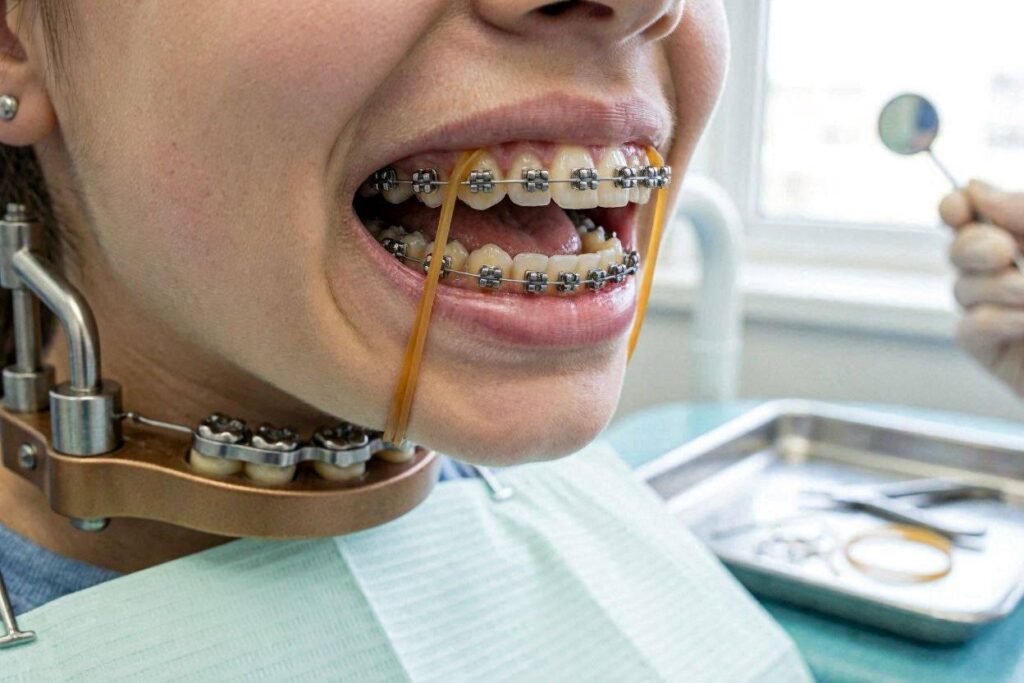
Elastics are the most common auxiliary used in overbite treatment. These small rubber bands are stretched between hooks on the upper and lower braces. They are removable, changed by the patient daily, and come in various sizes and force levels.
Class II elastics are the specific pattern used to correct overbites. They run from the upper canine or lateral incisor bracket to the lower first molar bracket. When the patient bites down, these elastics exert a force that pulls the lower teeth forward and the upper teeth backward. In growing patients, this force can also encourage forward growth of the mandible. In adults, the movement is primarily dental, tipping and translating the teeth through the bone.
Patient compliance with elastic wear is essential. Elastics work only when they are worn. The orthodontist prescribes a specific wear schedule, often full-time except for eating and brushing. Patients who do not wear their elastics as instructed will not see the expected overbite correction, and treatment will stall or fail. This reliance on patient cooperation is one of the reasons orthodontists emphasize the importance of elastic wear so strongly.
Headgear
Headgear is an external appliance that uses the back of the head or neck as an anchor to apply forces to the teeth and jaws. It is one of the older but still effective tools for overbite correction, particularly in growing patients with skeletal discrepancies.
Cervical headgear consists of a strap that goes around the back of the neck and a facebow that attaches to the upper molars. It applies a backward and upward force to the upper jaw and teeth, restraining the forward growth of the maxilla while allowing the mandible to continue growing forward. This can correct a skeletal Class II relationship in a growing child without surgery.
High-pull headgear has a strap that goes over the top and back of the head. It is used when the orthodontist wants to control the vertical growth of the maxilla in addition to the anteroposterior relationship.
Headgear is typically worn for twelve to fourteen hours per day, often at night and during evening hours. Like elastics, it requires patient cooperation. Headgear has become less common in some practices as other methods of skeletal anchorage have been developed, but it remains a valuable and effective tool in the right circumstances.
Functional Appliances
Functional appliances are designed to modify jaw growth in children and adolescents. They work by posturing the mandible forward, which stimulates growth at the mandibular condyle and encourages the lower jaw to grow into a more forward position. These appliances are used during the active growth phase, typically between ages eight and fourteen, when the skeletal response is possible.
The Herbst appliance is a fixed functional appliance that connects the upper and lower jaws with a telescoping mechanism. It holds the mandible in a forward position continuously. Because it is fixed in place and cannot be removed by the patient, compliance is assured. The Herbst is worn for approximately six to twelve months.
The Twin Block appliance consists of separate upper and lower removable plates with inclined ramps that guide the mandible forward when the patient bites together. It is removable, which aids hygiene but introduces the compliance variable. Twin Block treatment typically lasts nine to twelve months, followed by full braces.
Other functional appliances include the Bionator, the Frankel appliance, and the Activator, each with specific design features suited to different clinical situations. The common principle is mandibular advancement during growth to correct the skeletal component of the overbite.
Forsus Springs and Similar Fixed Appliances
The Forsus Fatigue Resistant Device is a fixed spring appliance that is attached to the braces and worn full-time. It connects the upper molars to the lower archwire near the canines, providing a continuous forward force on the lower teeth and a backward force on the upper teeth. It serves a similar function to Class II elastics but does not depend on patient compliance.
These fixed functional appliances are often used in adolescents who are not compliant with elastic wear or whose overbite requires more force than elastics can comfortably deliver. They are worn for several months and then removed when the overbite has been corrected.
Temporary Anchorage Devices (TADs)
Temporary anchorage devices, also called mini-implants or mini-screws, are small titanium screws that are temporarily placed into the bone of the jaws. They provide absolute anchorage, a fixed point from which forces can be applied to move teeth without causing unwanted movement of the anchor teeth.
In overbite treatment, TADs can be used to retract the entire upper arch when the upper teeth are protrusive and there is no desire to move the lower teeth forward. They can also be used to intrude over-erupted posterior teeth or to control the vertical dimension. TADs are placed under local anesthesia, removed when treatment is complete, and the insertion sites heal quickly.
Bite Turbos and Bite Plates
In some overbite cases, the deep bite is so significant that the lower incisors contact the palate behind the upper incisors, or the upper and lower brackets collide when the patient tries to close. Bite turbos are small bumps of composite resin bonded to the back of the upper front teeth or the biting surface of the back teeth. They open the bite slightly so that the teeth and brackets do not interfere with each other, allowing tooth movement to proceed.
Bite plates are removable appliances, typically worn on the upper arch, that cover the palate and prevent the lower incisors from biting into it. They can also incorporate springs or screws to move teeth. Bite plates are used early in treatment or in mixed dentition cases where full braces are not yet placed.
The Role of Extractions in Overbite Treatment
In some overbite cases, particularly those involving significant crowding or protrusion of the upper incisors, the orthodontist may recommend the extraction of teeth to create space. Premolars, the teeth between the canines and the molars, are the most commonly extracted for orthodontic purposes.
Extractions create space into which the protruding incisors can be retracted. Without extractions, attempting to retract incisors in a crowded arch is like trying to move a line of parked cars backward when there is no space behind them. The space must be created somewhere.
The decision to extract teeth is made carefully, weighing the severity of the crowding, the amount of retraction needed, the patient’s profile, and the long-term stability of the result. Modern orthodontics has moved away from routine extractions and now uses them only when clearly necessary.
Clear Aligners for Overbite Correction
Clear aligner systems such as Invisalign can effectively treat many overbite cases. Aligners correct overbites through several mechanisms. The aligner plastic covers the biting surfaces of the teeth, creating a flat plane that discourages overbite deepening. Class II elastics can be attached to precision cuts in the aligners, just as with braces. In growing patients, aligners can incorporate mandibular advancement features, similar to a functional appliance, with plastic wings that posture the lower jaw forward.
Aligner treatment for overbite has limitations. Severe overbites, particularly those with a significant skeletal component, may not be fully correctable with aligners alone. The success of aligner treatment also depends heavily on patient compliance, as the aligners must be worn twenty to twenty-two hours per day to be effective.
Surgical Correction for Severe Skeletal Overbite
When the overbite is primarily skeletal and the patient is no longer growing, orthognathic surgery combined with orthodontics provides the definitive correction. The surgery involves advancing the mandible, moving the entire lower jaw forward into a proper relationship with the upper jaw. In some cases, the maxilla may also be repositioned.
Braces are placed before surgery to align the teeth within each arch. The surgery is performed by an oral and maxillofacial surgeon, and after a healing period, the braces are used to fine-tune the occlusion. The combination of orthodontics and surgery corrects the skeletal discrepancy that braces alone cannot address in a non-growing patient.
Retainers After Overbite Correction
Once the overbite is corrected, retention is essential to prevent relapse. The teeth and jaws have a strong tendency to return toward their original positions. Retainers are worn full-time initially, then transitioned to nighttime wear, often for life.
Fixed retainers, thin wires bonded to the back of the anterior teeth, provide continuous retention without relying on patient compliance for the front teeth most prone to relapse. Removable retainers, either Hawley retainers with wires and acrylic or clear vacuum-formed retainers, are also used.
Conclusion
Overbite correction uses a combination of braces components including brackets, archwires, and ligatures, along with auxiliary appliances such as Class II elastics, headgear, functional appliances, Forsus springs, and TADs, each selected based on the patient’s age, the severity and type of overbite, and the degree of patient cooperation expected. In growing children, functional appliances and headgear can modify jaw growth to correct skeletal discrepancies. In adults, camouflage treatment with braces and elastics or, for severe skeletal overbites, orthognathic surgery combined with orthodontics provides the solution. Clear aligners offer an alternative for mild to moderate overbites in compliant patients.
FAQ
How long does it take to correct an overbite with braces?
Overbite correction typically takes eighteen to twenty-four months as part of comprehensive orthodontic treatment, though the timeline varies based on severity, patient compliance, and the specific treatment approach. The overbite begins to improve visibly within the first few months, but complete correction takes the full treatment duration.
Do elastics hurt when used for overbite correction?
Patients experience some discomfort when elastics are first started or when the force is increased. This soreness is similar to the discomfort after an adjustment and typically resolves within a few days. Consistent wear reduces the overall discomfort because the teeth and jaws adapt more quickly.
Can an overbite be corrected without headgear?
Yes. Many overbites are corrected without headgear using elastics, functional appliances, TADs, or a combination of these. Headgear is one tool among many, and its use has declined as other options have become available. The orthodontist recommends headgear when it is the most appropriate tool for a specific case.
At what age should an overbite be treated?
The ideal time for an initial orthodontic evaluation is around age seven. Some overbite problems benefit from early intervention during the mixed dentition phase, ages seven to eleven. Comprehensive treatment with full braces typically begins between ages eleven and fourteen, when most permanent teeth have erupted. Adults can be treated at any age, though skeletal correction without surgery is not possible after growth is complete.
Can Invisalign fix a severe overbite?
Invisalign can treat mild to moderate overbites effectively. Severe overbites, particularly those with a significant skeletal component, may exceed the capabilities of aligner treatment. Invisalign with mandibular advancement features can address some growing patients’ needs, but severe adult skeletal overbites usually require surgery.
Will correcting an overbite change my face?
Correcting a significant overbite can improve facial balance. Retracting protruding upper incisors allows the lips to close more naturally and can make the chin appear more prominent relative to the upper lip. Severe skeletal corrections through surgery produce more dramatic facial changes, while dental corrections produce subtle but often noticeable improvements in profile.
What happens if I do not treat my overbite?
Untreated overbites can lead to progressive wear of the lower incisors against the upper lingual surfaces, trauma to the palatal tissue, increased risk of dental trauma to protruding upper incisors, temporomandibular joint issues, and functional difficulties with chewing and speech. The condition tends to worsen over time rather than remain stable.
Do I need to wear elastics with braces for my overbite?
Most overbite corrections with braces involve Class II elastics at some stage of treatment. The elastics provide the force needed to move the upper teeth back and the lower teeth forward. Your orthodontist will instruct you on the specific wear schedule. Compliance with elastic wear is one of the most important factors in achieving a successful overbite correction on schedule.
Additional Resource
For more information about orthodontic treatment for overbites and to locate a board-certified orthodontist, visit the American Association of Orthodontists at aaoinfo.org. The AAO provides extensive patient education materials on malocclusion types and treatment options.