Can Gingivitis Cause Blood In Saliva?
You finish brushing your teeth, spit into the sink, and notice a tinge of pink or red in the foam. Later in the day, you taste something metallic and realize your saliva has a faint bloody tint. The sight of blood where it should not be is unsettling, and your mind immediately begins searching for an explanation. Gingivitis, the earliest and most common form of gum disease, frequently produces exactly this symptom. The connection between inflamed gums and blood in saliva is direct and well-established.
Blood appearing in saliva usually originates from the gums rather than from deeper sources. The gums become fragile when inflamed, and their rich blood supply lies close to the surface. Even gentle pressure can rupture the tiny vessels in the swollen tissue. This guide explains the mechanism by which gingivitis causes bleeding, how to distinguish gingivitis-related bleeding from other causes, and what steps to take when you notice blood in your saliva.
The Mechanism of Bleeding in Gingivitis
Healthy gums do not bleed. This is a fundamental principle of oral health. When gums bleed, something has disrupted the integrity of the tissue. In gingivitis, that disruption is inflammation.
The Inflammatory Process
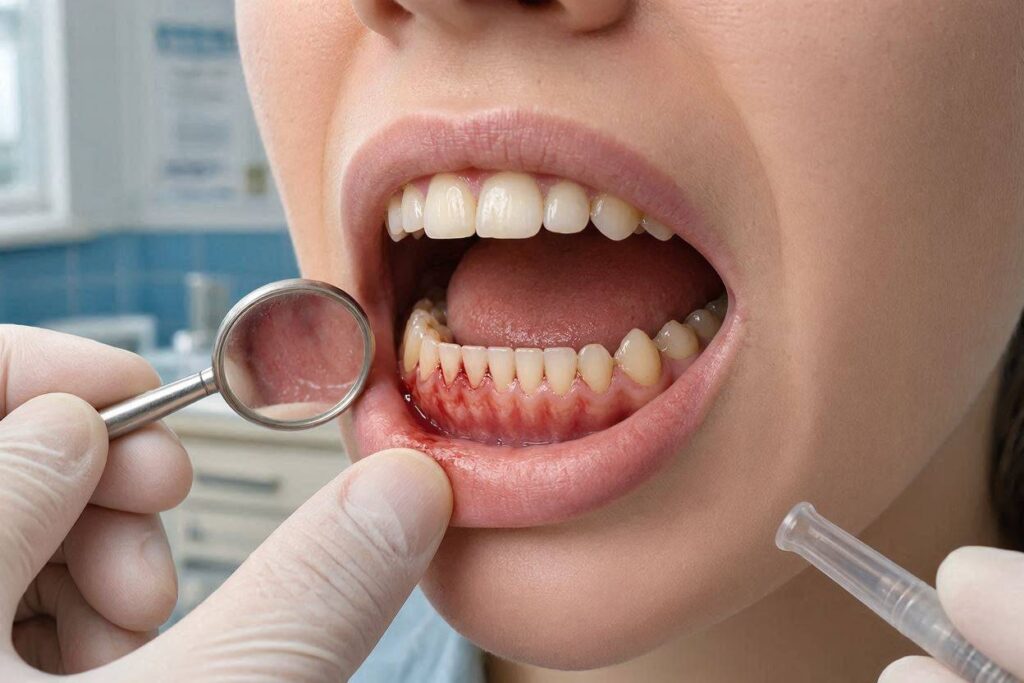
Gingivitis develops when dental plaque, the sticky bacterial film that forms on teeth, accumulates along the gumline. The bacteria in plaque release metabolic byproducts and toxins. The body’s immune system responds by sending blood and immune cells to the area. Blood vessels in the gum tissue dilate and become more permeable, allowing immune cells to reach the bacteria.
This increased blood flow produces the redness and swelling characteristic of gingivitis. The tissue becomes engorged with blood. At the same time, the inflammatory chemicals weaken the epithelial lining of the gum. The protective barrier between the bacteria-laden plaque and the delicate underlying connective tissue thins and breaks down.
The result is gum tissue that is fragile, swollen, and packed with blood vessels that lie closer to the surface than they do in healthy tissue. Under these conditions, minor mechanical forces that would not affect healthy gums can rupture these vessels and cause bleeding.
Ulceration of the Gingival Crevice
The gingival crevice, the shallow groove where the gum meets the tooth, is where the inflammatory battle is most intense. In gingivitis, the lining of this crevice becomes ulcerated. Microscopic breaks in the epithelial lining expose the underlying connective tissue and its blood vessels.
When you brush, floss, or even eat crunchy foods, you apply mechanical force to this ulcerated tissue. The force disrupts the fragile vessels, and blood seeps into the crevice and mixes with saliva. This is why bleeding is most noticeable during brushing and flossing. Those activities directly contact the most inflamed and ulcerated areas.
Spontaneous Bleeding
In more severe gingivitis, or when the condition is progressing toward periodontitis, bleeding can occur spontaneously without any obvious mechanical trigger. The inflammation is so intense that the vessel walls break down even without external pressure. Blood seeps continuously into the mouth, mixing with saliva to produce a persistent bloody or metallic taste.
Spontaneous bleeding is a more concerning sign than brushing-induced bleeding. It indicates a higher level of inflammation and should prompt prompt dental evaluation.
Why Blood Mixes with Saliva
Blood from the gums mixes with saliva because the oral cavity is a constantly wet environment. Saliva is produced continuously, and the movement of the tongue, cheeks, and lips distributes it throughout the mouth. When even a small amount of blood enters this system, it becomes visible throughout the saliva.
The Magnifying Effect of Saliva
A surprisingly small amount of blood can make a large volume of saliva appear red or pink. A few drops of blood, which on a dry surface would be barely noticeable, can tint an entire mouthful of saliva. This visual magnification can make the bleeding seem more significant than it actually is.
The foaming action of toothpaste during brushing further disperses the blood, creating pink foam that looks dramatic. Patients are often alarmed by the appearance of the sink after brushing, but the volume of blood is usually small. This is not to minimize the significance of the bleeding, it is an important sign that should not be ignored, but to contextualize what you see.
The Metallic Taste
Blood contains iron in hemoglobin, and when blood mixes with saliva, the iron produces a characteristic metallic taste. This taste can persist even after visible bleeding has stopped. The taste itself is not dangerous, but it is a reliable indicator that bleeding has occurred or is occurring at a low level.
Distinguishing Gingivitis Bleeding from Other Oral Bleeding
Not all blood in saliva comes from gingivitis. Several other oral conditions can cause bleeding, and distinguishing between them guides appropriate care.
Periodontitis Bleeding
Periodontitis is the progression of untreated gingivitis. While gingivitis affects only the gum tissue, periodontitis involves the destruction of the bone and ligament that support the teeth. Bleeding in periodontitis arises from the same inflammatory mechanism as in gingivitis, but it is typically more profuse and may occur spontaneously.
The key distinguishing feature of periodontitis bleeding is that it often originates from deeper pockets rather than from the visible gum margin. Probing by a dentist reveals bleeding from the base of pockets that measure four millimeters or deeper. Bone loss visible on X-rays confirms the diagnosis. If you have periodontitis, the bleeding is a sign of active disease that requires professional treatment beyond improved home care.
Trauma-Related Bleeding
Physical injury to the gums can cause bleeding unrelated to inflammation. Aggressive tooth brushing with a hard-bristled brush can abrade the gum tissue and cause it to bleed even if the gums are otherwise healthy. Flossing too forcefully or snapping the floss into the gums rather than guiding it gently can cut the tissue.
Eating sharp, hard foods such as crusty bread, chips, or nuts can scratch the gums and cause minor bleeding. Dental procedures, recent extractions, or oral surgery sites will bleed as part of the normal healing process. Ill-fitting dentures or orthodontic appliances can rub against the gums and create sore, bleeding spots.
These traumatic causes are typically localized. Bleeding comes from a specific, identifiable area rather than being generalized across the entire mouth. The gum tissue elsewhere looks pink and firm rather than red and swollen. If you can identify a specific injury that explains the bleeding, and the rest of your gums appear healthy, the bleeding is likely traumatic rather than disease-related.
Oral Ulcers and Lesions
Aphthous ulcers, traumatic ulcers from cheek biting, and other oral lesions can bleed slightly, especially when irritated. This bleeding is typically minor and localized to the ulcer site. The ulcer itself is visible as a discrete sore with a white or yellow center and a red border. These lesions are painful and easily identifiable as distinct from the generalized gum bleeding of gingivitis.
Post-Procedural Bleeding
If you have had a tooth extracted, a deep cleaning, or any other dental procedure, some bleeding is normal during the healing period. The dentist provides specific instructions for managing this bleeding. Post-procedural bleeding should decrease steadily over the hours and days following the procedure. Bleeding that increases or persists beyond the expected timeframe warrants a call to the dentist.
Medical Causes of Blood in Saliva
Not all blood in saliva originates from the gums or even from the mouth. Several medical conditions can produce this symptom, and it is important to be aware of them.
Respiratory Sources
Blood from the lungs or airways can mix with saliva when it is coughed up or when it drains into the mouth. Respiratory infections such as bronchitis or pneumonia can produce blood-tinged sputum. More seriously, lung cancer, tuberculosis, or pulmonary embolism can cause hemoptysis, the medical term for coughing up blood.
Blood from the respiratory tract is usually coughed up rather than appearing passively in saliva. It is often mixed with mucus and may be bright red or frothy. If you are coughing and seeing blood, the source is more likely respiratory than oral.
Gastrointestinal Sources
Blood from the esophagus, stomach, or upper small intestine can be regurgitated or can reflux into the mouth. This blood is typically darker, often described as coffee-ground in appearance, because it has been partially digested. Vomiting blood, called hematemesis, is a medical emergency.
Bleeding Disorders
Conditions that impair the blood’s ability to clot can cause oral bleeding that is disproportionate to the level of gum inflammation. Hemophilia, von Willebrand disease, and thrombocytopenia, low platelet count, can all present with oral bleeding. Patients taking anticoagulant medications such as warfarin, clopidogrel, or newer direct oral anticoagulants may experience more gum bleeding than would be expected from their level of plaque.
If you have a known bleeding disorder or take blood-thinning medication, inform your dentist. Bleeding from gingivitis can be more profuse in these patients, and special precautions may be needed during dental procedures.
Vitamin Deficiencies
Severe vitamin C deficiency, scurvy, causes gum swelling, bleeding, and tooth mobility. Vitamin K deficiency impairs the production of clotting factors and can cause bleeding. These deficiencies are rare in developed countries but can occur in individuals with severely restricted diets, alcohol use disorders, or malabsorption conditions.
Oral Cancer
In rare cases, a bleeding lesion in the mouth can be a sign of oral cancer. A squamous cell carcinoma can ulcerate and bleed, particularly when irritated. The distinguishing feature is that the lesion does not heal. Any ulcer or growth in the mouth that persists for more than two to three weeks and bleeds should be evaluated by a dentist or physician, regardless of whether gingivitis is also present.
When Gingivitis Is the Likely Cause
If you notice blood in your saliva, a systematic self-assessment helps determine whether gingivitis is the probable source.
Signs Pointing to Gingivitis
The blood appears primarily when you brush or floss. The blood is mixed with toothpaste foam in the sink. The bleeding is generalized across multiple teeth rather than localized to one spot. Your gums appear red and swollen along the margins. You have visible plaque buildup along the gumline. You have not had a professional dental cleaning in more than six months. The bleeding stops quickly after you finish brushing. You have no other symptoms such as coughing, vomiting, or unexplained bruising elsewhere on your body.
If these conditions describe your situation, gingivitis is the most likely explanation. The appropriate response is to improve your oral hygiene and schedule a dental cleaning.
Signs That Suggest Something Else
The blood appears without any obvious trigger, such as brushing. The bleeding is profuse and does not stop promptly. The blood comes from a specific lesion or ulcer rather than from the gumline. You are coughing up blood or vomiting blood. You have unexplained bruising or bleeding elsewhere on your body. You have a known bleeding disorder or take anticoagulant medication. You have a persistent sore in your mouth that has not healed for several weeks.
If any of these conditions apply, the source may be something other than simple gingivitis, and medical or dental evaluation is appropriate.
What to Do About Gingivitis-Related Bleeding
If gingivitis is the cause of your blood-tinged saliva, the solution lies in treating the inflammation.
Do Not Stop Brushing
The most common mistake patients make when they see bleeding gums is to avoid brushing the area. This is counterproductive. The bleeding is caused by plaque accumulation. Stopping or reducing brushing allows more plaque to accumulate, worsening the inflammation and the bleeding.
Continue to brush twice daily, using a soft-bristled toothbrush and gentle technique. Angle the bristles toward the gumline at forty-five degrees and use short, gentle strokes. The bleeding may continue for the first few days, but as the inflammation subsides, it will decrease and eventually stop.
Floss Daily
Flossing cleans the interdental areas where plaque accumulates and where gingivitis-related bleeding is often most pronounced. Floss gently, curving the floss around each tooth and sliding it just below the gumline. Do not snap the floss, which can cut the gum. If traditional floss is difficult, use floss holders, interdental brushes, or a water flosser.
Rinse with Salt Water
A warm salt water rinse can soothe inflamed gums and help reduce the bacterial load. Dissolve half a teaspoon of salt in a cup of warm water and swish gently for thirty seconds. Do this two or three times daily. The salt water does not cure gingivitis, but it can help manage inflammation while you improve your brushing and flossing.
See a Dental Professional
The single most effective intervention for gingivitis-related bleeding is a professional dental cleaning. The dentist or hygienist removes the plaque and tartar that have accumulated on the teeth, particularly in areas you cannot reach effectively at home. Once the irritants are removed, the gums can begin to heal.
A standard prophylaxis, the routine cleaning, is sufficient for gingivitis. Bleeding typically decreases noticeably within a few days of the cleaning, and as home care improves, it stops entirely within one to two weeks.
Conclusion
Gingivitis is a common cause of blood in saliva because the inflammation makes gum tissue fragile, ulcerated, and engorged with blood vessels that rupture under the mild pressure of brushing, flossing, or even normal oral function. The bleeding is typically most noticeable during oral hygiene and stops quickly afterward. Distinguishing gingivitis-related bleeding from other causes such as periodontitis, trauma, respiratory or gastrointestinal sources, and bleeding disorders involves assessing the pattern, triggers, and associated symptoms. The appropriate response to gingivitis bleeding is improved oral hygiene with gentle brushing and daily flossing, combined with a professional dental cleaning.
FAQ
How much blood in saliva is normal with gingivitis?
Any amount of blood in saliva indicates a problem that needs attention. Healthy gums do not bleed. The amount with gingivitis is typically small, enough to tint saliva pink or red, but not large enough to cause concern about blood loss. The significance of the bleeding is that it signals active inflammation, not that the blood loss itself is dangerous.
Can gingivitis cause blood in saliva without brushing?
Yes. In more severe gingivitis, spontaneous bleeding can occur without mechanical stimulation. Blood seeps from the inflamed, ulcerated gum tissue into the mouth continuously. Spontaneous bleeding is a sign that the inflammation is significant and requires prompt professional attention.
How quickly does gingivitis bleeding stop with treatment?
Bleeding typically decreases noticeably within three to five days of a professional cleaning combined with improved home care. Complete resolution, where no bleeding occurs with brushing or flossing, usually takes one to two weeks. If bleeding persists beyond two weeks despite good care, further evaluation is needed.
Is blood in saliva a sign of oral cancer?
In rare cases, yes, but it is far more commonly a sign of gingivitis or periodontitis. A cancerous lesion that bleeds is usually visible as a non-healing ulcer or growth. Any persistent oral lesion that bleeds and does not heal within two to three weeks should be evaluated by a professional.
Can pregnancy cause blood in saliva from gingivitis?
Pregnancy gingivitis is common due to hormonal changes that increase the inflammatory response to plaque. Pregnant women often experience bleeding gums even with plaque levels that did not cause bleeding before pregnancy. Meticulous oral hygiene and professional cleanings during pregnancy are safe and recommended.
Should I use mouthwash if my gums are bleeding?
An alcohol-free therapeutic mouthwash with ingredients like chlorhexidine or essential oils can help reduce bacterial load. However, mouthwash does not remove plaque mechanically and cannot replace brushing and flossing. Alcohol-based mouthwashes can irritate already inflamed gums and are best avoided when bleeding is present.
Can stress cause my gums to bleed?
Stress does not directly cause gingivitis, but it can impair immune function and increase the inflammatory response to plaque. People under high stress may experience more gingivitis-related bleeding for the same amount of plaque compared to when they are less stressed. Stress can also lead to neglect of oral hygiene, compounding the problem.
When should I see a doctor rather than a dentist for blood in saliva?
See a doctor if you are coughing up blood, vomiting blood, experiencing unexplained bruising or bleeding elsewhere, or have blood in saliva with no signs of gum disease and good oral hygiene. A physician can evaluate for respiratory, gastrointestinal, or hematologic causes that a dentist does not diagnose.
Additional Resource
For comprehensive information on gum health and periodontal disease, visit the American Academy of Periodontology at perio.org. The site provides patient education materials on recognizing and treating gum disease at all stages.