What Is Used to Hold Tooth-Whitening Gel on the Teeth?
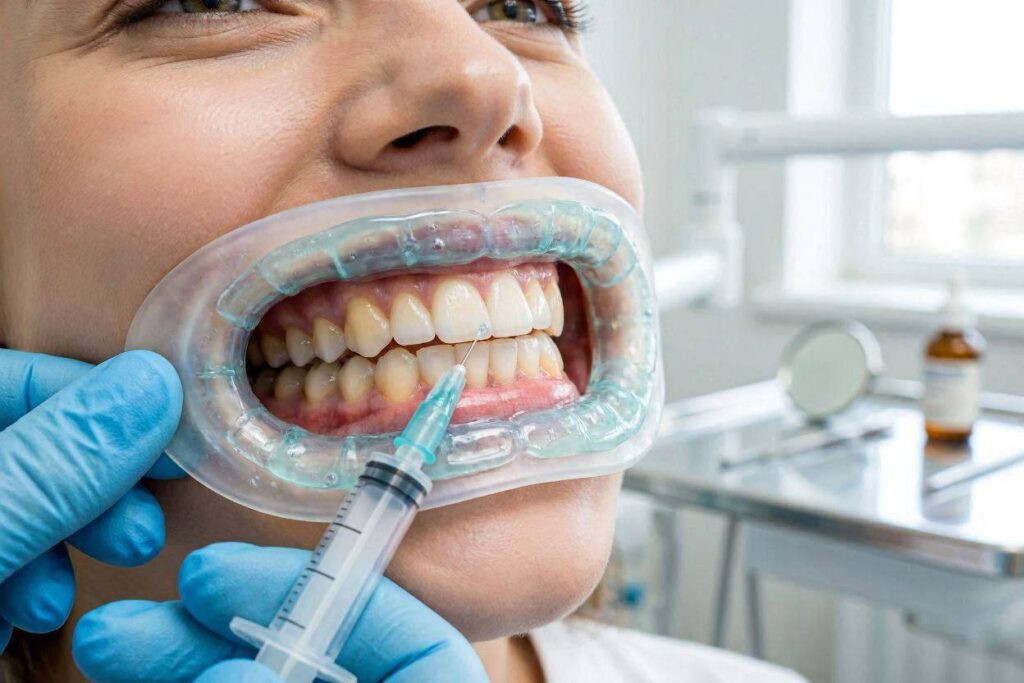
Whitening gel works through contact. The peroxide must sit against enamel for a specified period, usually 15 minutes to several hours. But gel does not naturally stay in place. It runs, dilutes with saliva, and spreads onto gums. Something must hold the gel precisely where it belongs, against the tooth surface, for the entire treatment duration.
The method used to contain and position whitening gel dramatically affects results, comfort, and safety. A well-designed holding system keeps gel in intimate contact with enamel while protecting delicate gum tissue. A poorly designed system leaks gel, irritates soft tissues, and produces uneven whitening.
We will explore every method used to hold whitening gel on teeth, from professional dental barriers to over-the-counter strips, from traditional trays to innovative paint-on formulas. You will understand how each method works, its advantages, and its limitations.
The Fundamental Requirements for Holding Whitening Gel
Before examining specific methods, we need to understand what any holding system must accomplish. These requirements explain why some methods work better than others.
Continuous Contact
The holding method must maintain uninterrupted gel contact with enamel throughout the treatment period. Any gap between gel and tooth creates an area where whitening does not occur. The result is patchy, uneven lightening that can look worse than the original staining.
Saliva presents the greatest challenge to continuous contact. As saliva flows through the mouth, it can seep between the gel and the tooth surface, diluting the peroxide and physically lifting the gel away from enamel. Effective holding systems seal against saliva ingress.
Gum Tissue Protection
Peroxide irritates and burns soft tissue. The holding method must prevent gel from contacting gums, inner cheeks, lips, and tongue. This requires either a physical barrier between gel and tissue or a gel formulation that stays precisely where placed without spreading.
Gum protection is not merely about comfort. Chemical burns on gingival tissue cause real injury. Repeated burns can lead to chronic gum irritation and recession. A holding system that fails to protect gums fails entirely.
Even Distribution
The holding method should spread gel evenly across all visible tooth surfaces. Thick spots deliver more peroxide to some areas than others. Thin spots result in under-treatment. The ideal system creates a uniform gel layer of consistent thickness from gumline to incisal edge and from canine to canine.
Oxygen Containment
The whitening reaction requires oxygen released from peroxide to penetrate enamel. Some holding systems help contain this oxygen against the tooth surface, potentially enhancing efficiency. Systems that allow free oxygen exchange with air may still work but might require longer treatment times.
Patient Compliance
A holding system must be comfortable enough that patients actually use it as directed. The most technically perfect method fails if it is so uncomfortable, inconvenient, or difficult that people abandon treatment. Comfort and ease of use directly impact clinical outcomes.
Custom-Fabricated Dental Trays
Custom trays, made by a dentist or dental laboratory from an impression of your teeth, represent the gold standard for holding whitening gel.
How Custom Trays Are Made
The process begins with a dental impression. The dentist takes an accurate mold of your teeth using alginate or digital scanning. A dental laboratory pours stone models from this impression. The technician then vacuum-forms a thin, clear plastic sheet over the stone model, creating a tray that exactly replicates the contours of your teeth.
The tray material is typically ethylene vinyl acetate or a similar flexible, durable plastic. Thickness ranges from 0.5 to 1.5 millimeters. Thinner material is more comfortable but less durable. Thicker material lasts longer but may feel bulkier.
The Precision Fit Advantage
Custom trays fit intimately against every tooth surface and closely follow the gumline. This precision creates a near-seal that holds gel against enamel while minimizing gel escape onto gums. The close adaptation means a very thin gel layer suffices for full coverage.
Because custom trays fit so precisely, patients can use lower peroxide concentrations and achieve results equal to higher concentrations in ill-fitting trays. The efficiency of the holding system directly impacts the required chemical potency.
The Reservoir Design
Some custom trays incorporate a reservoir, a small space between the tray material and the facial surface of the teeth. This reservoir holds a slightly thicker layer of gel exactly where it is needed most. The reservoir prevents the tray from squeezing all the gel away during insertion.
Reservoirs are created during fabrication by applying a thin layer of block-out material to the stone model before forming the tray. The block-out is then removed, leaving a slight standoff between tray and tooth.
Longevity and Reusability
Custom trays last for years with proper care. They can be used for initial whitening courses and then stored for periodic touch-up sessions. This reusability makes them economical over the long term despite higher upfront cost compared to disposable alternatives.
Limitations of Custom Trays
The primary limitation is cost and access. Custom trays require a dental visit, impressions, and laboratory fabrication. The total cost typically ranges from $100 to $400 for a set. Some patients find the process inconvenient compared to purchasing OTC products.
Custom trays also require more patient involvement than disposable strips. You must dispense gel, insert trays correctly, clean them after each use, and store them properly. This multi-step process can feel burdensome compared to peel-and-stick strips.
Boil-and-Bite Trays
Boil-and-bite trays attempt to provide semi-custom fit without the dental visit. They are included with many over-the-counter whitening kits.
The Fitting Process
The user heats water to boiling, immerses the thermoplastic tray for a specified time, removes it, lets it cool briefly, then bites into the softened material. The teeth create indentations in the plastic. As the material cools, it hardens in a shape approximating the user’s dental arch.
The process sounds straightforward but requires some skill. Overheating makes the material too soft and floppy. Underheating prevents adequate adaptation. Biting too hard pushes all the material away from teeth. Biting too softly leaves gaps. Getting a truly good fit often takes multiple attempts.
Fit Quality Compared to Custom Trays
Even a well-executed boil-and-bite fit does not match custom tray precision. The material cannot capture subtle tooth contours. It does not follow the gumline closely. Gaps between tray and teeth are larger and more variable than with custom trays.
These gaps require more gel to fill, increasing the risk of overflow. The looser fit also allows more saliva to mix with the gel, potentially reducing effectiveness.
When Boil-and-Bite Trays Are Appropriate
Boil-and-bite trays work adequately for people with straight, regularly shaped teeth. Those with crowded, rotated, or irregularly positioned teeth struggle to achieve acceptable fit. The trays are also reasonable for short whitening courses where the investment in custom trays seems disproportionate.
Upgrading from Boil-and-Bite
Many people start with boil-and-bite trays included in a kit, see some results, and later invest in custom trays for better comfort and more predictable outcomes. The boil-and-bite experience often motivates the upgrade.
One-Size-Fits-All Trays
Generic trays come pre-formed in small, medium, or large sizes. They are the least expensive and lowest-performing holding method.
The Universal Fit Problem
No mouth is universal. Generic trays fit poorly by design. They contact teeth at a few points and leave large gaps elsewhere. Gel pools in some areas and barely touches others. Saliva floods in freely, diluting peroxide and washing gel away from teeth.
The Gum Irritation Issue
Because generic trays do not follow individual gumlines, they often extend well onto gum tissue or leave significant gaps at the margins. Both situations irritate gums, either through direct pressure or through gel leakage.
Why Manufacturers Include Them
Despite their limitations, generic trays appear in many OTC kits because they are extremely inexpensive to produce. They allow the manufacturer to claim the kit includes trays without the cost of custom fabrication. Consumer satisfaction with these trays is consistently low.
Minimizing Problems with Generic Trays
If you must use generic trays, apply gel sparingly. Use small beads placed precisely where teeth contact the tray. Wipe away any overflow immediately after insertion. Consider trimming the tray edges with small scissors to reduce gum overlap, though this further compromises fit.
Whitening Strips
Strips take a fundamentally different approach to holding gel. Rather than a separate tray filled with gel, the strip itself carries the gel layer.
Strip Construction
Whitening strips consist of a thin, flexible plastic substrate coated with a layer of peroxide gel. The substrate is typically polyethylene. The gel layer is formulated to be sticky, adhering the strip to teeth without additional adhesive.
The strip is die-cut into a shape that approximates the dental arch. Upper strips and lower strips have different shapes. Some products include strips long enough to wrap around to the back of the front teeth.
Adhesion Mechanism
The gel itself provides adhesion. It is formulated with thickeners and tackifiers that create a sticky consistency. When pressed against dry teeth, the gel grips the enamel surface. Saliva can gradually undermine this adhesion over time, which is why strips have recommended wear times.
The Simplicity Advantage
Strips require no dispensing, no tray fitting, no cleaning afterward. You peel, apply, wear, remove, and discard. This simplicity drives high compliance. People who find tray systems fussy often complete strip treatment courses successfully.
The Coverage Limitation
Strips cover the front surfaces of teeth but often do not wrap fully into interproximal spaces, the areas between teeth. These areas may whiten less than the flat facial surfaces. People with very curved dental arches may find strips do not adapt well to the curvature.
The Slippage Problem
Talking, moving the mouth, or generating excess saliva can cause strips to slip or lift. Once a strip loses adhesion, gel contact becomes inconsistent. Some people find they must remain still and silent during strip wear, which limits when and where they can whiten.
Whitening Pens
Pens dispense gel through a brush, rollerball, or sponge tip directly onto teeth. The gel then dries into a film that adheres without a separate holding device.
The Paint-On Principle
You apply gel by painting it across each tooth surface, similar to applying nail polish. The gel is formulated to dry quickly, typically within 30-60 seconds, forming a thin, adherent film. This film stays on teeth for a prescribed period, usually 20-30 minutes for daytime formulas or overnight for some products.
The Film as Its Own Holding System
The dried gel film is the holding system. No tray, strip, or external device is needed. The film must resist saliva dissolution for the treatment period. Different products achieve this with different polymer systems that create a semi-permeable barrier.
Precision Application
Pens allow you to paint gel exactly where you want it, avoiding gums with precision. This can be an advantage for people with gum recession or irregular gumlines where trays consistently irritate soft tissue.
The Technique Dependency
Pen results depend heavily on application technique. Paint too thin, and the film is inadequate. Paint too thick, and the gel runs before drying. Miss a spot, and that area does not whiten. The learning curve is steeper than with strips or trays.
Practical Limitations
Pens work best for touching up a few teeth. Coating an entire smile arch with a pen is time-consuming and requires contorting to reach all visible surfaces. Pens also contain less total gel than syringe-and-tray systems, making them better suited for maintenance than initial whitening.
| Holding Method | Fit Precision | Gum Protection | Ease of Use | Cost | Reusability |
|---|---|---|---|---|---|
| Custom Trays | Excellent | Excellent | Moderate | High ($100-400) | Yes (years) |
| Boil-and-Bite Trays | Moderate | Moderate | Moderate | Low (included in kit) | Limited (one course) |
| One-Size-Fits-All Trays | Poor | Poor | Easy | Very low | Limited (one course) |
| Whitening Strips | Moderate | Good | Excellent | Low-moderate ($20-60) | No (disposable) |
| Whitening Pens | Good (technique dependent) | Good (with care) | Moderate | Low-moderate ($15-40) | No (single pen) |
| Professional Isolation | N/A (in-office) | Excellent | N/A (provider managed) | High ($300-800) | N/A (single session) |
Professional In-Office Isolation Methods
Dentists use methods to hold and contain gel that are not available for home use. These methods allow use of much higher peroxide concentrations safely.
Rubber Dam Isolation
A rubber dam is a thin sheet of latex or non-latex material that isolates teeth from the rest of the mouth. The dentist punches holes for the teeth to be whitened and stretches the dam over them. The dam covers gums, tongue, and other soft tissues completely.
This absolute isolation allows the dentist to apply high-concentration gel (35-40% hydrogen peroxide) directly to teeth with no risk of soft tissue contact. The dam remains in place throughout the procedure.
Liquid Gingival Barrier
A liquid gingival barrier, sometimes called a gingival dam or light-cured barrier, is a flowable resin material painted onto gum tissue around the teeth to be whitened. The material is then cured with a light, forming a flexible, protective coating.
This method is faster to apply than a rubber dam and can be more comfortable for the patient. It protects gums while leaving the teeth fully accessible for gel application. After whitening, the dentist peels off the cured barrier in one piece.
Cotton Roll and Gauze Isolation
For less intensive professional treatments, dentists may use simpler isolation with cotton rolls placed in the cheek folds and gauze tucked around the treatment area. This absorbs saliva and keeps soft tissues away from gel but provides less absolute protection than a rubber dam or gingival barrier.
Cheek Retractors
Plastic cheek retractors hold the lips and cheeks away from the teeth, providing access and visibility. They do not protect gums from gel, so they are used in combination with gingival barriers, not as standalone isolation.
Pre-Loaded Disposable Trays
Some products provide single-use trays pre-filled with gel. These are a hybrid between custom trays and strips.
Construction and Use
Pre-loaded trays are thin, flexible plastic forms filled with a measured dose of whitening gel. They are packaged in sealed pouches to prevent peroxide degradation. The user opens the pouch, places the tray over their teeth, and presses to adapt it.
The tray material is more substantial than a strip but thinner than a reusable tray. It provides some structural support while remaining flexible enough to adapt somewhat to individual dental arches.
The Measured Dose Advantage
Because the manufacturer fills the tray, the gel quantity is consistent. This eliminates the over- and under-dispensing errors common with user-filled syringes. For people who struggle with dispensing technique, pre-loaded trays remove a variable.
Fit and Adaptation
Pre-loaded trays fit better than one-size-fits-all empty trays but not as well as custom trays. They adapt somewhat to individual tooth shapes when pressed into place, but the fit is approximate. People with very irregular teeth may experience gaps or pressure points.
Cost and Convenience Trade-offs
Pre-loaded trays cost more per session than gel-and-tray systems because you pay for a new tray each time. The convenience of no dispensing, no cleaning, and no storage appeals to some users, particularly for travel or occasional touch-up use.
Light-Activated Systems and Their Gel Holding
Some whitening systems combine gel with light sources, either LED or halogen. The light does not hold the gel, but the overall system design affects how gel is contained.
In-Office Light Systems
During professional light-activated whitening, the dentist applies gel to isolated teeth, then positions a light source near the teeth. The gel is held in place by the same isolation methods used for non-light professional whitening: rubber dam or gingival barrier.
The light may warm the gel slightly, and the system design must account for this. The holding method must remain stable under light exposure. Rubber dams and gingival barriers are unaffected by whitening lights.
Home LED Kits with Trays
Some home kits combine gel in trays with a battery-powered LED light that fits over the trays. The tray holds the gel as it would in any tray-based system. The light adds no gel-holding function. The tray must fit well enough to keep gel in place during the extended treatment time that light systems sometimes employ.
The Light as a Marketing Element
Most evidence suggests the light adds little to whitening efficacy. The holding system, the tray or strip, contributes far more to results than the presence or absence of a light. When choosing a whitening method, evaluate the gel-holding system primarily, not the light feature.
Specialized Trays for Specific Situations
Certain clinical situations require modified tray designs that hold gel differently.
Nightguard Whitening Trays
For patients who whiten overnight, trays must be comfortable enough for sleep and must retain gel for extended periods. Nightguard whitening trays are typically made from softer, more flexible material than daytime trays. They may have extended borders for better retention during sleep.
Trays for Sensitive Teeth
Patients with sensitivity may benefit from trays designed with slightly less intimate contact, creating a slightly thicker gel layer that provides a buffer effect. The modified design trades some whitening efficiency for improved comfort.
Sectional Trays
For whitening only a few teeth, such as single dark teeth that do not match surrounding teeth, sectional trays cover only the target teeth plus one or two adjacent teeth for stability. These mini-trays hold gel on a limited area, avoiding unnecessary peroxide exposure to teeth that do not need whitening.
The Role of Gel Viscosity in Holding
The holding method and the gel formulation work together. A tray that works perfectly with one gel consistency may fail with another.
High-Viscosity Gels
Thick, viscous gels stay where they are placed. They resist flowing under gravity and do not readily mix with saliva. High-viscosity gels are forgiving in trays with less-than-perfect fit because they do not run into gaps.
The trade-off is that viscous gels can be harder to dispense precisely and may not spread into tight interproximal spaces as effectively.
Low-Viscosity Gels
Thin, fluid gels spread easily across tooth surfaces and penetrate into interproximal areas. They provide more uniform coverage with less manipulation. However, they run out of poorly fitting trays quickly and are more likely to contact gums.
Thixotropic Gels
Some professional gels are thixotropic, meaning they flow under pressure but set up when stationary. These gels spread during tray insertion then maintain position during wear. This behavior optimizes both coverage and containment but requires precise formulation.
Matching Gel to Method
When purchasing a complete kit, the manufacturer has matched the gel viscosity to the holding method. When buying gel refills for existing trays, ensure the gel is compatible with your tray type. Professional gels designed for custom trays may be too fluid for boil-and-bite trays.
Home Remedies and Unconventional Methods
People sometimes attempt to create their own gel-holding systems. These approaches are generally inadvisable.
Using Sports Mouthguards
Some people use athletic mouthguards as whitening trays. Sports mouthguards are thick, bulky, and designed for impact absorption, not gel containment. They fit poorly against facial tooth surfaces. Gel pools unpredictably inside them. The material may react with peroxide.
Plastic Wrap or Film
Using kitchen plastic wrap to hold gel against teeth is dangerous. The wrap can slip and obstruct breathing. It provides no controlled gel layer thickness. Gel migrates freely beneath the wrap, contacting gums unpredictably.
Direct Application Without Holding
Applying peroxide gel directly to teeth and attempting to keep the mouth still for the treatment period rarely works. Saliva rapidly dilutes the gel. Tongue movement spreads gel onto soft tissues. Treatment is ineffective and messy.
Why Professional Holding Methods Exist
The decades of engineering behind trays, strips, and professional isolation reflect the genuine challenge of safely positioning reactive chemicals on teeth. Home improvisation consistently fails to meet the requirements of continuous contact, gum protection, and even distribution.
Maintaining and Caring for Reusable Holding Devices
Trays and other reusable devices require proper care to remain effective and hygienic.
Daily Cleaning
After each whitening session, rinse trays thoroughly with cool water. Hot water can warp the plastic. Gently brush the trays with a soft toothbrush dedicated to this purpose, not the brush used for your teeth. Mild soap is acceptable; toothpaste is too abrasive and will scratch the tray surface over time.
Disinfection
Periodically disinfect trays using a denture cleaner or a dilute hydrogen peroxide solution. Follow the manufacturer’s cleaning instructions. Rinse thoroughly after disinfection to remove cleaning product residues.
Storage
Store trays dry in a ventilated case. A closed, damp environment promotes bacterial and fungal growth. Keep trays away from heat sources, direct sunlight, and pets who may chew them.
Inspection
Before each use, inspect trays for cracks, warping, or discoloration. Damaged trays may not hold gel properly and can irritate soft tissue. Replace trays that show significant wear or damage.
Lifespan
Custom trays typically last 2-5 years with proper care. The plastic gradually absorbs some peroxide and may develop a cloudy appearance. When trays become uncomfortable, lose fit, or show visible degradation, have new ones fabricated.
Choosing the Right Holding Method for You
Your choice of holding method should reflect your specific circumstances and priorities.
Factors to Consider
Think about your budget, your schedule, your dental anatomy, your sensitivity level, and your patience for multi-step procedures. Someone with straight teeth, a tight budget, and a desire for simplicity may do well with strips. Someone with irregular teeth, sensitivity concerns, and a long-term whitening plan may benefit more from custom trays.
The Dentist Consultation Advantage
A dentist can evaluate your teeth and recommend the most appropriate holding method. They can identify anatomical factors that might complicate certain approaches. They can also demonstrate proper technique, which significantly improves outcomes with any method.
Trial and Error Realities
Many people try several methods before finding their ideal. Strips are an accessible starting point. If results are unsatisfactory or sensitivity is problematic, upgrading to custom trays often resolves the issues.
Frequently Asked Questions
What holds the whitening gel in place during treatment?
The holding method depends on the product type. Trays hold gel against teeth mechanically. Strips use adhesive gel that sticks to enamel. Pens use gel that dries into an adherent film. Professional treatments use rubber dams or gingival barriers.
Do custom whitening trays work better than strips?
Custom trays provide more precise gel placement, better gum protection, and more predictable results than strips. However, strips are simpler to use and less expensive upfront. Both can produce good results when used correctly for appropriate candidates.
Can I reuse whitening strips?
No. Whitening strips are designed for single use. The gel layer depletes during the wear period. Reusing a strip would provide negligible additional whitening and would introduce bacteria from the previous wear.
Why does whitening gel sometimes leak out of trays?
Leakage occurs when trays fit poorly, when too much gel is dispensed, or when the gel viscosity is too low for the tray design. Custom trays with proper gel quantity rarely leak. Generic trays leak commonly.
How do dentists keep whitening gel off gums?
Dentists use rubber dams that cover gum tissue completely, or they paint on a light-cured liquid gingival barrier that forms a protective coating over gums. These professional methods allow use of high-concentration gels safely.
Can I whiten without any tray or strip?
Pens allow tray-free whitening by painting gel directly onto teeth where it dries into an adherent film. This method works for maintenance and touch-ups but is less practical for full-arch initial whitening.
How long do custom whitening trays last?
With proper care, custom trays typically last 2-5 years. They should be replaced if they become uncomfortable, lose their snug fit, crack, warp, or show significant discoloration or cloudiness.
Additional Resource
For more information about whitening delivery systems and professional options, visit the American Dental Association’s resource on whitening:
https://www.ada.org/resources/ada-library/oral-health-topics/whitening
Conclusion
Whitening gel is held on teeth using several methods, each with distinct advantages: custom-fabricated trays provide the most precise fit and best gum protection, boil-and-bite trays offer a compromise between cost and fit, whitening strips use adhesive gel for simplicity, pens create adherent films without external devices, and professional isolation methods like rubber dams and gingival barriers enable safe use of the highest peroxide concentrations. The holding method you choose directly impacts whitening effectiveness, comfort, and safety, making it as important as the gel itself.
Frequently Asked Questions (FAQ)
Q: What is the best method to hold whitening gel on teeth?
A: Custom-fabricated trays from a dentist provide the best combination of precise gel placement, gum protection, and even coverage. For those seeking OTC options, whitening strips offer good simplicity and adequate results for many users.
Q: How do whitening strips stay on teeth?
A: Whitening strips use a gel layer formulated with adhesive thickeners and tackifiers. When pressed against dry teeth, the gel grips the enamel surface. Saliva gradually weakens this adhesion over the recommended wear time.
Q: Can I make my own whitening trays at home?
A: Boil-and-bite trays included in OTC kits allow at-home fitting and provide semi-custom fit. Generic one-size-fits-all trays are also available. Neither matches the precision of professionally fabricated custom trays, but both can work for straightforward cases.
Q: How do dentists protect gums during professional whitening?
A: Dentists use rubber dams that completely cover soft tissues, or they apply a light-cured liquid gingival barrier painted directly onto gums. Both methods provide absolute protection, allowing use of high-concentration peroxide gels safely.
Q: Why does my whitening gel keep getting on my gums?
A: The most common causes are using too much gel, using trays that fit poorly, or using gel with viscosity too low for your tray type. Reduce gel quantity, consider upgrading your trays, or switch to a product with better gum protection design.
Disclaimer: This article provides general information about methods used to hold teeth whitening gel. It does not constitute dental or medical advice. Different products and methods suit different individuals. Consult your dentist for personalized recommendations based on your dental anatomy, oral health status, and whitening goals.