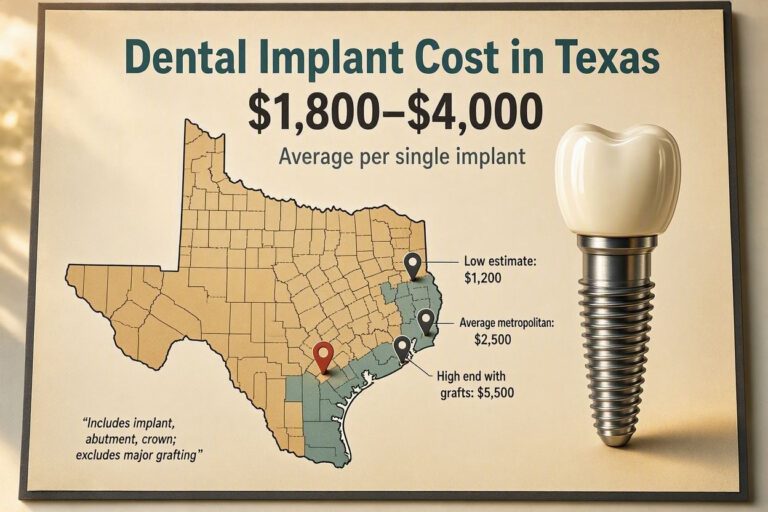
What the Dentist Price for an Implant?
You have a missing tooth or are facing an extraction, and your mind immediately goes to the financial aspect. You are asking a very direct and practical question: what is the dentist’s price for an implant? It is a simple question that deserves a thorough, honest answer. The price you pay is not for a single, off-the-shelf product. It is for a multi-stage, custom-crafted medical procedure involving surgery, advanced technology, artistry, and materials science. This guide will dismantle the total cost of a dental implant, explaining exactly what you are paying for at each stage. We will explore the price ranges across different regions, compare single implants to full-arch solutions, and provide the tools you need to evaluate a treatment plan. The goal is to ensure you are fully informed, with no surprises, when you sit down to discuss the financial investment with your dentist.

The “One Price” Myth: Why an Implant is a Process, Not a Product
The first and most critical concept to understand is that a dental implant is not a discrete product you buy, like a television. It is a therapeutic journey. A credible dentist will rarely quote you a single, catch-all price over the phone without seeing you. This is not evasiveness; it is professionalism. An implant treatment involves a sequence of distinct, billable procedures. First, the diagnostic phase: the clinical examination, the radiographs, and the essential 3D Cone Beam CT scan. Second, the surgical phase: any necessary tooth extraction, the bone grafting procedure to rebuild the socket, and the placement of the titanium implant post into the jawbone. Third, the restorative phase, which occurs months later: the uncovering of the implant, the placement of the abutment, and the fabrication and cementation of the custom crown.
Each of these phases requires a different set of skills, materials, and time. A fee for an implant that sounds suspiciously low almost always excludes the abutment and the crown—the visible tooth itself. It is a “surgical placement only” fee. The cost of the final restoration is equal to or greater than the surgery itself. When you compare prices, you must compare the total, all-inclusive cost from start to finish, including all components. An ethical treatment plan will be itemized, listing every procedure code and its individual fee, summing up to a total case fee that leaves no room for ambiguity.
Itemized Breakdown: What You Are Paying For
Let’s walk through the line items on a typical, comprehensive implant treatment plan.
1. Diagnostics and Planning:
This is the intellectual and technological foundation of the case. It includes the dentist’s consultation, a panoramic X-ray, and a Cone Beam Computed Tomography (CBCT) scan. The CBCT is non-negotiable for safe, modern implantology. It creates a 3D model of your jaw, revealing the exact bone volume, the location of nerves and sinuses, and any hidden pathology. The dentist can then virtually plan the implant’s position. This phase alone can cost between $250 and $700, and its value in preventing catastrophic surgical complications is immeasurable.
2. Preparatory Procedures:
This is where costs often escalate beyond a base quote. If a damaged tooth is still present, you will pay an extraction fee ($150 to $500). If the tooth has been missing and bone has atrophied, or if the extraction creates a defect, you will need a bone graft. A minor socket graft adds $300 to $900. A major ridge augmentation or a sinus lift adds $1,500 to $3,500. These procedures require high-skill surgery and expensive, sterile grafting materials. They are not optional extras designed to inflate a bill; they are essential to creating a solid, healthy foundation for a successful, long-lasting implant.
3. The Surgical Implant Placement:
This fee covers the surgeon’s time, their surgical skill, the sterile disposables, and the implant body itself. This is the titanium screw that replaces the root. The cost of the hardware varies significantly. Premium, well-researched brands cost the dentist more, and that cost is reflected in the fee. The surgical fee ranges from $1,500 to $3,000 per implant.
4. The Final Restoration:
After months of healing, the implant is ready for a tooth. The dentist takes a final impression and places an abutment, a custom-milled connector that screws into the implant. The abutment cost is $400 to $800. The crown itself is a custom work of art, fabricated by a skilled technician in a dental laboratory. The lab cost to the dentist for a high-quality, all-ceramic crown is significant. The final crown fee to the patient is $1,000 to $2,000. This is the visible result of all the prior work.
A Comparative Price Table by Region
The cost of living and the standard of dental care vary dramatically by region. Here is a realistic, comparative look at all-inclusive single implant costs in different markets.
| Region/Country | All-Inclusive Single Implant Range | Notes on the Market |
|---|---|---|
| United States (Major Metro) | $4,500 – $7,000 | High overheads, specialist fees, premium labs. |
| United States (Rural/Suburban) | $3,500 – $5,000 | Often placed by a skilled general dentist, lower lab costs. |
| United Kingdom (London) | £2,500 – £5,000+ | Harley Street premium vs. zone 3 practice. |
| United Kingdom (North/Regional) | £1,800 – £2,800 | High quality, lower real estate costs. |
| Canada | CAD $3,500 – $6,000 | Similar to US market structure. |
| Mexico (Dental Tourism Hub) | $1,000 – $2,500 | Lower labor and overhead, variable lab quality. |
| Hungary/Poland (Europe Tourism) | €1,200 – €2,500 | EU-regulated materials, popular for full-arch work. |
This table illustrates that even within one country, the range is wide. The US and Canada are the most expensive markets globally, reflecting higher educational debt for clinicians, higher staff salaries, and higher malpractice insurance premiums. The lower costs in dental tourism destinations are primarily driven by lower labor costs and lower overhead, not necessarily lower material quality, though the regulatory oversight and recourse mechanisms if something goes wrong are vastly different and should be a primary consideration.
The Dentist’s Overhead: Where Your Money Goes
To understand the price, it helps to understand the business of dentistry. The fee you pay is not pure profit for the dentist. A modern implant practice carries a staggering overhead. The CBCT machine costs $80,000 to $150,000. The surgical motors, handpieces, and kits are thousands of dollars. The implant inventory for a range of sizes and platforms represents a significant investment. The dental laboratory bill for a single custom abutment and crown can be $300 to $500.
Then there are the human costs. A skilled surgical assistant, a treatment coordinator, and a well-trained front desk team all earn competitive wages. Sterilization protocols require expensive equipment and strict adherence to OSHA and infection control standards, which is a costly, ongoing process. Malpractice insurance for a surgical dentist is a major annual expense. Finally, the dentist has spent a decade or more in university and residency training, often incurring significant student loan debt. The fee for an implant case must cover the dentist’s own labor, skill, and judgment, pay for the team and the facility, pay the laboratory, and service the debt on the technology. When viewed through this lens, the price is a sum of many tangible and intangible high-quality components, not an arbitrary number.
The Hidden Cost of the “Cheap” Implant
The allure of a deeply discounted implant, advertised for $999 complete, is strong. Understanding the hidden costs and risks of this path is essential. The most common cost-cutting measure is the use of a “clone” or off-brand implant system. A premium implant from a manufacturer like Straumann, Nobel Biocare, or Zimmer Biomet has decades of peer-reviewed scientific research, meticulous quality control, and a guarantee that replacement parts and components will be available for decades. A clone implant is a copy, often manufactured in a region with less stringent quality control. Its surface technology and the purity of its titanium alloy may be inferior. The critical risk is that in 10 years, if you need a new screw or abutment, the company that made your clone implant may be out of business, and no dentist will be able to find a matching part. This can render your implant unrestorable and require its removal.
Another hidden cost is the absence of a CBCT scan and true guided surgery. This increases the risk of a malpositioned implant that is either aesthetic failure or damages a nerve. Correcting a poorly placed implant is vastly more expensive than doing it right the first time. The cheap fee also rarely includes a high-end, lifelike ceramic crown. It might be a stock, acrylic transitional crown, or a low-cost porcelain-fused-to-metal crown with inferior aesthetics. You must ask the hard questions: What implant system is being used? Is a CBCT scan included? Who is the lab? What is the warranty? A cheap implant that fails or is unrestorable is the most expensive procedure you will ever undergo.
Full-Mouth Implant Solutions: A Different Financial Scale
The conversation about “the price for an implant” changes when you need a full arch of teeth. The most effective and life-changing options are the implant-retained overdenture and the fixed, screw-retained full-arch bridge. An implant-retained overdenture for one jaw typically involves two to four implants and a custom-made denture that snaps onto them. The price range in the US for this is $6,000 to $15,000 per arch. This is often the single most impactful and affordable quality-of-life upgrade for a struggling denture wearer.
A fixed, full-arch prosthesis, such as the All-on-4 treatment concept, is the premium solution. It involves four to six implants and a permanent bridge that is screwed in place. The patient treats it like natural teeth. In the US, the fee for one arch is $20,000 to $35,000. This comprehensive fee includes all diagnostics, any extractions, sedation, the surgical placement of all implants, a same-day temporary fixed bridge, and the final, high-strength permanent bridge. It also includes a period of post-operative care. When you see an advertisement for “All-on-4 for $12,995,” you must again examine what is included. It is almost always the fee for the temporary bridge, with the final permanent bridge being an additional, separate and significant cost. A transparent practice will clearly delineate the surgical fee and the separate final restorative fee.
Navigating Dental Insurance and Financing Your Implant
Dental insurance in the United States has been slow to embrace implants. While it is the standard of care, many plans still classify them as a cosmetic procedure. A typical plan with implant coverage pays 50% of the allowed amount, up to a low annual maximum, often $1,500 or $2,000. This means the insurance will pay a maximum of $1,500-$2,000 toward your implant case in a calendar year. This is a contribution, not comprehensive coverage. A well-run dental office will submit a pre-treatment estimate to your insurance company before treatment begins, giving you a clear breakdown of your estimated out-of-pocket responsibility.
For the significant remaining balance, third-party patient financing is a standard part of implant dentistry. Companies like CareCredit, LendingClub, and Proceed Finance offer medical and dental loans. The most attractive option for a patient is a 0% interest promotional period, often for 12 or 24 months. This acts as a short-term, no-cost loan if you pay it off within the term. For longer terms, low-interest loans can stretch the payments to 60 months, reducing the monthly cost to a manageable level. Many practices also allow you to pay in phases. You pay for the extraction and graft at one visit, the implant surgery three months later, and the crown three months after that. This pay-as-you-go model spreads the financial impact over the treatment timeline without requiring a third-party loan.
Conclusion
The dentist’s price for an implant is a bundled investment for a multi-stage medical process, ranging from $3,500 to $7,000 for a complete single tooth in the US, encompassing diagnostics, surgery, the implant hardware, and the custom laboratory-made crown. The variability in cost is driven by the expertise of the provider, the quality and long-term traceability of the implant system, and the necessity of preparatory procedures like bone grafts. The best way to approach the financial decision is to compare detailed, all-inclusive treatment plans, understand your insurance contribution, and use practice-offered financing to transform a long-term investment in your health into a manageable monthly reality.
Frequently Asked Questions
Why is the crown for an implant so expensive?
The crown is not a mass-produced item. A highly skilled dental technician fabricates it by hand or using CAD/CAM technology in a specialized laboratory. It requires custom shading, layering of ceramics, and precise milling to fit your specific abutment and bite. The lab fee alone to the dentist is substantial.
Is it cheaper to get a tooth pulled and an implant placed the same day?
The surgical fee is typically the same whether the extraction and implant are done on the same day (immediate placement) or in separate stages. The advantage is one fewer surgery and a shorter overall timeline, not necessarily a lower cost.
What is the difference between a surgical fee and a restorative fee?
The surgical fee is for the placement of the implant body into the bone. The restorative fee is for the abutment and the crown. Often, a surgeon (oral surgeon or periodontist) charges the surgical fee, and your general dentist charges the restorative fee. They are separate professional services.
Do I have to pay for the implant all at once?
Almost never. Most dental practices take a deposit for each phase or offer a financing plan. You will pay for the surgery on the day of surgery and the crown on the day it is delivered, which is several months later.
What is a “mini” implant and is it cheaper?
A mini implant is a one-piece, narrow-diameter implant, often used to stabilize a lower denture. They are less expensive than standard implants. However, they are not indicated for single tooth replacement in most cases and have a different risk profile for long-term fatigue fracture.
Additional Resource: Link
To learn more about the standard of care for dental implants and find a qualified implant dentist, you can explore the resources of the International Congress of Oral Implantologists. Visit the ICOI Patient Page