When Were Implants Invented? The 4,000-Year History You Never Knew
Have you ever looked at a dental implant, a hip replacement, or a pacemaker and wondered: when did humans first try to put artificial things inside their bodies?
The answer might shock you.
Most people assume implants are a modern invention—something born in the 1960s or 1980s. But the truth is far older and much more fascinating.
The very first implants appeared over 4,000 years ago. Ancient civilizations experimented with replacement teeth made from shells and stones. Of course, those early attempts were nothing like today’s titanium wonders. But they prove one thing: the human desire to repair the body is as old as civilization itself.
In this guide, we will walk through the entire timeline of implant history. You will learn about ancient pioneers, accidental discoveries, the genius who invented the modern dental implant, and the future of smart implants.
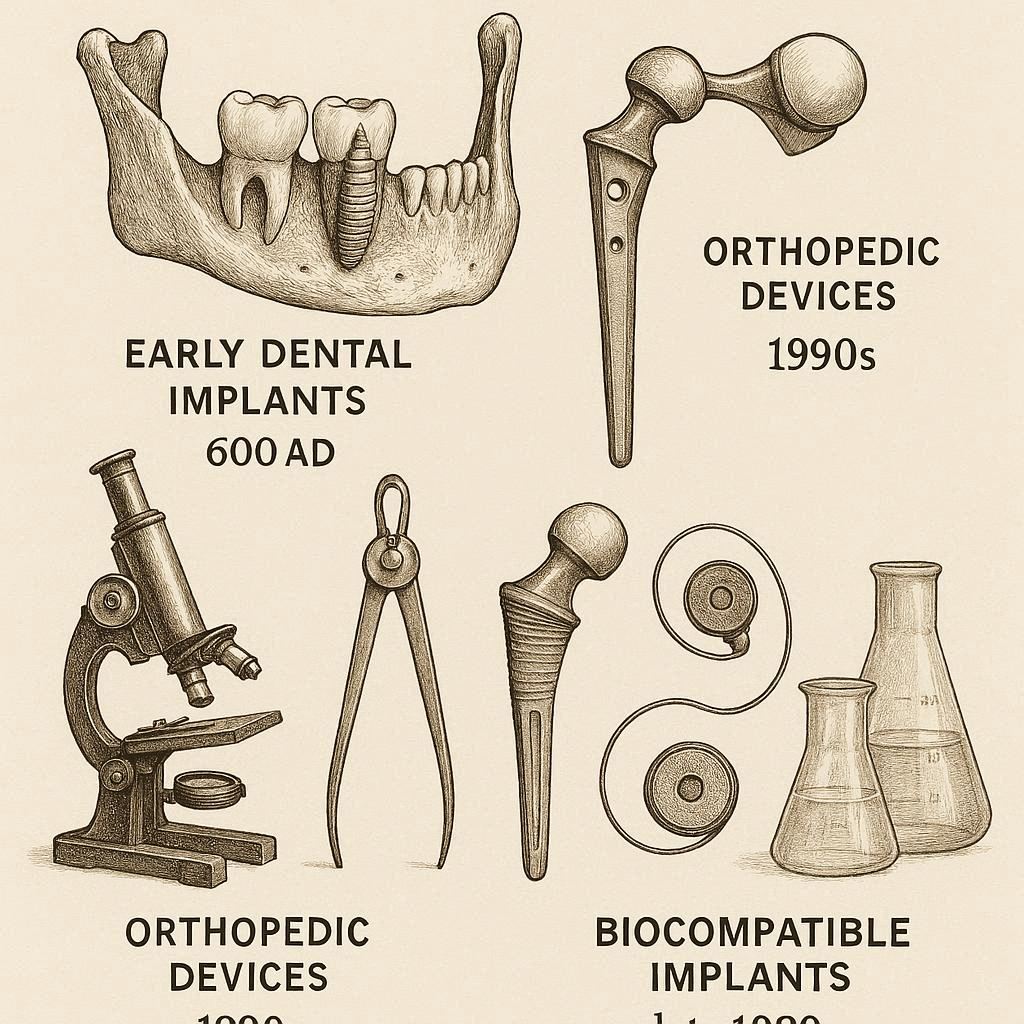
1. Ancient Beginnings: The First Implants (2000 BCE – 500 CE)
Long before modern medicine, ancient cultures tried to replace missing body parts. Their methods were crude by today’s standards, but they were surprisingly creative.
The 4,000-Year-Old Dental Implant
In 1931, archaeologists found something strange in a Neolithic grave in France. A young woman’s jaw contained a canine tooth carved from a piece of flint. Flint is a hard, stone-like material. Someone had carefully shaped it to look like a real tooth and placed it into her jawbone.
Was it placed while she was alive? Probably not. Most historians believe this was a post-mortem ritual. Still, it shows that the idea of replacing a tooth with an artificial object existed thousands of years ago.
Ancient China: Bamboo Pegs
Around 2000 BCE, ancient Chinese healers tried something more practical. They carved small pegs from bamboo and hammered them into empty tooth sockets. Bamboo is tough, lightweight, and resists rot. Some evidence suggests these pegs were placed in living patients.
Did they work? For a short time, maybe. But bamboo is not biocompatible. The body likely rejected it within weeks. Still, the attempt was brave.
The Etruscans and Romans: Gold Bands and Ox Bone
The Etruscans (from modern-day Italy) were master goldsmiths. Around 500 BCE, they started making replacement teeth from ox bone and gold. They would carve a single false tooth or craft a gold band that held several fake teeth together.
Romans later copied this technique. The Roman poet Martial joked about a woman named Thais whose teeth “buy and sell” every day—meaning she wore removable dental prosthetics.
Important note: These ancient “implants” were not true implants by modern medical standards. Most did not fuse with the bone. They were more like early prosthetics held in place by wires, bands, or luck.
2. The Dark Ages and Renaissance: A Long Pause (500 CE – 1800 CE)
For over a thousand years, progress on implants nearly stopped. Medical knowledge in Europe declined. The Church often discouraged invasive body modifications. But a few bright spots appeared.
The Iron Tooth of a Roman Soldier
In the 150s CE (late Roman era), a soldier in the Netherlands received an iron replacement tooth. Archaeologists found it in the 1990s. The tooth was a simple iron peg hammered into the jaw. It showed signs of use, meaning the man probably ate with it.
This is one of the earliest examples of a metal implant placed in a living person.
John Hunter and Tooth Transplants (1770s)
In the 18th century, Scottish surgeon John Hunter experimented with tooth transplants. He did not use artificial materials. Instead, he transplanted teeth from one person to another—or even from animals to humans.
He famously paid poor Londoners to let him transplant a rooster’s tooth into a human mouth. It failed, of course. But Hunter’s work laid the foundation for transplant biology.
Why Did Progress Stall?
Three reasons:
- Infection: No one understood germs. Most implant patients died from sepsis.
- Rejection: The body attacks foreign objects. Ancient cultures had no way to prevent this.
- Pain: Without anesthesia, implant surgery was torture.
It took the Industrial Revolution and modern science to solve these problems.
3. The Birth of Modern Implants (1800 – 1950)
The 19th century brought three game-changing inventions: anesthesia, antiseptics, and X-rays. Suddenly, surgery became safer. Implant research could finally advance.
The First Metal Hip (1891)
Most people think the first hip replacement happened in the 1960s. Wrong.
In 1891, German surgeon Themistocles Gluck implanted a ball-and-socket joint made from ivory. He fixed it to the bone with nickel-plated screws and a cement made from colophony (a type of pine resin) and plaster of Paris.
Gluck performed over 20 joint replacements. Many failed due to infection. But his work was brilliant. He even designed modular implants—parts that could be swapped out—over 100 years before they became standard.
The Rise of Vitallium (1930s)
The biggest problem with early metal implants was corrosion. Iron and steel rusted inside the body. This caused pain, swelling, and failure.
Then came Vitallium.
Vitallium is an alloy of cobalt, chromium, and molybdenum. It is incredibly strong, lightweight, and most importantly—it does not corrode in body fluids. In 1937, a dentist named Charles Venable used Vitallium to fix broken bones.
For the first time, doctors had a truly biocompatible metal.
The First Successful Hip Replacement (1940)
In 1940, American surgeon Dr. Austin T. Moore performed the first successful metal hip replacement. He used a Vitallium prosthesis shaped like a nail with a ball on top. The patient was a 42-year-old man with a bone tumor. The implant lasted for years without loosening.
Moore later designed the “Moore Hip,” which became the global standard until the 1980s.
Dental Implants Finally Work (1930s – 1940s)
While joint replacements advanced, dental implants lagged. But two doctors changed that.
Drs. Alvin and Moses Strock (brothers) experimented with Vitallium screws in dogs. In 1937, they placed the first successful Vitallium dental screw in a human patient. The implant integrated with the bone—a concept later called osseointegration.
Unfortunately, their work was mostly forgotten during World War II.
4. The Breakthrough: Osseointegration (1950 – 1970)
This is the most important period in implant history. Without these discoveries, modern dental and orthopedic implants would not exist.
Who Discovered Osseointegration?
Swedish orthopedic surgeon Professor Per-Ingvar Brånemark.
In 1952, Brånemark was studying blood flow in rabbits. He placed a titanium chamber into a rabbit’s leg bone. When he tried to remove it weeks later, the titanium had fused so tightly to the bone that it broke his instruments.
Brånemark was stunned. He called this phenomenon osseointegration—from the Latin osseus (bone) and integrare (to make whole).
At first, his colleagues laughed. They said bone could not fuse with metal. But Brånemark spent the next 30 years proving them wrong.
The First Titanium Dental Implant (1965)
In 1965, Brånemark placed the first titanium dental implant into a living human patient—a Swedish man named Gösta Larsson. Larsson had a cleft palate and missing teeth. The implant worked perfectly.
Larsson kept his implants for over 40 years until his death in 2006. When researchers examined them, the titanium was still fused to his bone.
Key fact: This 1965 surgery marks the true birth of the modern dental implant. All contemporary dental implants descend from Brånemark’s work.
Why Titanium?
Titanium is special. When exposed to air, it forms a thin layer of titanium dioxide. This layer does two things:
- It resists corrosion.
- It tricks the body into not rejecting it.
Bone cells actually attach directly to the titanium oxide layer. This is osseointegration in action.
The World Resists (1960s – 1980s)
For nearly 20 years, the medical world rejected Brånemark’s findings. Most dentists continued using gold, silver, and porcelain crowns held by screws or cement. They did not believe bone could fuse with metal.
Brånemark was patient. He published his research. He gave lectures. He trained other surgeons.
Finally, in 1982, the Toronto Conference on Osseointegration changed everything. Hundreds of dentists watched live surgeries. They saw X-rays of 17-year-old implants still solidly fused. The room erupted in applause.
Titanium dental implants became the new global standard.
5. The Implant Revolution (1970 – 2000)
After Brånemark’s breakthrough, implant technology exploded. New materials, new designs, and new applications appeared every year.
Hip Replacements Go Mainstream (1970s)
British surgeon Sir John Charnley perfected the modern hip replacement. His design used:
- A metal ball (stainless steel or cobalt-chrome)
- A plastic socket (ultra-high-molecular-weight polyethylene)
- Bone cement (PMMA—polymethyl methacrylate)
Charnley’s “low friction arthroplasty” became the gold standard. Millions of people received Charnley hips.
The First Knee Replacement (1974)
While hips advanced, knees were trickier. The knee moves in multiple directions. Early knee implants often loosened or broke.
In 1974, Dr. John Insall and Dr. Chitranjan Ranawat designed the “Total Condylar Knee.” It replaced all three compartments of the knee joint. For the first time, patients could walk without pain after knee replacement.
Today’s knee implants still follow the Insall-Ranawat design principles.
The First Penile Implant (1973)
Urologists also entered the implant field. In 1973, Dr. Brantley Scott invented the first inflatable penile implant. It allowed men with severe erectile dysfunction to have natural-looking erections on demand.
Earlier rigid rod implants existed (1960s), but Scott’s inflatable design was a revolution in urology.
Breast Implants: A Controversial History
- 1962: The first modern silicone breast implant. Timmie Jean Lindsey received it in Houston, Texas.
- 1970s – 1980s: Breast implants became popular, but safety concerns grew.
- 1992: The FDA restricted silicone implants due to links with autoimmune diseases (later largely disproven).
- 2006: The FDA re-approved silicone implants after better safety studies.
Today, breast implants are among the most-studied medical devices in history.
6. The Modern Era (2000 – Present)
The last 20 years have seen implants become smarter, smaller, and safer.
3D-Printed Custom Implants
Early implants came in standard sizes. Surgeons had to carve bone to fit the implant.
Today, we can 3D print implants perfectly matched to a patient’s anatomy. Doctors scan the body with CT or MRI. Engineers design an implant that fits like a puzzle piece. A printer builds it from titanium powder, layer by layer.
Real example: In 2014, surgeons in the Netherlands replaced a 22-year-old woman’s entire skull with a 3D-printed titanium implant. She recovered fully.
Smart Implants: The Internet of Bodies
Modern implants can talk to smartphones and doctors’ computers.
- Smart pacemakers adjust themselves to your activity level.
- Smart glucose monitors send blood sugar data to your phone.
- Smart spinal implants measure pressure and alert doctors to problems.
In 2021, a British man received the world’s first 3D-printed prosthetic eye. It looks completely natural and cost a fraction of traditional handmade eyes.
Dissolving Implants
Some new implants are designed to disappear. After they finish their job, they dissolve safely in the body.
For example, dissolving cardiac stents open blocked arteries, then slowly turn into water and carbon dioxide. The patient is left with a healed artery and no permanent hardware.
The First Human Neuralink (2024)
In early 2024, Elon Musk’s company Neuralink implanted its first brain-computer interface (BCI) in a human. The device, roughly the size of a coin, reads neural signals and allows the patient to control a computer cursor with thought alone.
This is still experimental. But it points to the future: implants that merge human biology with artificial intelligence.
7. Comparative Table: Implant Evolution at a Glance
| Time Period | Key Material | Success Rate | Typical Use | Who Invented/Introduced |
|---|---|---|---|---|
| 2000 BCE | Bamboo, stone | <5% | Dental | Ancient Chinese, French |
| 500 BCE | Gold, ox bone | <10% | Dental | Etruscans, Romans |
| 1891 | Ivory, cement | ~20% | Hip | Themistocles Gluck |
| 1937 | Vitallium | ~50% | Dental, bone | Strock brothers, Venable |
| 1952 | Titanium | ~70% | Research | Per-Ingvar Brånemark |
| 1965 | Titanium | ~90% | Dental | Per-Ingvar Brånemark |
| 1970s | Cobalt-chrome + plastic | ~85% | Hip, knee | Sir John Charnley |
| 2000s | Titanium + bioactive coatings | ~95% | All types | Various |
| 2020s | 3D-printed titanium + smart sensors | >98% | Custom implants | Many companies |
Success rate = percentage still functioning without serious complications after 10 years (estimated averages for the time period).
8. Who Really Invented the Implant?
You cannot point to a single person.
The implant was invented over 4,000 years by hundreds of surgeons, dentists, engineers, and scientists. But if we must name the most influential figures:
- Ancient unknown craftspeople – First to try.
- Themistocles Gluck (1853–1942) – First modern joint replacement.
- Austin T. Moore (1899–1963) – First successful hip replacement.
- Per-Ingvar Brånemark (1929–2014) – Father of osseointegration and modern dental implants.
- Sir John Charnley (1911–1982) – Father of modern hip replacement.
If the question is “who invented the implant as we know it today?”—most experts say Per-Ingvar Brånemark. His discovery of osseointegration made long-term, reliable implants possible.
But even Brånemark stood on the shoulders of ancient goldsmiths and Victorian surgeons.
9. Helpful Lists: Types of Implants by Decade
1950s
- Metal rods for fractures (first widely used)
- Early pacemakers (bulky, external batteries)
1960s
- First modern dental implants (Brånemark)
- First silicone breast implants
- First rigid penile implants
1970s
- Modern total hip (Charnley)
- Inflatable penile implant (Scott)
- Total knee replacement (Insall & Ranawat)
1980s
- Cochlear implants (hearing)
- Spinal fusion cages
- Hydroxyapatite-coated implants (better bone bonding)
1990s
- Drug-eluting stents (heart)
- Artificial lumbar discs (spine)
- First minimally invasive implants
2000s
- 3D-printed custom implants
- Dissolving stents (experimental)
- Bionic eye implants (early)
2010s – 2020s
- Smart implants with Bluetooth
- Fully 3D-printed skulls and jaws
- Brain-computer interfaces (Neuralink)
- Living implants (cells + synthetic materials)
10. What Does “Successful” Mean for an Implant?
A successful implant must pass four tests.
Test 1: Biocompatibility
The material cannot poison you. No rust, no toxic breakdown. Titanium, ceramics, and certain plastics pass. Old iron and copper implants failed.
Test 2: Osseointegration (for bone implants)
The implant must fuse with living bone, or at least stay stable without excessive movement. Loose implants fail.
Test 3: Infection Resistance
Every surgery risks infection. But implant infections are especially dangerous because bacteria can hide on the implant surface. Modern implants often have antibacterial coatings or microscopic textures that reduce bacterial attachment.
Test 4: Longevity
A “successful” hip or dental implant should last 15–25 years or more. Brånemark’s first patient kept his dental implant for over 40 years. That is the gold standard.
Important note: No implant lasts forever. The average hip replacement lasts 15–25 years. Dental implants can last 30+ years with good care. Eventually, all implants fail or wear out.
11. Common Myths About Implant History
Let us clear up some false stories you might have heard.
Myth 1: “Implants were invented in the 1960s.”
False. The first modern dental implant (titanium, osseointegrated) appeared in 1965. But the first metal hip implant was 1891. The first bone screws were 19th century. And the first attempted tooth replacements were over 4,000 years old.
Myth 2: “The Egyptians invented dental implants.”
False. This myth comes from old Hollywood movies. Egyptian mummies sometimes have teeth tied with gold wire, but those were real teeth from other people (or animals). No Egyptian implant made from metal or stone has been found in a living person’s jaw.
Myth 3: “Titanium was discovered for implants.”
False. Titanium was discovered in 1791. It was used in aircraft and industrial equipment for 150 years before Brånemark discovered its medical properties. He did not invent titanium—he discovered how bone fuses to it.
Myth 4: “All old implants failed.”
False. Some ancient techniques worked surprisingly well. Roman gold dental bands held false teeth for years. The 1940 Austin Moore hip lasted for decades in some patients. Success was rare, but possible.
12. The Future: What Happens Next?
Implants will become smarter, more biological, and eventually invisible.
Regenerative Implants
Instead of metal, future implants will be made from living tissue grown in labs. Doctors will implant a “scaffold” coated with your own stem cells. The scaffold dissolves, leaving behind new, real tissue.
This already works for simple structures like tracheas (windpipes). Within 20 years, we may grow new knees and jaws.
Brain-Computer Interfaces (BCIs)
Neuralink is just the beginning. Future BCIs will treat paralysis, blindness, depression, and memory loss. Patients will control robotic limbs, computers, and even household appliances with thought.
Self-Healing Implants
Researchers are developing implants that repair their own cracks. They contain microscopic capsules of healing agent. When a crack forms, the capsules break and release a substance that seals the damage.
No More Battery Changes
Today’s pacemakers need battery replacement surgeries every 5–10 years. Tomorrow’s implants will draw power from your own body—heat, motion, even glucose in your blood.
Conclusion (3 Lines)
Implants are not a modern invention. Humans have tried to replace missing body parts for over 4,000 years, from ancient bamboo teeth to Roman gold bands. The real breakthrough came in 1952 when Per-Ingvar Brånemark discovered titanium’s ability to fuse with bone—a discovery that led to today’s dental, hip, and smart implants.
Frequently Asked Questions (FAQ)
Q1: When were the first dental implants invented?
The first true modern dental implant (titanium, osseointegrated) was placed in 1965 by Dr. Per-Ingvar Brånemark. However, ancient people tried dental implants as early as 2000 BCE using bamboo, stones, and shells.
Q2: Who invented the hip replacement?
The first successful modern hip replacement was performed by Dr. Austin T. Moore in 1940. Sir John Charnley later perfected the design in the 1960s and 1970s.
Q3: When did breast implants start?
The first modern silicone breast implant was placed in 1962 on Timmie Jean Lindsey in Houston, Texas.
Q4: Are implants safe today?
Yes. Modern implants have success rates above 90–98% at 10 years. But no surgery is risk-free. Always discuss risks with your doctor.
Q5: How long do implants last?
- Dental implants: 20–30+ years with good care
- Hip/knee replacements: 15–25 years
- Breast implants: 10–20 years (may need replacement)
- Pacemakers: 5–15 years (battery dependent)
Q6: What is osseointegration?
Osseointegration is the direct fusion between living bone and the surface of a titanium implant. Brånemark discovered it in 1952. It is the foundation of modern dental and orthopedic implants.
Q7: When was titanium first used in the human body?
Titanium was first used in a human patient in 1965 (Brånemark’s dental implant). However, titanium bone screws and plates were tested in animals and a few humans in the 1950s.
Q8: Can the body reject an implant?
The body does not “reject” metal implants like it rejects organ transplants (no immune attack). However, the body can react by forming scar tissue, causing loosening, or triggering infection. True allergic reactions to titanium are extremely rare.
Q9: What is the oldest successful implant still in a living person?
It is difficult to verify, but several patients from Brånemark’s early 1970s studies still had functioning dental implants 40+ years later. Some hip replacement patients from the 1970s still have their original implants.
Q10: Will implants ever last a lifetime?
Possibly. New materials like tantalum, diamond coatings, and ceramic composites wear much slower than older materials. Some experts believe 50+ year implants will be common by 2040.
Additional Resource
Link: National Institutes of Health (NIH) – History of Medical Implants (non-commercial, authoritative source)
For readers who want to go deeper: this free online exhibition from the U.S. National Library of Medicine covers implant history with photos, patents, and original documents.
Disclaimer
This article is for informational and educational purposes only. It does not constitute medical advice. Implant surgery carries risks, including infection, bleeding, nerve damage, and implant failure. Always consult a licensed medical professional before making any healthcare decisions. The author and publisher are not responsible for any outcomes resulting from the use of this information.