Who Can Get Dental Implants On The Nhs?
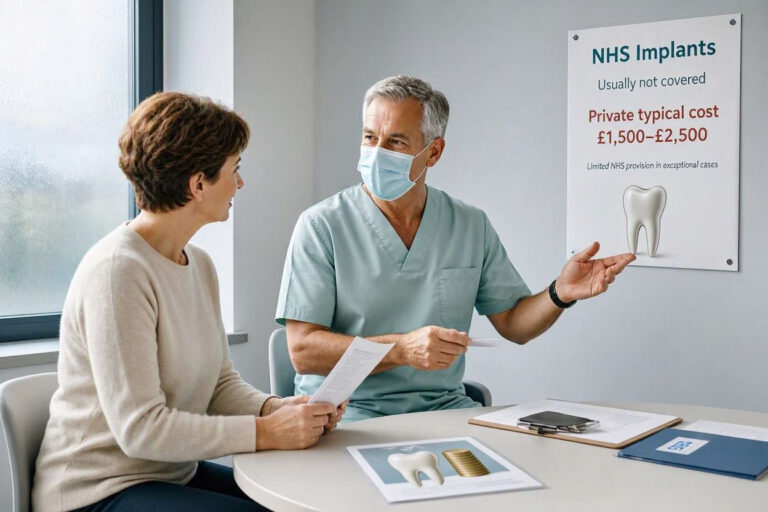
The National Health Service (NHS) in the United Kingdom provides healthcare free at the point of delivery. However, when it comes to dentistry, the rules are different. Dental implants are considered a “luxury” or “cosmetic” treatment by the NHS. Therefore, getting them for free or at a subsidized rate is very difficult.
The short answer: Very few people can get dental implants on the NHS. It is not a matter of “wanting” them; it is a matter of strict medical necessity. This article explains the rules, the criteria, and what your options are if the NHS says no.
The NHS Dental Contract
The NHS operates under a Band system for dental charges.
- Band 1: Examination and cleaning (£25.80).
- Band 2: Fillings, extractions (£70.70).
- Band 3: Crowns, dentures, bridges (£306.80).
Dental implants are not included in these bands. If you get an implant on the NHS, it is usually under a hospital contract, not a general dental practice contract.
The Medical Necessity Criteria
To qualify for an NHS implant, you must meet specific criteria. These are strictly enforced.
1. Congenital Absence (Hypodontia)
If you were born without certain teeth (often the lateral incisors), the NHS might provide implants. This is often done in a hospital setting.
- Catch: They usually only do this if orthodontic treatment (braces) has already been completed and the space has been opened.
2. Trauma and Cancer
If you lost teeth due to a serious accident or as part of treatment for mouth cancer (jaw resection), the NHS considers this a reconstructive need. This is not “cosmetic” dentistry; it is restoring function.
- Catch: You must be referred by a consultant.
3. Inability to Wear Dentures
Some patients have severe anatomical issues (e.g., a very shallow palate or a strong gag reflex) that make it impossible to wear a traditional denture. If a consultant confirms that a denture will not stay in place, they might approve implants to hold the denture down.
Who Does NOT Qualify?
- Someone who lost a tooth due to decay or gum disease. The NHS view is that this was preventable. They will offer a bridge or denture instead.
- Someone who just wants a better look. Purely cosmetic reasons are rejected.
- Someone who has enough bone for a denture. If you can wear a denture, even with difficulty, the NHS will tell you to use that.
The Referral Process
You cannot just ask your NHS dentist for an implant. They will look at your mouth and refer you if they think you meet the criteria.
- GP/Dentist Visit: You see your general dentist.
- Referral: They write a referral to the local hospital’s Oral and Maxillofacial Surgery or Restorative Dentistry department.
- Assessment: You wait for an appointment (this can take months).
- Consultant Decision: The consultant decides if you meet the “medical necessity” criteria.
- Approval/Denial: If approved, you go on a waiting list for surgery.
The “Grey Area” and Appeals
Sometimes, a consultant might say no. You can appeal this decision, but you need a strong case. You might need letters from your GP explaining the impact on your mental health or nutrition.
Alternatives if the NHS Refuses
If the NHS says no, you have to go private.
Private Costs in the UK
- Single Implant: £2,000 – £3,500.
- Full Mouth: £15,000 – £30,000.
Dental Schools in the UK
Universities like King’s College London or Manchester Dental School offer implants at reduced prices (often £800 – £1,200 per implant). You are treated by students under supervision.
Going Abroad
Many Brits fly to Hungary or Turkey for implants. Prices can be 50% cheaper.
Table: NHS Eligibility at a Glance
| Patient Situation | NHS Implant? |
|---|---|
| Born without a tooth (Hypodontia) | Possible (Hospital) |
| Lost tooth in a car crash | Possible (Reconstructive) |
| Had jaw cancer surgery | Likely |
| Lost tooth to decay | No |
| Does not like wearing dentures | No (unless severe physical gag) |
| Wants a “Hollywood Smile” | No |
Conclusion
Getting dental implants on the NHS is possible but highly restricted. You must demonstrate a clear medical or developmental need, not just a preference for a fixed solution. For most people, private treatment or a dental school is the only realistic route to obtaining dental implants in the UK.
Additional Resource
For official guidance on NHS dental charges, visit www.nhs.uk.