Why Do Implant Teeth Need Crowns? Understanding the Restoration Process
A patient who has completed the surgical phase of implant treatment often asks a seemingly simple question: Why does my implant need a crown? The implant is already in place. The metal post is integrated into the bone. The gum has healed around it. Why not just leave it as is, or shape the top of the implant to look like a tooth?
The answer lies in the fundamental distinction between the implant fixture and the tooth restoration. The implant replaces the root. The crown replaces the visible portion of the tooth. Both are essential. Neither alone constitutes a complete tooth replacement. This guide explains the biological, mechanical, and esthetic reasons why every dental implant requires a crown or other prosthesis.
The Division of Labor: Implant as Root, Crown as Tooth
Understanding why a crown is necessary begins with understanding what the implant is and is not.
The Implant Fixture: A Root Replacement
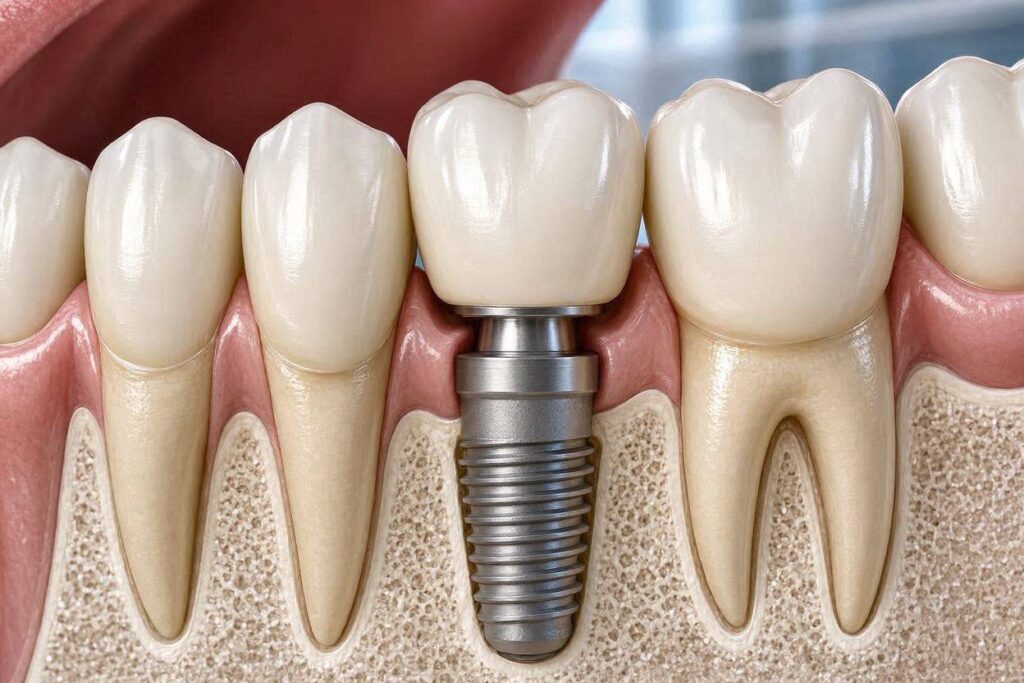
A dental implant is a titanium or zirconia cylinder, threaded on the outside, with an internal connection at the top. It is designed to be placed into the jawbone and to achieve osseointegration, a direct bond with the bone. Its entire design and surface are optimized for this biological integration. The implant is buried partially or fully below the gum line, depending on the healing protocol. It is not shaped like a tooth crown. It is not intended to be visible in the mouth. Its color, usually titanium gray or white for zirconia, is not esthetic for a visible tooth surface.
The implant provides anchorage. It transfers chewing forces to the bone. It stimulates the bone to prevent resorption. It is the foundation. It is not the visible, functional chewing surface.
The Crown: The Visible, Functional Tooth
The crown is the portion of the restoration that is visible above the gum line. It mimics the shape, size, and color of a natural tooth crown. It has the anatomy needed for efficient chewing, the contours needed for proper speech and lip support, and the esthetics needed for a natural smile.
The crown is fabricated from ceramic materials, such as porcelain fused to metal, lithium disilicate, or zirconia, sometimes layered with porcelain for optimal esthetics. These materials are chosen for their wear resistance, strength, and ability to replicate the translucency and color of natural teeth. The implant material, whether titanium or zirconia, is not suitable in its raw form to serve as a visible tooth surface.
Mechanical Reasons for the Crown
The separation of implant and crown serves critical mechanical functions.
The Abutment: The Connector
Between the implant fixture and the crown sits the abutment. The abutment is screwed into the implant’s internal connection. It emerges through the gum and provides the structural base onto which the crown is cemented or into which the crown screw engages in a screw-retained design.
This modular system allows the restorative dentist to customize the angle, height, and contour of the foundation for the crown. If the implant was placed at a slight angle, an angled abutment can correct the alignment so that the crown sits in the proper position. If the gum is thick or thin, an abutment with an appropriate cuff height is selected. This modularity is essential for achieving proper esthetics and function.
Force Distribution and Protection
The crown and abutment system distributes chewing forces in a controlled manner. The crown makes contact with the opposing teeth. These forces travel through the crown, into the abutment, through the abutment screw, and into the implant fixture. The implant then distributes the forces into the surrounding bone.
The crown is designed with specific occlusal anatomy. The cusps and fossae are shaped to direct forces axially, down the long axis of the implant. Off-axis forces are minimized. The crown material provides a surface that wears against the opposing natural or artificial teeth at an appropriate rate.
If chewing forces were applied directly to the implant fixture without a crown, the forces would be concentrated on a small area, the internal connection would be exposed, and the implant would be vulnerable to damage.
Sacrificial Protection
The crown serves as a sacrificial layer. It is designed to wear or, in the case of fracture, to fail before the implant fixture or the abutment screw fails. Replacing a fractured crown is a straightforward, non-surgical procedure. Replacing a fractured implant is a surgical ordeal. The crown protects the more valuable and less accessible underlying components.
Customization of Emergence Profile
The emergence profile is the contour of the restoration as it emerges from the gum. It must transition from the circular cross-section of the implant platform to the triangular or oval cross-section of a natural tooth at the gum level. This transition is critical for esthetics and for creating a cleansable contour that the patient can maintain. The abutment and crown together create this emergence profile. The implant alone cannot achieve this.
Biological Reasons for the Crown
The crown contributes to the health of the tissues around the implant.
Establishing the Biological Width
The biological width is the dimension of soft tissue and bone that forms a seal around the implant, protecting the underlying bone from the oral environment. This seal includes the sulcular epithelium and the connective tissue attachment. The interface between the crown or abutment and the gum is where this seal forms. The crown must have a smooth, well-polished surface at this interface to minimize plaque accumulation. The implant fixture, with its roughened surface designed for bone integration, would be a poor substrate for this soft tissue seal if exposed to the oral cavity.
Protecting the Implant Platform
The implant platform, where the abutment connects, is a precision-machined interface. If this platform were exposed to the oral environment, it would accumulate plaque and be impossible for the patient to clean. The result would be chronic inflammation and bone loss around the implant neck. The crown, in conjunction with the abutment, covers and seals this platform, protecting it.
Enabling Effective Oral Hygiene
The crown is contoured so that the patient can clean around it with a toothbrush, floss, and interdental aids. It has a smooth surface below the gum line that resists plaque accumulation. An exposed implant fixture, with its threads and rough surface, would be a plaque trap.
Esthetic Reasons for the Crown
The most visually obvious reason is esthetics.
Color and Translucency
Titanium is gray. Zirconia is white but opaque and monochromatic. Neither material replicates the color, translucency, and vitality of a natural tooth. Modern dental ceramics can be layered and stained to match the adjacent natural teeth almost perfectly. The crown provides the esthetic visible surface.
Anatomy and Contour
Natural teeth have specific anatomical features: cusps, fossae, marginal ridges, contact areas, and cervical contours. These features contribute to efficient chewing, proper food deflection, and a natural appearance. The crown replicates this anatomy. The implant fixture is a simple cylinder or tapered screw with no such features.
Gingival Esthetics
The way the crown emerges from the gum is critical to a natural appearance. A well-designed emergence profile supports the gum papilla between the implant crown and adjacent teeth. It creates the illusion that the tooth is emerging naturally from the gum. The implant alone, even with a healing abutment, does not achieve this.
What Happens If a Crown Is Not Placed?
In some situations, a patient might have an implant with a healing abutment but no final crown for an extended period, or a patient might wonder about leaving the implant buried.
The Healing Abutment
After implant placement, a healing abutment is often placed. This is a temporary metal cylinder that protrudes through the gum, shaping the soft tissue for the eventual crown. The healing abutment is not a functional chewing surface. It is not esthetic. It is not intended for long-term use. Leaving a healing abutment in place indefinitely would result in a non-functional, unattractive metal post protruding from the gum.
The Buried Implant
If the implant is buried under the gum with a cover screw, it is completely hidden and protected. This is done during the osseointegration phase. If the implant were left buried permanently, it would provide bone preservation at that site but no tooth function. The patient would still need a tooth replacement of some kind.
The Temporary Crown
During the healing phase with immediate loading protocols, a temporary crown is placed. This provisional restoration is made of acrylic or composite and is designed for limited function and short-term use. It is replaced with the final crown after osseointegration is confirmed.
The Crown Fabrication Process
Understanding how the crown is made underscores its role.
Impression Taking
After the implant has integrated and the soft tissue has matured, the restorative dentist takes an impression of the implant platform and the surrounding tissues. This can be done with traditional impression materials and a transfer coping or with a digital intraoral scanner.
Abutment Selection
The dentist selects a stock or custom abutment. Stock abutments are prefabricated in various sizes and angles. Custom abutments are milled from a block of titanium or zirconia specifically for the patient’s anatomy. The abutment choice depends on the implant position, the tissue depth, and the esthetic requirements.
Crown Design and Fabrication
The crown is designed based on the opposing dentition, the adjacent teeth, and the space available. It is milled from a ceramic block or fabricated by a dental laboratory technician using traditional layering techniques. The occlusion is carefully adjusted to ensure light contact in maximum intercuspation and no interferences in excursive movements.
Delivery and Cementation or Screw Retention
The final crown is either cemented onto the abutment or screwed directly into the implant. The occlusion is verified. The patient is instructed in hygiene and maintenance.
Table: Roles of Implant Components
| Component | Function | Material | Visibility |
|---|---|---|---|
| Implant fixture | Root replacement, bone anchorage, bone stimulation | Titanium or zirconia | Below gum and bone |
| Abutment | Connector, emergence profile, crown foundation | Titanium, zirconia, or gold alloy | Partially above gum |
| Crown | Visible tooth, chewing surface, esthetics, speech, lip support | Ceramic, porcelain fused to metal, zirconia | Above gum |
| Abutment screw | Secures abutment to implant | Titanium or gold alloy | Internal, not visible |
Conclusion
Dental implants require crowns because the implant replaces only the root, providing anchorage and bone stimulation, while the crown replaces the visible, functional, and esthetic portion of the tooth. The crown distributes chewing forces, protects the underlying implant platform from plaque exposure, establishes a proper soft tissue seal, and provides the color, shape, and contour that make the restoration look and feel like a natural tooth. The abutment serves as the critical connector between these two components. Together, the implant, abutment, and crown form a complete tooth replacement system where each component performs distinct, essential functions.
Frequently Asked Questions
Why can’t the implant itself be shaped like a tooth?
The implant is designed for osseointegration with bone. Its surface is roughened to promote bone attachment, which would be terrible for hygiene if exposed in the mouth. Its material, whether titanium or zirconia, lacks the esthetic properties of dental ceramics. The implant is a root replacement, not a tooth replacement.
What is the difference between an abutment and a crown?
The abutment is the connector that screws into the implant and provides the foundation. The crown is the visible tooth that attaches to the abutment. Together they form the part of the restoration above the gum.
Can an implant function without a crown?
No. A healing abutment or cover screw does not provide a chewing surface. The implant would not be functional without a crown or other prosthesis attached.
Is the crown on an implant the same as a crown on a natural tooth?
They are similar in appearance and function, but an implant crown has a different internal design. A crown on a natural tooth fits over a prepared tooth stump. An implant crown fits onto an abutment or screws directly into the implant.
How long does the crown on an implant last?
The crown may last 10 to 20 years or more, depending on material, occlusal forces, and maintenance. It may need replacement before the implant fixture, which can last much longer.
Additional Resources
American College of Prosthodontists – Implant Restorations
https://www.gotoapro.org
Information from prosthodontic specialists on the restoration of dental implants, including the design and fabrication of implant crowns and prostheses.