Why Do You Need a Dental Implant
A missing tooth is never just a cosmetic gap in your smile. It is a structural event that sets off a chain reaction of biological consequences, shifting teeth, and deteriorating bone. For many, the immediate thought after a tooth extraction is relief from pain, followed by the quiet, creeping worry about the empty space. The dental industry offers multiple ways to fill that space: a removable partial denture, a tooth-supported bridge, and the dental implant. Each option has its place, but only one addresses the root of the problem—literally. This guide explains, in clear and uncompromising terms, why you need a dental implant. It is not an argument for the most expensive option. It is a clinical exploration of what happens to your mouth when a tooth is gone and how an implant stops that process in its tracks. By understanding the biomechanics of your jaw, the fate of the bone, and the long-term cost of doing nothing, you can make a decision that honors the complex, living system that is your mouth.
The Immediate and Hidden Consequences of Tooth Loss
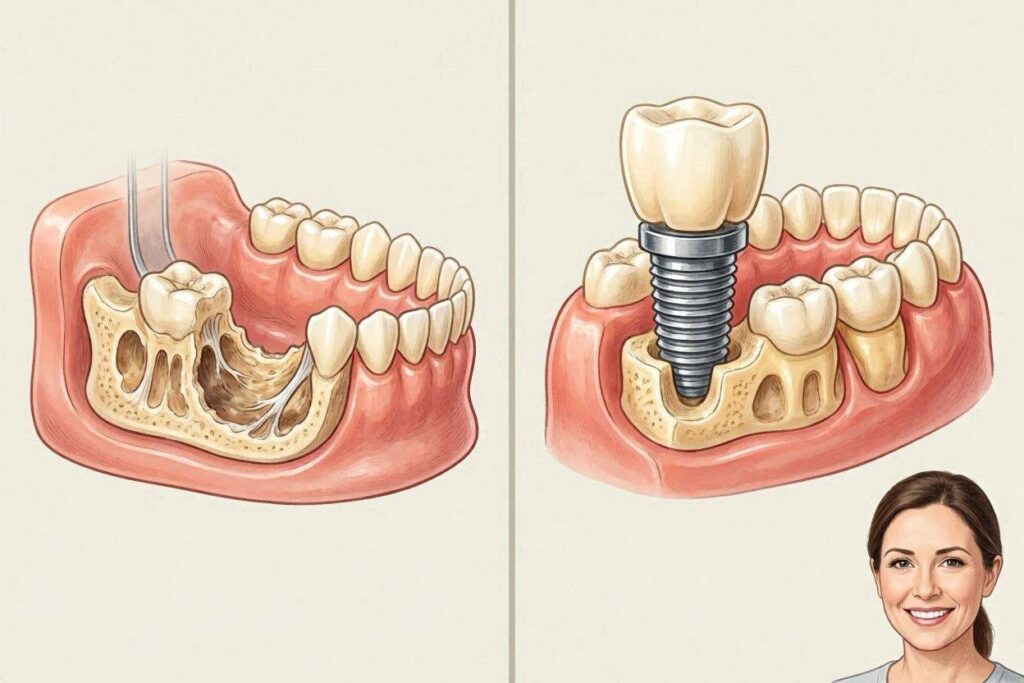
The moment a tooth is removed, the clock starts on a series of changes. The most obvious one is functional. A gap in your smile makes chewing on that side awkward or uncomfortable. You begin to favor the other side, which puts an asymmetric load on your jaw joint and your remaining teeth. The less obvious, and more destructive, consequence is the loss of the periodontal ligament. This ligament is a microscopic sling of collagen fibers that suspends a natural tooth root in its bony socket. Every time you chew, the tooth moves microscopically within this ligament, and that movement transmits a flexing signal to the surrounding bone. The bone cells, the osteoblasts and osteoclasts, constantly receive this signal of mechanical demand. The bone is alive and it is maintained by function. When the tooth is gone, the signal stops. The body interprets the absence of loading as a message that the bone is no longer needed in that area. A slow, relentless process of resorption begins. The alveolar ridge, the horseshoe-shaped bone that holds your teeth, begins to shrink in width and then in height. In the first year after a tooth extraction, you can lose up to 25% of the bone width in that area. The face of the ridge collapses inward. This is the hidden cost of a missing tooth that no bridge and no denture can prevent.
The Neighboring Teeth Shift: A Domino Effect
Nature abhors a vacuum, and so does your dental arch. A tooth is held in its position by two forces: the bone socket and the neighboring teeth on either side, with the opposing tooth biting down into it. When a tooth is extracted, these balance forces are lost. The tooth behind the gap, the one distal to the space, begins to tip and drift forward. The tooth above the gap, in the opposing jaw, begins to super-erupt, slowly moving down or up into the empty space because it no longer meets resistance. This shift does not happen overnight, but over months and years, it creates a cascade of malocclusion. The drifting tooth creates a food trap, a space that is impossible to clean, leading to decay and gum disease on teeth that were previously healthy. The super-erupted tooth has its roots exposed, leading to sensitivity and risk of decay. A simple single-tooth loss, left untreated, can evolve into a complex, multi-tooth problem that requires orthodontics to realign the bite before any replacement can be placed. A dental implant, by contrast, is a fixed, immovable post that acts just like a natural root. It fills the space completely and prevents this drift from ever starting. It stabilizes the arch.
The Bone Preservation Principle: Why Only an Implant Works
This is the physiological argument that separates the implant from every other tooth replacement option. A removable partial denture rests on the gum and clips to the remaining teeth. It transmits no load to the bone beneath the fake tooth. The bone under a partial denture actually resorbs faster, because the pressure of the denture base on the gum accelerates atrophy. A traditional fixed bridge uses the two teeth on either side of the gap as pillars. The dentist files them down into small posts and cements a three-unit bridge over them. The bridge floats the replacement tooth, called a pontic, over the gum. The chewing force is transferred to the two pillar teeth, which is an excellent load for them, but the bone under the pontic receives absolutely no stimulation. It continues its silent resorption. Over time, an unsightly gap appears between the gum and the underside of the pontic.
A dental implant is the only replacement that transmits chewing forces directly into the jawbone. The titanium or zirconia post is osseointegrated, meaning the bone cells grow directly onto its specially treated surface without a ligament. When you bite on an implant crown, the force travels down the abutment, down the implant, and into the bone trabeculae. This compresses the bone. The bone cells sense this mechanical load and maintain their density. The implant preserves the bone volume. This is not a small advantage. It is the fundamental reason why implant dentistry is the standard of care for the healthy individual with a missing tooth. You are not just replacing the visible crown; you are replacing the root stimulus that keeps the jawbone alive and intact.
The Functional Restoration: Chewing, Speaking, and Confidence
A missing front tooth steals your smile and your confidence. A missing back molar steals your ability to chew efficiently. The human mouth is designed for a full complement of teeth. Losing a single molar reduces your overall chewing efficiency by approximately 10%. You begin to swallow larger, less-chewed food particles, which places a burden on your digestive system. You avoid hard, fibrous, and nutritious foods like raw vegetables, nuts, and certain meats. Your diet silently degrades.
A removable denture, particularly a partial, often comes with a plastic plate that covers part of your palate. This interferes with taste, triggers the gag reflex, and moves during speech. A fixed bridge restores function beautifully but at the expense of the two healthy neighboring teeth, which are now permanently crowned and at a higher lifetime risk of root canal and decay at the margin. An implant is a stand-alone unit. The dentist prepares no neighboring teeth. It is cleaned by flossing around it, just like a natural tooth. It does not move. It does not cover your palate. It restores your bite force to near-natural levels, allowing you to eat an apple, a steak, a crusty piece of bread with confidence and pleasure. The psychological impact of this functional restoration is profound. You stop thinking about the gap. Your mouth feels whole again.
Preventing Facial Collapse and Premature Aging
The long-term aesthetic consequence of bone loss is facial collapse. The alveolar bone is the foundation for your lips and cheeks. When multiple teeth are lost and the bone resorbs, the distance between the base of the nose and the chin shortens. The lips curl inward, creating deep vertical lines around the mouth. The lower face takes on a sunken, prematurely aged appearance. This is the classic “denture face” look. Dentures do not prevent this; they merely sit on top of the slowly disappearing ridge. Dental implants, especially when used in full-arch rehabilitations like the All-on-4 technique, maintain the bone and the facial structure. They preserve the vertical dimension of the lower face. An implant-supported restoration is not just a tooth replacement. It is a facial support structure. Patients who replace a failing set of teeth with a full-arch implant bridge often look years younger because the underlying bone is preserved and the prosthetic teeth are built to support the lips and cheeks correctly.
The Oral Health Hygiene Advantage
A single-tooth implant simplifies your oral hygiene. A tooth-supported bridge requires threading special floss under the false tooth, and even then, the area is prone to plaque accumulation. The margin where the bridge meets the prepared tooth is a common site for recurrent decay, which is the leading cause of bridge failure after ten to fifteen years. An implant crown has a smooth, independent contour. You floss it by wrapping the floss around it in a C-shape and sliding it under the gum line, exactly like a natural tooth. An implant-supported denture snaps securely into place and is removed for cleaning. It does not have the metal clasps of a partial denture that trap food and torque the anchor teeth. The hygiene advantage leads to a healthier, more sustainable oral environment.
The Psychological and Social Freedom
Living with a missing tooth or an unstable denture creates a low-level, chronic anxiety. You place your hand over your mouth when you laugh. You cut your food into tiny pieces before eating. You decline dinner invitations. You smile with your lips pressed tightly together. This social inhibition is exhausting. A dental implant removes this psychological burden. The tooth is fixed. It is yours. It does not come out at night and soak in a glass. It does not click when you talk. It feels, to your tongue and to your brain, like a part of your body. This re-integration of the body image is one of the most profound gifts of implant dentistry. Patients report forgetting, over time, that they have an implant at all. It is simply their tooth.
Conclusion
You need a dental implant because it is the only tooth replacement that replaces the root, stopping the irreversible bone resorption that begins the moment a tooth is lost and preserving the architecture of your jaw. It prevents the domino effect of neighboring teeth drifting and opposing teeth super-erupting, and it restores full chewing function, clear speech, and natural aesthetics without damaging healthy adjacent teeth. Beyond the biomechanics, an implant restores the psychological wholeness of a complete smile, freeing you from the anxiety of a gap or a loose appliance.
Frequently Asked Questions
Can I wait a few years after an extraction before getting an implant?
You can, but time works against you. The bone will continue to resorb in the absence of a root. If you wait many years, the ridge may become so narrow and shallow that a bone graft is required to rebuild it before an implant can be placed. The graft adds cost, time, and complexity. The best time for an implant is often at the time of extraction or within the first few months.
Why is a dental implant better than a bridge if a bridge is cheaper?
A bridge requires filing down the two healthy, structurally intact teeth on either side of the gap. These prepared teeth are permanently crowned and carry a higher lifetime risk of decay, root canal, and failure. A bridge has an average lifespan of 10-15 years. An implant is a stand-alone restoration with a 95%+ long-term success rate that spares the neighboring teeth and preserves the bone.
Am I too old for a dental implant?
Age, in itself, is not a contraindication. The key factor is your medical health, not your chronological age. An 85-year-old with controlled medical conditions and adequate bone can be an excellent implant candidate. The healing capacity of bone does not vanish with age. A thorough medical and radiographic evaluation is the only way to determine candidacy.
Can a dental implant fail?
Yes, like any medical procedure, it has a failure rate. Early failure is due to a failure of osseointegration, often from infection or excessive surgical trauma. Late failure is due to peri-implantitis, a bacterial infection of the gum and bone around a functioning implant, or excessive biting forces. The long-term success rate in a healthy, non-smoking patient is over 95%, making it one of the most predictable procedures in medicine.
Additional Resource:
For in-depth patient education on implant dentistry, visit the American Academy of Implant Dentistry’s website at www.aaid.com.
Disclaimer: This article is a comprehensive educational guide. It is not a substitute for an individual clinical examination and diagnosis by a licensed dentist or dental specialist. Your specific oral health condition requires a personal consultation.
continue
How Do You Remove a Dental Implant?
Meta Description: A detailed guide on how and why a dental implant is removed. Learn the step-by-step explantation procedure, the tools used, healing expectations, and the difference between a failed and a failing implant.
A dental implant is designed to be a permanent, lifelong replacement for a missing tooth. The titanium post, with its specially treated surface, is placed with the intention that it will osseointegrate—fuse with the living bone—and remain there, stable and functional, for decades. The published success rates of over 95% reflect this reality. But no medical procedure has a zero percent failure rate. In a small percentage of cases, an implant must be deliberately, carefully removed. This process is called explantation. It is a clinical decision made not lightly but with surgical precision, and it is not a simple act of “unscrewing” a screw. It requires specific instruments, a deep understanding of bone biology, and a plan for what comes next. This guide demystifies the implant removal process. It walks you through the exact reasons an implant fails, the detailed surgical technique of removal, the critical preservation of the bone during the procedure, and the realistic path to re-implantation.
Understanding the Difference: Ailing, Failing, and Failed Implant
Before the removal decision, the clinician diagnoses the implant’s status on a spectrum. An “ailing” implant is one showing early signs of trouble: bleeding on gentle probing, pus (suppuration) on pressure, and early radiographic bone loss around the top of the implant, but with no mobility. An ailing implant is often salvageable with surgical cleaning and decontamination. A “failing” implant is one with progressive, significant bone loss, deep pocketing, and perhaps the beginning of perceptible mobility, but still partially integrated. This implant is in a gray zone where heroic treatment may be attempted but the prognosis is guarded. A “failed” implant has lost osseointegration. It is clinically mobile, often painless, and cannot support a functional load. A failed implant is a foreign body in the jaw that the bone has rejected. It must be removed. There is no salvage procedure for a truly mobile, failed implant.
The Causes of Implant Failure Necessitating Removal
The reasons an implant must be removed fall into a few clear clinical categories.
Peri-Implantitis: The Leading Cause
This is a bacterial infection of the tissues surrounding an osseointegrated implant. It begins as peri-implant mucositis, a reversible inflammation of the soft gum tissue, analogous to gingivitis around a natural tooth. If left untreated, the bacterial biofilm migrates down the implant surface. The body’s inflammatory response, driven by endotoxins from the bacteria, activates osteoclasts, the bone-resorbing cells. A saucer-shaped crater of bone loss forms around the implant. Unlike a natural tooth, which has a periodontal ligament with a rich blood supply and a defense system of fibers, an implant has a direct bone-to-implant contact. The inflammatory infiltrate can spread unimpeded along the surface. Advanced peri-implantitis results in a deep, bleeding, infected pocket, crater-like bone loss visible on an X-ray, and eventual implant mobility. Once a certain threshold of bone support is gone, the implant is terminal and must be removed.
Early Failure: Failure of Osseointegration
An implant that has never integrated feels mobile at the time of second-stage surgery or crown delivery. The cause is often a combination of factors: surgical trauma (overheating the bone during drilling, causing osteocyte death), bacterial contamination at the surgical site, a micro-gap at the implant-abutment connection that leached bacteria, or a systemic patient factor such as heavy smoking, uncontrolled diabetes, or a previously unrecognized bone metabolic disorder. The implant sits in a fibrous capsule of scar tissue rather than a rigid, bony union. It has no pain sensation because there are no nerve fibers in the fibrous tissue, but it moves when torque is applied. This implant is a non-integrated mechanical failure and must be removed.
Mechanical Failure: Implant Fracture
This is rare with modern titanium alloy implants but occurs. The implant body itself fractures, usually at the point of highest bending stress, which is the neck of the implant just below the bone crest. The cause is almost always a combination of excessive occlusal forces (a heavy bite, bruxism) and a design or manufacturing flaw, or a long-term metal fatigue in a narrow-diameter implant. The fractured fragment deep in the bone must be surgically removed.
Malposition: A Strategic Error
An implant placed in a prosthetically unusable position—too close to a vital nerve causing chronic pain, too angled to restore with a crown, or impinging on the root of an adjacent tooth—may need removal even if it is perfectly integrated. This is a strategic failure of planning. Removal of a well-integrated but malpositioned implant is a particularly challenging and bone-destructive procedure.
The Explantation Procedure: A Step-by-Step Surgical Account
Removing a dental implant is a minor surgical procedure that requires local anesthesia, sterile technique, and a philosophy of bone preservation. The approach differs based on the degree of osseointegration remaining.
Step 1: Profound Anesthesia and Flap Reflection
The area is numbed completely. A full-thickness flap is raised. The surgeon makes an incision along the crest of the ridge and releases vertical incisions at the corners to fold the gum tissue back like a book cover. This provides direct visualization of the bone and the implant neck. You cannot safely remove an implant through a blind hole.
Step 2: The Explantation Trephine Technique
For an implant that is still partially integrated, the surgeon uses a specialized instrument called an explantation trephine. This is a hollow, circular drill with sharp teeth on its cutting end. The trephine is placed over the implant, engaging the bone around it. The goal is to core out a thin, circumferential shell of bone, about 0.5 to 1 millimeter thick, around the implant body. This trephine cut releases the bony attachment. The surgeon must use copious irrigation, a constant stream of sterile saline, to keep the bone cool and prevent thermal necrosis of the remaining bone walls. The depth is carefully controlled, often with a guide, to match the implant length. This is the most technically sensitive part of the procedure.
Step 3: The Removal and Counter-Torque Ratchet
Once the trephine has freed the implant from the surrounding bone, a removal tool is engaged. For implants with an internal connection, a specific explantation driver is inserted and a counter-torque ratchet is used to rotate the implant out. An integrated implant has a breaking torque of around 45-50 Ncm. The surgeon applies a controlled, slow, rotational force. The implant unscrews, and often a thin layer of bone comes attached to the threads, which is the core sample created by the trephine. For a truly mobile, failed implant, a trephine may not even be necessary; it may be able to be simply rotated out with a driver.
Step 4: For the Fractured Implant: The Trough Approach
If the implant body has fractured and the apical half is stuck deep in the bone, the surgeon uses a piezoelectric ultrasonic unit with a thin, diamond-coated tip. This device cuts bone selectively without damaging soft tissue. The surgeon creates a small, vertical window or a trough in the buccal (cheek-side) bone plate to access the fragment. The fragment is then teased out. This is a more invasive, bone-sacrificing rescue procedure.
Step 5: Debridement and Grafting of the Defect
The empty osteotomy site is now a circular socket filled with inflammatory granulation tissue. The surgeon uses sharp bone curettes and surgical burs on a slow-speed handpiece, under constant irrigation, to meticulously remove all the infected and inflamed granulation tissue. The bony walls must be clean, healthy, and bleeding. The defect is then packed with a bone graft material to fill the void and preserve the ridge for future implant placement. The flap is then repositioned and sutured with primary closure, completely covering the graft.
What to Expect After Implant Removal
The post-operative experience is similar to an extraction and bone graft. You will have swelling, mild to moderate discomfort, and you must follow the same ice, rest, and soft-diet protocol as any oral surgery. The sutures are typically removed in one to two weeks. The bone graft requires a healing period of three to four months before the site can be evaluated for a new implant. During this time, you will wear a temporary replacement, typically a small, tooth-supported bridge or a removable partial denture, that puts no pressure on the healing graft.
Can a New Implant Be Placed Immediately After Removal?
In most cases of a failed, infected implant, the answer is no. The site is contaminated, and immediate re-implantation carries a high risk of re-infection and failure. The site must be thoroughly debrided, grafted, and allowed to heal and revascularize for three to four months. However, in a very specific case—an atraumatic removal of a non-infected, early-failure implant with perfectly intact bony walls—the surgeon may place a slightly wider implant immediately into the same site. This is a clinical judgment made intra-operatively.
Conclusion
Dental implant removal, or explantation, is a precise surgical procedure required for a failed, fractured, infected, or strategically malpositioned implant, most commonly caused by peri-implantitis. The technique involves a full-thickness flap, the use of a trephine bur to release the bony integration around a partially fused implant, careful counter-torque removal, and thorough debridement of the socket followed by bone grafting to preserve the ridge. A healing period of three to four months is then required before a new implant can be planned and placed.
Frequently Asked Questions
Is implant removal painful?
No, the procedure is performed under complete local anesthesia. You will feel pressure and vibration but no sharp pain. The post-operative discomfort is managed with oral analgesics and is comparable to a tooth extraction with a bone graft.
How much bone is lost when an implant is removed?
The goal of the trephine technique is to sacrifice the absolute minimum of bone, ideally a 0.5-1mm circumferential collar. However, an implant that has failed from peri-implantitis already has a significant, crater-shaped bone defect. The amount of remaining bone is determined by the extent of the pre-existing disease, not just the removal technique. A bone graft is almost always needed to rebuild the site.
Can a failed implant make me sick?
A chronically infected, failing implant with active suppuration is a low-grade source of systemic inflammation and bacterial seeding. It should be removed to eliminate this infectious burden, especially in a medically compromised patient. It will not cause a sudden, acute systemic illness in a healthy person, but it is a chronic biological cost.
What if I do not want to replace the removed implant?
You have the choice. The site will be grafted to preserve the bone, and it can be left to heal. Your dentist will explain the consequences: the bone will still slowly resorb over time without a root stimulus, and the opposing and adjacent teeth may drift. A bridge or a removable partial are alternative replacements. But the implant site, once healed, remains a viable option for a future implant should you change your mind.
Additional Resource:
For technical information on implant complications and their management, consult the resource library of the Academy of Osseointegration at www.osseo.org.
Disclaimer: This article explains a surgical procedure for educational purposes. It does not constitute a diagnosis or a treatment recommendation. A thorough clinical and radiographic examination by a qualified dental surgeon is the only way to determine the appropriate treatment for a specific implant concern.