Why Is My New Dental Implant Greyish?
You have completed your dental implant journey. The surgery is behind you, the healing is done, and your new crown was finally placed. You look in the mirror, ready to see a seamless, radiant tooth. Instead, a subtle, or perhaps not so subtle, greyish tint catches your eye. The tooth looks dull, slightly lifeless, or simply darker than the teeth next to it. Your heart drops. Is this what you paid for? Is there a problem? A greyish new dental implant restoration is a recognized aesthetic complication with specific, diagnosable causes. It does not mean the implant is failing, but it does mean the optical harmony of the restoration is compromised. This article will guide you through every reason why your new implant tooth can look grey, from the buried titanium deep in your bone to the crown on top. We will explain the definitive fixes, so you can have an informed conversation with your dentist and reclaim the bright, natural-looking smile you intended.
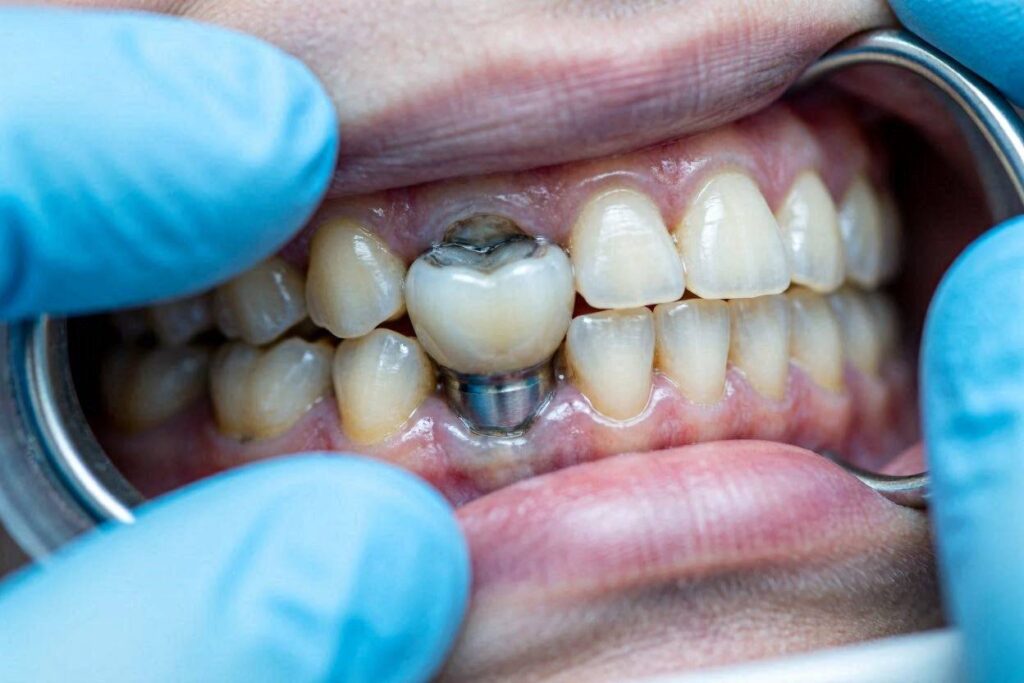
The Optical Problem: Why Grey Happens
A natural tooth is a masterwork of optical physics. It is not a solid, opaque white block. Light travels through the translucent enamel shell, enters the warm, yellowish dentin core, reflects and scatters, and then travels back out. This interplay of transmission and reflection gives a tooth its vitality, its three-dimensional life. A dental implant restoration is an assembly of manufactured materials. The implant post, the abutment, and the crown all have their own optical properties. They can block, absorb, or reflect light in ways a natural tooth never does. The greyish appearance is a manifestation of light behaving differently as it passes through the gum or the crown, encountering a dark, opaque metal component instead of the natural translucency of dentin. The key to fixing the grey is to identify exactly which layer of the restoration is the source of the optical disturbance.
Source 1: The Implant Post and Thin Gum Tissue
The most common cause of a greyish hue around, not necessarily in, the crown is the underlying titanium implant post. Titanium is a dark, metallic grey. It is completely opaque. This is an excellent property for strength and biocompatibility, but a problematic one for optics. Your gum tissue, your biotype, acts as a translucent drape over the implant and the bone. Some people have a thick, fibrous, opaque gum biotype. The dark metal is completely masked, and the gum appears a healthy, solid pink. Other people have a thin, scalloped gum biotype. The tissue is delicate and semi-translucent, like a thin veil. Light easily penetrates the gum, hits the dark titanium post or abutment, and reflects back a shadowy, bluish-grey light. This is not a disease. The gum is healthy, the implant is integrated, but the aesthetic result is a grey shadow right at the gumline. This grey effect is constant, present from the day the abutment or crown was placed, and becomes more pronounced if the gum recedes even a millimeter with time, exposing more of the dark under-structure.
Source 2: The Abutment Material
Hidden under your crown is the abutment, the connector that screws into the implant post. Its color matters profoundly. A standard titanium abutment is dark grey. If your final crown is an all-ceramic crown with high translucency, which is the preferred material for beautiful front teeth, the dark grey of the abutment can show directly through the ceramic. This is like placing a white, semi-transparent shirt over a dark grey undershirt. The resulting color is a dull, muted, greyish tooth. It lacks the bright, warm chroma of the adjacent natural teeth. This is an optical transmission error through the crown itself, not a gum shadow. The tooth structure itself looks grey. This can also happen if a metal post-and-core buildup was placed in a natural tooth that was prepared for a crown, but in implantology, the titanium abutment is the classic culprit.
Source 3: The Crown Material and Thickness
The crown itself can be the source. Not all ceramics are equal. A porcelain-fused-to-metal (PFM) crown is an older technology where porcelain is baked onto a metal substructure. The metal coping is a dark grey. To mask this, the technician must apply an opaque layer of porcelain over the metal. If the porcelain is layered too thin, or if the opaque layer is insufficient, the dark metal core shows through, giving the crown a lifeless, greyish, or bluish cast. Even with modern, full-contour zirconia, the type of zirconia matters. Traditional, high-strength tetragonal zirconia is brilliant white but can be overly opaque, looking like a chalky, dead-white block. In shaded areas of the mouth, this high-opacity material can appear unnaturally dull and greyish compared to the radiant, translucent natural tooth next to it. Multi-layered, high-translucency cubic zirconia and lithium disilicate (e.max) are much less prone to this.
Source 4: Metal Tattoo and Foreign Body Reaction
If you notice a focal, localized grey, blue, or black spot on the gum next to a healthy-looking implant crown, the cause may be a metal tattoo. This is also called an amalgam tattoo, though it can be from any metallic particle. If the tooth you lost previously had a large silver amalgam filling, microscopic particles of amalgam could have been embedded in the gum during the extraction, years before the implant. Alternatively, during implant surgery, tiny titanium particles can be generated from the implant surface or instruments and become lodged in the soft tissue. These are biologically inert and do not cause pain or inflammation, but they create a permanent, flat, bluish-grey stain in the gum. It’s essentially a tattoo. It does not rub off and is not a sign of implant failure.
Source 5: Insufficient Bone and Soft Tissue Collapse
A healthy, pink gum color relies on a thick, vascular soft tissue drape supported by an opaque, white layer of bone. If the buccal bone plate, the thin wall of bone on the cheek side of the implant, is missing, the gum collapses into the void. It is no longer supported by white, opaque bone. Instead, it drapes directly over the dark, rough titanium implant threads. The result is a grey shadow that is often combined with a concave contour. The tissue is thin and avascular because it is stretched over metal. This is a severe aesthetic and biological problem. It is usually caused by a failure to graft the site adequately at the time of extraction or implant placement, or by late bone loss from peri-implantitis.
Diagnostic Table: Why Is My Implant Grey?
| Grey Presentation | Location | Pain/Bleeding? | Timing | Most Likely Cause | Solution Path |
|---|---|---|---|---|---|
| Diffuse bluish shadow through gum | Gum over implant | None | Since placement | Thin biotype with metal show-through | Connective tissue graft |
| Tooth itself looks dull grey, no gum shadow | Crown structure | None | Since placement | Dark titanium abutment under translucent crown | Abutment exchange to zirconia |
| Dead-white/greyish dull crown | Crown structure | None | Since placement | Opaque or monolithic zirconia with poor translucency | New multi-layered ceramic crown |
| Grey/black flat spot on gum | Gum isolated spot | None | Long-standing, may pre-date implant | Metal/amalgam tattoo | Laser depigmentation or excisional biopsy |
| Grey gum with concave contour, recession | Gum recession | Possible bleeding | Progressive | Bone dehiscence, thin tissue over exposed threads | Hard and soft tissue grafting |
How to Fix a Greyish Dental Implant
A grey implant is a problem with a solution. The approach is either surgical, prosthetic, or a combination. The diagnosis dictates the treatment.
Fix 1: Soft Tissue Grafting for Metal Show-Through
If the problem is a thin biotype with titanium show-through, the solution is to thicken the gum drape. A connective tissue graft is the standard of care. Under local anesthesia, a small piece of connective tissue is harvested from the roof of the patient’s mouth (the palate). The surgeon creates a small pouch in the gum over the implant and inserts the graft. This increases the tissue thickness, making it sufficiently opaque to mask the dark metal. The visual difference is dramatic. The gum transforms from a greyish-blue to a healthy, opaque pink. This surgery also improves the biological seal around the implant. Healing takes about 3-6 months for final tissue maturation.
Fix 2: Abutment Exchange for an Optical Block
If a dark titanium abutment is the cause of a greyish crown, the definitive fix is prosthetic. The dentist will access the abutment screw, which requires removing the crown if it is screw-retained, or carefully cutting off a cemented crown. The grey titanium abutment is unscrewed and discarded. A new, custom-milled white zirconia abutment is torqued into place. A new, perfectly shade-matched all-ceramic crown is fabricated over this white abutment. The white abutment reflects light back through the translucent crown exactly as natural dentin would. The grey is eliminated at its source. This is a non-surgical, highly effective solution when the tissue is healthy and thick enough, but the abutment was the optical mistake.
Fix 3: Crown Replacement for Opacity and Value Issues
If the crown material itself is the culprit—a PFM with a dark metal margin or an overly opaque, dead-white monolithic zirconia block—the crown must be replaced. The new crown should be an all-ceramic, high-translucency restoration. Lithium disilicate (IPS e.max) is the gold standard for anterior aesthetics, providing unmatched vitality and chameleon effect. Multi-layered zirconia is an excellent option for posterior or full-arch strength. The key is to work with a master dental ceramist who can layer the porcelain with internal dentin cores, translucency, and surface texture to mimic a natural tooth. The crown alone can be the fix.
Fix 4: Combined Hard and Soft Tissue Reconstruction
For a grey, recessed, concave gum caused by an underlying missing buccal bone plate, the fix is the most complex. It requires a dual approach. First, a flap is raised, and a bone graft is packed into the dehiscence defect to rebuild the missing bony contour. After the bone graft heals for several months, a connective tissue graft is layered on top to create a thick, pink, convex gum profile. Only then, once the biological foundation of bone and thick tissue is restored, is a new, optimally contoured crown fabricated. This is a full aesthetic reconstruction and the highest level of aesthetic implantology.
Prevention: Designing Out the Grey From the Start
The most elegant fix is never to have the grey in the first place. This requires a proactive, aesthetically driven workflow from the very beginning.
3D Planning for Bone and Tissue
Using CBCT imaging, the dentist evaluates the volume and architecture of the buccal bone plate. If it is thin or absent, a guided bone regeneration (GBR) procedure is planned and executed at the time of implant placement. The implant is positioned three-dimensionally so that it is surrounded by at least 2mm of bone on the cheek side. This is the “restoration-driven” implant placement: you start with the ideal crown position in the software and then place the implant into the available bone, grafting where it’s missing. The surgical guide ensures this precision.
Biotype Assessment and Material Selection
Before a single drill touches the bone, the dentist must assess the patient’s gingival biotype. The patient must be informed if they have a thin biotype and that a titanium abutment poses an aesthetic risk. In these cases, the treatment plan should specify a custom zirconia abutment from the start. No grey metal is ever placed in the aesthetic zone. The crown material should be selected with an understanding of the abutment color. A high-translucency e.max crown on a white zirconia abutment is a recipe for a brilliant, natural-looking result.
Immediate Provisionalization and Tissue Sculpting
For a single front tooth, an immediate, non-functional temporary crown is often placed at the time of surgery. This provisional restoration acts as a scaffold. It supports the gum during healing, preventing it from collapsing and forming a grey, flat contour. The temporary is sculpted to create an ideal emergence profile, with natural-looking papillae. The tissue heals around this shape. Months later, when the final crown is made, the pink and white aesthetic is already established. This “tissue training” is a hallmark of advanced aesthetic implant dentistry.
Important Note: A small amount of gum recession and a subtle grey line at the very margin of a crown can be a normal, stable outcome in patients with thin tissue. Perfection in implant aesthetics is the goal, but a “perfectly undetectable” result is a challenging standard. If your grey appearance is subtle, stable, and does not bother you aesthetically, it may not require any intervention. However, any grey that is progressive, associated with bleeding, or darkening should be investigated immediately for peri-implant bone loss.
The Emotional Side of an Aesthetically Compromised Implant
An implant is not just a medical device; it is part of your face, your smile, your first impression to the world. A grey, dull tooth in the smile zone is a source of daily, chronic self-consciousness. Patients report smiling with their lips closed, placing a hand over their mouth when they laugh, and regretting the entire process. These feelings are valid and are a legitimate reason to seek correction. A dentist who dismisses this as “just a cosmetic issue” is failing in the comprehensive care of the patient. The fix, whether a simple abutment swap or a more complex graft, is an investment in restoring not just the tooth, but the patient’s confidence and quality of life.
Conclusion
A new dental implant can look greyish due to a thin gum biotype revealing the dark titanium underneath, a dark abutment showing through a translucent crown, an overly opaque crown material, or a metal tattoo in the soft tissue. Definitive solutions range from exchanging the abutment for a white zirconia one and replacing the crown, to surgical soft tissue and bone grafting to thicken the pink foundation. Accurate diagnosis by an aesthetic dentist is the critical step that leads to a predictable, transformative correction.
FAQ
1. Can I whiten a greyish implant crown with bleaching trays?
Absolutely not. Teeth whitening agents are hydrogen peroxide or carbamide peroxide gels. They work by oxidizing organic pigment molecules within natural tooth enamel. They have zero effect on ceramic, porcelain, zirconia, or metal. A grey ceramic crown can only be made lighter by being replaced.
2. Is a grey gum around an implant always a sign of infection?
No. A painless, non-bleeding, stable grey hue is usually the benign metal showing through thin tissue. An infected gum is red, puffy, bleeds easily, and often has a bad taste or pus. The distinction between cosmetic shadow and inflammatory disease is critical.
3. Will dental insurance or medical aid cover the cost of fixing a grey implant?
Typically, no. If the procedure is coded as purely cosmetic—a soft tissue graft or new crown to improve aesthetics—most insurers will not provide cover, as they deem it an aesthetic and not a medically necessary procedure. The cost is the patient’s responsibility. If the grey is due to active peri-implantitis, the treatment of the disease itself may be partially covered.
Additional Resource
For in-depth information on aesthetic implant dentistry and finding a qualified clinician, visit the American Academy of Cosmetic Dentistry: https://aacd.com/