Will Dental Implants Lift My Face?
The loss of teeth is about much more than just a gap in your smile. It sets off a chain of events that can dramatically alter the structure of your face. For many people, the reflection in the mirror after tooth loss is a shock. The face looks older, more sunken, and tired. The cheeks hollow out, the lips lose support, and deep wrinkles form around the mouth.
When patients explore tooth replacement options, they often focus on chewing and smiling. But a common and important question arises: “Will getting dental implants make me look younger? Will they lift my face?”
The answer is a profound yes, with some important nuances. Dental implants can have a remarkable, rejuvenating effect on your facial appearance. This guide will explain the science behind facial collapse and how implants work to reverse it.
The Root of the Problem: Bone Resorption
To understand how implants lift the face, you must first understand why the face “falls” after tooth loss.
Your facial structure is not just skin and muscle. It is supported by your skull, and specifically, by your jawbones. The teeth play a critical role in maintaining the jawbone. The roots of your teeth extend into the bone and stimulate it every time you chew.
When you lose a tooth, that stimulation stops. The body interprets the lack of stimulation as a signal that the bone in that area is no longer needed. It begins a process called resorption—the bone shrinks away.
- Single Tooth Loss: Minor, localized bone loss.
- Multiple Tooth Loss: The jawbone begins to shrink significantly.
- Full Tooth Loss: Widespread, severe bone loss.
As the jawbone shrinks, it no longer provides adequate support for the skin and muscles of the face. The face begins to sag and collapse inward.
The Classic “Denture Face” Look:
- Sunken lips.
- Deep wrinkles around the mouth (marionette lines).
- A pointed, receding chin.
- Hollow cheeks.
- Jowls forming along the jawline.
This is why people who have worn dentures for many years often look much older than they are.
How Dental Implants Reverse the Process
The magic of a dental implant is that it replaces the root of the missing tooth. The titanium post is surgically placed into the jawbone. Once it heals, it functions just like a natural tooth root.
1. Restoring Bone Stimulation
When you chew on an implant-supported crown or bridge, the forces are transmitted through the implant into the jawbone. This stimulates the bone cells, just like a natural tooth root would. This stops the resorption process. The bone is preserved.
2. Rebuilding Facial Support
The implants themselves do not “lift” the skin in the way a facelift does. Instead, they provide a solid foundation for the replacement teeth. The replacement teeth (crowns, bridges, or implant-supported dentures) restore the correct height and shape of your bite.
This restored support plumps up the lips, fills out the cheeks, and reduces the appearance of wrinkles. By restoring the lower third of the face to its proper dimension, the entire face looks more balanced and youthful.
The Difference Between Dentures and Implants
This is where the comparison becomes dramatic.
Traditional Dentures:
- Rest on the gums.
- Do not stimulate the bone.
- Accelerate bone loss over time.
- The denture may fit well initially, but as the bone shrinks, it becomes loose. The denture itself can rub and cause further bone loss. The facial support diminishes over time.
Implant-Supported Dentures (Snap-On):
- Anchor to implants.
- Stimulate the bone at the anchor points.
- Significantly slow down bone loss.
- Provide better stability and facial support than a traditional denture.
Full-Arch Fixed Bridges (All-on-4):
- Permanently attached to 4-6 implants.
- Distribute chewing forces across the arch.
- Preserve bone and provide the most natural facial support.
A “Facelift” in a Day?
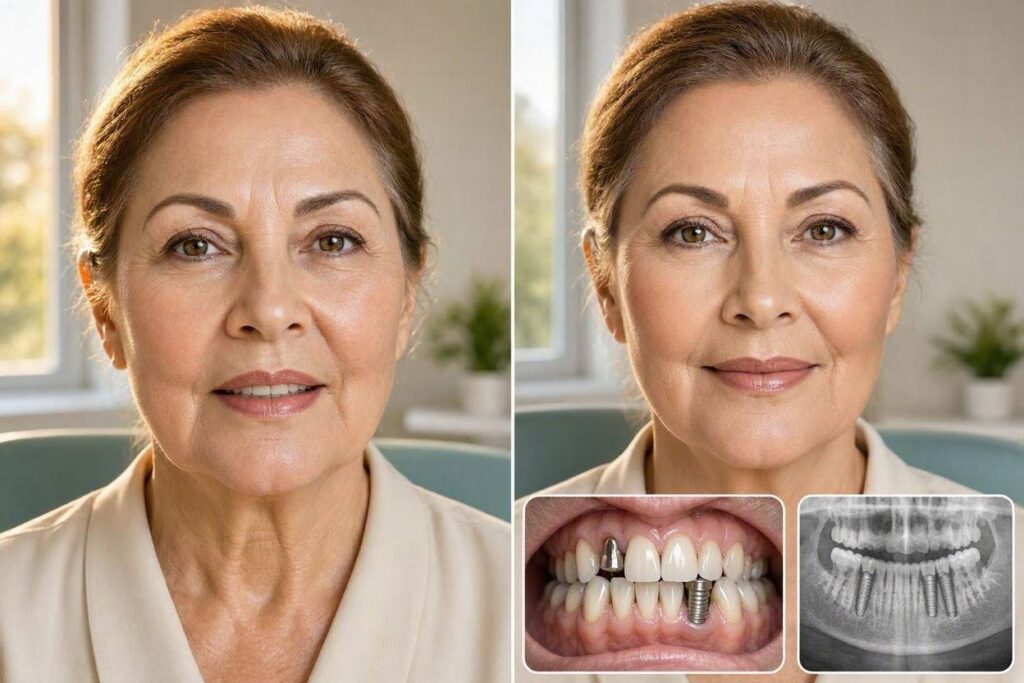
Some patients who have severe bone loss and have been wearing dentures for decades undergo a full-arch reconstruction (like All-on-4). When the temporary fixed bridge is placed, the transformation is often startling.
The lips, which had been sunken, are suddenly supported. The wrinkles around the mouth are softened. The jawline appears more defined. Patients often say they look 10 years younger.
However, it is important to have realistic expectations.
- Dental implants are not a substitute for a surgical facelift. They will not tighten sagging skin on the neck or eliminate deep wrinkles on the forehead.
- They will address the volume loss in the lower face caused by tooth loss.
The Long-Term Benefit
The anti-aging benefits of implants are not just immediate; they are long-lasting. Because the implants preserve the bone, they prevent the gradual facial collapse that occurs with dentures. You are not just fixing the problem today; you are preventing it from getting worse.
The Psychological Lift
It is also worth mentioning the psychological “lift” that comes with implants. The confidence that comes from having a stable, beautiful smile is immense. When you are not afraid to smile or laugh, your face naturally looks more vibrant and alive. This emotional well-being is reflected in your appearance.
Conclusion
Yes, dental implants can and do lift the face. By replacing the roots of the missing teeth, they stimulate the bone, halt the resorption process, and restore the structural support of the lower face. The result is a more youthful, balanced appearance. For patients suffering from the sunken look associated with tooth loss, implants offer not just a restoration of function, but a restoration of their facial identity.
Frequently Asked Questions (FAQ)
Q: Will a single dental implant change my face shape?
A: It may provide a subtle change. A single implant will prevent bone loss in that specific area. If the missing tooth was a front tooth that affected lip support, the change could be noticeable. The main benefit is preventing future deterioration.
Q: How much younger will I look with dental implants?
A: This varies. It depends on the severity of the bone loss and the type of restoration. Some full-arch patients report looking 5 to 10 years younger. The improvement is most dramatic for those who have lost a lot of facial structure.
Q: Can implants fix wrinkles around my mouth?
A: They can soften them significantly. The wrinkles are often caused by the lips collapsing inward due to lack of support. By restoring that support with implants and fixed teeth, the wrinkles become less pronounced. They will not disappear entirely.
Q: Is bone grafting necessary for the facelift effect?
A: Not always, but it helps. If you have significant bone loss, a bone graft can rebuild the lost jawbone before the implants are placed. This provides even more structural support for the face.
Q: Will my face continue to age if I have implants?
A: Yes, normal aging will continue. However, you will not experience the accelerated aging caused by bone loss. Your facial structure will remain stable and supported.
Additional Resource:
To see the transformative effects of full-arch implant treatment, you can explore the patient gallery of the American Academy of Implant Dentistry (AAID): https://www.aaid.com/