Will Your Body Reject Dental Implants?
You sit in the dentist’s chair, heart pounding, and ask the one question that keeps you up at night: will my body push this implant out? The fear feels real. You have heard horror stories. A friend of a friend had one fail. You read online about metal allergies. So now you wonder if you are making a huge, expensive mistake.
Let us stop the panic right here. A true biological rejection of a dental implant—where the body attacks it like a virus or a splinter—is practically nonexistent. Dental implants do not trigger the same immune response that a transplanted organ does. The material, usually medical-grade titanium or zirconia, is bioinert. Your body does not recognize it as a foreign invader.
But that does not mean every implant succeeds. When people talk about “rejection,” they almost always mean failure. The implant does not fuse to the bone. It becomes loose. Infection sets in. The gum recedes. These problems look and feel like rejection, but the mechanism is different. And the good news? Most causes of failure are preventable.
This comprehensive guide will explain exactly what happens when an implant enters your jaw. We will explore the science of osseointegration, the real reasons implants fail, the difference between rejection and failure, and the exact steps you can take to make sure your implant lasts a lifetime.
The Truth About Biological Rejection: It Is Not an Organ Transplant
We must clarify a major misconception right away. When surgeons transplant a heart, liver, or kidney, the recipient’s immune system identifies the donor organ as foreign tissue. The body sends T-cells and antibodies to attack. Without immunosuppressive drugs, the organ dies. This is true biological rejection.
A dental implant is not living tissue. It is a medical device, a screw-shaped post made from materials the body finds invisible. Titanium forms a natural oxide layer on its surface the moment it touches air. This layer is biologically inert. Bone cells do not run away from it; they happily latch onto it.
Zirconia, a ceramic alternative, is equally non-reactive. It does not corrode. It does not release ions that alarm the immune system. So when your dentist places an implant, your body does not sound an alarm. It simply sees a stable, clean surface and decides to grow bone against it.
Important Note: True allergic reactions to titanium are extremely rare but do exist in a tiny fraction of the population. This is a hypersensitivity, not a rejection. We will discuss this in detail later.
Dental Implant Failure vs. Rejection: Know the Difference
If your implant becomes loose or falls out, call it what it is: a failure. Understanding this distinction empowers you. Rejection implies you are a helpless victim of your body’s whims. Failure implies a reason, and reasons can often be fixed or avoided.
Here is a simple breakdown of the terminology:
| Term | Definition | Is it common? |
|---|---|---|
| Biological Rejection | Immune system attacks the implant as foreign tissue. | Does not happen with inert materials. |
| Early Failure | Implant fails to fuse with bone (osseointegration fails). | Occurs within 2-6 months of placement. |
| Late Failure | A fused implant loses its integration after years. | Occurs after crown placement, often due to overload or infection. |
| Allergic Reaction | Hypersensitivity to titanium or other metals. | Very rare, <1% of patients. |
Most “rejection” stories are actually cases of early failure. The implant never gets a firm grip. It stays wobbly and eventually comes out. Or it is a late failure, where a perfectly good implant meets an enemy like bacteria or excessive force.
The Magic of Osseointegration: How the Body Welcomes the Implant
To grasp why rejection is so unlikely, you must understand osseointegration. A Swedish orthopedic surgeon, Per-Ingvar Brånemark, discovered this phenomenon by accident in the 1950s. He placed titanium chambers in rabbit bones for an experiment. When he tried to remove them later, he could not. The bone had bonded directly to the titanium surface.
This discovery changed dentistry. Osseointegration is the direct structural and functional connection between living bone and the surface of a load-bearing artificial implant. Under a microscope, bone cells (osteoblasts) grow right up to the titanium oxide layer. They deposit a mineral matrix that locks the implant in place. There is no soft-tissue interface, no ligament, just bone-to-implant contact.
Your body actively welcomes the implant when conditions are right. The bone is happy to grow onto a material that is clean, stable, and biocompatible. This is not a passive tolerance; it is active acceptance.
“Osseointegration is not a scar tissue encapsulation. It is a direct anchorage, a functional ankylosis. The body does not wall off the implant; it embraces it.” — Based on the foundational principles of modern implantology.
For this embrace to happen, three things must be true:
- The implant material must be biocompatible.
- The surgical site must be free of infection and overheating.
- The implant must remain absolutely still during the healing period.
If any of these conditions are violated, you get a failure. Not a rejection, but a failed biological union.
The Real Reasons Implants Fail (What Feels Like Rejection)
If the body does not reject the implant, what goes wrong? Let us dig into the six main culprits. Understanding these will help you see failure as a series of controllable factors.
1. Peri-implantitis: The Silent Enemy
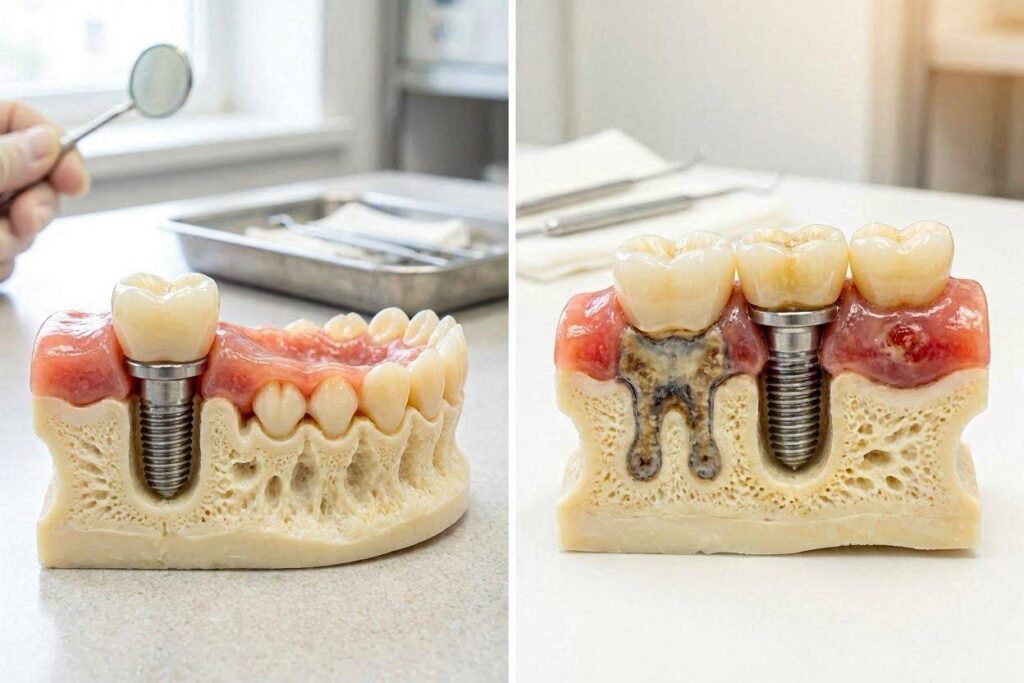
Peri-implantitis is the number one cause of late implant failure. It is an inflammatory disease affecting the soft and hard tissues around an osseointegrated implant. Think of it as gum disease on steroids. Plaque biofilm accumulates on the implant surface, just like on natural teeth. The bacteria trigger an inflammatory response. The gum gets red, bleeds, and swells.
Without treatment, the inflammation moves deeper. It destroys the jawbone supporting the implant. A natural tooth has a periodontal ligament, a shock-absorbing, blood-rich network that offers some defense. An implant has no such ligament. The inflammatory infiltrate goes straight to the bone.
As the bone melts away, the implant loses its support. It starts to feel loose. The patient notices gum recession and sometimes pus. If the bone loss becomes too severe, the implant must come out. The patient may feel like their body is rejecting the implant, but the real culprit is a chronic, bacteria-driven infection.
Prevention: Meticulous oral hygiene is non-negotiable. We will cover cleaning techniques later. Regular professional maintenance and the use of specific tools are your implant’s best friends.
2. Failed Osseointegration (Early Bone Healing Failure)
This is the most common form of early failure. The surgeon places the implant, waits 3-6 months, and on testing day, the implant is not rigid. It moves. The bone simply did not lock it in.
Why does this happen?
- Surgical Overheating: Drilling into bone generates heat. If the surgeon does not use adequate, copious water irrigation, the bone temperature exceeds 47°C (116.6°F) for more than a minute, bone cells die. The implant sits in dead bone, which the body must first resorb and replace. The implant often fails to integrate during this process.
- Lack of Primary Stability: When the implant is first placed, it must be mechanically locked in place tightly. If the bone is very soft, or the surgeon places an implant into an extraction socket that is too wide, the implant moves slightly during healing. Micromotion disrupts the delicate bone cells trying to form a bond. Fibrous tissue forms instead of bone.
- Contamination: If the implant surface touches saliva, bacteria, or epithelial cells before placement, a healthy bone connection is unlikely.
- Systemic Conditions: Uncontrolled diabetes, heavy smoking, or certain medications can impair blood flow and bone healing.
3. Excessive Force (Bruxism and Overload)
Your jaw can generate immense force. People who grind or clench their teeth at night (bruxism) can exert hundreds of pounds of pressure. Natural teeth have a ligament that flexes and gives a little. An implant is fused directly to the bone. It has zero give.
When a grinder puts force on an implant crown, that force transmits 100% to the bone interface. Over time, this can cause microfractures in the bone, bone loss, and eventual loosening. The implant did not fail due to rejection. It failed due to mechanical overload. The body was simply protecting itself from a force it interpreted as traumatic.
Protection: A well-fitted night guard is mandatory for anyone with implants who has a history of grinding. The dentist must also design the crown carefully, avoiding heavy contacts in excursive movements.
4. Titanium Allergy (Hypersensitivity)
This is the one scenario that mimics true rejection. A small subset of people have a hypersensitivity to titanium. Their immune system reacts to the metal ions that slowly, microscopically corrode from the surface. This is a Type IV hypersensitivity reaction, a delayed allergic response.
Symptoms might include:
- A persistent rash or eczema (rarely just oral).
- Chronic pain and burning sensation around the implant.
- Swelling and peri-implantitis that does not respond to typical cleaning.
- Aseptic bone loss (bone loss without bacteria).
True titanium allergy is hard to diagnose. Standard patch tests often miss it because titanium dioxide (used in patches) differs from titanium metal. A MELISA test (memory lymphocyte immunostimulation assay) is more specific but not universally accepted.
If a patient has a confirmed titanium allergy, they are not out of luck. Zirconia implants offer a metal-free alternative with excellent biocompatibility. A patient with a history of severe metal allergies should discuss a zirconia implant before surgery.
5. Poor Surgical Placement
A dentist might place the implant in a less-than-ideal position. If the implant is too close to a nerve, it causes chronic pain and must be removed. If it perforates the sinus cavity, it can cause chronic sinus infections. If it is placed at a bad angle, the forces on the crown will be unfavorable, leading to bone loss and failure. If it is placed without enough surrounding bone volume, a thin, fragile ridge results, and the gum recedes.
These are not biological rejections. They are technical errors that compromise the body’s ability to maintain the implant long-term. The body is not attacking the implant; it is simply losing the battle against a biomechanical problem.
6. Systemic Health Issues and Medications
Some health conditions tilt the balance toward failure. Healing is a complex biological cascade. If your body has a compromised healing capacity, osseointegration suffers.
- Uncontrolled Diabetes: High blood sugar damages small blood vessels (microangiopathy) and reduces the delivery of oxygen and immune cells. Bone turnover is slower. Controlled diabetics (HbA1c < 7%) have success rates comparable to healthy patients. Uncontrolled diabetics face a much higher risk.
- Smoking: Nicotine is a potent vasoconstrictor. It chokes off blood flow to the gums and bone. Carbon monoxide reduces oxygen in the blood. Smokers have a significantly higher risk of both early and late implant failure.
- Bisphosphonates: These drugs, often used for osteoporosis or certain cancers, drastically alter bone metabolism. Dental surgery while on intravenous bisphosphonates carries a risk of medication-related osteonecrosis of the jaw (MRONJ), a catastrophic failure where the bone dies and is exposed.
- Autoimmune Diseases: Conditions like rheumatoid arthritis or lupus involve a dysregulated immune system. Many patients do fine with implants, but the risk of inflammation and healing complications is higher. The medications (like corticosteroids) can also impair healing.
Factors That Skyrocket Your Success Rate
Instead of fearing a phantom rejection, focus on the factors that create a 95-98% success rate over 10 years.
| Success Factor | Why It Matters |
|---|---|
| Skilled Surgeon | Prevents overheating, ensures primary stability, uses sterile technique. |
| Adequate Bone Volume | Implant needs a solid foundation. Grafting can rebuild it if needed. |
| Good Oral Hygiene | Prevents peri-implantitis, the #1 long-term killer of implants. |
| Healthy Lifestyle | No smoking, controlled blood sugar, minimal alcohol. |
| Regular Dental Visits | Professional cleanings and early detection of bite issues. |
| A Well-Designed Prosthetic | A crown that fits perfectly and distributes force evenly. |
Your choices matter more than your biology. Choosing a periodontist or oral surgeon with extensive implant training. Committing to quit smoking. Learning how to floss under your crown. These actions almost guarantee your body will keep the implant.
What Does an Allergic Reaction Look Like?
Since rejection is so rare, let us detail the symptoms of a true material hypersensitivity. This is what a small fraction of patients might experience, and it is often mistaken for failed osseointegration.
- Timing: Symptoms can begin weeks or months after placement. They are often slow and chronic, not a sudden, acute event like an infection.
- Pain: A dull, persistent ache that does not respond to antibiotics or bite adjustment.
- Soft Tissue: Redness and swelling that do not correlate with plaque levels. A healthy, clean implant site that is still angry-looking.
- Skin: In some cases, a systemic reaction like eczema or itching elsewhere on the body.
- Bone Loss: Rapid, aseptic bone loss visible on an X-ray.
If a patient suspects a metal allergy, a referral to an allergist or a discussion about switching to a zirconia implant is the next step. Removing the titanium implant usually resolves the symptoms completely, further proving the hypersensitivity link.
Timeline: From Placement to Knowing If It “Took”
You just had surgery. Your mind races. “Has my body accepted it yet?”
- Day 1-7: You are dealing with surgical healing. Swelling, bruising, minor bleeding. You are not waiting for osseointegration yet; you are waiting for soft tissue closure.
- Week 2-6: The bone healing begins in earnest. A blood clot formed the scaffold. New blood vessels invade. Soft callus-like woven bone forms. If something goes wrong here (like an infection), you will see persistent pus, severe pain, or the implant might feel movable.
- Month 2-4: Woven bone is slowly replaced by stronger lamellar bone. The implant is gaining stability. You likely feel nothing. The temporary crown or healing cap sits quietly.
- Month 4-6: Osseointegration is mature. The dentist will test the implant. They might tap it, apply a torque test to the abutment screw, or take an X-ray. A healthy implant gives a sharp, high-pitched ringing sound on tapping. A failing one gives a dull thud. A solid implant has zero mobility.
If the implant is wobbly at this final check, it did not integrate. The dentist removes it, often with just local anesthetic and a simple twist. It is usually painless. The site is cleaned, and you wait a few months for bone healing before trying again.
Can You Prevent “Rejection”? An Action Plan
You are not a passive participant. You are the CEO of your oral health. Execute this plan.
- Choose Your Clinician Wisely: Ask about their training, their success rates, and their use of 3D cone-beam CT scanning for planning. A great surgeon avoids nerves, places the implant in dense bone, and uses surgical guides for precision.
- Get a Medical Clearance: Have an honest conversation with your physician. Get your blood sugar checked. If you smoke, now is the time to stop. Even a smoking cessation program four weeks before and eight weeks after surgery dramatically improves outcomes.
- Discuss Material Options: If you have a known metal allergy, ask about zirconia implants. They are white, metal-free, and have a success rate comparable to titanium. They are a fantastic option for the right patient.
- The Healing Diet: For the first two months, feed your body. Bone healing demands protein, Vitamin D, calcium, and Vitamin C. Avoid hard, crunchy foods that could transmit vibration to the healing implant.
- Master Your Hygiene Tools: A soft manual or electric brush is just the start. You need:
- A water flosser with a non-metal tip on a very low setting.
- Implant-specific floss (like Superfloss) with a spongy middle.
- Interdental brushes coated with plastic to avoid scratching the implant abutment.
- Commit to Maintenance: See your hygienist every 3-4 months, not just twice a year. They use special plastic or titanium scalers to clean the implant without scratching it. Scratches create a rough surface for bacteria to hide.
The Psychological Side: Trusting the Process
The fear of rejection often masks a deeper anxiety about control. You pay thousands. You undergo surgery. You want a guarantee. The truth is, biology offers no 100% guarantees. But it does offer overwhelming odds in your favor.
Shift your mindset. Instead of worrying about a mysterious, random “rejection,” focus on what you can measure and control. Are your gums pink and firm? Is your home care excellent? Did you make your follow-up appointment? These are the dials you can turn.
A dental implant is the closest thing to a miracle in modern dentistry. The fact that a piece of metal can become a functional part of the human skeleton, painlessly and permanently, still inspires awe. Trust the science. Trust the process. And trust your ability to care for your investment.
When It Really Does Fail: Next Steps Without Panic
So the implant failed. Your dentist says it must come out. Do not view this as a personal failing. It is a setback, not a dead end.
The dentist will remove the failed implant. The site will be thoroughly debrided. Often, a bone graft material is packed into the socket to preserve the ridge. You then wait. The body heals with incredible vigor. In 3-6 months, the site is often ready for a new implant. The success rate on a second attempt is still very high.
Some patients worry that if one implant fails, they have an undiagnosed allergy and will lose them all. This is rarely the case. Most failures are site-specific: a localized infection, a specific bone defect, a surgical error. Unless you have systemic uncontrolled disease or a confirmed metal allergy, a second attempt is typically successful.
Conclusion
Your body will not reject a dental implant in the way it rejects a virus or a transplanted organ. Dental implants are made from biocompatible materials that bone naturally fuses with. What feels like rejection is almost always a preventable failure caused by infection, poor healing, or mechanical overload. By choosing a skilled surgeon, maintaining meticulous oral hygiene, and managing your systemic health, you set the stage for an implant that can last a lifetime.
FAQ
1. How common is a true titanium allergy with dental implants?
True titanium hypersensitivity is very rare, estimated to affect less than 1% of the population. The symptoms are often chronic, low-grade inflammation and pain. If you suspect a metal allergy, a MELISA test or a zirconia implant can be a good alternative.
2. Can an implant be rejected years after it was placed?
Not rejected, but it can fail later. The most common cause of late failure is peri-implantitis, a bacterial infection that destroys the supporting bone. Another cause is excessive force from tooth grinding. Both are treatable if caught early.
3. What does a failing implant feel like?
A healthy implant feels rock-solid, just like a natural tooth fused to the bone. A failing implant might have a sensation of movement or wobbling. You might also notice gum tenderness, bleeding, a bad taste from pus, or a dull ache.
4. If one implant fails, will the others fail too?
Not necessarily. Each implant site has its own local conditions. Unless you have an uncontrolled systemic disease, an allergy, or a generalized infection, one failure does not predict another.
Additional Resource
For a deeper dive into the scientific study of dental implant survival rates and the phenomenon of titanium allergy, we recommend visiting the American Academy of Periodontology: https://www.perio.org/for-patients/periodontal-treatments-and-procedures/dental-implant-procedures/