3 On 6 Dental Implants in Mexico
Losing most of your teeth can feel overwhelming. You might avoid smiling, struggle with eating, or feel self-conscious in conversations.
But you have options.
One of the most advanced and affordable solutions today is the 3 on 6 dental implant system. And Mexico has become a top destination for this procedure.
Why?
Because you can restore an entire arch of teeth using just six implants and three fixed bridges. It is faster, more stable, and far less expensive than traditional methods.
This guide walks you through everything you need to know. No fluff. No exaggerated claims. Just honest, practical information to help you decide if 3 on 6 implants in Mexico are right for you.
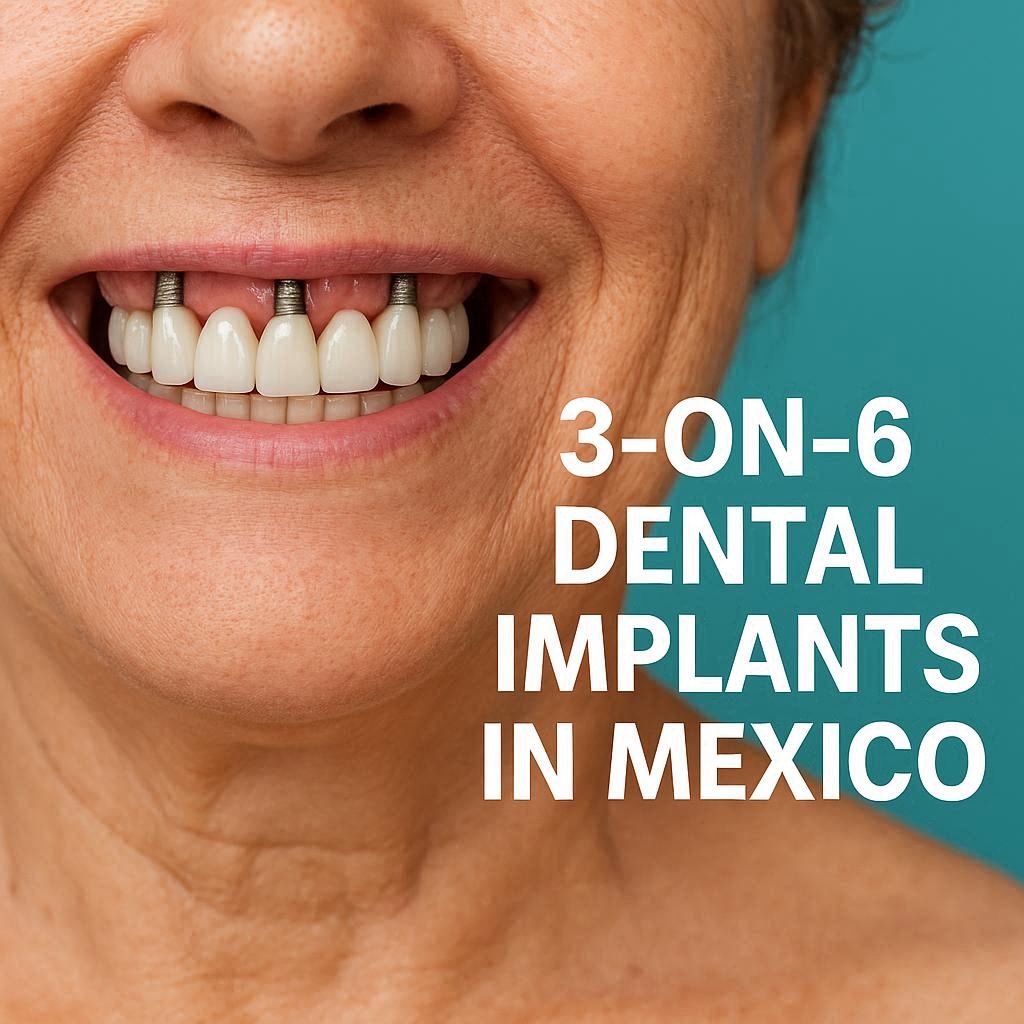
What Are 3 on 6 Dental Implants?
Let us start with a simple definition.
The name tells you exactly what this treatment involves:
- 3 = Three separate dental bridges (prostheses)
- On 6 = Supported by six dental implants placed in your jawbone
Unlike full dentures that sit on your gums, these implants fuse with your bone. They act like artificial tooth roots.
The six implants are strategically positioned. Then, your dentist attaches three fixed bridges. Each bridge replaces several missing teeth.
The result is a full arch of new teeth. Upper jaw. Lower jaw. Or both.
How Is This Different from All-on-4?
Many people confuse 3 on 6 with All-on-4. But they are not the same.
| Feature | 3 on 6 Implants | All-on-4 Implants |
|---|---|---|
| Number of implants | 6 per arch | 4 per arch |
| Number of bridges | 3 separate bridges | 1 single bridge |
| Stability | Very high | High |
| Bone density required | Moderate to good | Less bone needed |
| Ease of repair | One bridge can be fixed individually | Full arch must be removed |
| Cost in Mexico | 6,000–9,000 per arch | 5,000–7,500 per arch |
Important note: 3 on 6 provides better load distribution. The extra two implants reduce pressure on each individual implant. This often means longer-lasting results, especially for patients who grind their teeth.
Why Choose Mexico for 3 on 6 Implants?
You already know dental care in Mexico is cheaper. But price is not the only reason.
Here is what makes Mexico a smart choice for this specific procedure.
1. Significant Cost Savings
In the United States or Canada, 3 on 6 implants cost between 20,000and30,000 per arch. In Mexico, you pay between 6,000and6,000and9,000.
That is a saving of 60% to 70%.
These savings come from lower overhead costs, not lower quality. Rent, labor, and materials are simply more affordable in Mexico.
2. Experienced Implantologists
Many Mexican dentists trained in the United States or Europe. Some are members of the International Congress of Oral Implantologists (ICOI). Border cities like Los Algodones, Tijuana, and Cancun have clinics that perform hundreds of 3 on 6 procedures every year.
3. Advanced Technology
Do not picture old-fashioned clinics. Most top Mexican dental centers use:
- 3D CBCT scans for precise planning
- Intraoral scanners (no goopy impressions)
- Digital smile design software
- Same-day or next-day placement
4. Shorter Waiting Times
In Canada or the UK, public dental lists can take months. Private clinics in the US often have 6 to 8 week waiting periods. In Mexico, you can often book your consultation within a week. Surgery can happen within 2 to 4 weeks.
*“I had my 3 on 6 upper arch done in Tijuana. The dentist had done over 200 similar cases. I paid 7,400.ThesameprocedureinSeattlewasquotedat26,000. That’s not a small difference. That’s life-changing.”*
— Mark, 58, from Oregon
Who Is a Good Candidate for 3 on 6 Implants?
Not everyone qualifies. And honest clinics will tell you that upfront.
You are likely a good candidate if:
- You are missing most or all teeth in one jaw
- You have enough bone density to support six implants
- You do not smoke heavily (or are willing to quit during healing)
- You have no uncontrolled chronic diseases (diabetes, osteoporosis)
- You want a fixed solution, not removable dentures
When 3 on 6 Is Not Recommended
Let us be realistic.
You may need a different solution if:
- Severe bone loss – You may need bone grafting first or consider All-on-4
- Uncontrolled gum disease – This must be treated before implants
- Bruxism (teeth grinding) – Possible, but you will need a night guard
- Very narrow jawbone – Implants may not fit without a sinus lift
A key note: A responsible Mexican clinic will always perform a CBCT scan before promising anything. If a clinic guarantees 3 on 6 implants without a scan, walk away.
Step-by-Step Procedure for 3 on 6 Implants in Mexico
Understanding the process removes fear. Here is exactly what happens, from first contact to final smile.
Step 1: Virtual or In-Person Consultation
Many Mexican clinics offer free online consultations. You send photos or a scan. The dentist reviews your case and gives a preliminary quote.
Step 2: Travel and Arrival
Most patients fly into:
- Tijuana (San Diego airport, cross by foot or car)
- Cancun (direct flights from US, Canada, Europe)
- Los Algodones (fly to Yuma or Phoenix, then drive)
- Mexico City (for high-complexity cases)
Your clinic often arranges medical travel packages. These include airport pickup, hotel discounts, and translator services.
Step 3: CBCT Scan and Treatment Plan
Day one at the clinic. You receive a cone beam CT scan. This gives a 3D map of your jaw, nerves, and sinuses.
The dentist then plans exactly where each of the six implants will go. You will see a digital preview of your new smile.
Step 4: Implant Placement Surgery
This takes 2 to 4 hours per arch.
You receive local anesthesia. IV sedation is optional (extra cost but highly recommended for nervous patients).
The dentist:
- Removes any remaining damaged teeth
- Places six titanium implants into precise positions
- Attaches temporary healing abutments
- May place a temporary fixed bridge (immediate loading)
Immediate loading possible? Sometimes. If your bone is strong and implants achieve good stability, you leave with a temporary fixed bridge that day. Otherwise, you wait 4 to 6 months for healing.
Step 5: Healing Period (Osseointegration)
Your jawbone grows around the implants. This takes 4 to 6 months. During this time, you wear a temporary denture or bridge.
You must eat soft foods and avoid putting pressure on the implants.
Step 6: Final Bridge Placement
After healing, you return to Mexico (or your dentist scans and sends the case to a lab). The final zirconia or acrylic bridges are screwed onto the implants.
These are not removable. Only a dentist can take them off.
Step 7: Follow-Up
Most clinics include:
- 1-year warranty on implants
- Free check-up at 6 months and 1 year
- Discounted future maintenance
Cost Breakdown of 3 on 6 Dental Implants in Mexico
Prices vary by city, materials, and clinic reputation. Here is a realistic range.
| Component | Low-cost clinic | Premium clinic |
|---|---|---|
| 6 titanium implants (per arch) | $3,000 | $4,500 |
| 3 zirconia bridges (per arch) | $2,500 | $4,000 |
| CBCT scan | $150 | $250 |
| IV sedation (optional) | $300 | $500 |
| Temporary bridge during healing | $400 | $800 |
| Total per arch | $6,350 | $10,050 |
Both arches (full mouth): 12,000to18,000 on average.
Compare that to the US average of 45,000to60,000 for full mouth 3 on 6.
Hidden costs to ask about:
- Extraction fees (20–50 per tooth)
- Bone grafting (if needed: 300–800 per site)
- Sinus lift (600–1,200)
- Travel and accommodation (800–1,500 for a week)
Important note: Always request an itemized written quote before paying. Reputable clinics provide this without hesitation.
Materials Used: What You Should Know
Not all 3 on 6 implants are the same. The material matters for longevity and appearance.
Implant Brands
Top Mexican clinics use global brands like:
- Nobel Biocare (Swiss/US) – Gold standard
- Straumann (Swiss) – Excellent bone integration
- BioHorizons (US) – Very popular in Mexico
- Neodent (Brazilian, owned by Straumann) – Affordable but reliable
Avoid no-name implants from unknown manufacturers. Ask for the brand and certificate of authenticity.
Bridge Materials
You have two main choices:
| Material | Pros | Cons | Best for |
|---|---|---|---|
| Zirconia | Extremely strong, natural look, stain-resistant, hypoallergenic | More expensive, harder to adjust | Front and back teeth |
| Acrylic (PMMA) | Cheaper, lighter, easy to repair | Wears faster, can stain, less natural | Temporary or budget cases |
Most patients choose zirconia for permanent bridges. It lasts 15+ years with good care.
Risks and Complications: An Honest Look
Let us not pretend this is risk-free. Implant surgery carries real risks. A good dentist minimizes them but cannot eliminate them.
Common (but usually manageable)
- Swelling and bruising – Normal for 5 to 7 days
- Mild pain – Controlled with over-the-counter medication
- Bleeding – stops within 24 hours
Less common but serious
- Implant failure – 3 to 5% of implants do not integrate. Smoking increases this risk significantly.
- Infection – Peri-implantitis can develop months or years later
- Nerve damage – Rare (under 1% with CBCT planning) but can cause numbness
- Sinus perforation – For upper jaw implants, possible but repairable
How Mexican clinics reduce risks
- CBCT scans before every case
- Sterile surgical suites (not regular exam rooms)
- Antibiotics before and after surgery
- Post-op care instructions in English
“I was nervous about getting implants in Mexico because of horror stories online. I found a clinic that showed me their sterilization room and their CBCT machine. That made me comfortable. My surgery went perfectly.”
— Linda, 62, from Arizona
Top Cities for 3 on 6 Implants in Mexico
You have choices. Each city has a different vibe and cost structure.
Los Algodones (Molar City)
- Pros: 500+ dentists in 4 square blocks, walkable from US border, very competitive prices
- Cons: Small town, limited non-dental activities
- Average 3 on 6 cost: 6,500–8,000 per arch
Tijuana
- Pros: Large modern clinics, easy access from San Diego airport, many US-trained dentists
- Cons: Border crossing can be slow, safety perception (though most areas are fine)
- Average cost: 7,000–9,000 per arch
Cancun
- Pros: Combines treatment with a vacation, high-end resort-style clinics, English widely spoken
- Cons: More expensive than border cities, higher travel costs
- Average cost: 8,500–11,000 per arch
Mexico City
- Pros: World-class specialists, university-affiliated hospitals, lowest complication rates
- Cons: Higher altitude (can increase bleeding), more overwhelming city
- Average cost: 7,500–10,000 per arch
Recovery Timeline: What to Expect
Everyone heals differently. But here is a general timeline.
| Time | What happens | What you can eat |
|---|---|---|
| Day 1-3 | Swelling peaks. Use ice packs. Rest. | Cold liquids, smoothies, yogurt |
| Day 4-7 | Swelling decreases. Stitches may dissolve. | Mashed potatoes, scrambled eggs, soup |
| Week 2-4 | Soft tissue heals. No hard chewing. | Soft bread, pasta, soft fish |
| Month 2-3 | Bone integration continues. | Gradual return to normal food |
| Month 4-6 | Implants fully integrated. Final bridges placed. | Almost everything (avoid ice and hard candy) |
Do not eat: Popcorn, nuts, sticky candy, ice, or tough steak during the first 4 months.
How to Choose a Clinic in Mexico
Do not pick based on price alone. Follow this checklist.
1. Verify Credentials
Ask for the dentist’s:
- Dental degree (check with UNAM or university registry)
- Specialty in implantology (3+ years additional training)
- Membership in ICOI or AO (Academy of Osseointegration)
2. Read Recent Reviews
Look for Google Maps and Facebook reviews from the last 6 months. Ignore 5-star only profiles. Look for 4.2 to 4.8 stars with balanced feedback.
3. Ask These 5 Questions
- “How many 3 on 6 procedures have you done in the last year?” (Good answer: 50+)
- “What brand of implants do you use?” (Good answer: Nobel, Straumann, BioHorizons)
- “Do you offer a warranty?” (Good answer: 1-5 years on implants)
- “What happens if an implant fails?” (Good answer: replacement at reduced or no cost)
- “Can I speak to a past patient?” (Good clinics will arrange this)
4. Avoid Red Flags
- Prices under $5,000 per arch for zirconia
- No CBCT scan on premises
- Pressure to pay 100% upfront
- No written treatment plan
- Dentist who does not speak your language (unless translator provided)
Before and After Care Tips
Your success depends on what you do before and after surgery.
One month before surgery
- Stop smoking (or reduce significantly)
- Get a full medical check-up
- Tell your dentist about all medications (especially blood thinners)
- Start taking vitamin D and calcium (with your doctor’s approval)
After surgery – first week
- Do not spit or use straws (prevents dry socket)
- Sleep with head elevated
- Rinse gently with warm salt water after 24 hours
- Take prescribed antibiotics fully (do not stop early)
Long-term maintenance
- Brush twice a day with super-soft bristles
- Use a water flosser around implants
- Visit a dentist every 6 months for professional cleaning
- Wear a night guard if you grind teeth
With proper care, 3 on 6 implants last 15 to 25 years or more.
Travel Tips for Dental Tourism in Mexico
A little planning makes your trip smooth.
Documents to bring
- Passport (valid for at least 6 months)
- Medical records from your home dentist
- List of allergies and medications
- Travel insurance (some cover emergency dental complications)
What to pack
- Soft foods (instant oatmeal, protein shakes)
- Button-up shirts (easier to put on after surgery)
- Ice packs (small gel packs)
- Extra pillows for sleeping upright
Border crossing advice
For Tijuana and Los Algodones:
- Cross early morning (6-8 AM) to avoid long lines
- Get Sentri or Global Entry if you cross multiple times
- Park on US side and walk across if possible
Money tips
- Pay with credit card for fraud protection
- Ask for a 5-10% discount for cash payments
- Never carry large amounts of cash across the border
Frequently Asked Questions (FAQ)
How long do 3 on 6 implants last?
With good oral hygiene and regular check-ups, 15 to 25 years. The bridges may need replacement after 10 to 15 years, but implants themselves often last a lifetime.
Is the procedure painful?
No. You receive local anesthesia and optional sedation. Most patients report only pressure during surgery. Afterward, mild soreness similar to a tooth extraction.
Can I get both upper and lower jaws done at once?
Yes. Many patients do full mouth reconstruction in one trip. The surgery takes 5 to 7 hours. Recovery is harder, but it saves a second trip.
Do Mexican dentists speak English?
In border cities and tourist areas, yes. In smaller clinics, maybe not. Always confirm that your dentist or a staff translator speaks fluent English.
What if I have a problem after returning home?
Reputable clinics offer remote follow-up via video calls. They can also recommend a local dentist for minor issues. For major problems, you may need to return to Mexico.
Are 3 on 6 implants better than dentures?
For most people, yes. Implants do not slip, do not require adhesives, and preserve jawbone. Dentures are cheaper upfront but cost more over time in relines and replacements.
Can I finance the treatment?
Some Mexican clinics offer payment plans through third-party companies. However, most require full payment before surgery. Many patients use US-based medical credit cards like CareCredit.
Additional Resources
For more reliable information, visit the International Congress of Oral Implantologists (ICOI) directory. They maintain a list of certified implantologists in Mexico.
🔗 Resource link: https://www.icoi.org/find-a-doctor/
Filter by country (Mexico) and specialty (Implant Dentistry).
Conclusion
3 on 6 dental implants in Mexico offer a reliable, affordable path to a full smile. You save 60-70% compared to US prices without sacrificing quality if you choose a reputable clinic. Focus on finding an experienced implantologist, verify materials and warranties, and follow proper aftercare — your new teeth can last two decades or more.
Disclaimer: This article is for informational purposes only and does not constitute medical advice. Always consult with a licensed dentist or oral surgeon before undergoing any dental procedure. Results and costs vary by individual case and clinic. The author and publisher are not responsible for any outcomes related to the use of this information.