All On 2 Dental Implants: A Realistic, Complete Guide for 2026
Losing most or all of your teeth in one jaw can feel overwhelming. You might think your only options are traditional dentures or the more famous “All-on-4” procedure. But there is another, less invasive solution gaining real traction.
It is called All On 2 dental implants.
This technique uses just two strategically placed implants to support a full set of fixed replacement teeth. It sounds surprising, doesn’t it? Only two screws holding an entire arch of teeth?
In this guide, we will walk you through everything you need to know. We will cover the pros, the cons, the costs, the recovery, and who is actually a good candidate. No hype. No false promises. Just practical, honest information to help you make a smart decision.
What Exactly Are All On 2 Dental Implants?
Let us start with a simple definition.
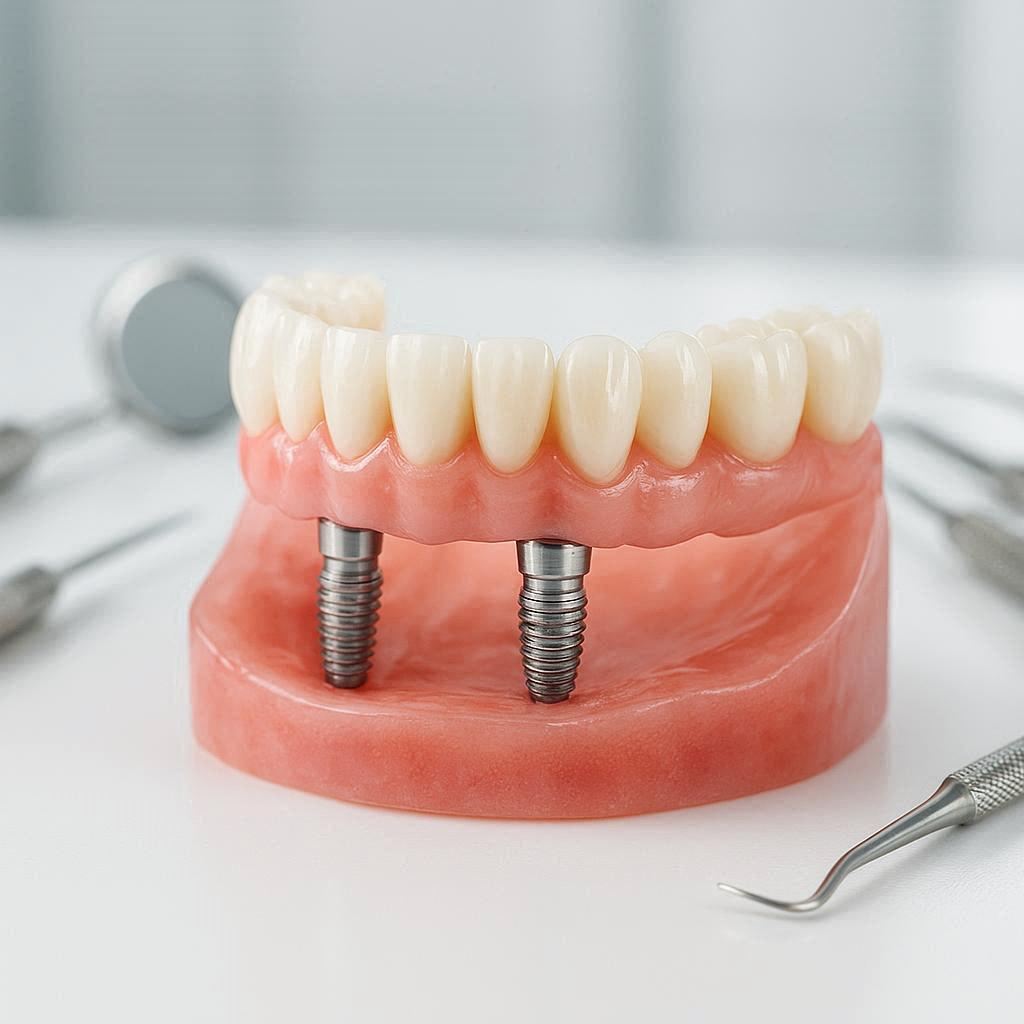
All On 2 dental implants are a type of full-arch restoration. This means they replace all the teeth on your upper jaw (maxilla) or lower jaw (mandible) with a single, fixed bridge.
The “2” in the name refers to the number of implant posts surgically placed into your jawbone. These two implants act like artificial roots. A custom-made prosthesis (the new set of teeth) is then screwed or cemented onto these two supports.
Important Note: This is not the same as an “implant-supported denture” that clips on and off. An All On 2 prosthesis is fixed. You do not remove it at night. Only a dentist can take it off.
The concept relies on a principle called “tilted implantology.” The two implants are not always placed straight up and down. Often, they are placed at specific angles (usually in the canine or premolar area) to maximize contact with the bone and distribute chewing forces evenly.
How It Differs from All-on-4
This is the most common question people ask. The classic All-on-4 method uses four implants per arch. So, why would anyone choose only two?
| Feature | All On 2 | All On 4 |
|---|---|---|
| Number of Implants | 2 per jaw | 4 per jaw |
| Surgery Time | Shorter (usually 1-2 hours) | Longer (2-3 hours) |
| Bone Requirement | Moderate to good bone density required | Can work with less bone (using tilted back implants) |
| Cost | Generally lower | Higher (more parts, more labor) |
| Long-Term Stability | Good for normal use | Excellent for heavy grinding or clenching |
| Prosthesis Type | Fixed bridge (12-14 teeth) | Fixed bridge (12-14 teeth) |
Think of it like a table. A table with four legs is obviously more stable than a table with two legs. However, if the two legs are very strong and well-anchored into the floor, the table can still work perfectly for daily use. The same logic applies here.
A Brief History
The concept of using only two implants for full-arch restorations is not brand new. It emerged from the “Trefoil” concept (using three implants) and evolved. Modern All On 2 systems became more reliable with the introduction of stronger materials like zirconia and advanced computer-guided surgery. Today, it is considered a viable alternative for specific patients.
Who Is a Realistic Candidate?
Not everyone qualifies for All On 2 dental implants. Honesty here is crucial. If a dentist tells you “anyone can get this,” walk away.
You are a good candidate if you meet most of these criteria:
Ideal Candidate Profile
- Good bone volume in specific areas. You do not need bone everywhere, but you need excellent bone quality in the front part of your jaw (the canine and first premolar zones). The two implants will go there.
- Low to normal bite force. If you are a heavy bruxer (teeth grinder), two implants may not withstand the pressure over 20 years.
- No active gum disease. Periodontal disease must be treated before any implant surgery.
- Non-smoker or willing to quit. Smoking drastically reduces implant success rates, especially with only two support points.
- Financially conscious but not desperate. You want a fixed solution that costs less than All-on-4, but you understand the trade-offs.
Who Should Avoid All On 2?
- People with severe bone loss in the front jaw.
- Patients with bruxism (night grinding).
- Those with uncontrolled diabetes or autoimmune diseases affecting healing.
- Anyone looking for a “cheap fix” – this still requires quality work.
Quote from a prosthodontist: *”I only recommend All On 2 for patients with a narrow bite, low muscle activity, and excellent anterior bone. For anyone else, I advise All-on-4 or All-on-6.”* – Dr. Sarah Jennings, DDS.
The Step-by-Step Procedure
What does the process actually look like? Most patients complete the journey in about 3 to 6 months. Let us break it down into clear stages.
Stage 1: Initial Consultation & Imaging
Your journey starts with a thorough exam. The dentist will take:
- CBCT scan (3D X-ray). This is essential. It shows the exact density and volume of your bone.
- Digital impressions or physical molds of your current teeth.
- Bite analysis to measure your chewing force.
Based on this, the dentist creates a surgical guide – a 3D-printed template that tells them exactly where to place the two implants. This is called computer-guided surgery, and it is highly recommended for All On 2 because there is zero room for error.
Stage 2: Extractions & Implant Placement (Surgery Day)
If you have remaining natural teeth, they will be extracted. This usually happens on the same day as implant placement.
Here is what happens step by step:
- Anesthesia. Local anesthesia numbs the entire jaw. Sedation (laughing gas or IV) is available for anxious patients.
- Extractions. Any failing or decayed teeth are removed gently.
- Implant osteotomy. The dentist drills two precise holes into the predetermined positions.
- Implant insertion. Two titanium or zirconia implant posts are screwed into the holes.
- Healing cap placement. Small caps are placed on top of the implants.
The entire surgery usually lasts 60 to 90 minutes for one jaw. Two jaws (upper and lower) will take longer.
Stage 3: Immediate Loading (Temporary Teeth)
In many cases, you leave the clinic with a temporary fixed bridge on the same day. This is called “immediate loading.”
This temporary prosthesis is made of acrylic or reinforced resin. It looks like teeth, but you cannot chew hard food with it. Its job is to:
- Protect the healing implants.
- Give you aesthetics (you are not toothless).
- Help you speak and eat soft foods.
Crucial warning: The temporary bridge is not for normal chewing. Treat it like a medical bandage in your mouth.
Stage 4: Osseointegration (Healing Period)
This is the most important phase. Osseointegration is the process where your jawbone grows and fuses with the titanium implant surface. It takes 3 to 6 months.
During this time:
- You eat a soft food diet (mashed potatoes, smoothies, scrambled eggs, soup).
- You avoid biting with the front teeth.
- You practice excellent oral hygiene (special brushes and water flossers).
- You attend follow-up visits to check healing.
Stage 5: Final Prosthesis Delivery
Once the implants are fully fused (the dentist will test stability), you return for the final step.
- The healing caps are removed.
- Impressions are taken of the implants.
- A custom final bridge is fabricated. This is usually made of:
- Acrylic with a titanium bar (affordable, durable but can stain).
- Zirconia (very strong, natural-looking, but more expensive).
- The final bridge is screwed onto the two implants.
Congratulations. You now have a full set of fixed teeth.
The Pros and Cons: A Realistic Look
Every dental procedure has trade-offs. Let us examine them honestly.
The Advantages (Why patients choose this)
| Advantage | Explanation |
|---|---|
| Lower cost | Two implants vs. four or six means lower material and surgical fees. |
| Less invasive surgery | Fewer incisions, less drilling, and less post-op pain. |
| Faster healing | Your body only needs to heal around two foreign objects, not four or six. |
| Easier to clean | You can floss around two abutments much easier than four crowded ones. |
| Good for narrow jaws | If your jaw is naturally narrow, fitting two implants is easier than four. |
| Preserves bone | The implants stimulate bone, preventing the “sunken face” look of dentures. |
The Disadvantages (What dentists don’t always say)
| Disadvantage | Explanation |
|---|---|
| Higher risk of failure | If one implant fails, the entire bridge fails. With four implants, you can lose one and still function. |
| Not for heavy chewers | The biomechanical leverage is high. Chewing on the back teeth puts extreme stress on the two front implants. |
| Limited to shorter bridges | You cannot make a very long (14+ teeth) bridge on only two implants in most cases. |
| Potential for fracture | The bridge itself can crack over time because it has only two support points. |
| Not reversible for denture wearers | If you hate it, removing the implants is complex. |
Real talk: Many dentists avoid All On 2 because they fear long-term complications and unhappy patients. It works wonderfully for the right patient, but it is not a universal solution.
Cost Breakdown (2026 Estimates)
Money matters. Let us talk numbers. Prices vary by country, clinic, and materials. These are average estimates in USD for one jaw.
| Component | Low Range | High Range |
|---|---|---|
| Consultation & CBCT scan | $250 | $500 |
| Extractions (if needed) | $100 per tooth | $300 per tooth |
| Two implants (brand like Straumann, Nobel, or Neodent) | $1,500 | $3,000 |
| Abutments & surgical guide | $500 | $1,000 |
| Temporary bridge (acrylic) | $800 | $1,500 |
| Final bridge (acrylic/titanium) | $2,500 | $4,000 |
| Final bridge (zirconia) | $4,500 | $7,000 |
| Total Average (one jaw, zirconia) | $8,000 | $15,000 |
For comparison:
- Traditional denture: 500–3,000 (removable, no implants)
- Implant-supported overdenture (2 implants, snap-on): 4,000–8,000
- All-on-4 (4 implants, fixed): 15,000–28,000 per jaw
- All-on-2 (2 implants, fixed): 8,000–8,000–15,000 per jaw
Note: Dental insurance typically covers little of this. Some plans cover extractions or the CBCT scan. Medical financing (CareCredit, Alphaeon) is common.
Recovery & Aftercare: Your New Lifestyle
Getting the implants is only 50% of the success. The other 50% is how you care for them.
The First Week After Surgery
- Swelling and bruising are normal. It peaks on day 2 or 3.
- Pain is usually manageable with over-the-counter ibuprofen. Prescription painkillers are rarely needed after day 2.
- Bleeding stops within 24 hours. Use gauze as directed.
- Diet: Cold soft foods only (ice cream, yogurt, cold soup). No hot drinks for 48 hours.
- No spitting or using a straw. This can dislodge the blood clot and cause a dry socket (painful complication).
Weeks 2 to 12 (Healing Phase)
- You switch to warm soft foods (oatmeal, mashed potatoes, scrambled eggs, pasta).
- You begin gentle brushing of the temporary bridge with a super-soft toothbrush.
- You use a water flosser on the lowest setting to clean around the implants.
- You avoid sticky, hard, or crunchy foods (caramel, nuts, popcorn, hard bread).
Long-Term Maintenance (After Final Bridge)
Once you have your final bridge, you live a mostly normal life. However, there are permanent changes.
Do’s:
- Brush twice a day with a non-abrasive toothpaste.
- Use a water flosser daily to clean under the bridge.
- Visit your dentist every 6 months for professional cleaning (they will use special instruments for implants).
- Use interdental brushes (super floss) to clean the gap between the bridge and gum.
Don’ts:
- Do not chew ice, hard candy, or bones.
- Do not use your teeth as tools (opening packages, biting nails).
- Do not skip hygiene. Peri-implantitis (bone loss around implants) is real and can cause failure.
Lifespan Expectations
How long do All On 2 implants last?
| Component | Expected Lifespan |
|---|---|
| Titanium implants | 20+ years (often lifetime if healthy) |
| Zirconia bridge | 15-25 years |
| Acrylic/titanium bridge | 10-15 years |
| Screws (fixing bridge to implants) | Replace every 3-5 years (minor maintenance) |
The bridge may need replacement due to wear, chipping, or staining. The implants themselves rarely fail after the first year if properly maintained.
Comparison Table: All On 2 vs. Other Options
To help you visualize where All On 2 fits, here is a detailed comparison.
| Feature | Traditional Denture | Implant Overdenture (2 implants) | All On 2 | All On 4 |
|---|---|---|---|---|
| Removable? | Yes (full removal) | Yes (snaps off) | No (fixed) | No (fixed) |
| Number of Implants | 0 | 2 | 2 | 4 |
| Stability while eating | Poor (floats) | Good (snaps) | Very good | Excellent |
| Bone preservation | None (bone shrinks) | Moderate | Good | Very good |
| Cleaning difficulty | Easy (out of mouth) | Moderate | High (requires flossers) | Moderate-high |
| Speech | Can click | Good | Excellent | Excellent |
| Cost (per jaw) | 500−3k | 4k−8k | 8k−15k | 15k−28k |
| Best for… | Budget, simple needs | Denture wearers wanting stability | Low-risk patients with good bone | Most standard patients |
Common Questions Patients Ask (Before Committing)
Let us address the real concerns people have in the consultation room.
“Will it feel like real teeth?”
Close, but not exactly. All On 2 feels more stable than dentures but less sensitive than natural teeth. You will feel pressure, but not fine texture. Most people describe it as “solid” and “reliable.”
“Can I eat steak and apples?”
After full healing (6+ months), yes – with caution. You can eat steak cut into small pieces. You can bite into a soft apple. But biting a hard, whole apple or corn on the cob is risky. The leverage on two implants is high. Cut your food into manageable pieces.
“What if one implant fails?”
This is the biggest risk. If one implant loses integration (fails to fuse with bone), the entire bridge becomes loose. The dentist will need to:
- Remove the bridge.
- Remove the failed implant (if necessary).
- Let the bone heal for 3-4 months.
- Place a new implant.
- Make a new bridge (old bridge will not fit).
This can cost another 5,000–10,000. This is why patient selection is critical.
“Is the procedure painful?”
The surgery itself is not painful because of anesthesia. Afterward, most patients rate the pain as 3-4 out of 10 for the first 2 days. It is less painful than multiple extractions. Many say the recovery is easier than a wisdom tooth removal.
“Can I get All On 2 on both upper and lower jaws?”
Yes, but caution is advised. If you do both jaws, your total support is only four implants (two per jaw). Your chewing force will be limited. Most dentists recommend All-on-4 for the lower jaw (which bears 70-80% of chewing force) and All On 2 for the upper jaw (lighter force). Or vice versa based on your bone.
Real Patient Scenario (Anonymized)
Let me share a realistic case.
Patient: “Robert”, 62 years old, retired teacher.
Problem: His upper denture was loose and caused gagging. Lower teeth were failing but mostly present.
Bone quality: Good in the upper front jaw. Poor in the back (sinus area).
Bite force: Normal (no grinding).
Budget: $12,000 for upper jaw.
Solution: All On 2 on the upper jaw. Two implants placed in the canine regions. Lower jaw received individual implants for his remaining natural teeth (not a full arch).
Outcome: Surgery took 70 minutes. Temporary bridge delivered same day. Healing took 4 months. Final zirconia bridge placed. Robert now eats chicken, salads, and pizza. He says: *”It’s not like my 20-year-old teeth, but it’s 100x better than that floating denture.”*
Caveat: Robert was told never to chew hard nuts or bite into a whole apple. He accepted this trade-off.
How to Find a Qualified All On 2 Provider
Not every dentist offers this. And not every dentist should offer this. Here is how to find a good one.
Questions to Ask During Consultation
- “How many All On 2 cases have you personally done?” (Look for at least 20-30 cases).
- “What is your failure rate for two-implant full arches?”
- “Do you use a CBCT scan and surgical guide for every case?” (Answer must be YES).
- “What happens if one implant fails? Do you have a warranty or free replacement policy?”
- “Can I speak to a previous All On 2 patient of yours?”
Red Flags to Avoid
- Dentists who say “it works for everyone.”
- Clinics offering “All On 2 for $4,000 total” (impossible with quality parts).
- No CBCT machine in the office (they are guessing the bone quality).
- Pressure to decide same day.
Credentials to Look For
- Prosthodontist (specialist in replacement teeth) or Oral surgeon for the implant placement.
- Membership in the American Academy of Implant Dentistry (AAID) or International Congress of Oral Implantologists (ICOI).
- At least 5 years of experience with full-arch restorations.
Maintenance Checklist (Printable Summary)
If you decide to proceed, here is your lifelong checklist.
Daily (morning and night):
- Brush bridge with soft brush and non-abrasive gel.
- Use water flosser on medium setting for 60 seconds under the bridge.
- Use super floss or interdental brush for the two abutment areas.
Weekly:
- Inspect the bridge for any cracks or chips.
- Check if the bridge feels loose (slight movement is normal; rocking is not).
Every 6 months (Dentist visit):
- Professional cleaning with plastic scalers (metal will scratch implants).
- X-ray to check bone levels around the implants.
- Tightening of the prosthetic screws (torque check).
Every 3-5 years:
- Replacement of the retaining screws (preventative maintenance).
Conclusion (3-line summary)
All On 2 dental implants offer a fixed, affordable, and less invasive alternative to traditional dentures or All-on-4, but only for patients with good bone quality and normal bite force. The procedure involves two implants supporting a full bridge, with a recovery time of 3-6 months and costs ranging from 8,000to15,000 per jaw. While not for everyone, it can be a life-changing solution when performed on the right candidate by an experienced implant dentist.
Frequently Asked Questions (FAQ)
1. How long does All On 2 last?
The titanium implants can last 20+ years or a lifetime. The prosthetic bridge lasts 10-25 years depending on material (acrylic vs. zirconia) and how well you care for it.
2. Is All On 2 cheaper than All-on-4?
Yes, typically 30-50% cheaper because you use half the implants, abutments, and surgical time. Average All On 2 cost is 8k−15k per jaw vs. 15k−28k for All-on-4.
3. Can I sleep with All On 2 implants?
Yes. They are fixed, permanent prostheses. You never remove them. You brush them like natural teeth and sleep normally.
4. Does insurance cover All On 2 dental implants?
Most medical and dental insurance plans do not cover implants. Some may cover extractions, the CBCT scan, or a small portion (10-20%) of the prosthesis. Check your plan.
5. What is the failure rate for All On 2?
Studies show a 5-year success rate of 92-95% for properly selected patients. This is slightly lower than All-on-4 (97-98%). Most failures happen in the first year due to poor bone quality or grinding.
6. Can I get All On 2 if I have bone loss?
It depends. If bone loss is only in the back, you may still qualify because the two implants go in the front. If bone loss is severe in the canine regions, you will need bone grafting or a different solution.
7. How many teeth are on an All On 2 bridge?
Typically 12 to 14 teeth per arch (first premolar to first premolar on the other side). It does not replace the very last molars (wisdom teeth area) in most cases.
8. Is the surgery done in one day?
The implant placement and temporary bridge are done in one day. The final, permanent bridge is delivered 3-6 months later. So, you leave with teeth on day one, but not the final teeth.
Additional Resource Link
For more detailed clinical studies and patient testimonials, visit the American Academy of Implant Dentistry patient education page:
https://www.aaid.com/Patients/ (External link – open in new tab)
Disclaimer
This article is for informational purposes only and does not constitute medical or dental advice. Individual results vary. Always consult a licensed dental professional for a personal examination and treatment plan. The author and publisher are not liable for any decisions made based on this content. Do not disregard professional medical advice because of something you read here.