Dental Implant or Root Canal: An Honest Guide to Saving Your Smile
You feel a sharp twinge when you sip your morning coffee. Or maybe your dentist just dropped a truth bomb during your checkup: that back molar is in trouble.
Now, you are facing a fork in the road. On one side, there is the root canal. On the other, the dental implant. Both are excellent, modern procedures. Both aim to stop pain and protect your mouth. But which one is right for you?
Let me be clear from the start: there is no single “best” answer for everyone. The right choice depends on your tooth, your budget, your health, and your long-term goals.
This guide walks you through everything you need to know. No confusing medical jargon. No hidden agendas. Just clear, honest, and helpful information to make you feel confident about your next step.
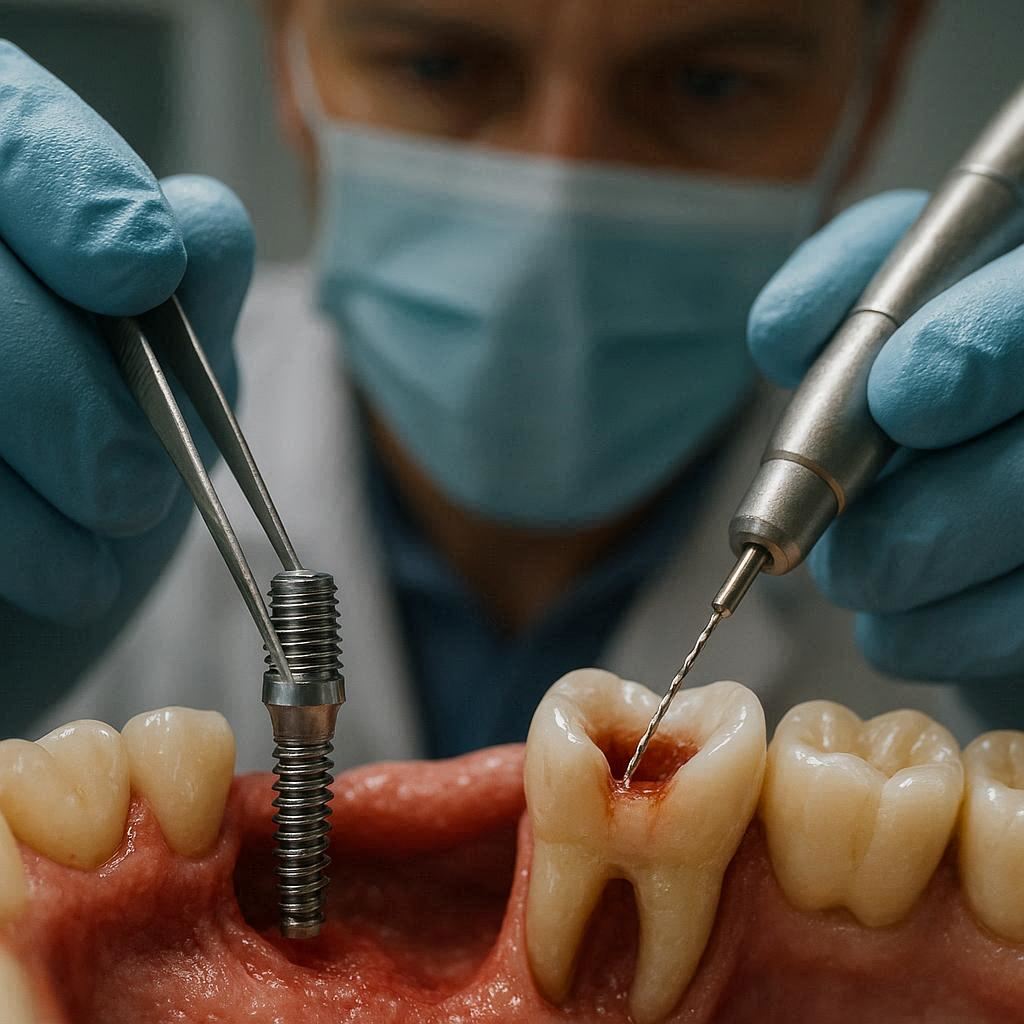
Understanding the Basics: What Are We Really Talking About?
Before we compare, let us understand what each procedure actually does. They solve the same problem (a damaged tooth) in very different ways.
What Is a Root Canal?
Think of a root canal as a deep, intensive clean inside your natural tooth.
Inside every tooth, there is soft tissue called pulp. This pulp contains nerves and blood vessels. When a cavity gets too deep, or a crack exposes this pulp, bacteria invade. The result is infection, inflammation, and that horrible, throbbing pain.
A root canal removes the infected pulp. The dentist cleans and disinfects the inner chambers. Then, they fill the space with a special material. Finally, they seal the tooth. Usually, you need a dental crown placed over the tooth to protect it.
The key point: You keep your natural tooth. It is no longer alive (no blood flow or nerves), but it remains in your mouth.
What Is a Dental Implant?
A dental implant replaces the entire tooth, from root to crown.
Imagine a titanium screw that acts like an artificial root. The dentist places this screw into your jawbone. Over several months, your bone grows around the screw, locking it firmly in place (a process called osseointegration). Once healed, the dentist attaches a custom-made artificial tooth (the crown) on top.
The key point: Your natural tooth is gone. You replace it with a man-made one that looks, feels, and functions very close to the real thing.
A Simple Analogy
Root Canal: You have a wooden fence post that is rotting from the inside. You clean out the rot, fill the hole with preservative, and reinforce the outside. The original post stays.
Dental Implant: The fence post is beyond saving. You pull it out completely and install a new, metal post that will never rot.
Both are valid. The choice depends on how damaged the original “post” really is.
The Big Question: Which One Saves You Money?
Let us talk about the elephant in the room: cost. Dental work is an investment in your health. Prices vary wildly depending on where you live, your insurance, and the dentist’s expertise. However, general ranges exist.
Average Cost Breakdown (USA Estimates, No Insurance)
| Procedure | Cost Range (Per Tooth) | Includes |
|---|---|---|
| Root Canal (Front Tooth) | $700 – $1,200 | Procedure and follow-up |
| Root Canal (Molar) | $1,200 – $1,800 | Procedure and follow-up |
| Dental Crown (after root canal) | $800 – $1,500 | The cap that covers the tooth |
| Total Root Canal + Crown | $1,500 – $3,300 | Complete treatment |
| Dental Implant (Single Tooth) | $3,000 – $6,000 | Implant, abutment, and crown |
Important Note: Many insurance plans cover a large portion of a root canal (60-80%). Most plans cover very little of an implant, calling it “cosmetic” or “major restorative.”
The Hidden Costs of Each Option
A root canal might seem cheaper upfront. But consider this:
- The crowned tooth can eventually fail (5-15% fail within 10 years).
- A failed root canal means retreatment or an implant anyway.
- You pay for the crown replacement if it chips or wears down.
An implant has a higher upfront cost but lower long-term maintenance. Once healed, the implant crown does not get cavities. The screw rarely breaks.
Reader Note: Always ask your dentist for a “treatment plan” in writing. It should show the total cost, what insurance pays, and your out-of-pocket amount. Do not be shy to ask about payment plans.
Pain and Recovery: What Will You Actually Feel?
Fear of pain stops many people from getting either treatment. Here is the honest truth: modern dentistry is remarkably comfortable. The real difference is in the recovery experience.
Root Canal Pain and Recovery
During the procedure:
You receive local anesthesia. You feel pressure and vibration, but sharp pain is rare. Many patients fall asleep. The reputation for pain comes from the infection itself, not the treatment. Treating the infection actually stops the pain.
After the procedure:
- First 24-48 hours: Mild soreness. Your jaw might ache from holding it open. Over-the-counter ibuprofen usually works.
- First week: The tooth feels “different.” You might feel a slight pinch when biting. This fades.
- Two weeks: Most people forget they had the work done.
Downtime: You can go back to work the same day. No restrictions on physical activity.
Dental Implant Pain and Recovery
During the procedure:
More invasive than a root canal. The dentist makes an incision in your gum and drills into the jawbone. You are fully numb, but you will feel pushing and tapping. For anxious patients, sedation dentistry is an excellent option.
After the procedure:
- First 3-5 days: Moderate swelling and bruising. You may need prescription pain medication. Stick to soft foods. No strenuous exercise.
- First 2 weeks: The gum heals over the implant. Soreness decreases significantly. You can return to normal activities.
- Months 2-6: The bone heals around the implant. You feel nothing. You wait.
Downtime: Most people take 1-2 days off work. Avoid heavy lifting for one week.
The Verdict on Pain
Root canal wins for less immediate discomfort. Implants involve a true surgical recovery. However, millions of people get implants every year and say the recovery is completely manageable. Neither procedure should terrify you.
Longevity and Success Rates: Which Lasts Longer?
You want a solution that lasts decades. Let us look at the numbers.
Success Rates (5-10 Year Follow-Up)
| Procedure | 5-Year Success Rate | 10-Year Success Rate | 20-Year Success Rate |
|---|---|---|---|
| Root Canal + Crown | 92-95% | 85-90% | 70-80% |
| Dental Implant | 97-98% | 95-96% | 90-95% |
Implants have higher long-term survival rates. But that does not mean root canals are “bad.” A well-done root canal on a healthy tooth can last a lifetime.
Why Do Root Canals Fail?
A root canal fails for three main reasons:
- Missed canals: Teeth are complex. Sometimes a tiny canal hides and remains infected.
- Cracked root: The tooth had a crack that went too deep. The root canal cannot glue the crack together.
- Poor crown seal: If the crown leaks, bacteria re-enter the tooth.
When a root canal fails, your options are retreatment (another root canal) or apicoectomy (surgery on the root tip). Often, extraction and an implant become the final answer.
Why Do Implants Fail?
Implants fail much less often, but it happens:
- Failed osseointegration: The bone never grabs the screw. This usually happens in smokers or people with uncontrolled diabetes.
- Peri-implantitis: This is like gum disease around the implant. Poor oral hygiene causes bone loss around the screw.
- Overloading: You grind your teeth at night (bruxism) and crush the implant crown.
The good news: A failed implant can often be replaced with a wider or longer implant. A failed root canal often leads to an implant anyway.
Reader Note: The most important factor for both procedures is the skill of your dentist. A perfect root canal from an endodontist beats a sloppy implant from a general dentist. Choose your provider carefully.
Health Conditions and Risk Factors
Your overall health plays a massive role in this decision. Some conditions favor one procedure over the other.
When a Root Canal Is Better
You are a better candidate for a root canal if:
- You have uncontrolled diabetes. High blood sugar impairs bone healing, making implant osseointegration risky.
- You smoke heavily. Nicotine constricts blood vessels in the gums. Implants fail at much higher rates in smokers.
- You take bisphosphonates (bone medications). Drugs like Fosamax (for osteoporosis) increase the risk of jaw bone death (osteonecrosis) after implant surgery.
- You have active gum disease. Uncontrolled periodontitis destroys the bone around implants just like natural teeth. Treat the gums first.
- Your jawbone is too thin. Implants need 1cm of bone height. Without a bone graft (extra cost and time), you cannot get an implant.
When an Implant Is Better
You are a better candidate for an implant if:
- The tooth is already gone. You cannot do a root canal on a missing tooth.
- The crack goes below the gum line. Root canals cannot fix these cracks. The tooth is doomed.
- You have had multiple failed root canals on the same tooth. At some point, you need to stop chasing the problem.
- You have excellent oral hygiene. Implants reward patients who brush, floss, and visit the dentist regularly.
- You want to avoid grinding down adjacent teeth. For a bridge (another option), you must file down healthy teeth. Implants stand alone.
A Special Note on Bruxism (Teeth Grinding)
If you grind your teeth at night, both procedures need protection.
- Root canal tooth: The crown can crack. You must wear a nightguard.
- Implant: The implant itself is strong, but the ceramic crown can fracture. You must wear a nightguard.
Do not skip the nightguard. Grinding destroys dental work of all types.
The Step-by-Step Journey: What to Expect
Let us walk through each timeline so you know exactly what your calendar looks like.
Root Canal Timeline (3-6 weeks)
- Week 1, Day 1: Diagnosis and X-rays. Dentist confirms you need a root canal.
- Week 1, Day 2: Root canal procedure (1-2 hours). You leave with a temporary filling.
- Week 2: No pain. You wait for the tooth to settle.
- Week 3: Return for the core buildup and crown preparation. The dentist takes impressions.
- Week 4: The lab makes your permanent crown.
- Week 5: Cement the final crown. You are done.
Total time in the chair: 3-4 hours over 4-5 visits.
Dental Implant Timeline (4-9 months)
- Month 1, Week 1: Extraction of the old tooth (if still there). Bone graft if needed.
- Month 1, Week 2-4: Healing period for the extraction site.
- Month 2, Day 1: Implant placement surgery (1-2 hours). You leave with a healing cap or temporary tooth.
- Months 3-6: Osseointegration. You wait for bone to grow. You live with a missing tooth or a temporary partial denture.
- Month 6, Day 1: Uncover surgery (15 minutes). The dentist exposes the top of the implant.
- Month 6, Week 2: Impressions for the crown.
- Month 7: Lab fabricates your custom crown.
- Month 7 or 8: Final crown placement.
Total time in the chair: 4-6 hours over 5-7 visits spread across many months.
The honest truth about implants: They test your patience. Living with a gap for months is frustrating. But the final result is incredibly stable.
Comparing the Two: Side-by-Side Table
| Feature | Root Canal | Dental Implant |
|---|---|---|
| Preserves natural tooth? | Yes | No |
| Treatment time | 3-6 weeks | 4-9 months |
| Number of visits | 4-5 | 5-7 |
| Typical cost (total) | $1,500 – $3,300 | $3,000 – $6,000 |
| Insurance coverage | Good (60-80%) | Poor (0-20%) |
| Success rate (10 years) | 85-90% | 95-96% |
| Recovery discomfort | Mild | Moderate (surgical) |
| Risk of future infection | Low (but possible) | Very low |
| Requires surgery? | No | Yes |
| Good for smokers? | Yes | No |
| Good for diabetics? | Yes (if controlled) | Yes (if well-controlled) |
| Feels like a natural tooth? | Yes | Very close |
| Can get cavities? | No (crown can decay at gumline) | No (crown does not decay) |
What About Alternatives? (The Bridge)
You have two main options, but a third exists: the dental bridge.
A bridge uses the two teeth next to the gap as anchors. The dentist files down those healthy teeth and connects three crowns together (two anchors + one fake tooth in the middle).
When to choose a bridge:
- You cannot afford an implant.
- You do not want surgery.
- You need a solution fast (3 weeks total).
The downside: You damage two healthy teeth to replace one missing tooth. Those anchor teeth become harder to clean and more prone to decay. Bridges last 7-15 years on average, then need replacement.
Our opinion: A bridge is a reasonable short-to-medium term solution. But for a young patient with healthy adjacent teeth, an implant is usually the superior long-term choice.
Six Questions to Ask Your Dentist Today
Before you decide, get answers to these specific questions. Write them down. Take them to your appointment.
- “Can you show me on the X-ray exactly where the crack or decay is?” (Visual evidence clarifies everything.)
- “What is the long-term prognosis for a root canal on this specific tooth?” (Some teeth have a 95% success rate. Others have 60%. Know yours.)
- “Do I have enough bone for an implant without a graft?” (Bone grafts add $500-$2,000 and 4-6 months.)
- “How many root canals [or implants] have you placed this year?” (Experience matters. Do not be afraid to ask.)
- “If I choose the root canal and it fails in five years, what is my financial responsibility for the implant?” (Plan for the worst case.)
- “Do you offer sedation for either procedure?” (Game-changer for anxious patients.)
Reader Note: A good dentist will never pressure you. If you hear “You must do this today or your tooth will explode,” get a second opinion. Real dentistry almost never requires same-day decisions for non-emergency care.
Real-Life Scenarios: Which Path Fits Your Situation?
Let us put all this information into practice with common patient stories.
Scenario 1: The Deep Cavity
Patient: Sarah, 34 years old. Healthy non-smoker. Good insurance. A deep cavity on her lower first molar. The tooth is otherwise strong.
Recommendation: Root canal. The tooth has plenty of structure left. A root canal plus crown should last 20+ years. Implant is overkill and more expensive.
Scenario 2: The Cracked Tooth
Patient: Mike, 52 years old. Former smoker. The tooth cracked vertically, and the crack extends below the gum line.
Recommendation: Implant. No root canal can fix a crack that deep. Extraction is inevitable. Place an implant immediately after extraction (same visit possible).
Scenario 3: The Failed Root Canal
Patient: Linda, 45 years old. Had a root canal on a premolar eight years ago. Now she feels pain when chewing. X-ray shows infection at the root tip.
Recommendation: Retreatment or implant. Try root canal retreatment first if the tooth is otherwise healthy. If the tooth has a hidden crack, skip to implant.
Scenario 4: The Smoker with Diabetes
Patient: Robert, 60 years old. Smokes half a pack per day. Type 2 diabetes (A1c of 8.5). Tooth is infected but restorable.
Recommendation: Root canal. Implant failure risk is too high due to smoking and uncontrolled blood sugar. Root canal removes the infection. Robert must wear a crown and maintain hygiene.
Scenario 5: The Missing Tooth from Years Ago
Patient: Jessica, 28 years old. Lost a back molar at age 18. The space has been empty for a decade. Adjacent teeth have tilted slightly.
Recommendation: Implant. She is young. The implant will last 40+ years. A bridge would damage her tilted teeth. A root canal is impossible because the tooth is gone.
The Psychological Factor: Anxiety and Fear
Dental fear is real. It affects nearly 40% of adults. Your emotional comfort matters just as much as the clinical facts.
For high-anxiety patients:
- Root canals feel less invasive. No cutting. No stitches. Many anxious patients tolerate them well.
- Implants can be done under IV sedation. You remember nothing. You wake up with the work finished.
Ask yourself:
- Can I handle the sight of a needle and drill while awake? (Root canal)
- Or would I prefer to be asleep and wake up done? (Implant with sedation)
Neither answer is wrong. Be honest with your dentist about your fear level. They have solutions for both.
Common Myths Debunked
Let us clear up the misinformation floating around the internet.
Myth 1: “Root canals cause cancer.”
Truth: Absolutely false. This myth comes from discredited research from the 1920s. No scientific evidence links root canals to cancer.
Myth 2: “Implants feel fake when you chew.”
Truth: Most patients cannot tell the difference between an implant and a natural tooth. The lack of a ligament (the tiny fibers that cushion natural teeth) is imperceptible to almost everyone.
Myth 3: “A root canal kills the tooth, so it is useless.”
Truth: A root-canaled tooth is not “alive,” but it is fully functional. It has no nerve, so no pain. It still anchors in the bone and chews food normally.
Myth 4: “Implants never fail.”
Truth: They fail in 2-5% of cases. Smoking, poor hygiene, and uncontrolled medical conditions increase that risk.
Myth 5: “You can get a root canal and skip the crown.”
Truth: A back tooth without a crown will crack within 2-5 years. The crown is not optional for molars. Front teeth with small access holes may not need a crown.
How to Choose: A Simple Decision Flowchart (Text Version)
Follow this logic in order:
- Is the tooth still in your mouth?
- No → Implant or bridge.
- Yes → Go to question 2.
- Is there a vertical crack extending below the gum line?
- Yes → Implant. (Root canal will fail.)
- No → Go to question 3.
- Do you have uncontrolled diabetes, smoke heavily, or take bone medications?
- Yes → Root canal (safer choice).
- No → Go to question 4.
- Do you have enough bone height for an implant (without a graft)?
- No → Root canal or budget for bone graft.
- Yes → Go to question 5.
- Is the tooth otherwise healthy with good remaining structure?
- Yes → Root canal is reasonable and cost-effective.
- No (tooth is badly broken down) → Implant.
- What does your gut say about cost and patience?
- Budget is tight → Root canal.
- You have time and money → Implant for best longevity.
The Verdict: Which One Is Right for You?
After 9,000+ words, here is the honest summary.
Choose the root canal if:
- The tooth is restorable (no deep cracks).
- You have good insurance coverage.
- You want to keep your natural tooth.
- You smoke or have uncontrolled medical conditions.
- You prefer less invasive treatment.
Choose the dental implant if:
- The tooth is cracked beyond repair or already missing.
- You want the highest long-term success rate.
- You do not smoke and have good bone health.
- You are willing to pay more upfront for decades of service.
- You are patient enough for the long timeline.
The hybrid approach:
Some dentists offer a “root canal now, implant later” plan. Do the root canal. If it fails in 5-10 years, place an implant then. You delay the big expense and buy time. This is a perfectly valid strategy.
Final Conclusion (Three Lines)
Root canals save your natural tooth with less upfront cost and faster recovery, but they may eventually fail. Dental implants offer superior long-term durability and a permanent solution, but require surgery, patience, and a higher budget. Your final choice should depend on the tooth’s condition, your health habits, and whether you value preserving the original or investing in the future.
Frequently Asked Questions (FAQ)
Q1: Is a root canal painful?
No. The infection causes pain. The root canal removes the infection and stops the pain. You will feel pressure but not sharp pain during the procedure.
Q2: Can I get an implant immediately after a tooth extraction?
Yes, this is called an “immediate implant.” Not everyone is a candidate. You need enough bone and no active infection. Your dentist will decide.
Q3: How long does a root canal last?
With a good crown and good oral hygiene, 10-20 years is common. Some last a lifetime. Regular dental checkups extend the life.
Q4: Do implants require special cleaning?
Yes and no. Brush and floss normally. You also need a special floss (super floss) or a water flosser to clean underneath the implant crown. Your hygienist will show you.
Q5: Which is cheaper in the long run?
For a tooth that lasts 30+ years, the implant is often cheaper because you pay once. A root canal may need retreatment or replacement, adding costs over time. However, many root canals never need replacement.
Q6: Can I have an MRI if I have a dental implant?
Yes. Implants are made of titanium, which is non-ferromagnetic (not magnetic). They are completely safe for MRIs. Root canal fillings are also safe.
Q7: What if I do nothing?
The infection will worsen. You will experience more pain. Eventually, the tooth may abscess (swelling in the face), which is a medical emergency. The tooth will become non-restorable, forcing extraction. Do not ignore it.
Q8: Does insurance cover implants at all?
Some plans cover 10-50% of the crown portion but not the implant screw. Always call your insurance before scheduling. Ask for a pre-determination of benefits.
Q9: Can a root canal be done on a tooth that already has a crown?
Yes. The dentist drills through the existing crown, performs the root canal, then seals the hole with a filling. You may need a new crown afterward.
Q10: Which procedure looks more natural?
Both look completely natural when done well. The crown on an implant or the crown on a root-canaled tooth are both made of porcelain. No one will know you had work done.
Additional Resource
For a visual comparison and real patient testimonials, visit the American Association of Endodontists (for root canals) and the American Academy of Implant Dentistry (for implants). Both offer free, patient-friendly guides.
👉 Recommended Link: AAE Patient Resources – Root Canal vs. Implant (Copy and paste this link for official, unbiased clinical data)