Difference Between Veneers and Dental Implants
You look in the mirror. One tooth is chipped. Another one is missing. You feel a little lost. Your dentist mentions two words: veneers and implants. They sound similar. But they are very different.
Do not worry. You are not alone. Many people confuse these two treatments. They both improve your smile. They both involve a dentist. But they solve different problems.
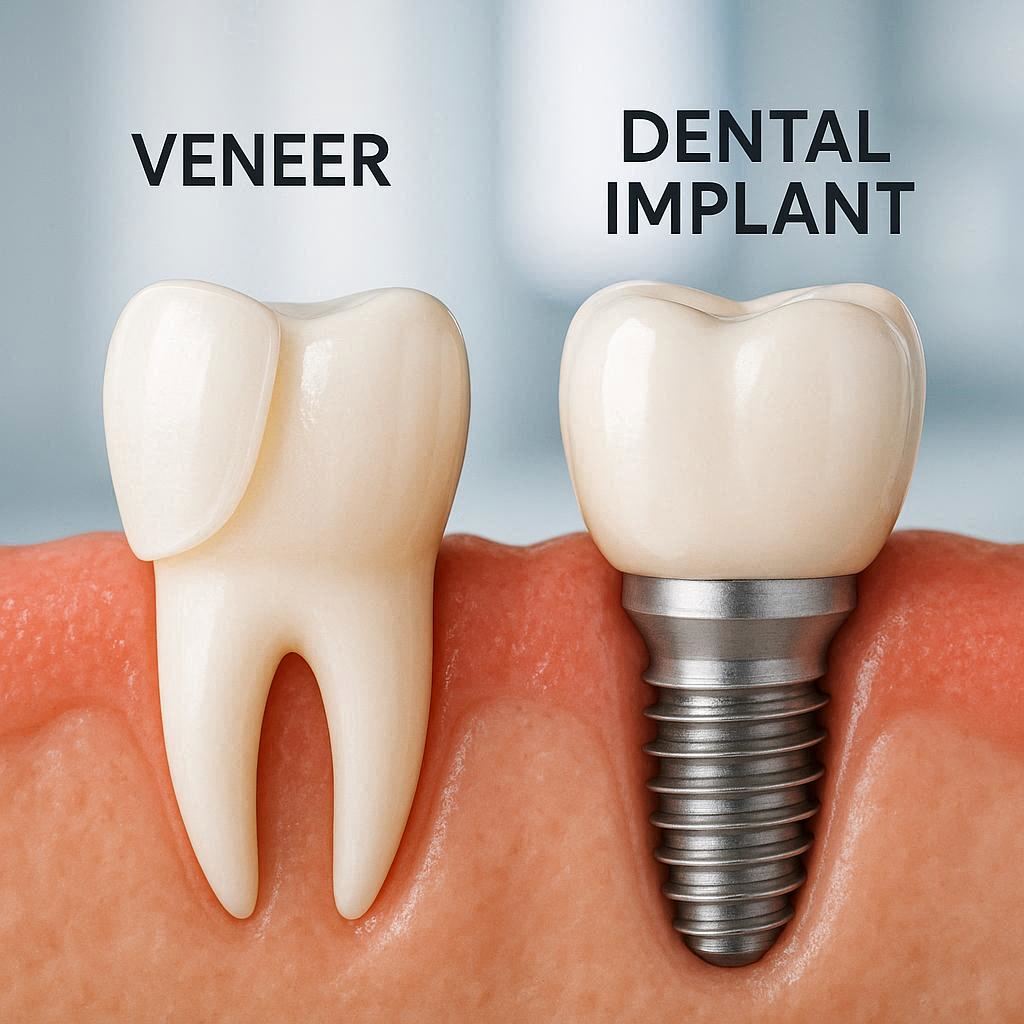
Think of it this way. Veneers are like a new facade for a house. Implants are like building a new foundation.
This guide will walk you through everything. We will use simple English. No confusing dental jargon. By the end, you will know exactly which option fits your situation. Let us begin.
What Are Dental Veneers? (A Pretty Cover)
A veneer is a thin shell. It is usually made of porcelain or composite resin. This shell covers the front of your tooth.
Imagine a fake fingernail. You glue it over your real nail. A veneer works the same way. It hides the flaws on the outside of your tooth.
Veneers do not replace the whole tooth. They just change how the tooth looks. Your natural tooth stays underneath.
When Do Dentists Use Veneers?
Veneers are for cosmetic problems. They fix what you see. Here are common reasons to get veneers:
- Chipped teeth: A small chip makes you feel shy. A veneer covers it.
- Discolored teeth: Some stains do not go away with whitening. Veneers cover them.
- Gaps between teeth: You can close small gaps without braces.
- Misshapen teeth: Some teeth are too small or oddly shaped. Veneers make them look normal.
- Worn-down edges: Years of grinding can flatten teeth. Veneers restore the length.
Important Note: Veneers require your natural tooth to be healthy. You cannot get a veneer on a missing tooth. If the tooth is gone, you need an implant.
The Procedure for Veneers (Step by Step)
Getting veneers usually takes two or three visits. It is not painful. Here is how it works.
First visit: Consultation
You tell the dentist what bothers you. They take X-rays. They check for cavities or gum disease. You need healthy gums first.
Second visit: Preparation
The dentist numbs the area. They remove a tiny amount of enamel from the front of your tooth. This is very thin—about 0.3 to 0.5 millimeters. Then they take a mold of your teeth. They send this mold to a lab. You get temporary veneers for one or two weeks.
Third visit: Bonding
The permanent veneers arrive from the lab. The dentist holds them on your teeth. You check the color and shape. Then they clean your tooth. They use a special glue. They place the veneer. A blue light hardens the glue quickly. You are done.
How Long Do Veneers Last?
Porcelain veneers last 10 to 15 years. Composite resin veneers last 5 to 7 years. Your habits matter. If you grind your teeth, they break sooner. If you bite your nails, they chip.
Good news: You can replace them. When a veneer breaks, the dentist makes a new one.
Pros and Cons of Veneers
Let us be honest. Veneers are great for some people. But they have downsides too.
Pros:
- They look very natural.
- They resist stains well (porcelain).
- The procedure is quick (2 to 3 visits).
- No pain during recovery.
- You keep your natural teeth.
Cons:
- The process is permanent. You cannot reverse it.
- They are expensive (but less than implants).
- You might need replacements later.
- They can break if you bite hard objects.
- Your teeth become slightly sensitive to hot and cold.
What Are Dental Implants? (A New Root)
An implant is different. It replaces the whole tooth. Not just the visible part. All of it.
Think about a real tooth. It has a root under the gum. The root holds the tooth in your jawbone. An implant acts like that root. It is a small screw made of titanium. The dentist puts this screw into your jawbone. Over time, the bone grows around the screw. This makes it very strong.
After the screw is secure, the dentist adds an abutment (a connector). Then they place a crown on top. That crown looks like a real tooth.
When Do Dentists Use Implants?
Implants are for missing teeth. You need an implant when:
- You lost a tooth from injury.
- You had a tooth pulled due to decay.
- You have a gap from birth (missing adult tooth).
- Your tooth is too damaged to save with a crown or root canal.
Veneers need a tooth to attach to. Implants do not. If there is no tooth, you need an implant. A veneer will not work.
The Procedure for Implants (Step by Step)
This takes longer. Much longer. Be patient. The process can last 3 to 9 months. Sometimes more. Here is the typical timeline.
Step 1: Consultation and planning
The dentist takes a 3D scan of your jaw. They check your bone density. You need enough bone to hold the screw. If you do not, they might do a bone graft first. That adds more time.
Step 2: Placing the implant
A surgeon cuts your gum. They drill a small hole in the bone. They place the titanium screw. Then they stitch the gum closed. You go home. This is surgery. You will feel sore for a few days.
Step 3: Osseointegration (healing)
This is a big word. It just means bone grows around the screw. This takes 3 to 6 months. During this time, you wear a temporary tooth or a partial denture. You cannot put pressure on the implant.
Step 4: Placing the abutment
The dentist reopens the gum. They attach a small metal piece (abutment) to the screw. Then the gum heals around it. This takes 2 weeks.
Step 5: Placing the crown
The dentist takes a mold. A lab makes your permanent crown. You come back. They screw or glue the crown onto the abutment. Now you have a new tooth.
How Long Do Implants Last?
A long time. With good care, dental implants can last 20 years to a lifetime. The crown on top might wear out after 10 to 15 years. But you can replace the crown. The titanium screw stays forever if you keep it clean.
Pros and Cons of Implants
Pros:
- They replace missing teeth completely.
- They feel and function like real teeth.
- They last a lifetime with care.
- They stop bone loss in your jaw.
- They do not damage nearby teeth.
Cons:
- Surgery is required. Some people fear this.
- Healing takes months.
- They cost more than veneers (often much more).
- You need enough bone. If not, you need a bone graft.
- Infection is possible (though rare).
The Main Difference Between Veneers and Dental Implants (Simple Table)
Let us make this very clear. Here is a quick comparison.
| Feature | Veneers | Dental Implants |
|---|---|---|
| What it replaces | Only the front surface of a tooth | The entire tooth (root and crown) |
| Your natural tooth | Must be present and healthy | Must be missing or beyond saving |
| Procedure length | 2 to 3 weeks | 3 to 9 months |
| Surgery required? | No (just enamel removal) | Yes (screw placed in bone) |
| Recovery time | No real recovery | Several days to weeks |
| Average lifespan | 10 to 15 years | 20+ years (often lifetime) |
| Typical cost per tooth | $800 to $2,500 | $3,000 to $5,000+ |
| Insurance coverage | Rarely covers (cosmetic) | May cover part (medical need) |
| Reversible? | No (enamel is gone) | Yes (can remove, but bone heals) |
Which One Costs More? (Realistic Numbers)
Money matters. Let us talk about real prices. These are averages in the United States. Your location changes the price. Big cities cost more. Rural areas cost less.
Veneers:
- Porcelain: $1,000 to $2,500 per tooth
- Composite resin: $250 to $1,500 per tooth
- You usually need 4 to 8 veneers for a full smile makeover.
Implants:
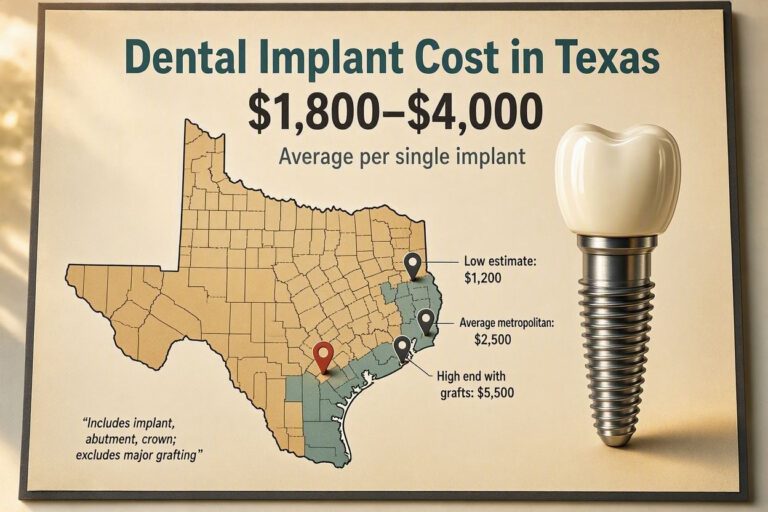
- Single implant: $3,000 to $5,000 (including the crown)
- Implant with bone graft: $4,000 to $7,000
- Full arch (All-on-4): $15,000 to $30,000 per arch
Note: Dental insurance rarely pays for veneers. They are cosmetic. Insurance sometimes pays part of an implant if the tooth is missing from injury or decay. Always check your policy.
How to Choose Between Veneers and Implants (Decision Guide)
You need an honest answer. Ask yourself these questions.
Question 1: Is your tooth still there?
- Yes, the tooth exists: You might be a candidate for veneers, crowns, or bonding.
- No, the tooth is gone: You cannot get a veneer. You need an implant or a bridge.
Question 2: Is your tooth healthy?
- Healthy tooth (no decay, no cracks): Veneers are an option.
- Decayed or cracked tooth: A crown or implant might be better. Veneers only cover the front. They do not protect a weak tooth.
Question 3: What is your budget?
- Under $1,500 per tooth: Veneers (composite) or bonding.
- Over $3,000 per tooth: Implants are possible.
- No money right now: A partial denture or a bridge might be cheaper.
Question 4: Can you wait?
- Need results in 2 weeks: Veneers.
- Can wait 6 months: Implants are fine.
- Need a tooth tomorrow: Ask about a “same-day implant” or a temporary denture.
Question 5: Do you fear surgery?
- Yes, very afraid: Veneers do not require cutting or needles (just numbing gel and a small enamel shave).
- No, surgery is fine: Implants are okay.
A Detailed Comparison Table (More Features)
Let us go deeper. This table covers extra details.
| Aspect | Veneers | Implants |
|---|---|---|
| Pain level (1-10) | 2 (mild sensitivity) | 5 to 7 (surgery recovery) |
| Number of visits | 2 to 3 | 4 to 6 |
| Anesthesia needed | Local numbing (often not required for composite) | Local or general anesthesia |
| Eating restrictions | Avoid hard foods for 2 days | Soft foods for 3 to 6 months |
| Stain resistance | Very high (porcelain) | High (the crown stains like a real tooth) |
| Can it get cavities? | No, but the tooth underneath can | No (titanium does not decay) |
| Gum health required | Yes, gums must be healthy | Yes, very important |
| Smoking allowed? | Not recommended (stains edges) | No (delays healing) |
| Fixes crooked teeth? | Only slightly | No (crooked teeth need braces) |
| Replacement cost | $800 to $2,500 | $3,000 to $5,000 (if crown breaks) |
Real-Life Scenarios (What Should You Do?)
Let us look at three real people. See which option fits them.
Scenario 1: Sarah, age 28
Sarah has small, discolored teeth. She never liked her smile. Her teeth are healthy. No gaps. No missing teeth. She wants a brighter, more even smile.
- Recommendation: Veneers (4 to 6 porcelain veneers).
- Why: Her teeth are present. She just wants cosmetic improvement. Implants are overkill.
Scenario 2: Mike, age 45
Mike lost his front tooth in a bike accident 10 years ago. He has a gap. He hates it. The teeth next to the gap are healthy.
- Recommendation: Dental implant.
- Why: The tooth is completely missing. A veneer cannot replace a missing tooth. An implant is the best long-term solution.
Scenario 3: Linda, age 60
Linda has a back molar that is badly decayed. The dentist says it cannot be saved. It needs extraction. She does not want to lose the tooth.
- Recommendation: Extract the tooth. Then get an implant or a bridge.
- Why: You cannot put a veneer on a tooth that is coming out. The tooth is dead. Save the money for an implant.
Can You Get Veneers on Implants?
This is a common question. The answer is no. But let me explain.
You cannot glue a veneer to an implant. Veneers are for natural teeth only. However, you can put a crown on an implant. A crown covers the whole visible part of the implant. It looks similar to a veneer. But it is stronger. It covers 360 degrees around the tooth.
If you want the cosmetic benefits of a veneer on an implant, just ask for a high-quality ceramic crown. It will look just as good.
What About Bridges? (A Third Option)
You asked about veneers vs implants. But there is a third option: a dental bridge.
A bridge uses the teeth next to the gap. The dentist shaves down those two healthy teeth. Then they glue a fake tooth between two crowns. The crowns sit on the shaved teeth.
Bridge pros:
- Faster than implants (3 weeks).
- Cheaper than implants ($2,000 to $3,000).
- No surgery.
Bridge cons:
- You damage two healthy teeth.
- Bridges last 5 to 10 years.
- They do not stop bone loss.
When to choose a bridge: You cannot afford an implant. You do not want surgery. You are okay with shaving down healthy teeth.
When to choose an implant: You want to protect your healthy teeth. You want a permanent solution.
Common Myths (Do Not Believe These)
Let us clear up some lies. I hear these all the time.
Myth 1: “Veneers ruin your teeth forever.”
Truth: They do remove a tiny bit of enamel. That is permanent. But your tooth stays healthy. You can always get a new veneer later. You are not ruining anything.
Myth 2: “Implants are painful.”
Truth: The surgery itself is not painful (you are numb). The recovery is sore, like pulling a tooth. Most people manage with ibuprofen. After a few days, you forget it is there.
Myth 3: “Veneers look fake.”
Truth: Old veneers looked fake. Modern porcelain veneers look very natural. They reflect light like real teeth. Just go to an experienced cosmetic dentist.
Myth 4: “Implants fail often.”
Truth: Implants have a 95% to 98% success rate. That is very high. They fail mostly in smokers or people with uncontrolled diabetes. For healthy people, they work great.
Caring for Veneers vs. Implants
Both need care. Neither is “no maintenance.”
Caring for veneers:
- Brush twice a day (soft toothbrush).
- Floss gently (do not pull up on the veneer edge).
- Avoid biting nails, ice, pens, or hard candy.
- Wear a night guard if you grind your teeth.
- Visit your dentist every 6 months.
Caring for implants:
- Brush twice a day (like normal teeth).
- Floss around the implant (special floss helps).
- Use a water flosser to clean under the crown.
- Do not smoke (it causes bone loss).
- Visit your dentist every 6 months for checks.
Important: Implants cannot get cavities. But the gum around them can get infected. This is called peri-implantitis. It is like gum disease. It can make the implant fail. So clean your gums well.
Frequently Asked Questions (FAQ)
Q1: Can I get one veneer or do I need a full set?
A: You can get just one veneer. But it might not match the color of your other teeth perfectly. Most people get 4 to 8 veneers for a uniform smile.
Q2: Do implants hurt when they put them in?
A: No. You get local anesthesia. You feel pressure but not pain. Afterward, you feel sore for 3 to 5 days. It is manageable.
Q3: Which lasts longer, veneers or implants?
A: Implants last much longer. A good implant can last 30+ years or a lifetime. Veneers last 10 to 15 years.
Q4: Can I eat normally with veneers?
A: Yes, but avoid hard foods. Do not bite apples directly. Cut them into slices. Do not chew ice or bones.
Q5: Can I get implants if I have gum disease?
A: No. You must treat gum disease first. Healthy gums are required for implants. Otherwise, the implant will fail.
Q6: Are veneers covered by insurance?
A: Rarely. Insurance calls them cosmetic. If a veneer repairs a chipped tooth from an accident, they might pay a small part.
Q7: Do implants look natural?
A: Yes. The crown on top is custom-made to match your other teeth. Most people cannot tell it is an implant.
Q8: What happens if an implant fails?
A: The dentist removes it. You let the bone heal for a few months. Then you try again or choose a bridge.
Q9: Can I whiten veneers?
A: No. Whitening gel does not work on porcelain. Choose the color carefully before they are made. Whitening only works on natural teeth.
Q10: Which is cheaper in the long run?
A: Implants. They cost more upfront but last longer. Veneers need replacement every 10 to 15 years. Over 30 years, implants cost less.
Additional Resource (Link)
For more detailed information about tooth replacement options, including costs in your area and finding a qualified dentist, visit the American Academy of Cosmetic Dentistry’s patient resource page:
🔗 aacd.com/patients (External link – official site)
You can also check the American Dental Association’s patient education section at mouthhealthy.org.
Conclusion (Three Lines)
Veneers cover the front of existing teeth to fix cosmetic flaws like chips, stains, and small gaps. Dental implants replace completely missing teeth with a titanium root and a crown, lasting a lifetime but requiring surgery and months of healing. Choose veneers for a fast smile upgrade on healthy teeth, and choose implants when a tooth is gone for good.
Final checklist before you decide:
- See a dentist for X-rays and an exam.
- Ask for a written quote for both options.
- Check your insurance coverage.
- Think about your timeline (weeks vs. months).
- Consider your fear of surgery.
- Remember: veneers need a tooth; implants do not.
You deserve a smile you love. Now you know the difference. Go talk to your dentist with confidence.