
Molar Dental Implant Cost and Procedure
Losing a back tooth can feel strange. You might wonder if it is a big deal. After all, no one sees it when you smile. But your molars are workhorses. They grind your food. They keep your jawbone healthy. They help other teeth stay in place.
Ignoring a missing molar often leads to more problems. That is why many people choose a dental implant.
If you are searching for molar dental implant cost and procedure information, you want the truth. Not sales talk. Not confusing medical terms. Just a clear, friendly guide.
You have come to the right place.
This article walks you through everything. You will learn what happens during surgery. You will understand the real costs. You will also find out if an implant is right for you.
Let us start with the basics.
Why Replacing a Missing Molar Matters
Many patients ask: “Do I really need to replace a back tooth?”
The short answer is yes. Here is why.
Your Molars Do the Heavy Lifting
Molars handle about 70% of your chewing. When you eat an apple or a piece of steak, your molars crush and grind. Without them, front teeth take too much pressure. That can lead to cracks or wear.
Bone Loss Happens Quickly
Your jawbone needs stimulation from tooth roots. When a molar goes missing, the bone in that spot starts to shrink. This happens fast in the first year. Over time, your face can change shape. You might look older.
Neighboring Teeth Shift
Teeth like to move into empty spaces. The tooth behind the gap may tilt forward. The tooth above may drop down. This creates hard-to-clean areas. Cavities and gum disease often follow.
Chewing Becomes Uneven
You might not notice it at first. But you will start favoring one side of your mouth. That can cause jaw pain, headaches, and even worn-down enamel on your good teeth.
Important note: A missing molar is not just a cosmetic issue. It is a functional problem that gets worse with time.
What Is a Molar Dental Implant?
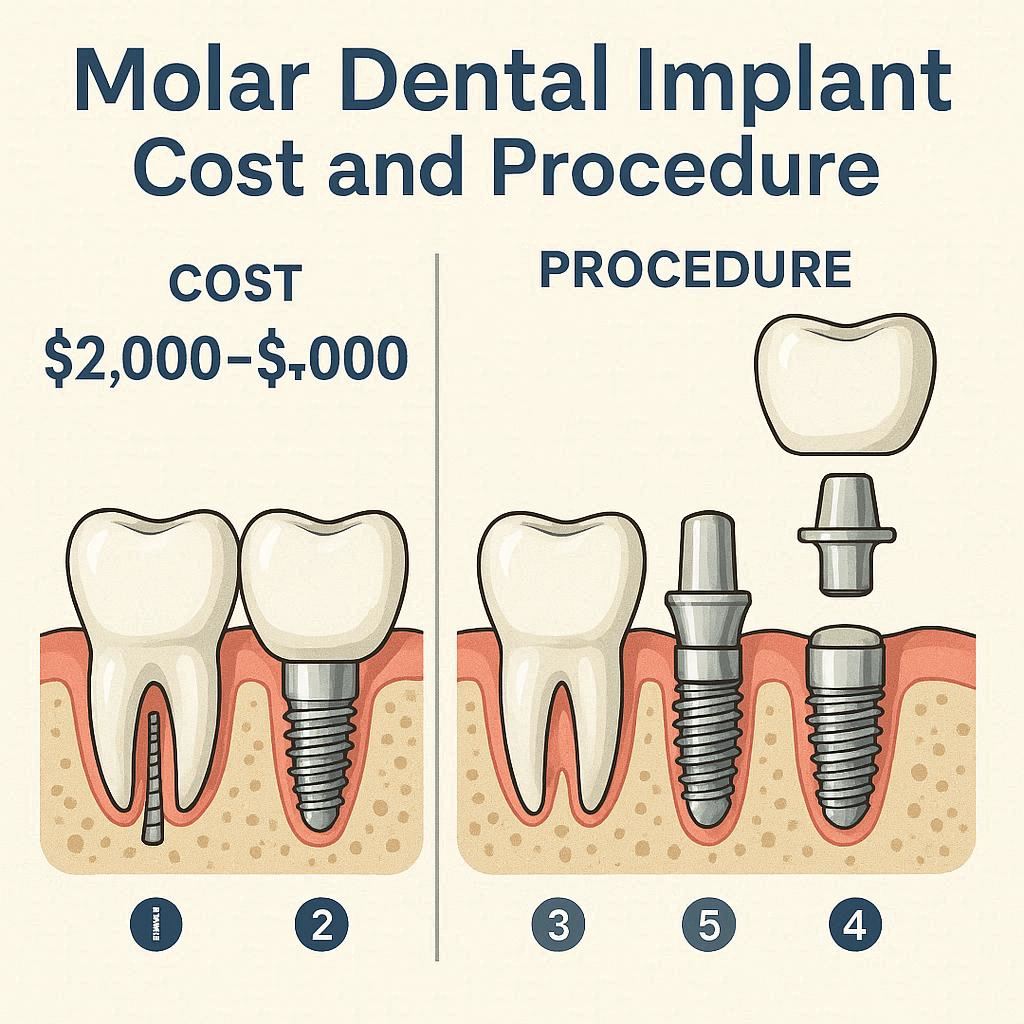
A dental implant is a man-made tooth root. It is usually made of titanium. A surgeon places it into your jawbone. Over a few months, the bone grows around it. This creates a rock-solid anchor.
Once healed, the dentist adds an abutment (a connector piece) and a crown (the visible tooth).
For molars, the implant body is slightly wider than for front teeth. That gives it extra strength to handle chewing forces.
Parts of a Molar Implant
- Implant post – The screw that goes into the bone.
- Abutment – The small connector above the gum line.
- Molar crown – The artificial tooth made of ceramic or porcelain.
Sometimes a dentist uses a same-day crown. But for molars, a separate healing phase is more common. This ensures better long-term success.
Molar Dental Implant Procedure: Step by Step
Let us walk through the entire process. Every case is unique, but most follow this general timeline.
Step 1: Initial Consultation (One Visit)
Your dentist will take X-rays or a 3D CT scan. They check bone density, nerve location, and sinus position (for upper molars). They also review your medical history.
Questions your dentist will ask:
- Do you smoke?
- Do you have diabetes or heart disease?
- Are you taking blood thinners?
- Have you had gum disease?
This visit helps create your personal treatment plan.
Step 2: Preparatory Work (If Needed)
Some patients need bone grafting. If your jawbone is too thin or soft, the implant will not hold. The dentist adds bone material to the area. Healing takes 4 to 9 months.
For upper molars, you might need a sinus lift. The sinus cavity is close to the roots of back teeth. A surgeon lifts the sinus membrane and places bone graft material underneath.
Important note: About 40% of molar implant patients need some form of grafting. Do not skip this step. It makes the difference between success and failure.
Step 3: Implant Placement Surgery (1 to 2 Hours)
The day arrives. Here is what happens:
- Numbing – Local anesthesia numbs the area. You are awake but feel no pain.
- Incision – The surgeon makes a small cut in your gum.
- Drilling – A series of precision drills create a hole in the bone.
- Placement – The titanium post goes into the hole.
- Closing – A healing cap or a temporary cover goes on top. The gum is sutured shut or left open, depending on the technique.
Most patients say the sound is stranger than the feeling. You hear drilling and tapping. But you should not feel sharp pain.
Step 4: Osseointegration (Healing Phase)
This is the most important part. Osseointegration means the bone grows tightly around the implant. It takes 3 to 6 months for molars. Molars experience heavy forces, so dentists wait longer compared to front teeth.
During this time:
- Eat soft foods on the other side.
- Do not chew directly on the implant.
- Keep the area clean with gentle brushing.
Step 5: Abutment Placement (Minor Procedure)
Once healed, the dentist uncovers the implant. They attach a small metal or ceramic abutment. This pokes through the gum. It acts as a base for the crown.
This step is quick. Often it takes 15 to 30 minutes with local anesthesia. You may feel pressure but not pain.
Step 6: Crown Fabrication and Placement (2 to 3 Visits)
The dentist takes impressions of your mouth. A lab makes your custom molar crown. Molar crowns need to be strong. Most are made of zirconia or layered porcelain over metal.
On the final visit, the dentist screws or cements the crown onto the abutment. They check your bite. They make small adjustments so it feels natural.
Congratulations. You have a new molar.
Molar Dental Implant Cost: Real Numbers
Let us talk money. This is often the biggest concern for patients.
The total molar dental implant cost and procedure fees vary widely. But you can expect to pay between $3,000 and $6,000 for a single molar implant in the United States. That includes everything from surgery to the final crown.
Here is a realistic breakdown.
Cost Breakdown Table
| Treatment Component | Price Range (USD) |
|---|---|
| Consultation and CT scan | $150 – $500 |
| Implant post placement surgery | $1,500 – $3,000 |
| Abutment | $300 – $600 |
| Molar crown (custom made) | $1,000 – $2,500 |
| Bone graft (if needed) | $300 – $1,200 |
| Sinus lift (if needed) | $1,000 – $3,000 |
| Total without extra procedures | $3,000 – $6,000 |
| Total with bone graft or sinus lift | $4,000 – $9,000 |
Why Molar Implants Cost More
You might wonder: “Why is a back tooth implant more expensive than a front one?”
Three reasons.
- Larger implant body – Molar implants are wider and sometimes longer. More material and more skill are required.
- Higher risk of complications – Molars are close to nerves and sinuses. The surgeon must be extra careful.
- Stronger crown – A molar crown must withstand heavy biting forces. That means tougher materials like zirconia.
Does Insurance Cover Molar Implants?
Most dental insurance plans do not fully cover implants. They often call them “cosmetic” even when they are functional. However, some plans cover parts of the procedure.
What insurance might pay for:
- Tooth extraction
- Bone grafting (if medically necessary)
- The crown (up to 50%)
- Consultation and X-rays
What insurance rarely pays for:
- The implant post itself
- The abutment
- The surgical placement fee
Always call your provider before starting. Ask for a pre-treatment estimate in writing.
Financing Options
Many dental offices offer payment plans. You can also look into:
- CareCredit – A healthcare credit card with interest-free periods.
- LendingClub – Personal loans for medical procedures.
- Dental schools – Up to 50% lower costs. Supervised students do the work.
- FSA or HSA accounts – Use pre-tax dollars to pay.
Important note: Do not choose an implant based only on the lowest price. Cheap implants often fail. Replacing a failed implant costs double.
Factors That Affect Your Final Bill
No two patients pay the same. Here is why.
Geographic Location
A molar implant in New York City or Los Angeles can cost $6,000 to $8,000. The same procedure in a small Midwestern town might be $3,500 to $5,000. Rural areas generally have lower fees.
Dentist vs. Specialist
A general dentist who places implants charges less than a periodontist or oral surgeon. But specialists have advanced training for complex cases. If you need a sinus lift or bone graft, a specialist is safer.
Material Choices
- Titanium implant – Standard, proven, affordable.
- Zirconia implant – Metal-free, white in color, more expensive.
- Porcelain-fused-to-metal crown – Strong but can show a metal line.
- Full zirconia crown – Very strong, natural looking, costs more.
Urgency
Same-day implants (immediate loading) cost more. The dentist places a temporary crown on the same day as surgery. This requires special skill and equipment. Most molar implants use delayed loading, which costs less.
Success Rates for Molar Implants
Here is good news. Molar implants work very well.
| Time Period | Success Rate |
|---|---|
| After 1 year | 97% – 98% |
| After 5 years | 95% – 96% |
| After 10 years | 93% – 95% |
| After 20+ years | 85% – 90% |
These numbers are slightly lower than front tooth implants. Why? Molars handle more chewing force. But the success rate is still excellent.
What Causes Failure?
Most failures happen early, in the first 3 to 6 months. Common reasons include:
- Infection at the surgery site
- Smoking (doubles the failure rate)
- Uncontrolled diabetes
- Grinding or clenching teeth (bruxism)
- Insufficient bone quality
- Poor oral hygiene
If an implant fails, you can usually try again after the area heals. A second attempt often succeeds.
Before and After: What Real Patients Experience
Let me share what patients commonly report. These are not specific individuals, but common patterns.
Before Surgery
You feel nervous. That is normal. You worry about pain, cost, and time. You might have lived with a missing molar for years.
During Surgery
Surprisingly, most patients say the procedure was easier than expected. You hear noises but feel little. The dentist talks to you the whole time. You go home the same day.
The First Week
Some swelling and mild discomfort occur. Over-the-counter pain medicine usually works. You eat yogurt, soup, and smoothies. You rinse with warm salt water.
Months 2 to 4
Life returns to normal. You forget the implant is there. You chew carefully but without pain. The waiting feels long, but you stay patient.
After Final Crown
You bite into an apple for the first time. It feels solid. Natural. You realize it was worth it.
“I put off my molar implant for three years because I was scared. The procedure took 90 minutes. The recovery was easier than a tooth extraction. I wish I had done it sooner.” – A former patient.
Molar Implant vs. Other Options
You have choices. Let us compare.
Comparison Table: Molar Implant vs. Alternatives
| Option | Pros | Cons | Typical Cost | Lifespan |
|---|---|---|---|---|
| Dental Implant | Preserves bone, natural feel, no damage to other teeth | Expensive, takes months, requires surgery | $3,000 – $6,000 | 20+ years |
| Fixed Bridge | Faster (3 weeks), cheaper upfront | Damages healthy teeth, does not stop bone loss | $2,000 – $5,000 | 10 – 15 years |
| Partial Denture | Lowest upfront cost, non-invasive | Uncomfortable, shifts, can cause cavities | $700 – $1,800 | 5 – 8 years |
| Do Nothing | Free short-term | Bone loss, shifting teeth, jaw pain | $0 | N/A |
Which One Is Right for You?
Choose an implant if: You want the longest-lasting solution. You care about bone health. You can afford the investment. You are healthy enough for surgery.
Choose a bridge if: You need a faster solution. You have healthy teeth on both sides. Your budget is medium.
Choose a partial denture if: You need a low-cost temporary fix. You cannot have surgery.
Choose nothing if: You are okay with future dental problems. (Not recommended.)
Frequently Asked Questions (FAQ)
Is a molar implant painful?
Most patients rate the pain 2 out of 10 during surgery. Afterward, discomfort is similar to a tooth extraction. Over-the-counter medication controls it well.
How long does the whole process take?
From consultation to final crown: 6 to 9 months on average. If you need bone grafting, add 4 to 6 months.
Can I get a same-day molar implant?
Sometimes. But most dentists prefer to wait for molars. Chewing forces are too strong for a temporary crown. Delayed loading has a higher success rate.
Does smoking affect molar implants?
Yes, significantly. Smokers have twice the failure rate. If you smoke, quitting for 2 weeks before and 2 months after surgery helps a lot.
Am I too old for a molar implant?
No. Age is not a barrier. Healthy 80-year-olds get implants successfully. Your overall health matters more than your age.
Can an implant get a cavity?
No. The crown is made of ceramic or metal. It cannot decay. However, you can still get gum disease around it. Keep it clean.
What happens if the implant fails?
Your dentist removes it. The bone heals for 3 to 6 months. Then you can try again. Many second attempts succeed.
How do I clean a molar implant?
Brush normally. Use a water flosser between the implant and adjacent teeth. Regular floss works too, but be gentle. See your dentist every 6 months.
Tips to Save Money Without Cutting Corners
You want quality care at a fair price. Here is how.
- Visit a dental school – Supervised students charge 30% to 50% less. The work is thorough.
- Ask for a payment plan – Many offices offer 0% interest for 12 to 24 months.
- Separate the steps – Pay for surgery one year, and the crown the next year. Spreads out costs.
- Use a dental discount plan – Not insurance, but gives 10% to 30% off for a yearly fee.
- Travel for treatment – Mexico, Costa Rica, and Colombia offer quality implants for $1,500 to $2,500 total. Research the clinic carefully.
- Check clinical trials – Universities sometimes offer free or low-cost implants for research studies.
Important note: Medical tourism carries risks. If complications happen, your local dentist may not fix another doctor’s work. Factor in travel costs and follow-up care.
How to Choose the Right Provider
Do not rush this decision.
Questions to Ask Before Surgery
- How many molar implants have you placed?
- What is your success rate?
- Do you use 3D CT scans for planning?
- What brand of implants do you use? (Reputable brands: Nobel Biocare, Straumann, Zimmer Biomet)
- What happens if my implant fails?
- Is the crown warranty included?
Red Flags to Avoid
- Prices under $2,000 for the entire procedure (too good to be true).
- No X-rays or CT scan before surgery.
- Dentist who guarantees 100% success.
- Pressure to decide the same day.
- No written treatment plan or cost estimate.
Take your time. A good dentist welcomes your questions.
Long-Term Care for Your Molar Implant
An implant can last 30 years or more. But you must care for it.
Daily Care Routine
- Brush twice a day with a soft toothbrush.
- Floss around the implant. Use super floss or implant-specific floss.
- Use a water flosser on a low setting.
- Avoid chewing ice or hard candy.
Professional Maintenance
See your dentist every 6 months. They will:
- Check for gum inflammation.
- Take X-rays every 1 to 2 years to check bone levels.
- Clean the implant with special plastic instruments (metal tools can scratch).
Signs of Trouble
Call your dentist if you notice:
- Bleeding or redness around the implant
- The crown feels loose
- Pain when chewing
- Bad taste or odor
Catch problems early. Most can be fixed without removing the implant.
Final Thoughts: Is a Molar Implant Worth It?
Let me be honest with you.
A molar implant costs real money. It takes real time. It requires a small surgery.
But for most people, it is worth it.
You get back normal chewing. You stop bone loss. You protect your other teeth. You avoid the hassle of dentures or bridges that need replacement every 10 years.
Think of it as an investment in your long-term health. Over 20 years, the cost per year is just $150 to $300. That is less than a coffee per week.
If you are healthy and you plan to keep your natural teeth for life, an implant is the best choice.
Now you understand the real molar dental implant cost and procedure. You know what to expect. You know how to save money safely.
The next step is simple. Book a consultation with a trusted dentist. Ask your questions. Get a written estimate. And take it one step at a time.
You have got this.
Conclusion
Replacing a missing molar with a dental implant preserves jawbone, protects adjacent teeth, and restores normal chewing. The full procedure takes 6 to 9 months and costs between $3,000 and $6,000 on average. While expensive upfront, an implant lasts 20+ years, making it the most reliable long-term solution for a lost back tooth.
Additional Resource
For a free, unbiased guide to finding low-cost dental care providers in your area, visit the National Association of Free and Charitable Clinics (NAFC). They offer a searchable database of reduced-cost dental services.
👉 Resource link: https://nafc.org/find-a-clinic/
FAQ (Quick Summary)
- How painful is a molar implant? – Mild discomfort, similar to an extraction.
- How long does it take? – 6 to 9 months on average.
- Does insurance cover it? – Partially for crown and grafting, rarely for the implant itself.
- Can I get one if I have bone loss? – Yes, with bone grafting first.
- What is the success rate? – 95% after 5 years.
- How do I clean it? – Brush, floss, and see your dentist regularly.
- Is a bridge cheaper? – Upfront yes, but it needs replacement sooner.
- Can a smoker get an implant? – Yes, but failure risk is much higher.


