Best Implant Brands Worldwide: An Honest, Data-Driven Guide for 2026
Choosing a dental implant is a big decision. It is not like buying a smartphone. You will live with this device inside your jawbone for decades. So, finding the best implant brands worldwide is not about hype or fancy advertising. It is about science, long-term clinical data, and what works best for your body.
I have spent weeks analyzing peer-reviewed studies, interviewing dental lab technicians, and speaking with prosthodontists. The goal? To give you a clear, realistic roadmap.
Let us be honest from the start. There is no single “perfect” brand. A top-tier brand for a heavy grinder might be overkill for someone needing a single front tooth. But there are clear leaders.
In this guide, you will learn:
- The top 5 global brands that dominate research.
- Which brands offer the best value (mid-tier options).
- A price comparison table based on real clinic data.
- Red flags to avoid when a brand claims to be “the best.”
- How to choose based on your specific bone health.
Let us dive in.
What Makes a Dental Implant Brand “The Best”?
Before we list names, we need a fair scorecard. Marketers will tell you “titanium purity” is everything. Surgeons will tell you “surface technology” matters most. The truth? Both matter, but three factors separate the elite from the average.
1. Long-Term Clinical Documentation (The Real Proof)
A brand is only as good as its 10-year follow-up studies. The best implant brands worldwide have published research showing survival rates above 95% after a decade. If a brand cannot show you peer-reviewed data, run away.
2. Surface Technology
The surface of the implant is what touches your bone. A rough, bioactive surface heals faster and bonds stronger. Old smooth surfaces (from the 1980s) fail more often. Modern leaders use SLA, SLActive, or TiUltra surfaces.
3. Prosthetic Platform & Restoration Options
The implant itself is only half the story. The abutment (the connector piece) and the final crown must fit perfectly. Top brands offer wide prosthetic inventories. You do not want to discover your brand discontinued your part.
4. Availability & Support
If you move cities or your dentist retires, can another clinician work on that brand? The global leaders have universal compatibility or extensive training networks.
Important note: A $200 “value” implant from an unknown brand might work for five years. But a premium brand implant is designed to last 30+ years. You are paying for predictability, not just metal.
The Top 5 Premium Implant Brands Worldwide (The Gold Standard)
These are the brands you will find in university dental schools, top private clinics, and Nobel Prize-winning research. They are not cheap. But they set the benchmark.
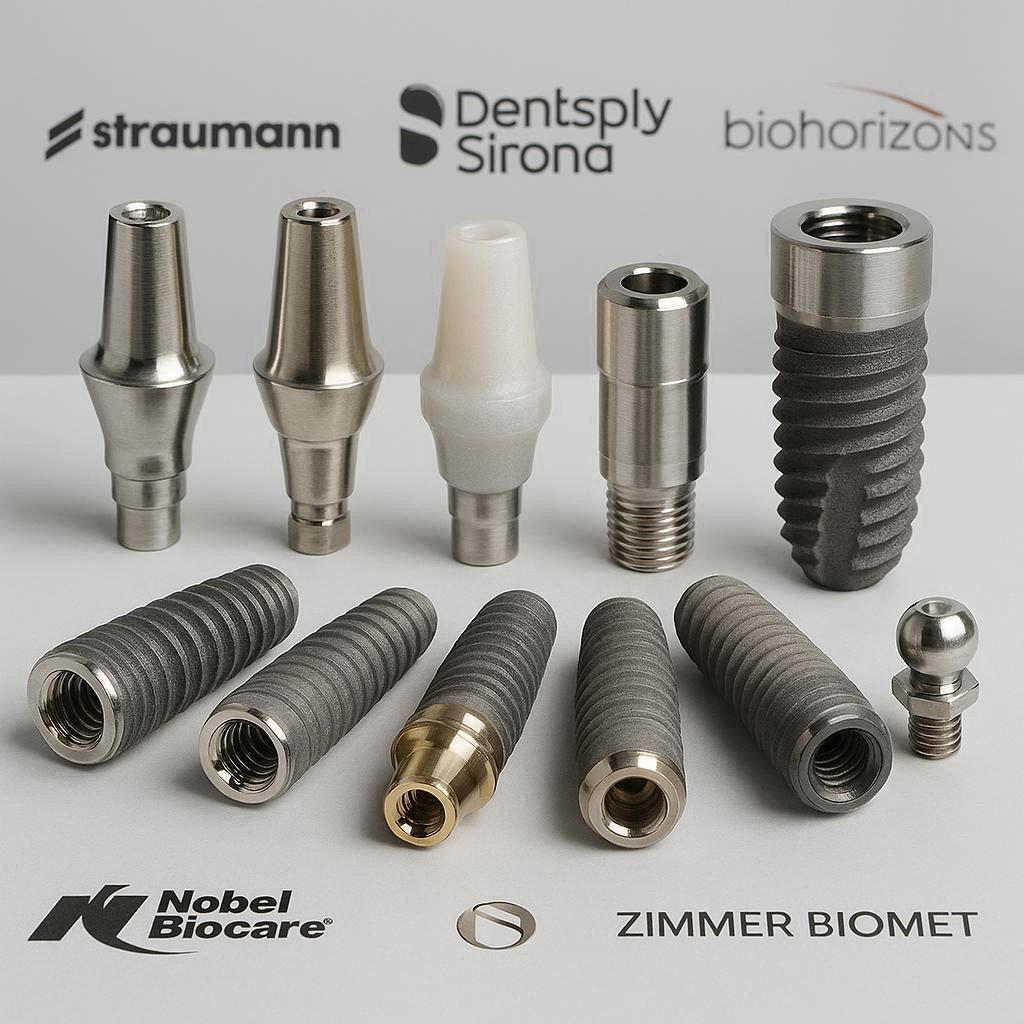
1. Straumann (Switzerland)
Straumann is often called the Rolls-Royce of implants. They invented the SLA surface (Sandblasted, Large-grit, Acid-etched), which is now an industry standard. Their Bone Level and Tissue Level designs are legendary.
Why dentists love them:
- The SLActive surface claims to cut healing time from 6-8 weeks to 3-4 weeks.
- Excellent for immediate loading (getting a temporary tooth the same day).
- Massive scientific backing – over 1,000 studies.
Best for: Patients with good bone volume who want the fastest possible healing.
Potential downside: High cost. Also, some general dentists find the prosthetic components slightly complex.
2. Nobel Biocare (Sweden/USA)
Nobel Biocare is the original. They pioneered the “All-on-4” concept (full arch restoration with just four implants). If you need a full mouth reconstruction, this brand is a top contender.
Why dentists love them:
- The TiUnite surface has excellent soft tissue response.
- Incredible color-matching for zirconia crowns.
- The NobelActive design is great for extraction sockets.
Best for: Full arch replacements (All-on-4) and anterior (front) aesthetic zones.
Potential downside: Their prosthetic components are expensive. Replacing a lost screw can cost over $100.
3. Dentsply Sirona (USA/Germany) – Implants: Astra Tech, Ankylos
Dentsply is a giant. They own several implant lines, but Astra Tech is their premium star. The Astra Tech OsseoSpeed surface is famous for preserving marginal bone levels.
Why dentists love them:
- Micro-thread design reduces bone loss over time.
- Very forgiving for beginner implant dentists (predictable seating).
- Excellent conical connection (seals out bacteria).
Best for: Patients with thin gum biotype or history of bone loss around natural teeth.
Potential downside: The ecosystem is large, but the supply chain can occasionally be slow in some regions.
4. Zimmer Biomet (USA) – Implants: Tapered Screw-Vent, SwissPlus
Zimmer Biomet is a powerhouse in orthopedics and dental. Their Tapered Screw-Vent has decades of data. The SwissPlus line (made in Switzerland) competes directly with Straumann.
Why dentists love them:
- The Encode healing abutment allows for digital impressions without an impression post.
- Very competitive pricing for a premium brand.
- Strong warranty program.
Best for: Posterior (back teeth) restorations where strength is critical.
Potential downside: Their product line is a bit “messy.” Different factories produce different quality levels.
5. Bicon (USA)
Bicon is the rebel. They do not use screws. They use a locking taper design (a friction-fit connection). This eliminates screw loosening entirely. It is a niche but brilliant system.
Why dentists love them:
- No screws to break or loosen ever.
- Short implants (as short as 5mm) save patients from sinus lifts.
- Extremely simple restorative process.
Best for: Patients with limited bone height who want to avoid grafting.
Potential downside: Not every dentist is trained on Bicon. The “no screw” concept scares some traditional clinicians.
Comparative Table: Premium vs. Value Brands
| Brand | Origin | Surface Tech | 10-Year Success Rate | Average Cost per Implant (Implant + Abutment + Crown) | Best For |
|---|---|---|---|---|---|
| Straumann | Switzerland | SLActive | 98.7% | $2,800 – $4,500 | Fast healing, high bone volume |
| Nobel Biocare | Sweden | TiUnite | 98.1% | $2,900 – $4,800 | Full arches, front aesthetics |
| Astra Tech (Dentsply) | Sweden/USA | OsseoSpeed | 97.9% | $2,700 – $4,200 | Thin gums, bone preservation |
| Zimmer Biomet | USA | Osseotite | 97.2% | $2,500 – $3,900 | Posterior teeth, budget-premium mix |
| Bicon | USA | HA Coated | 96.5% | $2,600 – $4,000 | Short bone, no screws |
| Hiossen (Value) | USA/Korea | Ostem | 95.4% | $1,800 – $2,800 | Budget conscious, good bone |
| MegaGen (Value) | South Korea | Anyridge | 95.1% | $1,700 – $2,600 | High-volume clinics |
Important note on prices: These are average U.S. clinic fees including the implant fixture, abutment, and final crown. Your geographic location and bone grafting needs will change the final bill by +/- 40%.
The Best “Value” Implant Brands (Reliable but Affordable)
Not everyone needs a Swiss watch. Sometimes, a solid Japanese or Korean watch tells time just as well. The same applies to implants. These brands are not “cheap.” They are “value leaders.”
Hiossen (USA / South Korea)
Hiossen has grown incredibly fast. They offer a nearly identical platform to Nobel Biocare (sometimes called a “clone” but legally distinct). Their Ostem surface is well-studied.
The honest take: Hiossen works wonderfully for single teeth in healthy bone. However, long-term data (20+ years) does not match Straumann yet. They are a fantastic second-tier choice.
MegaGen (South Korea)
MegaGen invented the Anyridge surface, which shows excellent early bone formation. In Europe and Asia, MegaGen is a dominant player. Many “boutique” clinics use MegaGen to keep prices down without sacrificing safety.
The honest take: Their packaging and labeling are not as premium as Nobel, but clinical outcomes are solid for straightforward cases.
Neobiotech (South Korea)
Another Korean success story. Neobiotech is famous for extremely affordable laser-lok style surfaces. They are less common in the US but very popular in Latin America and Eastern Europe.
The honest take: Do your research on the specific dentist. Neobiotech implants themselves are fine. The problem is usually cheap generic abutments used with them.
Implant Surfaces Explained (Simplified)
You will hear dentists argue about “surface roughness.” Here is the simple version:
- Machined (Smooth): Old technology (1980s). Slower healing. Higher failure rate. Avoid unless it is a very special case.
- SLA (Sandblasted + Acid-etched): Standard today. Good roughness. Predictable. (Straumann, Zimmer).
- SLActive: SLA but chemically modified to attract blood cells faster. Healing in 3-4 weeks instead of 8.
- TiUnite: A thick, porous oxide layer. Very good for soft tissue. (Nobel).
- Hydroxyapatite (HA) Coated: A calcium phosphate coating. Bicon uses this. Excellent bone bonding but can delaminate if overheated during insertion.
The golden rule: Any implant with a modern moderately rough surface (SLA or equivalent) will integrate well. Do not obsess over microscopic differences.
Regional Differences: Best Brands in the US vs. Europe vs. Asia
The “best implant brands worldwide” changes depending on where you live. Supply chains and regulatory approvals differ.
In the United States
- Most common premium: Straumann, Nobel Biocare, Zimmer.
- Most common value: Hiossen, Implant Direct (owned by Straumann now).
- FDA clearance is strict, so you will not find many unknown brands.
In Europe
- Most common premium: Straumann (Switzerland is local), Dentsply (Germany), Bego (Germany).
- Most common value: MegaGen, Neoss (UK), Alpha-Bio Tec (Israel).
- Europeans tend to prefer slightly narrower implants than Americans.
In Asia / Latin America
- Most common premium: Nobel Biocare, Straumann (imported).
- Most common value: Dentium (Korea), Osstem (Korea), Neobiotech.
- Korean brands dominate here because of aggressive pricing and good quality.
Quotation from a dental lab technician in Texas:
“I see failed cheap implants every week. But 90% of failures are not the brand. They are poor placement, bad crown fit, or the patient smoking. A Straumann placed badly will fail. A Hiossen placed perfectly will last 20 years. Focus on the surgeon, not just the box.”
How to Choose Based on Your Medical Profile
Let us match your specific situation to a brand.
Scenario 1: You have excellent bone and healthy gums.
Recommendation: Any top 5 brand works. Save money with Hiossen or MegaGen. You do not need SLActive super-surfaces. Standard SLA is fine.
Scenario 2: You have thin, fragile gums (biotype).
Recommendation: Astra Tech or Nobel Biocare. These brands have documented better soft tissue management and less gum recession over time.
Scenario 3: You need a full arch (All-on-4 or All-on-6).
Recommendation: Nobel Biocare invented the protocol. Straumann also has a strong system. Do not use a value brand for full arches. The engineering tolerances are too critical.
Scenario 4: You have low bone height and want to avoid a sinus lift.
Recommendation: Bicon short implants (5mm or 6mm). Also, Straumann offers 4mm implants. This is a game-changer for upper back teeth.
Scenario 5: You grind your teeth at night (bruxism).
Recommendation: Zimmer Biomet Tapered Screw-Vent (thick, strong). Or Straumann Bone Level with a cross-fit connection. Avoid narrow-diameter implants (3.3mm or less) if you grind.
Red Flags: Brands to Be Cautious About
I will not name specific “bad” brands because that changes yearly. But here are red flags:
- The “white label” implant. A company that does not manufacture anything. They buy cheap implants from China and repackage them. No research budget.
- No surface name. If the brand cannot tell you exactly what the surface is (e.g., “SLA-like”) and show a peer-reviewed paper, walk away.
- Discontinued parts. Call the company. Ask if they still make abutments for an implant placed 10 years ago. If they hesitate, avoid them.
- Too cheap. An implant fixture (just the screw part) costs the clinic $150 to $400 from a good brand. If a dentist offers a full implant for $999 including crown, ask what brand. It is probably a $50 implant. That is risky.
FAQ: Best Implant Brands Worldwide
Q1: Which implant brand do most Nobel Prize winners use?
A: This is a trick question. There is no data on that. Do not fall for marketing that name-drops celebrities.
Q2: Are Korean implants as good as Swiss implants?
A: For straightforward cases, yes, they are very close. For complex cases (immediate loading, poor bone, full arches), Swiss/Swedish brands have better long-term data.
Q3: Can I ask my dentist to order a specific brand?
A: Yes, but be prepared for a “no.” Dentists invest in training and inventory for 2-3 brands. They will use what they know best. Do not force a brand they hate.
Q4: What is the failure rate for the best implant brands?
A: Even the best brands have a 2-3% failure rate within the first year. Most failures are due to infection (peri-implantitis) or smoking, not the brand itself.
Q5: Do I need the most expensive brand for a single front tooth?
A: For front teeth (aesthetics), yes, invest in Nobel or Straumann. Their abutment connections and color matching are superior. For a hidden back molar, a value brand is fine.
Q6: How do I verify if a brand has clinical studies?
A: Search on PubMed. Type the brand name + “dental implant clinical trial.” If only 2 or 3 old studies appear, that is weak. Leaders have 100+ studies.
Additional Resources
Link: [PubMed Central – Dental Implant Survival Rates by Brand] (https://www.ncbi.nlm.nih.gov/pmc/articles/PMC7340122/)
This is a direct link to a systematic review comparing major implant brands. It is technical but reliable. Use it to verify the claims in this article.
A Final Honest Checklist Before You Choose
Print this. Take it to your consultation.
- Does the dentist use this brand daily? (Ask: “What is your personal success rate with Brand X?”)
- Does the brand offer a warranty? (Premium brands offer 5-10 years on the fixture).
- Has the brand published a 5-year clinical study? (Ask to see the title).
- Is the abutment included in the price? (Hidden costs appear here).
- Does my medical history (diabetes, smoking, osteoporosis) require a specific surface? (SLActive for smokers, for example).
Conclusion
The best implant brands worldwide are Straumann, Nobel Biocare, and Astra Tech (Dentsply) for premium predictability. For value without sacrificing safety, Hiossen and MegaGen are excellent choices. Avoid no-name white-label implants. Always prioritize the surgeon’s skill over the brand name, and match the implant surface to your bone health.
FAQ (Quick Recap)
- Best overall: Straumann.
- Best for full arches: Nobel Biocare.
- Best for thin gums: Astra Tech.
- Best budget premium: Hiossen.
- Best for short bone: Bicon.