swollen lip after dental implant surgery
You made the decision to restore your smile with a dental implant. You prepared for the procedure, arranged time off work, and even stocked up on soft foods. Then you looked in the mirror a few hours after surgery, and your heart sank a little.
Your lip looks like you went three rounds with a boxing champion.
Let’s pause for a moment. Take a breath. What you are seeing is incredibly common. In fact, a swollen lip after dental implant surgery happens to most people. It is not a sign that something went wrong. It is your body’s natural, healthy response to a carefully controlled surgical procedure.
This guide walks you through everything you need to know. We will explore why swelling happens, how to manage it at home, what to expect day by day, and – most importantly – how to tell the difference between normal healing and a potential problem.
No medical jargon overload. No scare tactics. Just clear, honest, practical information to help you heal with confidence.
Why Does Your Lip Swell After a Dental Implant?
Swelling is your body’s first responder. When the oral surgeon makes an incision in your gum and places a titanium post into your jawbone, your immune system immediately sends extra blood flow and white blood cells to the area. This process is called inflammation.
Inflammation sounds scary, but it is actually your best friend during healing. It delivers oxygen, nutrients, and repair cells directly to the surgical site.
Now, why the lip specifically? The dental implant procedure happens very close to the nerves, blood vessels, and soft tissues that supply your lower or upper lip. For implants in the lower jaw, the mental nerve runs near the premolar area. For upper implants, the infraorbital nerve affects the upper lip and cheek area.
During surgery, these tissues get gently retracted, stretched, or manipulated. Even with the most skilled surgeon, this causes fluid to leak into the surrounding soft tissues. Gravity then pulls some of that fluid downward, which is why swelling often appears worse in your lip than directly at the implant site.
Think of it like this: you stubbed your toe, but your whole foot swelled. The lip is simply the softest, most pliable tissue in the area, so it shows the inflammation most visibly.
Common causes of lip swelling after implant surgery
- Surgical trauma – Even minimally invasive surgery creates microscopic tissue damage.
- Local anesthesia – Needle injections can cause localized bruising and swelling.
- Fluid accumulation – The body’s natural inflammatory response brings extra fluid to the area.
- Tissue retraction – Instruments gently hold back your cheek or lip during the procedure.
- Bone drilling – Vibration and heat (even with irrigation) can irritate surrounding tissues.
Important note: A swollen lip alone is almost never an emergency. But when swelling is paired with other specific symptoms, you need to pay attention. We will cover those red flags later.
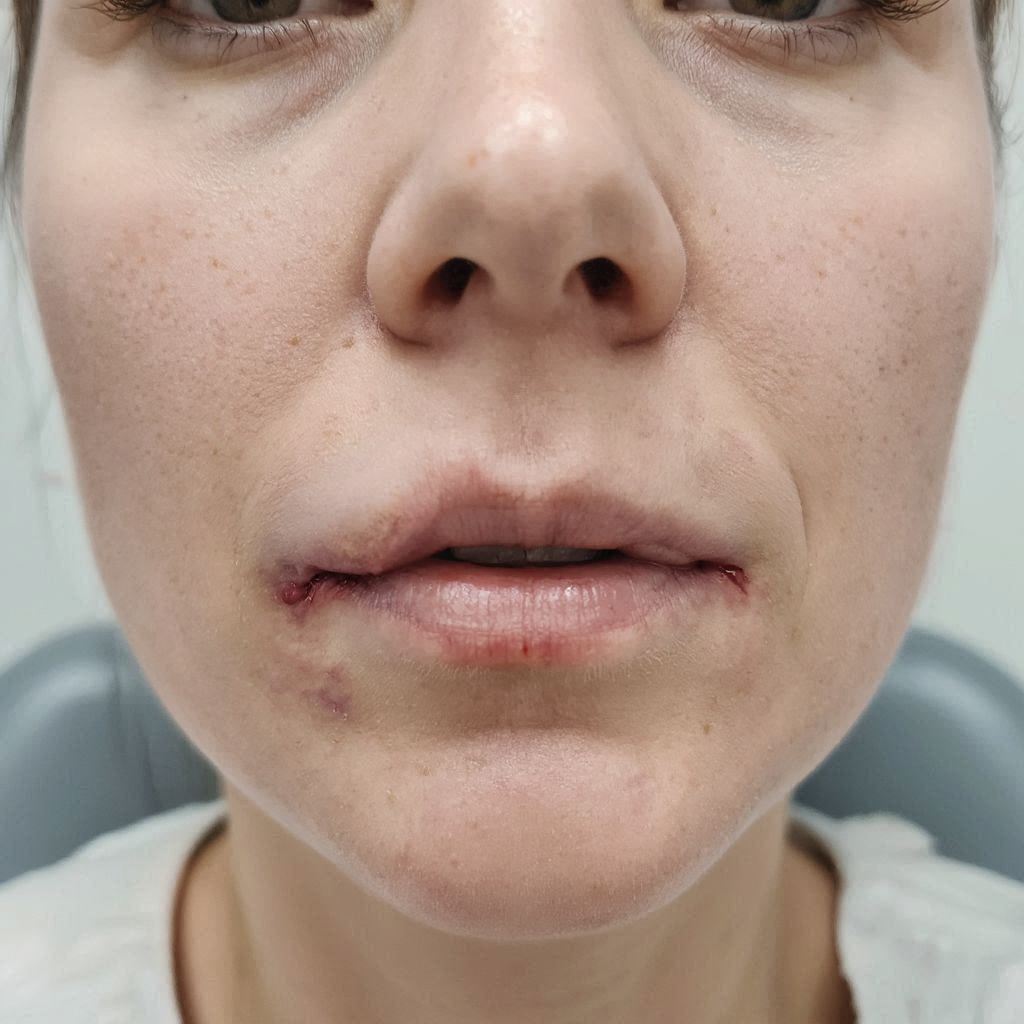
What a Normal Swollen Lip Looks Like After Dental Implant Surgery
Let us set realistic expectations. If you search online for photos of post-implant swelling, you might see extreme cases that make you panic. Do not do that to yourself. Every person heals differently.
A normal, healthy swelling pattern typically includes:
- One-sided swelling – The swelling is usually on the same side as the implant. If your implant is on the lower right, your right lower lip and chin area will be fuller.
- Soft to moderate firmness – The swollen area feels puffy but not rock-hard.
- Warm to the touch – Increased blood flow makes the area slightly warmer than the other side of your face. This is normal.
- Peaks around day two or three – Swelling gets worse before it gets better. Day two is often the worst.
- Gradual improvement after day three – By day four or five, you should notice steady improvement.
- Mild bruising – Yellow, purple, or greenish discoloration may appear. This is just old blood being reabsorbed.
Your lip might feel numb, tingly, or heavy. That is also normal, especially if the implant is near a nerve branch. Sensation usually returns within weeks to months.
Swelling levels: what to expect
| Days After Surgery | Typical Swelling Level | Lip Appearance |
|---|---|---|
| Day of surgery (hours 0–6) | Mild to none | Slight fullness, possibly numb |
| Day 1 (24 hours) | Mild to moderate | Noticeable puffiness |
| Day 2 (peak) | Moderate to significant | Most swollen, may affect smile |
| Day 3 | Moderate | Still full, but starting to plateau |
| Day 4 | Mild to moderate | Gradual decrease begins |
| Day 5–7 | Mild | Residual puffiness only |
| Day 10+ | Minimal or none | Back to normal or near normal |
Remember: these are averages. Some people swell very little. Others look like they are hiding a golf ball in their cheek. Both can be completely normal.
How to Reduce Swollen Lip After Dental Implant Surgery: Step-by-Step Home Care
You have power here. While you cannot prevent swelling entirely, you can dramatically reduce how long it lasts and how uncomfortable it feels.
The golden rule of post-surgical swelling
Cold for the first 48 hours. Heat after 48 hours.
This is non-negotiable. Using the wrong therapy at the wrong time can actually make swelling worse.
Phase 1: Cold therapy (first 48 hours)
Cold constricts blood vessels. This reduces fluid leakage into your tissues. It also numbs the area, which helps with pain.
How to apply cold properly:
- Use an ice pack, frozen peas, or a gel pack wrapped in a thin cloth.
- Never apply ice directly to your skin. Direct ice can cause frostbite or tissue damage.
- Apply for 15–20 minutes at a time.
- Remove for at least 20 minutes before reapplying.
- Repeat as often as you like during waking hours.
- Keep your head elevated even while using ice.
Why elevation matters: When you lie flat, gravity pushes fluid toward your head and face. Keeping your head elevated – even while sleeping – helps fluid drain away from your lip and jaw.
Phase 2: Warm therapy (after 48 hours)
After two days, you switch to warmth. Heat dilates blood vessels, which helps your lymphatic system flush away the fluid that accumulated. Warmth also soothes muscle stiffness in your jaw.
How to apply warmth safely:
- Use a warm, damp cloth or a microwavable heat pack.
- Ensure it is comfortably warm, not hot enough to burn.
- Apply for 15 minutes at a time.
- Do this 3–4 times daily until swelling resolves.
Other effective swelling reduction techniques
Sleep propped up. Use two or three pillows. Better yet, sleep in a recliner for the first two nights. This single habit reduces morning swelling dramatically.
Stay hydrated. Drink plenty of cool water. Hydration helps your lymphatic system work efficiently. Avoid using straws for at least a week – the suction can dislodge your blood clot.
Eat anti-inflammatory foods. Soft, cold foods like yogurt, smoothies (spoon only, no straw), and applesauce are your friends. Pineapple contains bromelain, an enzyme that some studies suggest helps reduce post-surgical swelling. Frozen fruit popsicles are also excellent.
Move gently. Do not exercise vigorously for at least a week. But gentle walking around your home improves circulation and helps fluid drain.
Avoid these common mistakes:
- Do not drink hot liquids for 24 hours.
- Do not spit forcefully.
- Do not smoke or vape (this is critical for healing and infection prevention).
- Do not take aspirin unless your surgeon prescribed it (aspirin thins blood and can worsen swelling).
- Do not poke or press on your swollen lip.
Day-by-Day Healing Timeline for Swollen Lip After Dental Implant Surgery
Knowing what comes next reduces anxiety. Here is a realistic, honest timeline.
Day of surgery (hours 0–12)
You leave the dental office with gauze between your teeth. Your lip feels thick and strange, mostly from the anesthetic. Actual swelling is minimal right now. You might feel euphoric or tired. Rest. Do not try to be productive.
Day 1
Swelling announces itself. Your lip looks noticeably fuller on one side. It might feel warm. You start your ice pack rotation. Eating is challenging – stick to cold smoothies and pudding. Keep your head high even when watching TV.
Day 2 (peak swelling day)
This is the day most people worry unnecessarily. Your lip looks its worst. It might feel tight. You cannot smile symmetrically. Ice is still your best friend. Do not panic. Tomorrow, things start improving.
Day 3
Swelling plateaus. It is still present, but it is not getting worse. You switch to warm compresses today. You notice the swelling feels softer, less firm. You can open your mouth a little wider.
Day 4
The downward trend begins. Swelling visibly reduces. You can see more of your natural lip shape returning. Bruising might appear now – yellow or purple patches near your chin or cheek. This is normal and good. It means your body is cleaning up.
Day 5–7
Swelling is mild. You look mostly like yourself. Some puffiness remains, especially in the morning after sleeping. Warm compresses still help. You can eat soft, warm foods now.
Week 2
Any residual swelling is likely only noticeable to you. Others would not see it. Your lip sensation may still feel strange – that is normal and can take months to fully return.
Week 3–4
Healing continues internally. External swelling should be completely gone. If you still have noticeable swelling at week three, call your dentist for a check.
Medications and Swelling: What Helps and What Hurts
Your dentist or oral surgeon likely prescribed or recommended specific medications. Understanding how each one affects swelling helps you use them wisely.
Anti-inflammatory drugs (NSAIDs)
Ibuprofen (Advil, Motrin) and naproxen (Aleve) directly reduce inflammation. They are excellent for both pain and swelling. Many surgeons recommend alternating ibuprofen with acetaminophen (Tylenol) for optimal relief.
Typical adult dosing (always follow your specific prescription):
- Ibuprofen 400–600 mg every 6–8 hours as needed
- Acetaminophen 500–1000 mg every 6 hours as needed
Important: Do not take ibuprofen if you have a history of stomach ulcers, kidney disease, or take blood thinners. Ask your surgeon before taking any medication.
Prescription pain relievers
Stronger opioids like hydrocodone or tramadol reduce pain but do very little for swelling directly. They also cause constipation, nausea, and drowsiness. Use them only as prescribed and only for severe pain.
Antibiotics
Antibiotics do not reduce swelling from normal surgical inflammation. They prevent or treat bacterial infection. If your swelling is caused by an infection (more on this below), antibiotics are essential. But for routine swelling, they make no difference.
Steroids (occasional prescription)
Some oral surgeons prescribe a short course of corticosteroids (like dexamethasone) to dramatically reduce post-surgical swelling. This is more common for complex procedures like multiple implants or bone grafting. If you were given a steroid pack, take it exactly as directed.
What to avoid
- Aspirin – Thins blood and can prolong swelling and bruising.
- Alcohol – Dehydrates you and can increase swelling.
- Unapproved herbal supplements – Ginkgo biloba, garlic, ginger, and vitamin E can thin blood. Avoid for at least one week post-surgery.
When a Swollen Lip Signals Something Wrong
Here is where we get serious. While most swollen lips after dental implants are completely normal, a small percentage indicate complications. Knowing the difference protects your health and your investment.
Normal swelling vs. concerning swelling
| Feature | Normal Swelling | Concerning Swelling |
|---|---|---|
| Onset | Gradual over 24–48 hours | Sudden, rapid, or delayed (after day 5) |
| Location | Localized to surgical side | Spreading to eye, neck, or opposite side |
| Pain level | Mild to moderate, controlled by medication | Severe, worsening, or unresponsive to meds |
| Lip feel | Soft or mildly firm | Rock-hard, hot, or shiny |
| Associated symptoms | None or mild discomfort | Fever, chills, bad taste, pus, difficulty breathing or swallowing |
| Timeline | Peaks day 2–3, then improves | Continues worsening after day 3 |
Red flag symptoms that require immediate medical attention
Call your dentist, oral surgeon, or go to an emergency room if you experience:
- Difficulty breathing or swallowing – This is rare but serious. It could indicate a severe allergic reaction or deep space infection.
- Fever over 101°F (38.3°C) – Low-grade fever (99–100°F) is common after surgery. High fever suggests infection.
- Swelling that worsens after day three – Normal swelling peaks then declines. Increasing swelling after the peak is concerning.
- Pus or foul drainage – White, yellow, or green discharge from the surgical site with a bad taste or odor.
- Numbness that spreads – Some numbness is expected. But if numbness extends to your entire lower face or both lips, call your surgeon.
- Inability to open your mouth more than one finger width – Trismus (jaw stiffness) is normal, but complete inability to open is not.
- Swelling that closes one eye – This suggests infection spreading toward the orbit.
Most likely complications that cause problematic swelling
Infection (peri-implantitis or surgical site infection)
Occurs in about 1–5% of dental implant procedures. Signs include increasing pain after day three, fever, bad taste, and swelling that does not respond to ice.
Allergic reaction
Rare but possible. Titanium allergy affects less than 1% of people. More common allergies include latex (gloves), local anesthetics, or chlorhexidine mouthwash.
Hematoma (collection of blood)
Sometimes a small blood vessel continues bleeding after surgery, creating a firm, bruised swelling. Most resolve on their own. Large hematomas may need drainage.
Nerve injury
The inferior alveolar nerve runs through the lower jaw. If irritated, it can cause unusual sensations. Swelling itself does not indicate nerve injury, but sudden facial droop requires immediate evaluation.
Note: Do not diagnose yourself online. When in doubt, call your surgeon’s after-hours number. They expect these calls. You are not bothering them.
Swollen Lip After Dental Implant Surgery: Special Situations
Multiple implants or full-arch reconstruction
If you received multiple implants or an “all-on-4” full arch restoration, expect significantly more swelling. Your lip, cheek, and even lower eyelid may swell. This is normal for extensive surgery. Follow the same cold/warm protocol but expect swelling to last 7–10 days instead of 3–5.
Bone grafting at the same time
Adding a bone graft increases surgical trauma. Swelling will be more pronounced and last longer. The graft material itself does not cause swelling, but the extra incisions and manipulation do.
Sinus lift for upper implants
Upper implants in the back of your mouth often require a sinus lift. This procedure lifts the sinus membrane and adds bone. Swelling may affect your upper lip, cheek, and area under your eye. You might also experience minor nosebleeds or sinus pressure. This is normal.
Previous radiation therapy to the head or neck
If you had radiation treatment for cancer, your tissues heal poorly. Swelling may be less but healing slower. Infection risk is higher. Your surgeon should know your full medical history.
Autoimmune conditions
Conditions like lupus, rheumatoid arthritis, or Crohn’s disease can affect healing. You may experience more prolonged swelling. Continue your regular medications unless your surgeon instructed otherwise.
Foods and Drinks That Help (and Hurt) a Swollen Lip
What you put in your mouth directly affects your lip swelling.
Helpful foods (anti-inflammatory and easy to eat)
- Cold fruit smoothies – Spoon only, no straw. Add protein powder for nutrition.
- Greek yogurt – Cold, soft, and probiotic.
- Mashed avocado – Rich in anti-inflammatory fats.
- Pineapple – Contains bromelain, a natural anti-inflammatory enzyme.
- Salmon (flaked, cold) – Omega-3 fatty acids reduce inflammation.
- Bone broth (cooled) – Collagen supports tissue repair.
- Cottage cheese – Soft and high in protein.
- Frozen fruit popsicles – Homemade with real fruit is best.
Foods that worsen swelling
- Hot soups or tea – Heat increases blood flow to the area.
- Spicy foods – Capsaicin irritates healing tissues.
- Crunchy or hard foods – Chips, nuts, crackers – these can poke the surgical site.
- Alcohol – Dehydrates and increases inflammation.
- High-sugar foods – Sugar promotes inflammation throughout the body.
- Coffee (hot) – Hot temperature and caffeine both affect healing.
Hydration tips
Drink plenty of cool or room-temperature water. Aim for 8–10 glasses daily. Dehydration slows healing and makes swelling last longer. Avoid using straws for at least 7 days – the suction can pull out your blood clot, leading to a painful dry socket.
Emotional Side of a Swollen Lip: You Are Not Alone
Let us talk about something most dental articles ignore: how you feel when you look in the mirror.
A swollen lip changes your face. You might not recognize yourself. Smiling feels awkward. Speaking feels strange. You worry that people will stare. You might even regret getting the implant.
These feelings are normal and valid.
Your face is the most public part of your body. When it changes, even temporarily, it affects your confidence. Give yourself permission to feel frustrated. Stay home for the first few days if that helps. Video call close friends instead of meeting in person. Wear a mask if you need to go out – no one will question it.
Here is the truth that helps most people: No one is looking at you as closely as you are looking at yourself.
Most people are too busy with their own lives to notice your slightly puffy lip. And those who do notice will assume you had dental work, which is exactly what happened.
Healing takes time. Your lip will return to normal. This temporary swelling is the price of a permanent, beautiful, functional tooth replacement. In a few months, you will barely remember this week.
Frequently Asked Questions About Swollen Lip After Dental Implant Surgery
How long does a swollen lip last after dental implant surgery?
Most people see significant improvement within 5–7 days. Mild puffiness can linger for up to two weeks. Complete resolution of all swelling typically occurs by day 10–14.
Is it normal for only one side of my lip to be swollen?
Yes. In fact, it would be unusual for both sides to swell equally. The swelling is almost always on the same side as the implant.
Can I use a straw to drink after dental implant surgery?
No. Avoid straws for at least 7 days. The suction can dislodge the blood clot that protects the surgical site, leading to a painful dry socket or implant failure.
When should I stop using ice packs?
Stop cold therapy after 48 hours. Continuing ice beyond two days can actually delay healing by constricting blood vessels too much.
Why is my swollen lip getting worse on day three?
Day two or three is the normal peak for post-surgical swelling. If it continues worsening after day three, call your dentist.
Can I wear lipstick or lip balm on my swollen lip?
Plain, unscented lip balm is fine. Avoid lipstick or any product with fragrances, dyes, or glitter for at least one week. These can irritate healing tissues.
My lip is numb and swollen. Is that bad?
Numbness plus swelling is very common, especially for lower implants near the mental nerve. Most numbness resolves within weeks to months. If numbness spreads or you cannot close your mouth, call your surgeon.
Does smoking make lip swelling worse?
Yes. Significantly worse. Smoking delays healing, increases infection risk, and can cause implant failure. This is the single most important lifestyle factor for successful healing.
Can I exercise with a swollen lip?
Light walking is fine. Avoid vigorous exercise, heavy lifting, or any activity that strains your body for at least 5–7 days. Increased blood pressure can worsen swelling and bleeding.
How do I brush my teeth with a swollen lip?
Brush your non-surgical teeth normally. For the surgical side, be very gentle. Avoid the implant site itself for the first few days. Use a child-sized soft toothbrush. Rinse gently with warm salt water (1/2 teaspoon salt in 8 oz water) starting 24 hours after surgery.
Additional Resource
For more detailed, evidence-based information on dental implant healing and long-term care, visit the American Academy of Implant Dentistry’s patient education library:
👉 https://www.aaid.com/patients/
This resource covers implant types, candidacy, costs, and long-term maintenance. It is written for patients, not dentists, so the language is clear and accessible.
Conclusion
A swollen lip after dental implant surgery is not a sign of failure. It is a sign that your body is doing exactly what it should: sending healing resources to the surgical site. Use ice for the first 48 hours, switch to warmth after, keep your head elevated, and watch for red flags like fever or worsening pain after day three. Most swelling resolves within a week. Be patient with your body and kind to yourself during recovery. Your future smile is worth a few puffy days.
Disclaimer: This article is for informational purposes only and does not constitute medical advice. Always follow the specific post-operative instructions provided by your oral surgeon or dentist. If you have concerns about your healing, contact your dental professional immediately.