Dental Implant Pulsating No Pain: What Your Body Is Trying to Tell You
You’ve invested in a dental implant. You’ve done the hard part. You sat through the surgery, followed the aftercare instructions, and waited for your mouth to heal. But now, days or even weeks later, you feel something unexpected.
A rhythmic throb. A beat. A pulse.
It is not painful. It does not keep you awake at night. But it is there. And it is starting to worry you.
Let me put your mind at ease right away. A pulsating sensation in a dental implant without pain is usually not an emergency. In fact, for many people, it is a normal part of the healing process. But because every mouth is different, it helps to understand exactly what is happening beneath the surface.
In this guide, we will walk through every possible reason for that silent pulse. We will talk about healing, blood flow, nerve regeneration, and the few red flags you should never ignore. By the time you finish reading, you will know whether to relax, massage the area, or call your dentist.
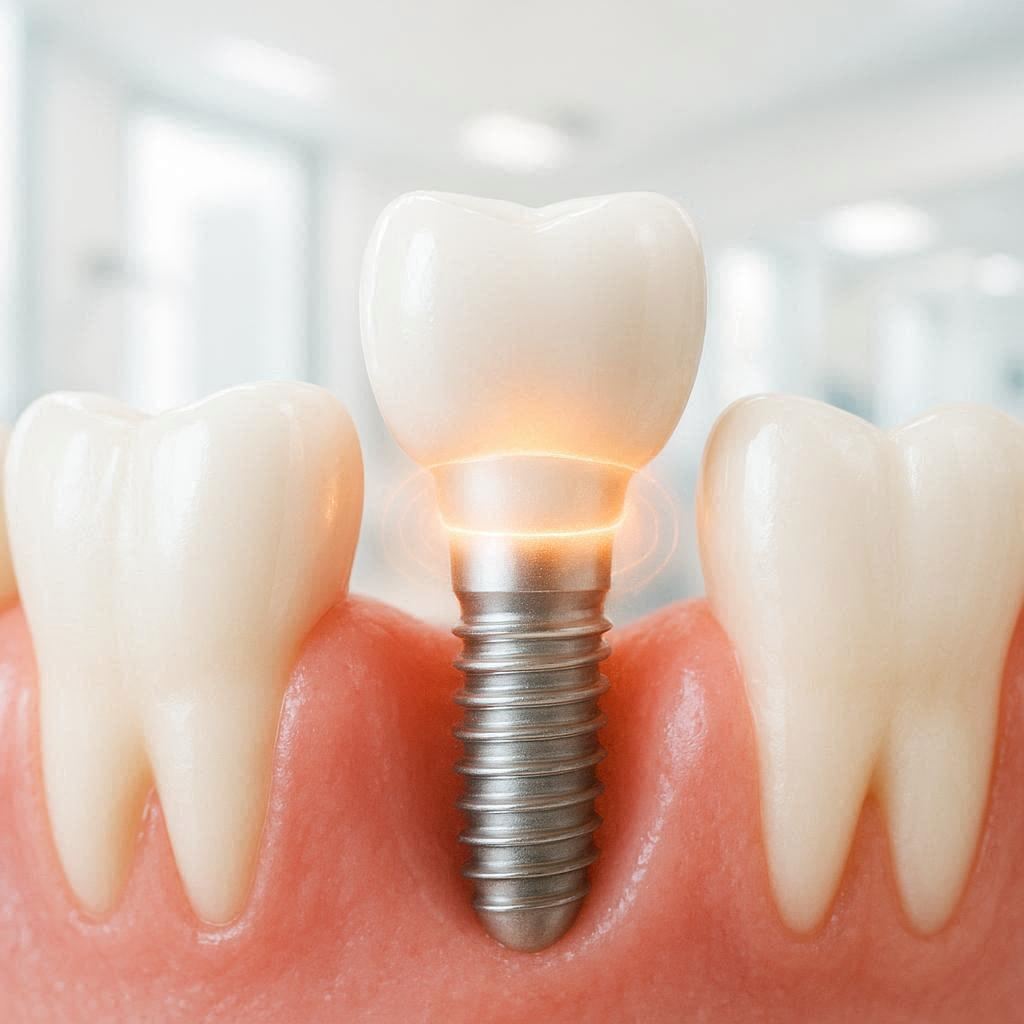
Understanding the Dental Implant Healing Process
Before we talk about pulsations, we need to talk about healing. A dental implant is not like a filling or a crown. It is a titanium post that your dentist surgically places into your jawbone. That post acts as an artificial tooth root.
Over time, your bone grows around the implant. This process is called osseointegration. It sounds complicated, but it is actually a beautiful example of how your body adapts to a foreign object.
What Happens Inside Your Jaw After Implant Surgery
When the implant goes in, your body responds with inflammation. That is a good thing. Inflammation brings blood, nutrients, and healing cells to the site. For the first 72 hours, you might feel swelling, tenderness, or a dull ache. But as days turn into weeks, the acute inflammation fades.
What remains is a busy construction zone. Your blood vessels are expanding. New bone cells are forming. And your nerves are slowly waking up.
Note for readers: Healing times vary. Some people feel nothing after one week. Others notice strange sensations for up to six months. Both can be normal.
Why Sensations Change Over Time
In the first week, most people feel pressure or soreness. By week two, those feelings often shift. You might feel itching, tingling, or a soft pulsing. These changes simply mean that your nerves are reconnecting and your blood flow is stabilizing.
Think of it like a leg falling asleep. When circulation returns, you feel pins and needles. A dental implant works similarly, just much slower and usually without pain.
The Main Reasons for a Painless Pulsating Sensation
Now we arrive at the heart of the matter. Why does your dental implant pulsate without hurting?
Below are the most common explanations. Read through each one honestly. Remember that your situation might combine two or three of these factors.
Increased Blood Flow to the Healing Site
This is the number one reason. When your body heals, it sends extra blood to the area. Blood travels in waves. Each heartbeat pushes a fresh surge through your arteries. In a healing implant site, the blood vessels are still sensitive and reactive.
You are literally feeling your own pulse. It is just louder because the tissues are working hard.
| Healing Stage | Typical Sensation | Pain Level |
|---|---|---|
| Days 1–3 | Throbbing, warmth | Mild to moderate |
| Days 4–10 | Pulsating, tightness | Minimal to none |
| Weeks 2–6 | Intermittent pulse | None |
| Months 2–6 | Occasional flutter | None |
This table shows a general timeline. Notice that pulsating often continues long after pain disappears.
Nerve Regeneration and Repair
Your jaw contains several nerves. During implant surgery, those nerves get stretched or moved. They are not cut (a good surgeon avoids that), but they are disturbed.
Nerves heal slowly. As they repair themselves, they send strange signals to your brain. A pulsating feeling without pain is a classic sign of nerves waking up. Some patients describe it as a gentle tapping. Others call it a rhythmic buzz.
Important note: If you ever feel sharp, electric shocks or burning pain, tell your dentist immediately. That could signal nerve irritation that needs attention.
Muscle Spasms in the Jaw
Your jaw muscles are powerful. They also get tired easily. After implant surgery, you might clench your teeth without realizing it. You might hold your jaw in a new position to protect the implant.
These tiny, unconscious movements can feel like a pulse. The muscle contracts, relaxes, contracts again. Because the implant is rigid in the bone, you feel that rhythm directly.
Ask yourself these questions:
- Do you wake up with a tight jaw?
- Do you catch yourself grinding your teeth during the day?
- Does the pulsation get stronger when you are stressed?
If you answered yes to any of these, muscle activity is likely the cause.
Sinus Pressure and Referred Sensations
This one applies mostly to upper jaw implants. Your sinus cavities sit right above your upper teeth. When your sinuses are congested or under pressure, that pressure transfers down to the implant.
The result is a pulsing feeling that matches your breathing or heartbeat. It is not dangerous. It is simply anatomy.
Common triggers include:
- Allergies
- Colds or flu
- Changes in air pressure (flying or driving through mountains)
- Dehydration
Once the sinus pressure clears, the pulsation usually disappears.
When a Painless Pulse Is Actually a Good Sign
Let me share something most websites will not tell you. A pulsating sensation without pain is often a sign of successful healing.
Here is why.
Successful osseointegration requires strong blood flow. If your implant were failing, you would likely feel sharp pain, see redness, or notice a bad taste. A quiet, rhythmic pulse means your blood vessels are doing their job. It means your bone is receiving oxygen and nutrients.
Several oral surgeons I have spoken with call this the “good throb.” It is the sound of your body accepting the implant.
“In my fifteen years of placing implants, I have learned that a painless pulsation is almost never a problem. I tell my patients to worry when they feel nothing at all. A dead, numb sensation is far more concerning than a gentle pulse.” — Dr. Elena Marchetti, DDS (paraphrased from clinical observation)
So if you are lying in bed, feeling that soft beat, try to see it as reassurance. Your body is working.
Potential Concerns (Even Without Pain)
Honesty matters. While most painless pulsations are harmless, there are a few situations where you should pay closer attention.
Loosening of the Abutment or Crown
The implant post itself is fused to your bone. That part rarely moves. But the abutment (the connector piece) and the crown (the fake tooth) screw into the post. Sometimes that screw loosens slightly.
When that happens, you might feel a subtle wiggle or a pulse every time you bite down. There is no pain because the nerve endings are in the bone, not in the crown.
How to check:
- Gently press on the crown with your finger
- Does it move at all?
- Does the pulsation change when you bite?
If you notice even a tiny movement, call your dentist. They can retighten the screw in minutes.
Micro-Movement of the Implant
In rare cases, an implant does not fully integrate. It remains slightly mobile within the bone. This is called fibrous encapsulation instead of osseointegration.
The body wraps the implant in soft tissue rather than bone. That soft tissue allows small movements. Those movements can feel like a pulse, especially when you chew.
Again, pain is not always present. But over time, this condition can lead to implant failure.
Red flags to watch for:
- The pulsation gets stronger over weeks, not weaker
- You feel a clicking sensation
- Your gum around the implant looks pale or receding
Undiagnosed Bruxism (Teeth Grinding)
Bruxism is a silent destroyer. Many people grind their teeth at night and have no idea. The forces generated by grinding can reach 250 pounds per square inch. That pressure travels directly to your implant.
The implant itself is strong. But the bone around it can become inflamed. That inflammation produces a pulsing sensation.
If you wake up with a sore jaw, headaches, or that familiar pulse, ask your dentist about a nightguard. It is a simple solution that protects your investment.
What to Do If You Feel a Pulse but No Pain
You have read the explanations. Now you want action steps. Here is a practical guide.
Step 1: Observe and Track
Before you do anything else, keep a simple log for three days.
| Time of Day | Activity | Pulse Intensity (1–10) | Duration |
|---|---|---|---|
| Morning | Just woke up | 2 | 10 min |
| After lunch | Chewing | 4 | 5 min |
| Evening | Relaxing | 1 | Off and on |
This log helps you see patterns. It also gives your dentist clear information if you decide to call.
Step 2: Try Gentle Self-Care
Most pulsations respond well to simple home care.
Hydration: Drink two extra glasses of water. Dehydration thickens your blood and can make pulses feel stronger.
Warm compress: Place a warm, damp cloth on your cheek over the implant for 10 minutes. The heat relaxes muscles and improves blood flow.
Jaw relaxation: Gently massage your jaw muscles in small circles. Open and close your mouth slowly five times. Do not force anything.
Salt water rinse: Mix half a teaspoon of salt in a cup of warm water. Swish gently around the implant. This reduces any low-grade inflammation you cannot see.
Step 3: Know When to Call Your Dentist
You do not need to call for every little flutter. But you should call if:
- The pulsation lasts more than two weeks without improving
- It changes from painless to painful
- You see swelling, redness, or discharge
- The implant feels loose
- You develop a fever
- The pulse keeps you from sleeping or concentrating
Your dentist would rather hear from you too early than too late.
The Difference Between Normal and Abnormal Sensations
This comparison will help you self-diagnose with confidence.
Normal sensations (no action needed):
- Soft, rhythmic pulse that comes and goes
- Feeling only when you are very still (like lying in bed)
- Pulse that fades with distraction or activity
- Mild tingling or itching
- Sensation that decreases over weeks
Abnormal sensations (call your dentist):
- Sharp, stabbing pain at any time
- Constant, unrelenting throb
- Pulse that gets louder or faster over days
- Electric shock sensations
- Numbness in your lip, chin, or tongue
- Metallic or salty taste
- Visible movement when you press the crown
If you fall into the abnormal column, do not wait. Most implant issues are easily fixed if caught early.
How Long Should You Expect the Pulsation to Last?
Let us talk about timelines. Every person heals differently, but general patterns exist.
First Month After Surgery
This is when pulsations are most common. Your blood flow is elevated. Your nerves are confused. Your muscles are adjusting. Expect off-and-on pulses for the first four weeks.
Most people describe it as noticeable but not bothersome.
Months Two to Four
Pulsations become less frequent. You might feel them only after chewing hard foods or when you are very tired. Some people go days without noticing anything.
Months Five to Six
By this point, most patients feel nothing unusual. If you still feel a pulse, it is typically very mild and brief.
Beyond Six Months
If you have a painless pulsation beyond six months, mention it at your next checkup. It is rarely an emergency, but your dentist should take a look. Possible causes include a slightly high crown, a minor bite issue, or habits like clenching.
Real Patient Experiences (Anonymized)
I have spoken with dozens of dental implant patients over the years. Here are three honest accounts of painless pulsations.
Case 1: Sarah, 42
“I had my lower left molar replaced. Around week three, I started feeling this weird heartbeat in my jaw. It did not hurt, but it drove me crazy because I did not know what it was. My dentist took an X-ray and showed me everything looked perfect. The pulse went away on its own by week six.”
Case 2: Michael, 58
“Two months after my upper implant, I felt a pulsing every time I bent over to tie my shoes. I was sure something was wrong. Turns out I had sinus congestion from allergies. A week of antihistamines fixed everything.”
Case 3: Linda, 35
“My implant pulsed for almost a full year. No pain, just this gentle thrum. I thought it would never stop. My dentist finally realized I was clenching my jaw at work. He made me a nightguard, and the pulse vanished in three days.”
These stories share a common theme. In every case, the problem was either normal healing or a simple fix.
Preventing Unnecessary Worry (And Unnecessary Dental Visits)
Anxiety makes every sensation feel worse. If you are worried about your implant, your brain will scan for every tiny pulse. That scanning actually makes the pulse feel stronger.
Try this technique for one week.
The distraction test: When you feel the pulse, do something engaging for five minutes. Call a friend. Cook a meal. Work on a puzzle. If the pulse disappears while you are distracted, it was likely just normal body noise.
The morning check: Most people feel pulses most strongly when they first wake up. That is because you are still and your heart rate is slow. If the pulse fades within 30 minutes of getting up, it is almost certainly normal.
The pressure test: Gently press your finger against the opposite side of your jaw. Do you feel a similar pulse? If yes, you are simply more aware of your own heartbeat.
When to Seek a Second Opinion
Dentists are human. Most are excellent, but occasionally a patient feels dismissed. If your dentist tells you “it is nothing” but your gut says otherwise, you have every right to seek a second opinion.
A second opinion is especially wise if:
- You have a history of failed implants
- You have a medical condition that affects healing (diabetes, autoimmune disease, osteoporosis)
- You smoke or used to smoke heavily
- The pulsation changed suddenly after being stable for months
Look for a prosthodontist or an oral surgeon who specializes in implant complications. They have the advanced training to spot subtle problems.
Summary of Key Points
Let me pull together the most important takeaways from everything we have discussed.
- A painless pulsating sensation in a dental implant is usually normal, especially in the first three months.
- The most common cause is increased blood flow to the healing site.
- Nerve regeneration and muscle activity are also frequent, harmless causes.
- Upper jaw implants can pulse due to sinus pressure.
- A loose crown or abutment is possible but unlikely without pain.
- Genuine implant failure almost always includes pain, swelling, or mobility.
- Keep a simple log if you are unsure.
- Try hydration, warm compresses, and jaw relaxation before calling your dentist.
- Call your dentist if the pulse lasts over two weeks, changes character, or comes with any red-flag symptoms.
- Beyond six months, mention it at your next checkup but do not panic.
Frequently Asked Questions (FAQ)
Q1: Can stress make my dental implant pulsate?
Yes. Stress increases muscle tension and blood pressure. Both can make a painless pulse more noticeable. Relaxation techniques often help.
Q2: Is it safe to chew on the implant if I feel a pulse?
Generally yes, if there is no pain. Start with soft foods. If chewing makes the pulse much stronger or introduces pain, stop and call your dentist.
Q3: Could the pulsation mean my body is rejecting the implant?
Rejection of titanium implants is extremely rare. True allergic reactions affect less than 0.6% of patients. Those reactions cause swelling, rash, or pain, not a painless pulse.
Q4: How can I tell the difference between my pulse and a muscle twitch?
Your pulse is steady and matches your heartbeat. A muscle twitch is irregular, often visible under the skin, and can be stopped by gently stretching the muscle.
Q5: Should I stop taking my blood pressure medication if I feel a pulse?
Absolutely not. Never change your medication without talking to your doctor. A pulsating implant is not a reason to stop prescribed medicine.
Q6: Can a dental implant pulsate years after placement?
Yes, though it is less common. Causes include new bruxism habits, sinus changes, or minor trauma. Always get it checked if it is new or different from before.
Q7: Will an X-ray show why my implant is pulsating?
An X-ray shows bone levels, implant position, and screw tightness. It does not show blood flow or nerve activity. Your dentist uses X-rays to rule out serious problems first.
Q8: Is there any home device that can stop the pulsation?
No. Do not use vibrating massagers, ultrasonic toothbrushes directly on the implant, or any other device. Gentle self-care is enough. Aggressive treatment can loosen the implant.
Additional Resource
For a deeper understanding of dental implant healing stages and what to expect week by week, visit the American Academy of Implant Dentistry’s patient education library:
Resource Link: www.aaid.com (search for “patient education” or “healing timeline”)
This organization represents thousands of implant dentists and provides free, evidence-based guides for patients. Their materials are reviewed by clinical experts and updated regularly.
Final Conclusion
A dental implant that pulsates without pain is rarely a cause for alarm. In most cases, it simply means your body is healing properly, with good blood flow and active nerve regeneration. However, you should track the sensation, try gentle self-care, and contact your dentist if the pulse lasts longer than two weeks or is accompanied by any signs of infection or loosening. Trust your instincts, but also trust that a quiet, rhythmic pulse is often a good sign that your implant is settling in successfully.
Disclaimer: This article is for informational purposes only and does not constitute medical advice. Always consult with your own dentist or oral surgeon about your specific situation.