Why Is My Dental Implant Throbbing? 7 Causes & When to Worry
You have invested time, money, and hope into your dental implant. It was supposed to feel like a natural part of your mouth—strong, stable, and pain-free. So when you start feeling a persistent, rhythmic throbbing deep in your jaw, it is natural to feel anxious.
Throbbing often signals that something is not right. Unlike a sharp, fleeting pain, a throb usually points to changes in blood flow, pressure, or inflammation deep within the tissues.
The good news? Most causes of implant throbbing are treatable. The bad news? Ignoring the sensation can lead to bigger problems.
In this guide, we will walk through every possible reason behind that pulsing ache. You will learn how to tell the difference between normal healing and a red flag. And you will know exactly when to pick up the phone and call your dentist.
Quick Reference: Is Your Throbbing an Emergency?
Before we dive deep, use this table to assess your situation right now.
| Symptom | Likely Cause | Urgency Level |
|---|---|---|
| Mild throb only when biting hard | Normal healing or high bite | Low (monitor) |
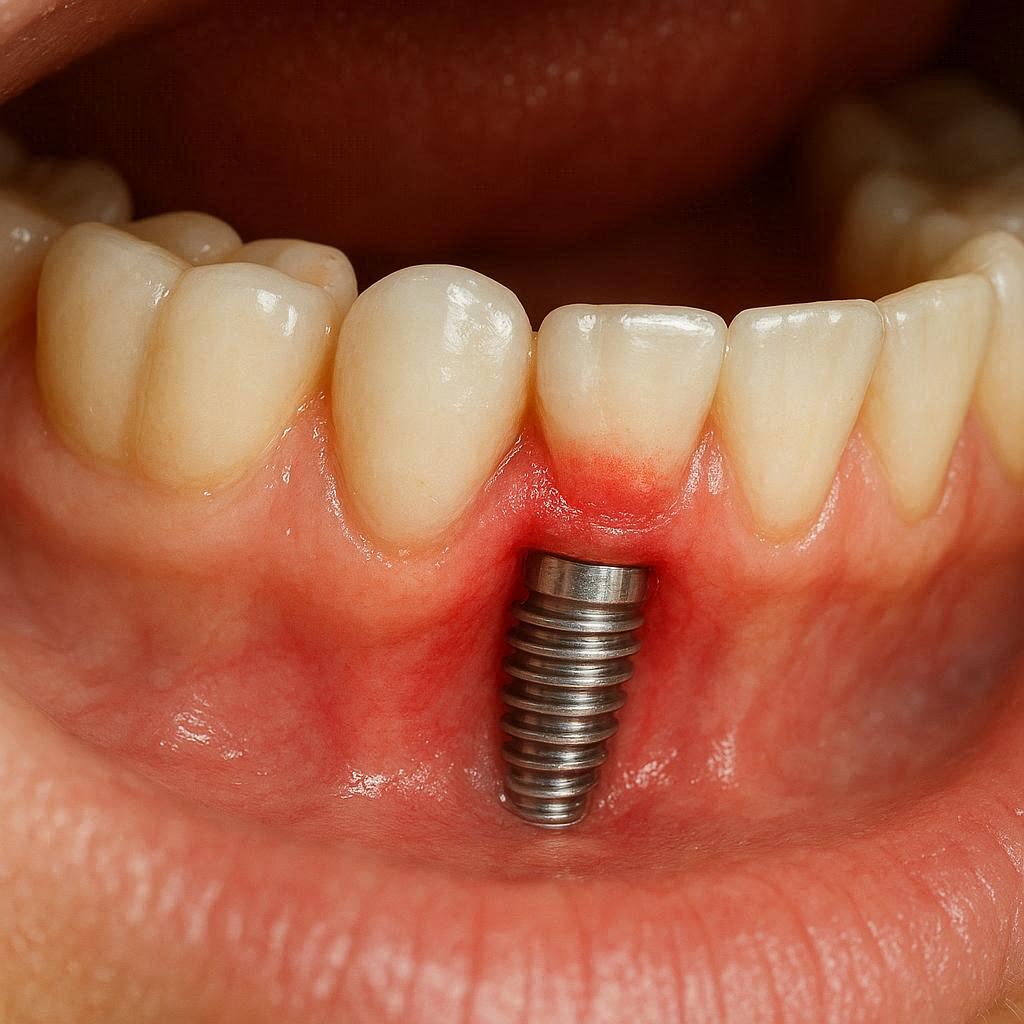
| Throb + redness/bleeding around gum | Mucositis (early gum inflammation) | Medium (call dentist this week) |
| Throb + bad taste + pus | Peri-implantitis (bone infection) | High (see dentist within days) |
| Throb + loose implant | Bone loss or implant failure | Emergency (call today) |
| Throb + fever + swelling spreading to neck | Severe infection | Emergency (go to ER) |
| Throb after recent sinus lift or upper implant | Sinus-related pressure | Medium (monitor, call if persists) |
Note: A small amount of throbbing in the first 48-72 hours after surgery is normal. Any throbbing that appears weeks or years after placement is never normal.
Understanding the Implant: A Quick Anatomy Lesson
To understand why your implant throbs, you need to know what lives beneath the surface.
A dental implant is not like a natural tooth. A natural tooth has a soft inner pulp containing nerves and blood vessels. That is why a cavity can cause a toothache.
An implant, however, is made of titanium or zirconia. It has no nerves. It cannot “hurt” on its own.
So where does the throbbing come from?
The sensation originates in the living tissues around the implant:
- The gum tissue (mucosa): Rich in nerve endings.
- The periosteum: The membrane covering your jawbone.
- The bone itself: Yes, bone has nerve fibers, especially in its outer layer.
- Ligaments and adjacent teeth: Sometimes pain “travels” from a neighbor.
When you feel a throb, you are feeling pressure, inflammation, or nerve irritation in these supporting structures. Think of the implant as a sturdy post. The post is silent. But the ground around it can shake.
The 7 Most Common Reasons for Implant Throbbing
Let us explore each cause in detail, from the most common to the rarest.
1. Peri-Implantitis (The Most Serious Cause)
Peri-implantitis is the number one reason for late-stage implant throbbing. It is essentially an infection deep in the bone surrounding your implant.
What happens: Bacteria accumulate under the gum line. They form a biofilm that your toothbrush cannot reach. Over time, this bacteria triggers an immune response. Your body tries to fight the infection, but in doing so, it also destroys the bone holding your implant.
Why it throbs: As the bone resorbs (melts away), the space fills with inflammatory fluid and pus. This increases internal pressure. The throbbing is the pulse of your blood trying to flush out the infection.
Key red flags:
- Bleeding when you brush near the implant
- Deep pocket (measured by your dentist with a probe)
- Bad taste or smell coming from the area
- Visible pus when pressing on the gum
Important: Peri-implantitis does not go away on its own. It requires professional cleaning, often with special instruments. In advanced cases, surgery or even implant removal is necessary.
2. Implant Overload or Bruxism (Grinding)
Your implant is strong, but it is also rigid. Unlike a natural tooth, which has a ligament that acts like a tiny shock absorber, an implant fuses directly to bone. This is called osseointegration.
What happens: If you grind or clench your teeth at night (bruxism), you transfer excessive force directly into the bone. The bone becomes micro-fractured and inflamed.
Why it throbs: The bone tries to heal from these micro-traumas. Throbbing is the inflammation response. You may notice the pain is worse in the morning (after grinding all night) or after a stressful day.
Signs it is bruxism:
- Flat, worn-down natural teeth
- Jaw muscle soreness or headache in the morning
- Partner tells you that you grind at night
- The implant throb comes and goes with stress levels
What helps: A custom nightguard from your dentist. Over-the-counter guards are too soft for implant patients.
3. High Bite (Occlusal Interference)
After an implant crown is placed, your dentist checks your bite. But sometimes, a “high spot” remains—meaning the implant crown hits before your other teeth touch.
What happens: Every time you close your mouth, the implant receives an extra jolt of pressure. Over hours and days, this repeated trauma inflames the bone.
Why it throbs: The bone is saying, “Too much pressure, too often.” The throbbing is most noticeable right after eating or clenching.
The telltale sign: Your dentist can spot this easily with articulation paper. They place a thin colored film between your teeth. You bite down. If only the implant crown leaves a dark, heavy mark, it is too high.
Solution: A simple, painless adjustment of the crown surface. This takes 30 seconds and often resolves the throbbing within 48 hours.
4. Sinus-Related Pressure (Upper Implants Only)
If your throbbing implant is in the upper jaw, near the premolar or molar area, the culprit may be your sinus.
What happens: The maxillary sinuses sit directly above your upper jawbone. If the implant protrudes slightly into the sinus cavity (or if the sinus membrane was lifted during surgery), pressure changes can affect the area.
Why it throbs: When you have a cold, allergy flare-up, or sinus infection, your sinuses swell. That swelling presses down on the implant’s tip. The bone and membrane respond with a dull, throbbing ache.
Key clues:
- Throbbing worsens when you bend over or blow your nose
- You have a cold or seasonal allergies
- Pain also in your cheekbone or upper teeth on the same side
What to do: Treat the sinus issue first (decongestants, nasal rinse, allergy meds). If the throbbing disappears, you have your answer. If it persists, see your dentist for a CBCT scan.
5. Nerve Involvement or Adjacent Tooth Problem
Remember: the implant itself has no nerves. But the nerves that serve your jaw run very close to the implant site.
What happens: During implant placement, the surgeon may have placed the implant near the inferior alveolar nerve (lower jaw) or the mental nerve. Even if the nerve is not damaged, the healing bone can swell slightly and irritate it.
Alternatively, a natural tooth next to the implant may develop a problem—a crack, a new cavity, or root infection. Your brain can misinterpret the location of the pain. This is called referred pain.
Why it throbs: Nerve irritation produces a rhythmic, electric, or pulsating sensation. It may feel like the implant is throbbing when the real source is the tooth right next to it.
How to tell:
- Tap on the teeth next to the implant. Does one feel tender?
- Does the throbbing shoot toward your lip or chin? (Nerve sign)
- Cold test: Your dentist can apply cold to adjacent teeth. If one reacts intensely, that is the problem.
6. Failed Osseointegration (The Implant Didn’t Fuse)
Osseointegration is the process where your bone grows tightly around the implant surface. It usually takes 3 to 6 months. But sometimes, it fails.
What happens: The implant develops a layer of scar tissue or fibrous tissue instead of bone. It remains “mobile” at a microscopic level.
Why it throbs: Every time you chew, the implant moves slightly within this soft tissue. The movement causes micro-bleeding and inflammation. Throbbing is the result.
Risk factors for failed integration:
- Smoking (massively reduces bone healing)
- Uncontrolled diabetes
- Radiation therapy to the jaw
- Certain medications (bisphosphonates)
- Immediate loading (putting a crown on the same day as surgery)
The big sign: The implant feels slightly loose. Even a millimeter of movement is a red flag. A successfully integrated implant should feel rock-solid, like it is part of your bone.
7. Allergic Reaction to Titanium (Rare but Real)
Less than 0.6% of the population has a true titanium allergy. But it exists.
What happens: Your immune system identifies titanium particles as invaders. It mounts a chronic inflammatory response.
Why it throbs: The inflammation is low-grade but constant. You may also notice:
- Chronic redness around the implant gum
- A burning sensation
- Skin rashes elsewhere (eczema or hives)
- Fatigue (systemic inflammation)
The only way to know: Your dentist can refer you for a MELISA test (blood test for metal allergy). If confirmed, the implant may need to be replaced with a zirconia (ceramic) implant.
Healing vs. Problem: A Timeline of Normal Throbbing
One of the most common questions is: “How much throbbing is normal after surgery?”
Here is a realistic timeline of what to expect after implant placement.
Day 1-3 (The Acute Phase)
- Normal: Moderate throbbing that comes in waves. It peaks when the local anesthesia wears off. Pain is controlled with over-the-counter ibuprofen or prescribed medication.
- Warning sign: Throbbing so severe you cannot sleep or speak. Uncontrolled bleeding. Swelling that closes your eye (upper jaw) or prevents swallowing (lower jaw).
Day 4-7 (The Healing Phase)
- Normal: Throbbing decreases significantly. You may feel a dull ache when you lie down (gravity increases blood pressure to the head). This should respond to ice packs.
- Warning sign: Throbbing that suddenly gets worse after improving. New bad taste or fever.
Week 2-4 (The Quiet Phase)
- Normal: No throbbing at rest. You might feel a mild sensation when tapping the implant or chewing soft food.
- Warning sign: Persistent, daily throbbing at this stage is not normal. Call your dentist.
Months 2-6 (Osseointegration Phase)
- Normal: Zero throbbing. You may even forget you have an implant.
- Warning sign: Any throbbing that appears during this period is suspicious. Do not “wait and see.”
After Crown Placement (Restoration Phase)
- Normal: 24-48 hours of mild soreness in the gum from the crown seating. A feeling of pressure as you adjust to the new bite.
- Warning sign: Throbbing lasting more than 3 days after crown delivery. This indicates a high bite, cement trapped under the gum, or micro-movement.
Important note: If your implant is more than one year old and suddenly starts throbbing with no recent trauma, assume peri-implantitis until proven otherwise.
What You Can Do at Home (While Waiting for Your Appointment)
You should never try to “treat” an implant problem entirely at home. But these steps can reduce discomfort and help you gather information for your dentist.
Do’s ✅
- Switch to a soft-bristled toothbrush. Aggressive brushing inflames the gum further.
- Use warm salt water rinses (1 teaspoon salt in 8 oz warm water). This reduces inflammation and soothes the gum.
- Take an over-the-counter anti-inflammatory like ibuprofen (if no medical contraindication). It directly targets the throbbing mechanism.
- Eat on the other side of your mouth. Give the implant complete rest.
- Keep a pain diary. Note: When does it throb? Morning or night? After eating? After stress?
Don’ts ❌
- Do not poke the gum with floss picks, toothpicks, or sharp objects. You risk introducing more bacteria.
- Do not use aspirin directly on the gum (aspirin burn is real and painful).
- Do not apply heat. Heat increases blood flow and can worsen the throbbing. Use cold compresses (15 minutes on, 15 off).
- Do not stop brushing that area completely. Plaque buildup will make it worse. Be gentle but thorough.
- Do not take antibiotics left over from a previous infection. You need the correct type and dose.
When to Call Your Dentist (A Decision Guide)
Use this flow chart in text form:
Question 1: Is the throbbing constant (24/7) or does it come and go?
- Constant: Call today.
- Comes and goes: Monitor for 48 hours.
Question 2: Can you see or feel any swelling on your face or gum?
- Yes: Call today. Swelling indicates active infection.
- No: Proceed to question 3.
Question 3: Does the implant feel loose when you push it with your finger or tongue?
- Yes: Emergency. Call now. Do not chew on it.
- No: Proceed to question 4.
Question 4: Has the throbbing lasted more than 7 days without improving?
- Yes: Schedule an appointment this week.
- No: You may monitor, but a checkup is still wise.
Final rule: If you are reading this article because the throbbing is worrying you, that is enough reason to call your dentist. Trust your gut. You know your body better than anyone.
What Your Dentist Will Do (The Diagnostic Process)
Knowing what to expect can reduce anxiety. Here is the typical step-by-step process.
Step 1: Visual and Tactile Exam
Your dentist will:
- Look for redness, swelling, or pus.
- Measure gum pockets around the implant with a tiny ruler (probe). Healthy pockets are 3mm or less. Pockets over 5mm suggest disease.
- Check if the implant is mobile (try to wiggle it with instrument handles).
Step 2: Bite Analysis
You will bite on colored paper or a digital sensor. This reveals if the implant crown is hitting too hard or too early.
Step 3: Percussion Test
Your dentist gently taps the implant crown and adjacent teeth with the back of a mirror handle. A solid, high-pitched sound is good. A dull, low-pitched sound suggests loosening or bone loss.
Step 4: Radiographs (X-rays)
- Periapical X-ray: Shows bone levels around the implant. Healthy bone reaches the first thread. Bone loss appears as a dark triangle.
- CBCT (3D scan): If the problem is complex, a CBCT shows bone loss in three dimensions, sinus relationships, and nerve proximity.
Step 5: Microbial Testing (If Infection Suspected)
A small paper point is inserted into the gum pocket. It absorbs fluid, which is sent to a lab. The results identify exactly which bacteria are causing the infection. This guides antibiotic choice.
Step 6: Referral to a Specialist
Your general dentist may refer you to a periodontist (gum and bone specialist) or prosthodontist (implant restoration expert) for advanced treatment.
Treatment Options by Cause
Once the diagnosis is clear, treatment varies widely. Here is what each cause typically requires.
| Cause | Typical Treatment | Success Rate | Time to Resolution |
|---|---|---|---|
| Peri-implantitis (mild) | Non-surgical cleaning with titanium or plastic curettes + local antibiotics | 70-80% | 2-4 weeks |
| Peri-implantitis (moderate) | Flap surgery + bone graft + implant surface decontamination | 60-75% | 3-6 months |
| Peri-implantitis (severe) | Implant removal + bone graft + new implant after healing | 90% (for new implant) | 6-12 months |
| High bite | Occlusal adjustment (grinding down the crown) | 95% | 24-48 hours |
| Bruxism | Custom nightguard + muscle relaxants if needed | 85% (with compliance) | Immediate relief |
| Sinus issue | Treat sinusitis (decongestants, steroids, possibly antibiotics) | 90% | 1-2 weeks |
| Failed osseointegration | Implant removal + bone graft + reattempt after 4-6 months | Varies | 6+ months |
| Titanium allergy | Replace with zirconia implant | 95% | 3-6 months |
Quotation from a periodontist: “The biggest mistake I see is patients waiting too long. A throbbing implant that could have been saved with a simple cleaning often becomes a throbbing implant that needs to be removed six months later.” — Dr. Elena Vasquez, DDS, MS.
Long-Term Prevention: How to Avoid Throbbing in the Future
Once your implant is healthy again (or if you are reading this proactively), adopt these habits.
The 5 Pillars of Implant Maintenance
1. The Right Tools
- Soft or extra-soft toothbrush
- Water flosser (set on low pressure for implants)
- Implant-specific floss (thicker and spongy) or superfloss
- Rubber tip stimulator for gum massage
2. The Right Technique
- Angle your brush 45 degrees toward the gum, just like with natural teeth.
- Use the water flosser on the lowest setting that still cleans. High pressure can damage the gum seal.
- Floss in a “C shape” around the implant neck.
3. The Right Schedule
- Professional cleaning every 3-4 months (not every 6 months). Implants need more frequent care than natural teeth.
- Annual X-rays to monitor bone levels.
- Nightguard check every 6 months if you grind.
4. The Right Lifestyle
- If you smoke, quit. Smoking is the #1 predictor of implant failure and infection.
- Control diabetes. High blood sugar feeds bacteria.
- Reduce sugar intake. Bacteria that cause peri-implantitis love sugar.
5. The Right Awareness
- Know your baseline. Check your implant gum once a week in good lighting. Does it look pink and firm?
- Act fast. The moment you feel a new throb, call. Do not wait for pain to become severe.
Home Monitoring Checklist (Print This)
Copy this into your phone notes:
- Gum color around implant: Pink □ Pale □ Red □
- Gum texture: Firm □ Swollen □ Spongy □
- Bleeding when brushing: No □ Yes □
- Bad taste or odor: No □ Yes □
- Implant feels: Solid □ Slightly movable □ Loose □
- Throbbing: None □ Mild □ Moderate □ Severe □
If you check any “Yes” or “Moderate/Severe,” call your dentist.
Special Situations and FAQs
Can a dental implant throb years later with no warning?
Yes. This is actually common. Peri-implantitis can develop silently for months or years before symptoms appear. The first symptom is often a vague throbbing that patients dismiss. Do not dismiss it.
Why does my implant throb more at night?
Three reasons:
- Lying down increases blood pressure to your head. More blood flow = more throbbing.
- You may be grinding your teeth in your sleep without knowing it.
- Less distraction at night makes you more aware of the sensation.
Can a sinus infection cause an upper implant to throb without the implant being the problem?
Absolutely. The implant acts like a tuning fork. When your sinus membrane swells, it vibrates against the implant tip. Treat the sinus, and the throb often disappears.
My dentist says the X-ray looks fine, but my implant still throbs. Now what?
X-rays show bone, but they do not show soft tissue inflammation, nerve irritation, or bite problems. Ask your dentist to:
- Re-check the bite with articulation paper.
- Perform a “periodontal probing” (measure gum pockets).
- Consider a CBCT if the standard X-ray was 2D.
Is it normal for an implant to throb after flossing?
No. Gentle flossing should never cause throbbing. If it does, you may have:
- Trapped food or cement under the gum
- A sharp edge on the crown irritating the gum
- Early peri-implantitis
How do I know if my body is rejecting the implant?
True rejection (as in an organ transplant) does not happen with implants because titanium is not living tissue. However, “failure” can occur. Signs include progressive bone loss on X-rays, chronic pain, mobility, and lack of osseointegration. An allergy is different and rarer.
The Psychological Side of Implant Throbbing
Let us be honest for a moment. Dental implants are expensive. The surgery is invasive. The recovery takes months. When you feel a throb, fear often follows.
You might worry:
- “Did I waste my money?”
- “Will I lose the implant?”
- “Was the procedure botched?”
- “Will I have to go through surgery again?”
These feelings are valid. But here is the perspective that helps most patients:
Throbbing is not a verdict. It is information.
Your body is communicating. That throb is not your enemy. It is an early warning system. And early warnings are gifts. They allow you to act before the problem becomes irreversible.
Most throbbing implants can be saved. Even with peri-implantitis, early treatment has a high success rate. The worst outcomes happen to patients who wait months or years because they were afraid to hear bad news.
So take a breath. Then pick up the phone.
Summary: Your Action Plan
Here is your step-by-step plan, right now.
- Stop chewing on that side. Give the implant rest.
- Take ibuprofen (if safe for you) to reduce inflammation.
- Rinse with warm salt water twice today.
- Check the “Home Monitoring Checklist” above.
- Call your dentist’s office. Say this: “I have a dental implant that is throbbing. It started [date]. It is [mild/moderate/severe]. Can I send a photo or come in for an exam?”
- If the office is closed and you have fever, facial swelling, or difficulty swallowing, go to an urgent care or ER for antibiotics.
- Do not remove the implant yourself. Ever. Leave that to a professional.
Conclusion (Three Lines)
A throbbing dental implant is never normal outside the first 72 hours after surgery. The sensation usually signals inflammation, infection, bite issues, or nerve irritation in the tissues surrounding the implant. Early diagnosis by a dentist is essential—most causes are treatable, but delays can lead to implant failure.
Frequently Asked Questions (FAQ)
Q1: Can a dental implant throbbing be nothing serious?
Yes, occasionally a high bite or minor gum irritation causes temporary throbbing. However, you need a dentist to rule out infection. Do not assume it is “nothing.”
Q2: How long does throbbing last after implant surgery?
Mild to moderate throbbing typically lasts 3-5 days. It should decrease each day. If it worsens after day 3, call your surgeon.
Q3: Why does my implant throb when I lie down?
Gravity increases blood flow to your head when lying flat. The extra pressure in the surgical area can cause a throbbing sensation. Try sleeping with an extra pillow for a few nights.
Q4: Can stress cause my dental implant to throb?
Indirectly, yes. Stress increases jaw clenching and teeth grinding (bruxism), which overloads the implant. Stress also weakens your immune system, making infections more likely.
Q5: Will antibiotics stop the throbbing?
Only if the cause is bacterial (peri-implantitis). If the throbbing is from a high bite, nerve issue, or bruxism, antibiotics will do nothing. Never take antibiotics without a diagnosis.
Q6: Can I use hydrogen peroxide on a throbbing implant?
No. Hydrogen peroxide can damage the soft tissue seal around the implant and irritate the gum. Stick to salt water or an alcohol-free chlorhexidine rinse if prescribed by your dentist.
Q7: How do I know if my implant is failing?
Key signs: increasing pain over time, mobility (looseness), progressive bone loss on X-rays, chronic infection, and inability to chew. A failing implant rarely improves on its own.
Q8: Is a zirconia implant less likely to throb?
Zirconia implants are metal-free and avoid allergic reactions. However, they can still develop peri-implantitis, bite issues, and nerve irritation. The material does not eliminate the risk of throbbing.
Q9: Can an old dental implant cause headaches?
Yes, if the implant is placed incorrectly or if you have bruxism, the referred pain can travel to your temples, jaw joint, or forehead. This is called myofascial pain.
Q10: My implant throbbed for a week and then stopped. Am I safe?
Not necessarily. Some infections “smolder” silently. The pain may stop because the bacteria have adapted, not because you healed. Schedule a checkup for peace of mind.
Additional Resource
For a deeper dive into implant maintenance, including video demonstrations of proper flossing and water flosser techniques, visit the American Academy of Periodontology’s patient education page:
👉 perio.org/consumer/dental-implants
This resource is peer-reviewed and updated annually by board-certified periodontists.
Disclaimer
This article is for informational purposes only and does not constitute medical or dental advice. Every patient’s situation is unique. Do not use this information to diagnose yourself or delay seeking professional care. Always consult a licensed dentist or dental specialist for any persistent pain or symptoms related to your dental implants. The author and publisher disclaim any liability for any adverse effects arising from the use or application of information in this guide.