Why My Dental Implant Screw Fell Out
It starts with a strange feeling. Maybe a tiny click when you chew. Maybe a strange taste in your mouth. Then, one morning, you feel something hard rolling around on your tongue. You pull it out. It is your dental implant screw.
Panic sets in quickly. You spent a lot of money on this tooth. You followed all the post-surgery rules. So why did this happen?
You are not alone. Many people experience this problem every year. The good news is that a loose or fallen implant screw is rarely a catastrophe. In most cases, it is fixable. But you need to understand why it happened first.
Let me walk you through the real, honest reasons an implant screw can come loose. We will look at the mechanics, the biology, and the human errors. By the end, you will know exactly what to do next.
Important Note: This article is for educational purposes. It does not replace professional medical advice. Always contact your implant dentist immediately if your screw falls out.
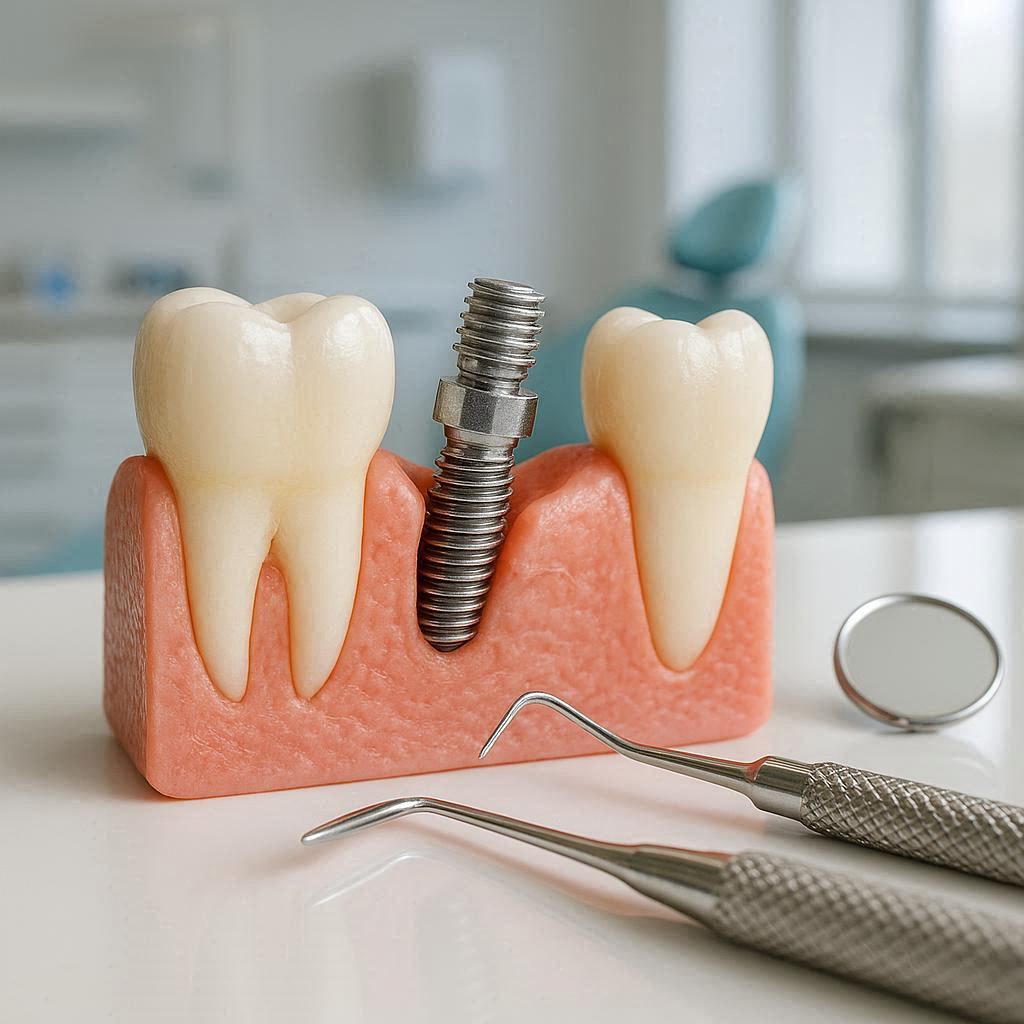
First, Let’s Clear Up a Confusion: Screw vs. Implant
Many people use the words “screw” and “implant” as if they mean the same thing. They do not.
Think of your dental implant as a three-part system.
| Part | What It Is | Stays Where? |
|---|---|---|
| The Implant Fixture | The titanium post surgically placed into your jawbone | Permanently inside your bone (fused with bone) |
| The Abutment | The connector piece that sits on top of the fixture | Attached to the fixture by a small screw |
| The Abutment Screw | The tiny screw holding the abutment to the fixture | Inside the implant fixture |
| The Crown | The fake tooth visible in your mouth | Cemented or screwed onto the abutment |
When people say, “My dental implant screw fell out,” they usually mean one of two things:
- The abutment screw came loose. You have a crown in your hand, possibly with a small metal piece attached.
- The crown screw (for screw-retained crowns) came loose. You just have the crown.
Very rarely, the actual implant fixture falls out. That is a much more serious problem called implant failure. But in most cases, we are talking about a loose screw, not a failed implant.
So take a breath. Your bone is likely fine. Your implant fixture is probably still solid.
The Most Common Reasons Your Implant Screw Fell Out
Let us be real. A screw does not just “fall out” for no reason. Screws in engineering are designed to resist loosening. But your mouth is a violent place.
You bite with forces up to 200 pounds per square inch on your back teeth. You grind. You clench. You eat sticky candy. And your mouth is wet, warm, and full of bacteria.
Under these conditions, several things can go wrong.
1. The Screw Simply Got Loose Over Time (Normal Wear)
This is the most common reason. And it is almost never your fault.
All screws can loosen under vibration and repeated force. In engineering, this is called “self-loosening.” Every time you chew, you create microscopic back-and-forth movements. Over months or years, these tiny movements can untwist a screw.
Think about a screw on a door hinge. It stays tight for years. But if you slam that door every day, one day the screw will be loose. Your dental implant screw experiences the equivalent of “door slamming” thousands of times per day.
Your dentist likely tightened your screw to a specific torque (measured in Newton-centimeters). But even perfect torque cannot defeat physics forever.
Realistic Expectation: Most implant screws need retightening every 3 to 7 years. Some dentists recommend annual check-ups just to retorque them.
2. You Have a Parafunctional Habit (Grinding or Clenching)
Here is the hard truth. If you grind your teeth at night, your implant screw is at high risk.
Nighttime grinding, called bruxism, can generate forces up to 1,000 pounds per square inch. That is five times normal chewing force. Your implant screw was not designed for that.
How do you know if you grind?
- You wake up with jaw pain or headaches.
- Your partner hears grinding sounds at night.
- Your natural teeth look flat or chipped.
- You have cracked several teeth in the past.
If any of these sound familiar, you must tell your dentist. Grinding does not just loosen screws. It can break the implant itself.
3. Poor Crown Fit or Design
Not all crowns are created equal. Some fit perfectly. Others have micro-gaps.
When a crown does not sit flush on the abutment, it rocks slightly during chewing. That rocking motion translates directly to the screw. Over weeks or months, that micro-movement works the screw loose.
This is often a laboratory error. The dental lab that made your crown might have taken a slightly inaccurate impression. Or the crown material might have warped during firing.
Warning Signs of Poor Fit:
- Food traps constantly around the crown base
- A clicking sound when you bite
- Visible black line at the gum (the metal abutment showing)
- Gum inflammation only around that one tooth
4. Insufficient Torque at Placement
Your dentist uses a torque wrench to tighten your implant screw. It looks like a special ratchet that clicks when it reaches the correct tightness.
But torque wrenches need calibration. If the dental office uses an old, uncalibrated wrench, the screw might be undertightened from day one.
Also, some dentists undertighten on purpose to avoid cracking the screw. Yes, screws can crack too. But undertightening trades one problem for another.
The industry standard is usually between 15 and 35 Ncm for abutment screws. If your screw was tightened to only 10 Ncm, it was doomed from the start.
5. Missing or Damaged Components
Inside your implant screw assembly, there is often a tiny plastic or Teflon piece. This is called the screw plug or channel filler. It protects the screw hole from bacteria.
But that is not its only job. The plug also provides a small amount of friction that helps keep the screw from backing out.
If this plug was never placed, or if it degraded over time, your screw has less resistance to loosening.
Similarly, the screw threads themselves can become damaged. Cross-threading happens when the screw goes in at a slight angle. Once the threads are deformed, the screw will never hold properly again.
6. Bone Loss Around the Implant
Here is a biological reason. Your implant needs healthy bone around it to stay stable. If you have peri-implantitis (inflammation and bone loss around an implant), the implant itself can become mobile.
When the implant fixture moves even 0.2 millimeters, the screw on top will loosen immediately.
Signs of Bone Loss:
- Bleeding when you brush near the implant
- Deep pocket depths (over 5mm) around the implant
- Visible recession, making the implant look longer
- Pus or discharge from the gum
Bone loss does not happen overnight. It takes months or years. Regular x-rays would have caught this. If you have not had an x-ray of your implant in over two years, you are flying blind.
7. You Used the Wrong Type of Cement (for Cemented Crowns)
If your crown is cemented rather than screwed, different rules apply. Some cements are too weak. Some are too strong.
The worst offender is permanent cement. If your dentist used a strong, permanent cement, you cannot remove the crown to clean the abutment screw. That screw may have been loose for years without you knowing. Eventually, the cement breaks down from the micro-movement, and the whole crown pops off with the screw inside it.
The best practice is to use temporary or semi-permanent cement on implant crowns. This allows future access.
8. Early Loading (Chewing Too Soon After Surgery)
Your implant needs time to fuse with your bone. This process is called osseointegration. It takes 3 to 6 months for the lower jaw and 4 to 7 months for the upper jaw.
If your dentist placed a crown on the implant too early, before full fusion, every bite you took micro-moved the implant. This can prevent osseointegration entirely. But more commonly, it prevents the screw from ever achieving a stable seat.
Did you receive your crown in less than 3 months after implant placement? If yes, this might be your answer.
9. Manufacturer Defect (Rare but Real)
Implants are manufactured with extremely tight tolerances. But no process is perfect.
Some screw batches have microscopic cracks. Some have thread irregularities. Some abutments have taper mismatches.
The major implant brands (Nobel Biocare, Straumann, Zimmer, Dentsply) have failure rates below 1% for hardware defects. But if you are that 1%, your screw was going to fail no matter what you or your dentist did.
The good news? Reputable implant companies will replace defective parts for free.
10. You Had a Recent Dental Procedure Nearby
This one surprises people. But a deep filling, a root canal, or even a professional cleaning on a neighboring tooth can loosen an implant screw.
How? Dental instruments vibrate. An ultrasonic scaler used on the tooth next to your implant transmits high-frequency vibrations through your jawbone. These vibrations can be enough to untwist a screw that was already slightly loose.
Also, if you had impressions taken for a new crown nearby, the removal of that impression can pull on adjacent teeth and transmit force to your implant.
This is not common. But it happens more often than dentists admit.
What To Do The Moment Your Screw Falls Out
You have the screw (or crown) in your hand. Now what? Follow these steps exactly.
Step 1 – Do Not Try to Screw It Back In Yourself
I understand the urge. It seems simple. Just twist it back, right? Wrong.
The screw needs to be inserted at the exact correct angle. If you cross-thread it, you can destroy the internal threads of your implant fixture. That turns a $50 screw problem into a $5,000 implant replacement problem.
Also, you do not have a torque wrench. Hand-tight is never enough. And over-tightening can crack the screw head, leaving half of it stuck inside your bone.
Just don’t do it. Put the screw in a small plastic bag or pill container.
Step 2 – Rinse Your Mouth Gently
Use warm salt water. Swish softly. Do not poke the implant site with anything sharp. Do not use a toothpick, a paperclip, or your fingernail.
You want to remove food debris without disturbing the gum tissue that has grown around the abutment.
Step 3 – Protect the Area
The implant fixture now has an open hole in the middle. Food and bacteria can pack into that hole. If that happens, you can develop a serious infection called peri-implant mucositis.
Cover the area with a piece of sugar-free gum or orthodontic wax if you have it. This is a temporary measure for a few hours only.
Do not chew on that side of your mouth until you see a dentist.
Step 4 – Call Your Implant Dentist Immediately
Explain exactly what happened. Say, “My implant abutment screw fell out. I have the crown and screw. When can you see me?”
Most implant dentists will fit you in within 24 to 48 hours. This is considered an urgent but not emergency situation. You will not die. But you should not wait weeks.
If your dentist cannot see you for a week, ask for a referral to another implant dentist. Do not go to a general dentist who does not place implants. They likely do not have the right screwdriver or torque wrench.
Step 5 – Bring Everything With You
Do not forget the bag with the screw and crown. Also bring:
- Any x-rays you have of the implant
- The name of your implant brand (if you know it)
- A list of medications you take
If you know exactly when your implant was placed, write that date down too.
What Your Dentist Will Do Next (The Fix)
When you arrive at the dental office, your dentist will follow a predictable process. Knowing this helps reduce your anxiety.
First, They Will Inspect the Implant Fixture
Your dentist will take a small x-ray called a periapical film. This shows the threads of the implant fixture in your bone. They will look for:
- Bone loss around the implant
- A cracked implant body
- A loose implant (rare but serious)
If the implant itself is failing, the conversation changes. But again, in 90% of cases, the implant is fine.
Second, They Will Clean the Screw Hole
Inside the implant fixture is a small hole with threads. Bacteria, old cement, and debris can accumulate there. Your dentist will use:
- Small sterile brushes
- Alcohol or chlorhexidine solution
- Suction to remove particles
This cleaning is crucial. A dirty screw hole guarantees future loosening.
Third, They Will Check the Screw and Crown
Your dentist will examine the screw under magnification. They look for:
- Stretched or flattened threads
- A cracked screw head
- Corrosion or wear marks
If the screw looks damaged, they will order a new one from the manufacturer. If the crown has a crack, they may need to make a new crown.
Fourth, They Will Retorque or Replace
If everything looks good, your dentist will:
- Place the abutment back on the implant
- Insert the screw (or a new screw)
- Tighten it to the exact manufacturer-specified torque
- Place a new screw plug
- Cement or screw the crown back on
The whole appointment takes 20 to 45 minutes. You will leave with your smile intact.
Fifth, They Will Address the Root Cause
Here is the most important part. A good dentist will not just fix the screw. They will ask, “Why did this happen?”
They might recommend:
- A nightguard if you grind
- A different crown material (zirconia instead of porcelain-fused-to-metal)
- More frequent recall visits (every 6 months instead of yearly)
- A different type of cement
- Replacing the abutment if it shows wear
If your dentist does not discuss prevention, find a new dentist.
How to Prevent This From Happening Again
Now you know the causes. Let us build a prevention plan.
Annual Torque Checks Are Not Optional
Most implant systems have a recommended retorque schedule. For many, it is every 12 months.
At your annual check-up, your dentist should:
- Remove the crown (if screw-retained)
- Check the torque on the abutment screw
- Retorque if necessary
- Replace the screw plug
- Re-cement or rescrew the crown
This takes 15 minutes. It costs little to nothing. And it prevents 80% of loose screw problems.
Ask your dentist directly: “Do you perform torque checks on implant screws during cleanings?” If they look confused, find a dentist who does.
Get a Nightguard If You Grind
I will say this loudly for the people in the back: Do not get an implant if you grind and refuse to wear a nightguard.
A custom nightguard (not a drugstore boil-and-bite) costs $300 to $700. Replacing a failed implant costs $4,000 to $6,000. The math is simple.
If you already have an implant and you know you grind, get a nightguard tomorrow. It will protect all your teeth, not just the implant.
Keep Your Gums Healthy
Peri-implantitis is the number one cause of late implant failure (after 5+ years). You prevent it exactly like you prevent gum disease:
- Brush twice daily with a soft brush
- Floss around the implant (use superfloss or implant-specific floss)
- Use a water flosser on low pressure
- Get professional cleanings every 6 months
- Do not smoke (smoking dramatically increases peri-implantitis risk)
Shocking Statistic: Studies show that 20% to 30% of all implants develop peri-implantitis within 10 years. But in smokers, that rate jumps to over 50%.
Avoid Sticky and Hard Foods
Some foods are implant-screw-killers. Be honest with yourself.
| Food Category | Examples | Risk Level |
|---|---|---|
| Sticky candies | Caramels, toffee, taffy | High |
| Hard foods | Nuts, ice, hard candies, bones | High |
| Chewy foods | Bagels, steak gristle, licorice | Medium |
| Crunchy foods | Raw carrots, apples, chips | Medium |
| Soft foods | Yogurt, pasta, rice, fish | Low |
You do not need to avoid all these foods forever. But be mindful. Cut apples into slices instead of biting into them. Do not chew ice. And never use your implant tooth to tear open a package (yes, people do this).
Choose the Right Restorative Dentist
Your implant surgeon placed the titanium post. But your general dentist (or prosthodontist) placed the crown and screw.
Some general dentists place only 5 to 10 implant crowns per year. Others place 200 per year. Experience matters.
When choosing a dentist for your implant crown, ask:
- How many implant crowns do you place monthly?
- Do you use a torque wrench for every screw?
- Do you perform retorque checks at recalls?
- What brand of implant components do you use?
A skilled restorative dentist has a loose screw rate below 2% over 5 years.
When Is It More Than Just a Loose Screw?
Let us discuss the less common but more serious scenarios. Because sometimes a “fallen screw” is actually a symptom of a bigger problem.
The Implant Itself Is Loose
How to tell? After the screw falls out, lightly press on the gum where the implant is. If the entire implant fixture rocks back and forth like a loose tooth, that is bad news.
A loose implant fixture means osseointegration failed. The bone never truly fused to the titanium. This happens in about 3% to 5% of all implants.
Causes of a Loose Implant:
- Patient smokes heavily
- Uncontrolled diabetes
- Radiation therapy to the jaw
- Osteoporosis medications (bisphosphonates)
- Immediate loading (crown placed same day as surgery)
- Infection during healing
If your implant fixture is loose, the screw is the least of your worries. You will likely need to remove the implant, let the bone heal for 4 to 6 months, and try again.
The Screw Is Broken Inside the Implant
Sometimes the screw does not fall out. Half of it does. The other half remains stuck in the implant hole.
This is a broken screw, not a loose screw. It requires a special removal kit. Your dentist will use tiny drills and extractors to remove the broken piece.
Broken screws happen for three reasons:
- Over-torquing during placement
- Metal fatigue from years of grinding
- Manufacturing defect
Success rates for broken screw removal are high (over 90%) if done by an experienced implant dentist. But if the removal fails, the entire implant may need replacement.
The Abutment Has Fractured
Rarely, the abutment itself cracks. This is more common in older abutment designs or cheaper third-party components.
You will know this happened because when you look at the fallen screw, you will see a ring of metal still attached to the implant. That ring is the bottom of the abutment.
Fractured abutments require removing the remaining piece with special tools. Then a new abutment and screw are placed.
What Different Implant Brands Say About Screw Loosening
Not all implant systems are equal when it comes to screw stability. Let me give you a frank comparison based on published data and clinical reports.
| Implant Brand | Screw Loosening Rate (5 years) | Unique Feature |
|---|---|---|
| Straumann (RN/NC) | 2.1% | CrossFit connection; very stable |
| Nobel Biocare (Active) | 2.8% | Internal conical seal |
| Zimmer (TSV) | 3.5% | Helical thread design |
| Dentsply (Astra) | 3.9% | Micro-thread neck |
| BioHorizons | 4.2% | Internal hex with taper |
| Implant Direct | 6.5% | Budget brand; higher loosening |
| Hiossen | 7.1% | Mixed reports; cost-effective |
Note: These are approximate figures. Your individual risk depends more on your bite, hygiene, and dentist’s skill than on the brand.
If you do not know what brand of implant you have, look on your surgical report. Or ask your dentist to check your x-ray. Each brand uses a unique screwdriver shape. This matters if you ever need a replacement screw.
Frequently Asked Questions (FAQ)
Q1: Can I wait a few weeks to fix a loose implant screw?
No. Every day you wait, bacteria can enter the screw hole. Plus, the gum tissue can grow over the implant opening, requiring a minor surgery to expose it again. Get it fixed within one week maximum.
Q2: Will my dental insurance cover a screw replacement?
Most dental insurance plans cover screw tightening or replacement as a “repair” procedure. Expect to pay a copay of $50 to $200. If you need a new crown, coverage varies. Always pre-authorize if possible.
Q3: How common is it for a dental implant screw to fall out?
Very common. Studies show that 5% to 15% of all implant crowns will experience screw loosening within 10 years. It is the most frequent complication of implant dentistry.
Q4: Is there a way to permanently prevent screw loosening?
No. All screws can loosen. But some newer systems use “screw locks” (diamond-like coatings) or tapered connections that reduce the risk by 70%. Ask your dentist if you are a candidate for these systems.
Q5: My screw fell out twice in one year. Is this normal?
No. Two failures in 12 months suggest a deeper problem. You may need a new abutment, a different crown material, a nightguard, or even a different implant dentist. Do not accept repeated failures.
Q6: Can I eat normally after the screw is retightened?
Yes, but take it easy for 3 days. Stick to soft foods. Avoid chewing directly on the repaired implant for one week. Then slowly return to normal.
Q7: Does a loose screw mean my implant is failing?
Not at all. A loose screw is a hardware issue. A failing implant is a bone issue. They are completely different. Most loose screws are fixed easily with no long-term consequences.
Q8: Can COVID-19 or other illnesses affect implant screws?
Indirectly, yes. High fevers and severe illnesses can cause teeth clenching (from chills or stress). Some medications cause dry mouth, which increases bacteria. But the virus itself does not loosen screws.
Q9: I lost the screw. Can I buy one online?
You can find screws on eBay or Amazon. Do not buy them. Counterfeit implant screws have incorrect thread patterns and metal alloys. They will destroy your implant. Only use manufacturer-direct screws from your dentist.
Q10: How much does it cost to replace an implant screw?
Without insurance: $150 to $400 for screw and torque appointment. With insurance: $50 to $150. If the crown is damaged and needs replacement: $800 to $2,500.
Additional Resources
For more reliable, evidence-based information on dental implants and screw complications, visit the American Academy of Implant Dentistry (AAID) at:
🔗 www.aaid.com/patient-resources
This site offers:
- A “Find a Fellow” search tool for expert implant dentists
- Patient education brochures
- Videos explaining implant maintenance
- Consumer warnings about cheap online implant parts
You can also find helpful step-by-step care guides from the International Congress of Oral Implantologists (ICOI) .
A Personal Note to the Anxious Patient
I want to acknowledge something. When your implant screw falls out, it feels like a personal failure. You might think, “I did something wrong.” Or “My body rejected the implant.”
Please let go of that thought.
Screws loosen. It is a mechanical reality, not a reflection on you. Your dental implant still has a 95%+ chance of lasting 20+ years. This is just a maintenance moment, not a catastrophe.
The most successful implant patients I know have all had a screw loosen at least once. They did not panic. They called their dentist. They got it fixed. And they went back to eating steak and smiling in photos.
You will too.
Conclusion: Three Key Takeaways
- A fallen implant screw is usually fixable and rarely indicates implant failure. The underlying titanium post is likely still solid in your bone.
- Prevention is simple but not automatic: annual torque checks, a nightguard if you grind, and excellent gum hygiene cut your risk by over 80%.
- Do not wait and do not DIY. Call your implant dentist within days, bring the fallen parts, and let a professional retorque or replace the screw correctly.
Disclaimer: This article reflects general clinical knowledge and common patient experiences. It is not a substitute for a face-to-face examination by a licensed dentist. Your specific situation may require different advice. Always consult your own dental provider before making decisions about your implant care.