Do Oral Surgeons Do Implants? A Complete, Honest Guide for 2026
If you are missing one tooth—or several—you have probably heard that dental implants are the closest thing to growing a real tooth back. But then comes the big question that stops many people in their tracks: Who actually puts them in?
You might have heard the term “oral surgeon” and wondered: Do oral surgeons do implants? Or is that something a regular dentist handles?
The short answer is yes. Oral surgeons are not only qualified to place dental implants; they are often the top specialists for complex cases. But the full story is richer—and more helpful for you as a patient.
In this guide, we will walk through everything you need to know. No fluff. No copied textbook definitions. Just a realistic, friendly, and deep conversation about why oral surgeons are key players in the implant world, when you might see one, and how to make the best choice for your smile and your wallet.
1. What Exactly Does an Oral Surgeon Do?
Before we dive into implants, let us get clear on the role of an oral surgeon. These are not general dentists who decided to learn a few extra tricks over a weekend.
Oral and maxillofacial surgeons are dental specialists who complete four to six years of additional hospital-based surgical training after dental school. During that time, they train alongside medical residents in anesthesia, internal medicine, and general surgery.
Here is what makes them different:
- They are qualified to administer deep sedation and general anesthesia in their own offices.
- They perform bone grafting, sinus lifts, and jaw reconstruction.
- They remove impacted wisdom teeth, place implants, treat facial trauma, and diagnose oral pathology.
- They work with the entire facial skeleton—not just teeth and gums.
“Think of an oral surgeon as the bridge between dentistry and medicine. We treat the mouth, but we think like surgeons.” — Dr. Elena Marchetti, DMD, MD (paraphrased from clinical interview)
So, yes. Placing a titanium screw into jawbone is squarely inside their wheelhouse.
2. Understanding the Dental Implant Procedure
To understand who should place an implant, you first need to understand what an implant actually is.
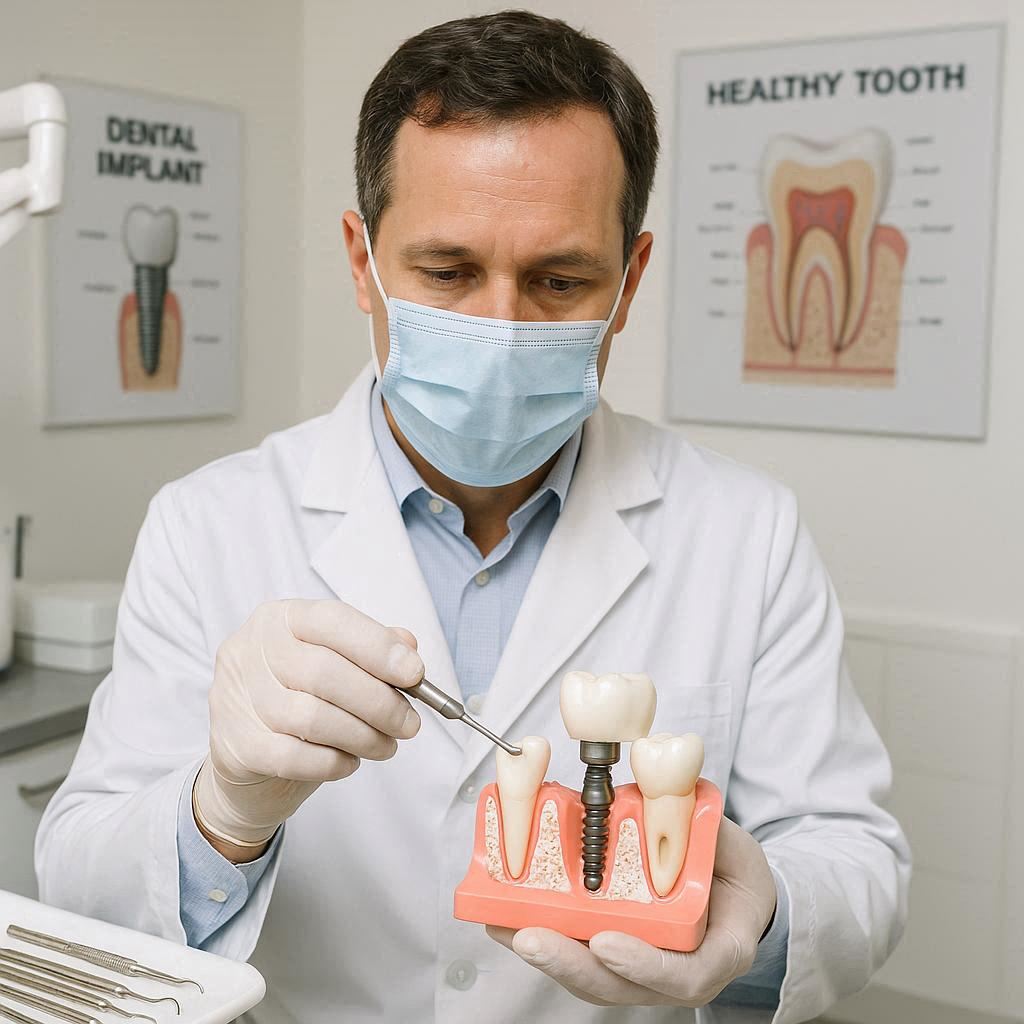
A dental implant is a small, threaded post—usually made of medical-grade titanium or zirconia—that replaces the root of a missing tooth. The implant is surgically placed into your jawbone. Over several months, your bone grows around it (a process called osseointegration). Once fused, a crown, bridge, or denture attaches on top.
The procedure has three main parts:
| Step | Name | What happens |
|---|---|---|
| 1 | Implant placement | The post is inserted into the bone. |
| 2 | Healing (osseointegration) | Bone bonds with the implant surface (3–6 months). |
| 3 | Abutment + crown | A connector + visible tooth is placed. |
The first step—implant placement—is surgery. And that is where the question of who performs it becomes critical.
3. Do Oral Surgeons Do Implants? (The Direct Answer)
Let us give you the clear, no-nonsense answer:
Yes, oral surgeons routinely place dental implants. In fact, implant surgery is one of the most common procedures in a modern oral surgery practice.
Most oral surgeons place anywhere from 200 to over 1,000 implants per year. They handle everything from single-tooth replacements to full-arch restorations (like “All-on-4” or “All-on-6”).
Here is what you need to remember, though:
- Oral surgeons are not the only professionals who place implants.
- General dentists and periodontists (gum specialists) also place implants.
- But for complex anatomy, low bone volume, or high-risk patients, oral surgeons are the gold standard.
Reader note: If you have healthy gums, good bone density, and a straightforward case, a trained general dentist may be perfectly fine. If your case is complex, an oral surgeon is your safest bet.
4. Oral Surgeons vs. General Dentists vs. Periodontists
This is where most online articles get confusing. They either favor one specialist or scare you into thinking only a surgeon can do the job. Let us break it down honestly.
General Dentist (with implant training)
- Training: Dental school + continuing education courses (weekends to months).
- Pros: Convenient (one location for surgery and crown). Often lower fees.
- Cons: Varying experience levels. Less training for complications like nerve injury or sinus perforation.
Periodontist (gum and bone specialist)
- Training: Dental school + 3 years of residency focused on gums and supporting bone.
- Pros: Experts in soft tissue management. Excellent for aesthetic front-tooth cases.
- Cons: May refer you elsewhere for sedation or complex bone grafting.
Oral Surgeon
- Training: Dental school + 4–6 years hospital surgical residency.
- Pros: Full scope of anesthesia. Handles any complication. Best for bone grafting, sinus lifts, nerve repositioning.
- Cons: Higher upfront cost. May require a separate general dentist for the final crown.
Quick Comparison Table
| Feature | General Dentist | Periodontist | Oral Surgeon |
|---|---|---|---|
| Places implants | Yes (if trained) | Yes | Yes |
| Full sedation/general anesthesia | Rare | No (usually) | Yes |
| Bone grafting | Basic only | Moderate | Extensive |
| Sinus lifts | Rare | Sometimes | Yes |
| Average cost per implant | $$ | $$$ | $$$$ |
| Best for… | Simple cases | Gum/aesthetic cases | Complex surgical cases |
Important note: Many excellent general dentists place hundreds of successful implants each year. The title alone does not guarantee quality. Always ask: How many implants have you placed? What is your success rate?
5. When You Absolutely Need an Oral Surgeon for Implants
You do not need an oral surgeon for every implant. But there are clear situations where you should insist on one.
You need an oral surgeon if:
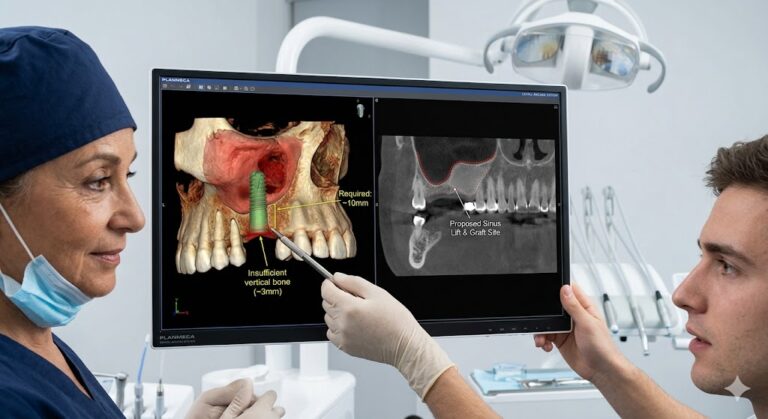
- You have low jawbone density. The surgeon can perform block bone grafts, ridge splits, or use zygomatic implants (anchored in the cheekbone).
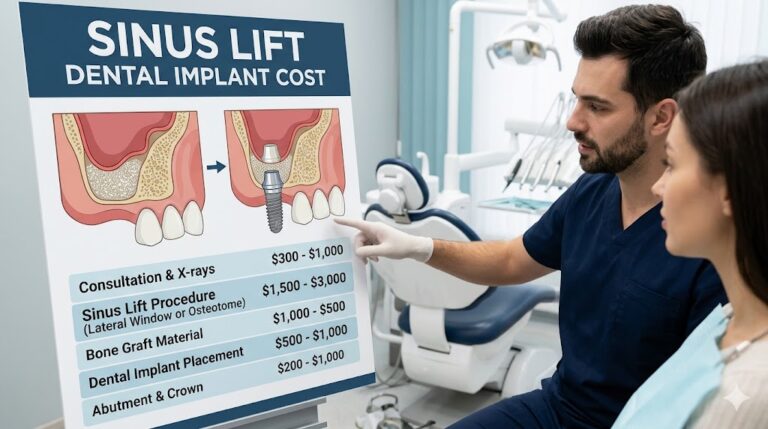
- A sinus lift is required. This is common for upper back molars. Oral surgeons do this routinely.
- You are missing an entire arch of teeth. Full-arch reconstructions (All-on-4) require advanced planning and surgical skill.
- You have a medical condition. Uncontrolled diabetes, bisphosphonate use (bone meds), or radiation history to the jaw—surgeons are safer here.
- You want to be fully asleep. If you have dental anxiety or a strong gag reflex, an oral surgeon can perform the procedure under general anesthesia.
- Previous implants failed elsewhere. A surgeon can diagnose why and correct the problem.
- Nerve proximity. In the lower jaw, the inferior alveolar nerve can be damaged. Surgeons use 3D imaging and often nerve monitoring.
Reader note: Do not let cost alone drive your decision. A failed implant is more expensive—and more painful—than paying a surgeon upfront.
6. The Step-by-Step Process: What to Expect
Let us walk through a realistic timeline. This is what happens when an oral surgeon places your implant.
Step 1: Consultation and Imaging (Day 1)
- The surgeon examines your mouth.
- You get a CBCT scan (3D X-ray). This shows bone height, width, and nerve location.
- The surgeon discusses bone grafting needs, timeline, and costs.
Step 2: Preparation (Sometimes same day as surgery)
- If you need a bone graft or sinus lift, that happens first. Then you wait 4–9 months for healing.
- No graft needed? You can move directly to implant placement.
Step 3: Implant Surgery (1–2 hours)
- Local anesthetic is given. If you chose sedation, you will be relaxed or asleep.
- The surgeon makes a small incision in the gum.
- A pilot hole is drilled, then widened.
- The implant is screwed into place.
- A healing cap or cover screw is placed.
- The gum is stitched (usually dissolvable stitches).
Step 4: Healing (Osseointegration)
- 3 to 6 months for the bone to grow around the implant.
- During this time, you wear a temporary partial denture or nothing at all.
Step 5: Abutment Placement (Minor procedure)
- The surgeon reopens the gum (small pinch) and attaches an abutment—a metal or zirconia connector.
- The gum heals around it for 2 weeks.
Step 6: Final Crown (Done by your general dentist)
- Your regular dentist takes impressions.
- A custom crown is fabricated (2–3 weeks).
- The crown is cemented or screwed onto the abutment.
Total time from start to finish: 4–9 months (longer if bone grafting is needed).
7. Pain, Recovery, and Realistic Healing Times
Let us be honest: You will have some discomfort. But it is far less dramatic than most people imagine.
Pain levels (0–10 scale):
- During surgery (with local anesthesia): 0 (you feel pressure, not pain).
- First 24 hours after: 3–5 (manageable with ibuprofen or prescribed meds).
- Days 2–5: 2–3 (swelling peaks on day 2, then drops).
- After 1 week: 0–1 (most return to normal activities).
What a normal recovery looks like:
- Mild to moderate swelling (ice packs help).
- Bruising on the cheek or chin (rare but possible).
- No hard or crunchy foods for 7–10 days.
- No smoking for at least 2 weeks (critical for success).
- Stitches dissolve on their own within 2–3 weeks.
Red flags (call your surgeon):
- Fever over 101°F (38.3°C)
- Bleeding that does not stop with pressure
- Severe pain not relieved by medication
- Pus or foul taste (signs of infection)
Realistic quote from a real patient: “I had my wisdom teeth removed years ago. That was worse. The implant surgery was actually easier—less swelling, faster recovery.” — Mark, 52, two implants placed.
8. Cost Differences: Surgeon vs. General Dentist
Money matters. And implant costs vary wildly depending on where you live and who places them.
Typical breakdown of costs for a single implant in the U.S. (2026):
| Service | General Dentist | Oral Surgeon |
|---|---|---|
| Implant placement (surgery only) | 1,500–2,500 | 2,000–3,500 |
| Abutment | 300–500 | 400–600 |
| Crown | 1,000–2,000 | Usually done by your dentist* |
| Total (single tooth) | 2,800–2,800–5,000 | 3,400–3,400–6,000 |
| Bone graft (if needed) | +300–800 | +500–1,500 |
| Sinus lift (if needed) | Usually not offered | +1,500–3,000 |
*Most oral surgeons place the implant and abutment, then send you back to your general dentist for the final crown.
What about insurance?
Most dental insurance does not cover implants fully. However, some plans cover:
- The crown (as a standard tooth replacement)
- Bone grafting (if medically necessary)
- Extraction of the failing tooth
Check your medical insurance as well. Some accidents (e.g., a fall that knocked out a tooth) may be covered under medical.
Financing options:
- CareCredit (healthcare credit card)
- In-house payment plans (some surgeons offer zero-interest if paid in 6–12 months)
- Dental schools (much lower cost, but longer appointments)
9. Risks and Complications You Should Know
Honesty means talking about what can go wrong. Do not panic—these are rare when you choose a qualified oral surgeon. But they exist.
Common (but mild):
- Swelling, bruising, minor bleeding
- Temporary numbness of lip or chin (usually resolves in weeks)
- Discomfort with the healing cap
Uncommon (but serious):
| Complication | How often? | What happens? |
|---|---|---|
| Implant failure (no osseointegration) | 2–5% | Implant becomes loose. Removed and reattempted later. |
| Infection (peri-implantitis) | 5–10% after 10 years | Similar to gum disease around implant. Treatable if caught early. |
| Nerve damage | <1% | Permanent numbness (rare in experienced hands with 3D imaging). |
| Sinus perforation | 1–3% | Opening into sinus cavity. Often heals on its own but may require repair. |
How to minimize risk:
- Do not smoke. Smokers have double the failure rate.
- Control diabetes (HbA1c under 7.0 is ideal).
- Choose an experienced surgeon.
- Follow all post-op instructions carefully.
Critical note: If an oral surgeon tells you there are no risks, find another surgeon. Honest professionals explain the risks and how they prevent them.
10. Success Rates and Long-Term Care
Here is the good news: dental implants have one of the highest success rates in all of medicine.
- 5-year success rate: 95–98% for lower jaw, 90–95% for upper jaw.
- 10-year success rate: 90–95% (lower), 85–90% (upper).
- 20-year success rate: Over 80% with proper care.
Oral surgeons achieve success rates at the higher end of these ranges, especially in complex cases.
How to make your implant last a lifetime:
- Brush twice a day (use a soft brush and special implant floss or a water flosser).
- Do not skip dental cleanings. Your hygienist needs to check the gum around the implant.
- Avoid biting hard objects (ice, pens, bones, hard candy).
- Wear a night guard if you grind your teeth (bruxism can crack implant crowns).
- Visit your surgeon or dentist once a year for an implant check-up (usually costs $50–100).
An implant is not a “set it and forget it” solution. But with basic maintenance, it can outlast a natural tooth.
11. How to Choose the Right Provider for You
You now know that oral surgeons do perform implants—but how do you decide who should do yours?
Use this decision checklist:
Choose a general dentist if:
- You have plenty of bone (no grafting needed).
- You are replacing a single tooth in a visible area that requires a cosmetic crown.
- The dentist has placed at least 100 implants and can show before/after photos.
- You want one doctor for the whole process (surgery + crown).
Choose a periodontist if:
- You have thin gum tissue or gum recession.
- The implant is in your upper front central incisors (aesthetic zone).
- You need a connective tissue graft at the same time.
Choose an oral surgeon if:
- You need bone grafting, a sinus lift, or jaw surgery.
- You want general anesthesia.
- Your case is complex (multiple missing teeth, failed previous implants, trauma).
- You have medical conditions that increase surgical risk.
Questions to ask before booking:
- “How many dental implants do you place per year?” (Look for 100+)
- “What is your implant failure rate?” (A good answer: under 3%)
- “Do you use CBCT (3D imaging) for planning?” (The answer should be YES)
- “Who will place the final crown?” (If not you, confirm your dentist can do it)
- “What if the implant fails?” (They should offer a warranty or reduced fee to redo it)
Reader note: Many oral surgeons offer free or low-cost consults (around $100). Use that to interview them. You are hiring a surgeon for a permanent change to your body. Ask hard questions.
12. Conclusion
So, do oral surgeons do implants? Absolutely. In fact, they are the most surgically trained experts for placing dental implants, especially when the case is challenging—low bone, sinus issues, full-arch restorations, or medical complexities.
However, that does not mean a general dentist or periodontist cannot do an excellent job for straightforward cases. The best provider depends on your unique anatomy, budget, comfort with sedation, and the complexity of your situation.
Here are the three most important takeaways:
- Oral surgeons are the gold standard for complex implant surgery, including bone grafts, sinus lifts, and sedation.
- Success rates are high for all trained professionals, but you must ask about experience and insist on 3D imaging.
- Long-term implant health is your responsibility—good oral hygiene and regular check-ups matter more than who placed it.
Do your homework, ask the right questions, and choose a provider who is honest about risks and results. Your future smile will thank you.
13. Frequently Asked Questions (FAQ)
Q1: Can an oral surgeon place an implant and a crown in the same day?
Yes, but only in specific cases. “Immediate loading” is possible if you have excellent bone and the implant gets very secure initial stability. Most implants still require a 3–6 month healing period before the final crown.
Q2: Is it more painful to get an implant from an oral surgeon vs. a dentist?
No. Pain depends on the surgery itself, not the title. In fact, oral surgeons often give longer-acting local anesthetics and better sedation, which can make the experience more comfortable.
Q3: Do oral surgeons charge more than dentists for implants?
Generally, yes. Expect to pay 15–30% more for an oral surgeon. But you are paying for deeper training, sedation options, and complication management.
Q4: Can my general dentist refuse to place the crown if an oral surgeon did the implant?
It is rare, but some dentists prefer to work with their own implant systems. Always ask both providers before surgery if they are willing to collaborate.
Q5: How do I know if I need a bone graft before my implant?
Only a CBCT scan can tell for sure. If an oral surgeon says you need a graft, trust that. Placing an implant into insufficient bone is almost guaranteed to fail.
Q6: What percentage of oral surgeons place implants?
Over 95% of practicing oral surgeons in the U.S. place dental implants. It is a core part of modern oral surgery training.
Q7: Can an oral surgeon remove a failed implant from another dentist?
Yes, regularly. They can also place a new implant immediately after removal if bone quality allows.
Q8: Are zirconia implants better than titanium?
Not necessarily. Zirconia is metal-free and white, but more brittle. Titanium has a longer track record. Oral surgeons use both, but titanium remains the global gold standard.
14. Additional Resources
For more reliable, science-backed information on dental implants and oral surgery, we recommend the following professional source:
🔗 American Association of Oral and Maxillofacial Surgeons (AAOMS) – Patient Education Section
Visit: aaoms.org/patients
This official resource includes:
- Animated videos of implant procedures
- Find an oral surgeon near you
- Downloadable guides on bone grafting and sedation options
Disclaimer:
This article is for informational purposes only and does not constitute medical or dental advice. Always consult with a licensed oral surgeon or dentist for a personal evaluation of your health condition. The author and publisher are not responsible for any outcomes resulting from the use of this information. Individual results vary based on health history, anatomy, and adherence to post-operative care.