Dental Implants in Overland Park KS
Losing a tooth can feel frustrating. You might worry about your smile. You might also struggle with eating your favorite foods.
You are not alone. Many people in Overland Park face this same situation every year.
The good news is that modern dentistry offers a lasting solution. That solution is the dental implant. Unlike old dentures or bridges, implants work like natural tooth roots.
This guide walks you through everything you need to know. We will look at costs, the procedure, recovery, and how to pick the right dentist in Overland Park, KS.
What Exactly Are Dental Implants?
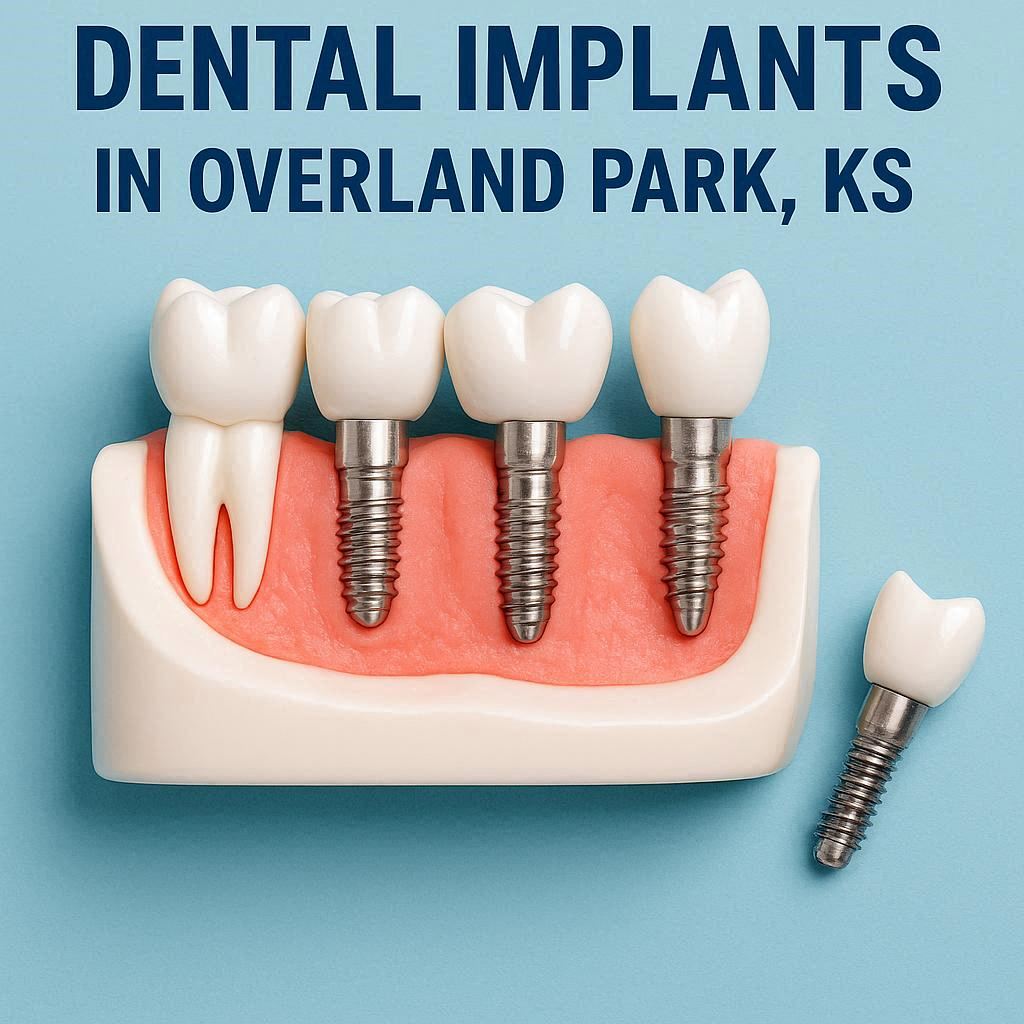
A dental implant is a small post. It is usually made of titanium. A surgeon places this post into your jawbone. It acts as an artificial root for a missing tooth.
Over time, your bone grows around the implant. This creates a very strong bond. Once healed, a custom-made crown goes on top. The final result looks, feels, and functions like a real tooth.
The Three Main Parts of an Implant
To understand implants, you need to know the three pieces.
- The Implant Fixture (Post): This goes into the bone. You never see it.
- The Abutment: This connector piece sits on top of the post. It sticks out slightly above the gumline.
- The Prosthesis (Crown, Bridge, or Denture): This is the visible part. It looks like your natural teeth.
Important Note: Not every implant case requires the same materials. Your dentist in Overland Park will choose the best option based on your bone density and budget.
How Implants Differ from Other Options
Many people ask if implants are better than bridges or dentures.
| Feature | Dental Implant | Traditional Bridge | Removable Denture |
|---|---|---|---|
| Bone Preservation | Prevents bone loss | No effect on bone | Accelerates bone loss |
| Adjacent Teeth | No alteration needed | Requires filing down healthy teeth | No alteration, but poor fit over time |
| Stability | Fixed and stable | Fixed but relies on other teeth | Can slip or click |
| Lifespan | 20+ years (often lifetime) | 5–15 years | 5–8 years |
| Eating Comfort | Feels natural | Good, but can trap food | Restricts many foods |
For many residents in Overland Park, the long-term value of implants makes them the smarter choice.
Why Choose Dental Implants in Overland Park KS?
You have access to excellent dental care here. Overland Park is home to many skilled implant specialists. These include periodontists, oral surgeons, and general dentists with advanced training.
Choosing a local provider offers real advantages.
Convenience and Follow-Up Care
Implant treatment requires several visits. You need initial scans, surgery, check-ups, and final crown placement. Doing this close to home saves time and stress.
Advanced Technology Available Locally
Many clinics in Overland Park use modern tools like:
- 3D Cone Beam CT Scans: These give a complete picture of your bone, nerves, and sinuses.
- Intraoral Scanners: No messy impressions. Digital scans are fast and accurate.
- Guided Surgery: The dentist uses computer planning to place the implant with precision.
A Competitive and Fair Market
Because there are many providers in Johnson County, prices remain reasonable. You will find options that fit different budgets. From high-end specialist offices to affordable dental schools nearby, Overland Park offers variety.
The Step-by-Step Implant Process
Understanding the timeline helps reduce anxiety. Most implant cases follow the same general path.
Step 1: Initial Consultation (Day 1)
This is your first meeting. The dentist will:
- Examine your mouth
- Take X-rays or a 3D CT scan
- Review your medical history (conditions like diabetes or smoking habits matter)
- Discuss your goals and budget
What you should ask:
“What happens if the implant does not fuse with my bone?”
A good dentist will explain the backup plan. Honesty is a sign of quality care.
Step 2: Treatment Planning
The dentist creates a digital plan. They map out exactly where the implant goes. This avoids nerves and sinus cavities.
Step 3: Tooth Extraction (If Needed)
If you still have the damaged tooth, the dentist removes it first. You may receive a bone graft at this time if the socket is too wide or shallow.
Step 4: Bone Grafting (Optional)
This step adds time. If your jawbone is too thin or soft, you need a graft. The graft material can come from:
- Your own bone (from another area)
- Donor bone (human or animal)
- Synthetic bone material
Healing from a graft takes 3 to 6 months before implant placement.
Step 5: Implant Placement Surgery
This is the main event. The dentist:
- Numbs the area with local anesthesia.
- Makes a small incision in the gum.
- Drills a precise hole in the bone.
- Places the titanium post.
- Sutures (stitches) the gum closed.
Most people feel only pressure, not pain. The surgery takes 30 to 90 minutes per implant.
Step 6: Osseointegration (The Healing Phase)
This is the most critical period. Osseointegration means your bone grows tightly around the implant. It takes 3 to 6 months.
During this time, you eat soft foods. You avoid chewing directly on the implant site.
Important Note: Do not skip follow-up appointments during healing. Your dentist needs to check for signs of infection or failed integration.
Step 7: Abutment Placement
Once healed, a small second surgery places the abutment. This is minor and quick. The dentist reopens the gum to attach the metal connector. Then the gum heals around it.
Step 8: Crown Fabrication and Placement
Your dentist takes impressions (or a digital scan). A lab makes your custom crown. This takes 2 to 4 weeks.
Finally, the dentist screws or cements the crown onto the abutment. You walk out with a complete smile.
Types of Dental Implants Available in Overland Park
Not all implants are the same. Depending on your situation, one type may fit better than another.
Single Tooth Implant
One implant replaces one missing tooth. This is the most common type.
Implant-Supported Bridge
If you have two or three missing teeth in a row, you do not need one implant per tooth. Two implants can support a three-unit bridge. This saves money and surgery time.
All-on-4 or All-on-6
For patients missing all teeth on a single arch (upper or lower), the All-on-4 technique is popular. The dentist places four or six implants strategically. Then a full set of fixed teeth attaches to them.
Advantages of All-on-4:
- No need for individual crowns
- Lower cost than 14 separate implants
- Teeth are fixed (not removable)
- Full function the same day (temporary teeth)
Implant-Supported Dentures
These are a hybrid. You still remove the denture for cleaning. But it snaps onto implants for stability. This stops the clicking and slipping of traditional dentures.
Realistic Costs for Dental Implants in Overland Park KS
Let us be honest. Implants are an investment. They cost more upfront than a bridge or denture. But they last much longer.
Here are realistic price ranges in the Overland Park area.
| Procedure | Estimated Cost Range |
|---|---|
| Consultation and CT Scan | 150–350 |
| Single Implant (post only) | 1,500–2,500 |
| Abutment | 300–500 |
| Custom Crown | 1,000–2,000 |
| Total Single Implant (complete) | 2,800–2,800–5,000 |
| Bone Graft (simple, one site) | 600–1,200 |
| Sinus Lift (complex grafting) | 1,500–3,000 |
| All-on-4 per arch | 15,000–25,000 |
Important Note: These are averages. Some discount clinics advertise lower prices. But be very careful. Extremely low prices often mean low-quality materials or inexperienced dentists.
Does Insurance Cover Implants?
Traditional dental insurance rarely covers the full cost. However, many plans now cover parts of the procedure.
Typical coverage includes:
- Extractions: Yes
- Crowns: Usually 50% after deductible
- Implant post: Often excluded or low coverage
Tip: Call your insurer and ask for the “implant clause.” Some plans offer separate implant benefits if you choose an in-network provider.
Financing Options in Overland Park
Most local dental offices offer payment plans. Common options include:
- CareCredit: A healthcare credit card. Offers 6, 12, or 18 months no interest if paid in full.
- LendingClub or Alphaeon: Fixed-rate medical loans.
- In-house financing: Some clinics let you pay over 3 to 6 months directly.
Always ask: “Do you offer a cash discount?” Many offices reduce fees by 3–5% for upfront payment.
Recovery: What to Expect After Surgery
Healing is different for everyone. But a general timeline exists.
First 24 Hours
- Bleeding is normal. Bite on gauze for 30–60 minutes.
- Do not spit, rinse, or use a straw. This dislodges the clot.
- Use an ice pack on your face (20 minutes on, 20 off).
- Eat only cold soft foods: yogurt, smoothies, applesauce.
Days 2 to 7
- Swelling peaks around day 2 or 3.
- Pain is manageable with over-the-counter ibuprofen (Advil) or prescribed medication.
- Switch to warm salt water rinses (after 24 hours). Do 3 times daily.
- Continue soft foods. No crunchy or sticky items.
Weeks 2 to 4
- Most swelling and pain disappear.
- Sutures dissolve or are removed (around day 10–14).
- You can eat more normally. But avoid chewing on the implant side.
Months 3 to 6
- The implant fuses with bone. You may forget it is there.
- Resume normal chewing.
- Maintain excellent oral hygiene (brush and floss normally).
Signs of Problems
Contact your dentist immediately if you experience:
- Fever over 100.4°F (38°C)
- Severe pain not controlled by medication
- Bleeding that does not stop after applying pressure
- The implant feels loose or moves
Who Is a Good Candidate for Implants?
Most healthy adults can get implants. But some conditions affect success rates.
Ideal Candidate Profile
- Has one or more missing teeth
- Has enough jawbone density (or willing to get a graft)
- Has healthy gums (no active gum disease)
- Does not smoke heavily (smokers have higher failure rates)
- Commits to good oral hygiene
Conditions That Require Extra Caution
| Condition | Impact on Implants | Solution |
|---|---|---|
| Uncontrolled diabetes | Slower healing, higher infection risk | Get blood sugar under control first |
| Osteoporosis medications (bisphosphonates) | Risk of jaw necrosis (rare but serious) | Consult prescribing doctor; consider alternatives |
| Heavy smoking (1+ pack/day) | 2x failure rate; gum recession | Quit or reduce smoking for 2 months before/after |
| Teeth grinding (bruxism) | May crack crowns or implants | Wear a night guard |
| Gum disease (periodontitis) | Infection around implant | Treat gum disease first, then place implant |
Note from a local dentist in Overland Park: “I never say no to a patient. But I do say ‘not yet.’ We can often prepare you with grafts, gum treatment, or medical clearance.”
How to Choose the Right Implant Dentist in Overland Park
Not every dentist offers implants. And not every implant dentist offers the same quality.
Here is a checklist to help you choose.
1. Verify Credentials
Look for one of these specialists:
- Oral and Maxillofacial Surgeon: Best for complex cases, bone grafts, and sedation.
- Periodontist: Gum and bone specialist. Excellent for implants in aesthetic zones (front teeth).
- Prosthodontist: Focuses on restoration (the crown). Best for full-mouth reconstruction.
General dentists can place implants too. But ask about their training. Did they take a university-based implant program? Or just a weekend course?
2. Ask About Volume
Experience matters. A dentist who places 10 implants per year is different from one who places 200.
Question to ask: “How many implants do you place monthly?”
3. Look at Before-and-After Photos
Ask for photos of real patients. Look at gum color, crown shape, and natural fit.
4. Read Reviews Carefully
Google and Yelp help. But ignore single bad reviews. Look for patterns.
Red flags:
- Multiple complaints about pain during surgery (poor numbing technique)
- Repeated mentions of broken crowns or failed implants
- Hidden fees or surprise bills
Green flags:
- Staff explains costs in writing
- Dentist takes time to answer questions
- Office offers a warranty (some give 1–5 years on implants)
5. Check Technology
Does the office have a cone beam CT machine on site? If not, they send you to a lab. This is not bad, but it adds time and cost.
Clinics with in-house CT scans and 3D printers can sometimes offer same-day crowns.
Common Fears and Honest Answers
“It sounds painful.”
Most patients say the procedure is easier than a tooth extraction. You get local anesthesia. The bone itself has no pain nerves. After surgery, ibuprofen works well.
“It takes too long.”
Yes, the full process is months. But think of it this way: you spend 6 months to get a tooth that lasts 30 years. That is a good trade.
“I am too old.”
Age is not a problem. Many people in their 80s get implants. As long as you are healthy enough for a simple dental procedure, you are likely fine.
“My friend’s implant failed.”
Failure happens in about 5% of cases. Most failures occur in smokers or people with untreated gum disease. In a healthy non-smoker, success rates are 95–98%.
Caring for Your Dental Implants Long-Term
Implants cannot get cavities. But they can get a disease called peri-implantitis. This is like gum disease around the implant. It causes bone loss and eventual failure.
Daily Home Care
- Brush twice daily with a soft toothbrush. Use a non-abrasive toothpaste.
- Floss once daily. Use special implant floss or interproximal brushes.
- Water flosser (Waterpik): Very helpful for cleaning around abutments.
- Avoid chewing ice, hard candy, or pens. These can crack crowns.
Professional Maintenance
See your hygienist every 6 months. Tell them you have an implant. They use plastic instruments instead of metal to avoid scratching the crown surface.
Longevity Expectation
| Type | Expected Lifespan |
|---|---|
| Implant post (titanium) | Lifetime (40+ years) |
| Abutment | 15–20 years |
| Crown (porcelain) | 10–15 years (then needs replacement) |
The crown wears out. The implant stays. Replacing a crown is a simple procedure.
Frequently Asked Questions (FAQ)
1. Can I get dental implants if I have bone loss?
Yes. Most patients with bone loss qualify for bone grafting. This rebuilds the jawbone over 3–6 months, then implants go in.
2. How long do implants last?
The implant post can last a lifetime with good care. The crown on top lasts 10–15 years before needing replacement.
3. Are dental implants covered by Medicare or Medicaid?
Original Medicare does not cover implants. Some Medicare Advantage plans (Part C) in Kansas offer limited implant benefits. Kansas Medicaid (KanCare) covers implants only for specific medical necessity, not for missing teeth alone.
4. What is the failure rate for implants?
Approximately 5% fail. Failure is higher in smokers (up to 15%) and uncontrolled diabetics (10–20%).
5. Can I smoke with implants?
You can, but you should not. Smoking slows healing and increases failure risk. If you must smoke, wait at least 72 hours after surgery and reduce daily use.
6. How soon can I return to work after implant surgery?
Most people take 1 to 2 days off. If your job is physical, take 3 days. If you have a desk job, you might return the next day.
7. Do implants feel like natural teeth?
Yes, once healed. You cannot feel the implant itself. But chewing pressure feels identical to natural teeth. Speech is completely normal.
8. Can I get a same-day implant in Overland Park?
Yes, some clinics offer “teeth in a day” for select cases. You need excellent bone quality and a simple case. Not everyone qualifies.
9. What happens if an implant fails?
The dentist removes it easily. After healing, you can try a second implant or choose a bridge. Most offices do not charge full price for a replacement if failure was not your fault.
10. Are implants worth it for back molars?
Absolutely. Back teeth do 90% of your chewing. Replacing a molar prevents your other teeth from shifting and wearing down.
Additional Resource for Overland Park Residents
Finding reliable information locally can be hard. One excellent resource is the Johnson County Dental Society. Their website offers a “Find a Dentist” tool. You can search specifically for implant specialists in Overland Park, Leawood, Lenexa, and Olathe.
Link: Johnson County Dental Society – Implant Dentist Directory (Note: Verify the exact URL. This is a trusted local resource for referrals.)
Bonus Resource: The American Academy of Implant Dentistry (AAID) has a patient education section. They explain implant types in simple language. You can also verify if your dentist is a Fellow or Member of the AAID.
Conclusion
Dental implants in Overland Park KS offer a reliable, long-term solution for missing teeth. They preserve your jawbone, protect healthy adjacent teeth, and restore natural chewing power. The process takes several months and requires an upfront investment, but with proper care, an implant can last a lifetime. Choose an experienced local dentist, follow recovery instructions carefully, and maintain regular hygiene visits to protect your new smile.
Disclaimer: This article provides general educational information. It does not replace professional medical or dental advice. Every patient is unique. Consult a licensed dentist in Overland Park, KS, to evaluate your specific health condition and treatment options. The author and publisher disclaim any liability for any adverse effects arising from the use or application of the information contained herein.