Dental Implants in Leicester: A Complete, Honest Guide to a Permanent Smile
Losing a tooth can feel uncomfortable. It might affect your confidence. It could also change how you chew or speak. Many people in Leicester face this situation every year.
You have options to fix a missing tooth. Dentures and bridges are common solutions. But there is another choice that feels more natural and lasts longer: dental implants.
This guide walks you through everything you need to know about dental implants in Leicester. You will learn how they work, what they cost, and where to find reliable care. No complicated jargon. No false promises. Just practical, honest information to help you decide.

What Exactly Is a Dental Implant?
A dental implant is a small, screw-like post made from titanium. A dentist places this post into your jawbone. It acts like an artificial tooth root.
Over time, your bone grows around the implant. This process is called osseointegration. It makes the implant very stable. Once healed, your dentist attaches a crown on top. The crown looks and works like a real tooth.
Think of it this way:
- Implant = new root
- Crown = visible tooth above the gum
Some implants support bridges or dentures instead of single crowns. But the basic idea stays the same. A metal post in the bone holds a replacement tooth securely.
Why Titanium?
Your body accepts titanium very well. It does not cause allergic reactions in most people. Titanium also fuses with bone better than other metals. That is why dentists have used it for decades.
Important note: Some modern implants use zirconia. Zirconia is a ceramic material. It is metal-free. But titanium remains the most common choice.
Who Can Get Dental Implants in Leicester?
Most healthy adults are suitable for implants. You need:
- Healthy gums (no active gum disease)
- Enough jawbone to hold the implant
- Good overall health (certain conditions can affect healing)
Age is rarely a problem. Older adults get implants successfully. Even people in their 80s and 90s can benefit. The key is your general health, not your age.
Who Might Need Extra Care?
Some situations require caution. You can still get implants, but you may need specialist help.
Smokers: Smoking slows healing. It also increases implant failure risk. Many dentists still work with smokers. But you must understand the higher risks.
Diabetics: Uncontrolled diabetes affects bone healing. Well-managed diabetes is usually fine. Your dentist may ask for a letter from your doctor.
Bone loss: If you have missing teeth for years, your jawbone shrinks. This happens naturally. In this case, you might need a bone graft before implants.
Medications: Some drugs (like bisphosphonates for osteoporosis) affect implant success. Always tell your dentist about all medications.
The Complete Dental Implant Process: Step by Step
Getting dental implants is not a one-day procedure. It takes several months from start to finish. Do not worry. Most of that time is waiting for healing. You are not in the dental chair for months.
Here is what happens at each stage.
Step 1: Initial Consultation (1 hour)
You meet a dentist or implant specialist. They examine your mouth. They take X-rays or a 3D CT scan. This shows the bone level and nerve positions.
The dentist asks about your medical history. They explain the treatment plan. You receive a written quote with all costs.
Pro tip: Bring a list of questions to your consultation. Write them down beforehand. It is easy to forget things when you are nervous.
Step 2: Preparatory Work (Sometimes Needed)
Some patients need extra steps before implants. These include:
- Tooth extraction – if the damaged tooth is still there
- Bone graft – adding artificial bone to rebuild the jaw
- Sinus lift – raising the sinus floor to make room for implants in the upper jaw
These procedures add time and cost. But they make implants possible when bone is lacking.
Step 3: Implant Placement Surgery (1–2 hours)
This is the main procedure. You receive local anaesthetic (numbing). You feel pressure but not pain. The dentist cuts the gum, drills a small hole in the bone, and places the implant.
Then they stitch the gum closed. The implant stays under the gum surface. You go home the same day.
For multiple implants, the surgery takes longer. Some clinics offer sedation if you feel anxious.
Step 4: Healing Period (3–6 months)
Now the magic happens. Your bone grows around the implant. This takes time. You cannot speed it up.
During healing, you may have a temporary tooth or denture. But you avoid chewing on that side.
Step 5: Abutment Placement (30 minutes)
Once the implant is solid, the dentist uncovers it. They attach a small connector piece called an abutment. This sticks out above the gum. It will hold the crown.
Your gums need 2–4 more weeks to heal around the abutment.
Step 6: Crown Fitting (1 hour)
Your dentist takes impressions of your mouth. A lab creates your custom crown. The colour matches your natural teeth. When ready, the dentist screws or cements the crown onto the abutment.
That is it. You now have a new tooth that looks and functions like a real one.
Dental Implants vs. Other Options: A Clear Comparison
Many people wonder how implants compare to traditional solutions. Here is an honest breakdown.
| Feature | Dental Implant | Removable Denture | Dental Bridge |
|---|---|---|---|
| Stability | Very firm, no movement | Can click or slip | Firm but relies on adjacent teeth |
| Appearance | Looks like a natural tooth | Can look artificial | Good appearance |
| Affects healthy teeth? | No | No | Yes (shaves down adjacent teeth) |
| Bone preservation | Prevents bone loss | Does not prevent bone loss | Does not prevent bone loss |
| Cleaning | Brush and floss normally | Needs special cleaning | Needs special flossing tools |
| Longevity | 20+ years possible | 5–7 years typical | 10–15 years typical |
| Upfront cost | Higher | Lower | Medium |
| Surgery required? | Yes | No | No |
Which Option Is Right for You?
Choose implants if:
- You want a permanent solution
- You have healthy bone and gums
- You dislike removable appliances
- You can afford a higher upfront cost
Choose dentures if:
- Your budget is very tight
- You have multiple missing teeth in a row
- You prefer a non-surgical option
- Medical conditions rule out surgery
Choose a bridge if:
- You need one missing tooth replaced
- Adjacent teeth already have crowns
- You want something faster than implants
Remember: Bridges damage healthy teeth. They require filing down the teeth next to the gap. Implants do not touch neighbouring teeth.
How Much Do Dental Implants Cost in Leicester?
Pricing varies between clinics. You can expect to pay:
- Single implant with crown: £2,000 – £3,500
- All-on-4 (full arch fixed denture): £12,000 – £18,000 per jaw
- Multiple implants for bridge: £4,000 – £8,000
These are typical Leicester ranges. They include:
- Consultation
- Implant placement surgery
- Abutment
- Crown
- Follow-up appointments
What Is Usually Extra?
Some items are not always included. Ask your clinic for a complete breakdown.
- Bone graft: £300 – £1,000
- Sinus lift: £500 – £1,500
- Temporary denture during healing: £200 – £500
- CT scan: £100 – £250
- Sedation (if you choose it): £150 – £400
Private vs. NHS
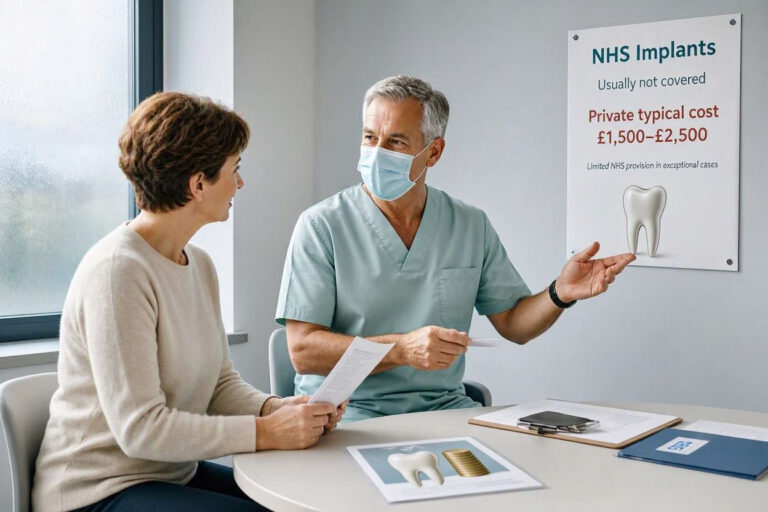
The NHS does not routinely offer dental implants. You can only get them on the NHS for specific medical reasons. For example, after jaw cancer surgery or severe trauma. Standard tooth loss is not covered.
Therefore, most people pay privately for dental implants in Leicester. Some clinics offer payment plans. You can spread the cost over 12 to 24 months. Ask about interest-free options.
Important: Cheap implants abroad may seem tempting. But you have little protection if something goes wrong. Complications need local follow-up. Many Leicester dentists refuse to work on implants placed overseas.
Finding a Reliable Implant Dentist in Leicester
Not all dentists place implants. It requires extra training. Look for specific qualifications.
What to Look For
- GDC registration (General Dental Council) – all UK dentists must have this
- Postgraduate implant diploma – e.g., from the Royal College of Surgeons
- Membership in professional bodies like the Association of Dental Implantology (ADI) or the International Team for Implantology (ITI)
- Before and after photos of real patients
- Positive patient reviews on Google or Trustpilot
Questions to Ask Before Committing
Do not be shy. A good dentist welcomes questions.
- How many implants have you placed?
- What is your success rate?
- What happens if my implant fails?
- Do you offer a warranty on the implant and crown?
- Can I speak to a previous patient?
- Are all costs clearly stated in writing?
Red Flags to Avoid
- Prices that seem too good to be true (e.g., £1,000 for a full implant)
- No written treatment plan
- Pressure to decide immediately
- Dentist who cannot show their qualifications
- No emergency contact out of hours
Success Rates and Longevity: Realistic Expectations
Dental implants have high success rates. But no medical procedure works 100% of the time.
- Lower jaw implants: 95–98% success after 10 years
- Upper jaw implants: 90–95% success after 10 years
- Smokers: success rate drops by about 10–15%
- Bone graft patients: success rates similar to normal bone after healing
How Long Do Implants Last?
The implant itself (the screw in the bone) can last a lifetime. The crown on top wears down eventually. You may need a new crown after 15–20 years.
Think of it like a car engine and tyres. The engine (implant) lasts. The tyres (crown) need replacement over time.
What Causes Implant Failure?
Failure means the implant does not fuse with bone. It becomes loose. This happens in three main scenarios:
- Early failure (first few months): Usually infection or poor healing.
- Late failure (years later): Gum disease around the implant (peri-implantitis).
- Overloading: Too much pressure from grinding teeth.
Most failures happen early. A good dentist will replace a failed implant at reduced or no cost if it fails within the first year.
Patient quote: “I had an implant in 2018. I grind my teeth at night. My dentist made me a nightguard. That saved my implant. Without it, I would have cracked the crown.” – Mark, Leicester
Caring for Your Dental Implants
Implants cannot get cavities. But they are not immune to problems. The main risk is gum disease around the implant.
Daily Cleaning Routine
- Brush twice daily with a soft toothbrush
- Floss around the implant (use superfloss or implant-specific floss)
- Use an interdental brush for wider gaps
- Consider a water flosser (Waterpik) for gentle cleaning
Professional Maintenance
See your dentist or hygienist every 6–12 months. They will:
- Check the implant stability
- Measure gum pockets around the implant
- Clean hard-to-reach areas
- Take X-rays every few years to check bone levels
What to Avoid
- Smoking – major risk factor for implant loss
- Chewing ice or hard sweets – can crack the crown
- Using your teeth as tools – opening bottles or ripping packages
- Skipping dental check-ups – problems grow silently
Common Fears About Dental Implants (Addressed Honestly)
It is normal to feel anxious. Here are real answers to common worries.
“Does implant surgery hurt?”
During the procedure: no. Local anaesthetic completely numbs the area. You feel vibration and pressure. Not sharp pain.
Afterwards: mild discomfort for 3–7 days. Like a tooth extraction. Over-the-counter painkillers (ibuprofen or paracetamol) usually help.
“Is the surgery dangerous?”
Implant placement is very safe for healthy people. Serious complications are rare. The biggest risks are infection (treatable with antibiotics) or nerve injury (uncommon with proper planning).
A CT scan before surgery shows exactly where nerves run. This prevents damage.
“Will my implant look fake?”
No. Modern crowns look extremely natural. The dentist matches colour, shape, and even translucency. Most people cannot tell which tooth is an implant.
“Can my body reject the implant?”
Rejection is the wrong word. Implants do not trigger an immune reaction like an organ transplant. Either the bone grows around it (success) or it does not (failure). Failure is not rejection. It is just lack of fusion.
“How long must I wait for a front tooth replacement?”
Front teeth are visible. Dentists use special techniques for faster results. Sometimes they place a temporary crown on the same day. But the final crown still requires several months of healing. You will not walk around with a gap.
Realistic Timeline for Dental Implants in Leicester
Here is a typical timeline from first visit to final crown.
| Stage | Time from start |
|---|---|
| Consultation and CT scan | Week 1 |
| Bone graft (if needed) | Week 2–4 |
| Implant placement surgery | Week 4–8 |
| Healing period (no crown) | 3–6 months |
| Abutment placement | Month 4–7 |
| Gum healing around abutment | 2–4 weeks |
| Crown fitting | Month 5–8 |
Total treatment time: 5 to 9 months on average.
Complex cases (with bone grafting) can take 12–18 months.
Patience pays off. A rushed implant has a higher failure rate. Trust the process.
Financing Dental Implants in Leicester
Cost is the biggest barrier for many people. You have options.
Payment Plans
Many Leicester clinics partner with finance companies. Typical plans:
- 0% interest over 10–12 months – best if you can pay within a year
- Low interest over 24–48 months – lower monthly payments but total cost higher
- Clinic savings schemes – some offer discounts for paying upfront
Alternative Approaches
Start with one implant: Replace the most important tooth first. Add others over time.
Use a dental savings plan: Some clinics offer membership plans. You pay monthly for check-ups and discounts on treatment.
Ask about a staged approach: Pay for the implant surgery first. Save for the crown later. Many clinics allow this.
What About Insurance?
Most standard dental insurance excludes implants. Some premium plans cover part of the cost. Check your policy carefully. The annual limit (e.g., £500–£1,000) rarely covers the full treatment.
Case Study: Two Leicester Patients, Two Different Journeys
Sarah, 34 – Single missing molar
Sarah lost a back tooth. She chewed on one side only. Her face looked slightly asymmetrical.
She chose a single implant. Cost: £2,500. Treatment took 6 months. Now she chews normally. No one sees the implant because it is at the back. She says: “Best money I ever spent on myself.”
David, 67 – Full upper denture problems
David wore a full upper denture for 10 years. It clicked, slipped, and hurt his gums. He could not eat apples or nuts.
He chose All-on-4 implants. Four implants support a fixed bridge across his upper jaw. Cost: £14,000. Treatment took 8 months. He now eats steak again. His denture never moves. “It changed my life,” he says.
Potential Complications and How Dentists Handle Them
Honest articles mention risks. Here they are.
| Complication | How common? | Solution |
|---|---|---|
| Post-op bleeding | Rare | Pressure and gauze |
| Infection | 1–2% | Antibiotics |
| Implant failure (early) | 2–5% | Replace implant (sometimes free) |
| Nerve numbness (lower jaw) | <1% (temporary) | Most resolves in months |
| Sinus problems (upper jaw) | Rare | Medication or minor procedure |
| Crown loosening | Uncommon | Dentist re-tightens screw |
A skilled implant dentist minimises these risks. The key is proper planning. CT scans and surgical guides make placement very precise.
Finding the Best Clinic for Dental Implants in Leicester
Leicester has many dental clinics. Here is how to shortlist the best.
Areas to Search
- City centre practices – convenient but often higher prices
- Suburbs like Oadby, Wigston, or Glenfield – sometimes lower overheads
- Specialist implant centres – do nothing but implants and complex surgery
How to Verify Quality
- Check GDC website for the dentist’s registration and qualifications.
- Look for “Diploma in Implant Dentistry” (not just a weekend course).
- Read Google reviews (but ignore 5-star-only clinics – no one is perfect).
- Visit the clinic before booking. Is it clean? Do staff seem caring?
Three Clinics to Start Your Research (Examples Only)
Disclaimer: This is not an endorsement. Always do your own research.
- Leicester Implant & Dental Centre – Specialist focus, long track record
- Smile Works Leicester – Known for All-on-4 treatments
- Bupa Dental Care Leicester – Large group with implant-trained dentists
Call each. Ask your questions. Compare how they treat you on the phone.
Questions to Ask During Your Consultation
Take this list with you. Tick off each question.
- Am I a good candidate for implants right now?
- Do I need bone grafting or a sinus lift?
- How many implants have you placed in the last year?
- Can I see before/after photos of similar cases?
- What brand of implant do you use? (Nobel Biocare, Straumann, Dentsply, etc.)
- What is your warranty policy?
- Who covers out-of-hours emergencies?
- Is the quoted price fixed or subject to change?
- How long until I can eat normally?
- What happens if the implant fails?
Helpful Resources for Leicester Residents
You are not alone in this journey. Use these local and national resources.
Free Implant Advice
- Association of Dental Implantology (ADI) – Find accredited implant dentists (adi.org.uk)
- General Dental Council – Verify a dentist’s credentials (gdc-uk.org)
- Leicester City Council Oral Health Team – General dental advice (not specific implants)
Patient Support
- Dental Fear Central – Help for anxious patients
- The Tooth Implant Forum – Real patient stories and Q&A
Note: Do not rely solely on social media groups. Some contain outdated or incorrect advice. Always verify with a real dentist.
Summary of Key Points
- Dental implants replace both root and crown for a permanent solution.
- Treatment takes 5–9 months on average.
- Success rates are 90–98% in healthy patients.
- Costs in Leicester range from £2,000 to £18,000 depending on complexity.
- Implants require daily cleaning and regular dental visits.
- Smoking, diabetes, and bone loss can affect success but do not rule it out.
- Always check dentist qualifications and ask about warranties.
- Financing options exist, including 0% payment plans.
Final Verdict: Are Dental Implants Worth It?
Yes – for the right person. If you have healthy gums, enough bone, and realistic expectations, implants are the best tooth replacement available. They feel natural, last decades, and protect your jawbone.
But they are not cheap. They are not instant. They require surgery and healing.
Consider your budget, your health, and your patience level. Talk to two or three Leicester implant dentists. Compare their advice and prices. Then decide.
A missing tooth is not an emergency. You have time to research. Use this guide as your starting point.
Conclusion
Dental implants in Leicester offer a permanent, natural-looking solution for missing teeth. Success depends on careful planning, a skilled dentist, and good oral hygiene. While the cost and treatment time are higher than other options, the long-term benefits often justify the investment for suitable candidates.
Frequently Asked Questions (FAQ)
1. Are dental implants on the NHS in Leicester?
No, not for typical tooth loss. The NHS only funds implants for medical necessity (e.g., cancer surgery).
2. How painful is implant surgery?
You feel no sharp pain during surgery due to local anaesthetic. Mild soreness for a few days afterwards is normal.
3. Can I have implants if I smoke?
Yes, but your failure risk is higher. Many dentists still treat smokers but advise quitting or reducing.
4. How long do implants last?
The titanium screw can last a lifetime. The crown lasts 15–20 years before needing replacement.
5. What is the cheapest implant option in Leicester?
Single implant from £2,000. Avoid any clinic offering below £1,500 – quality may be compromised.
6. Do implants set off metal detectors?
No. The titanium is non-magnetic and very small. Airport security will not detect it.
7. Can I get a full set of teeth on implants?
Yes. All-on-4 uses 4 to 6 implants to support a full arch of fixed teeth.
8. How soon can I eat after implant surgery?
Soft foods for 1–2 weeks. Avoid chewing on the implant side for 3–6 months.
9. Will my insurance cover implants?
Most UK dental insurance excludes implants. Check your policy. Some premium plans offer partial cover.
10. What happens if my implant fails?
The dentist removes it. After bone heals (3–6 months), you can try again. Some warranties cover replacement.
Additional Resource
For an official list of GDC-registered implant dentists in Leicester, visit:
🔗 General Dental Council – Find a Dentist
(www.gdc-uk.org/find-a-dentist)
Use filters: Location = Leicester → Advanced search → Special interest = Implant dentistry.
Disclaimer: This article provides general information only. It does not replace professional medical advice. Always consult a qualified dentist in Leicester for a personal assessment of your situation. Results and costs vary between individuals and clinics.