Dental Implants in Los Altos
Losing a tooth can feel like a small crisis. Maybe it happened suddenly during a weekend soccer game. Perhaps it has been a slow decline due to decay or gum disease. Whatever the reason, you are not alone. Many adults in Los Altos face this situation every year.
The good news? Modern dentistry offers a solution that looks, feels, and functions like a natural tooth. That solution is the dental implant.
But let us be honest. Searching online for “dental implants in Los Altos” brings up a lot of clinical terms, scary videos, and price tags that make you pause. You deserve a clear, friendly, and realistic guide. This article aims to be exactly that. We will walk through what implants really are, what the process feels like, how much you might pay, and how to find trustworthy care in Los Altos.
No hype. No false promises. Just the facts you need to make a confident choice for your health.
What Exactly Is a Dental Implant? A Simple Explanation
Imagine you are building a new fence. You do not just glue the wooden board to the ground. First, you dig a hole, set a strong metal post in concrete, and let it cure. Later, you attach the board to that post.
A dental implant works the same way, but on a tiny, precise scale.
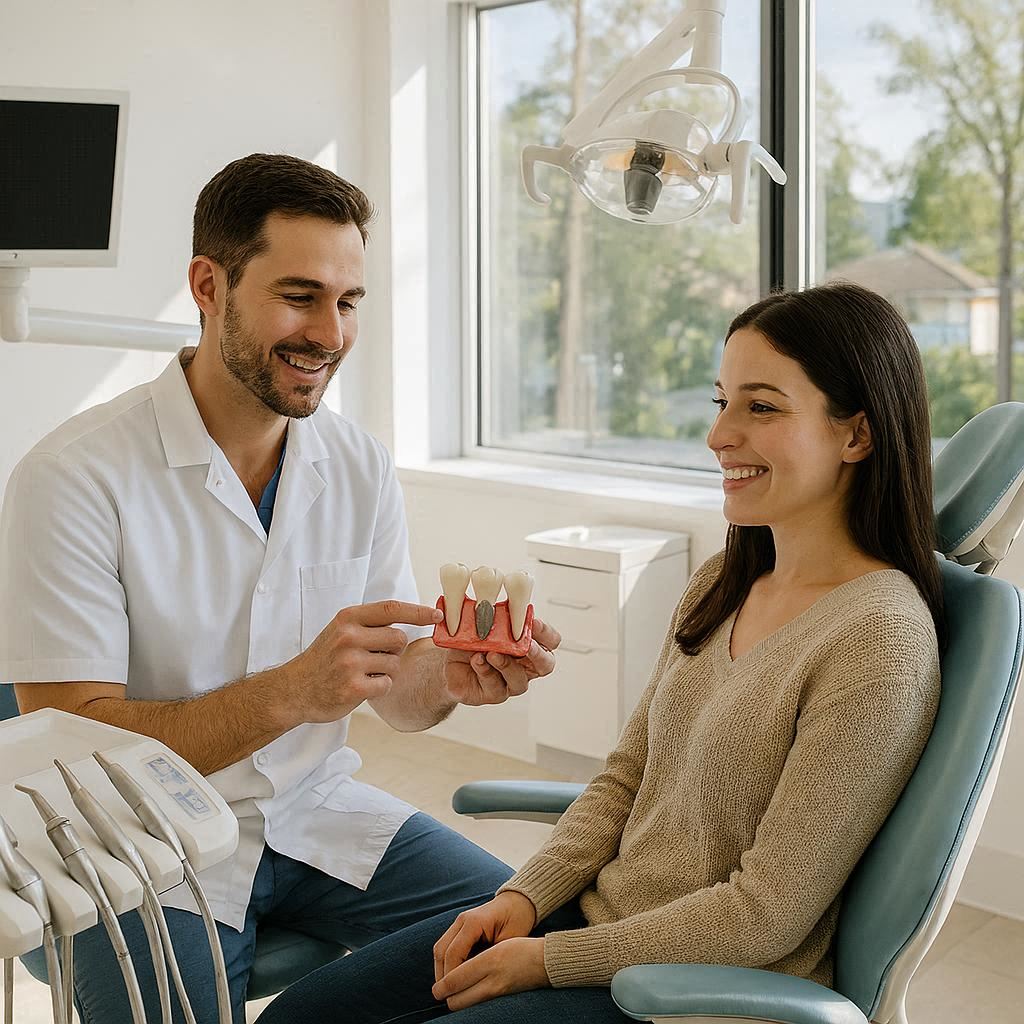
- The Post (Implant Fixture): A small screw made of medical-grade titanium. A dentist places this into your jawbone where the tooth root used to be.
- The Connector (Abutment): A small metal piece that screws into the post. It sticks out just above the gum line.
- The New Tooth (Crown): A custom-made, tooth-colored cap that attaches to the abutment. This is the part everyone sees when you smile.
Why titanium? Because your body accepts it remarkably well. Bone tissue grows right up against the metal and locks it in place. This process is called osseointegration (say that three times fast). It is what makes implants so strong. A natural tooth moves slightly in its socket. An implant does not move at all. That stability feels great when you bite into an apple.
Important note: Implants are not the same as bridges or dentures. Bridges rely on grinding down healthy teeth next to a gap. Dentures rest on your gums and can slip. An implant replaces the entire tooth structure, root and all.
Why Consider Dental Implants in Los Altos? The Real Benefits
You might wonder, “Is this really worth it?” Let us look at the real-world advantages.
1. They Save Your Neighboring Teeth
A traditional bridge requires the dentist to file down the two healthy teeth next to the missing one. Those teeth lose valuable enamel forever. An implant stands alone. It does not touch or alter your other teeth. That is a huge win for long-term dental health.
2. They Stop Bone Loss
When a tooth root disappears, your jawbone gets a message: “No work here anymore.” Over time, the bone resorbs (melts away). Your face can start to look sunken or older. Implants mimic a natural root, so the bone stays active and healthy.
3. You Eat Normally Again
Dentures can wobble. Bridges can trap food. An implant functions like a natural tooth. You can chew steak, corn on the cob, or nuts without worry. Many patients say they forget they even have an implant.
4. Long-Term Value
A good bridge lasts 7 to 10 years. A good denture lasts 5 to 8 years. A well-cared-for dental implant can last 30 years, often a lifetime. The upfront cost is higher, but the long-term cost is often lower because you replace it less often.
5. Confidence in Your Smile
This is harder to measure but very real. No more hiding your mouth when you laugh. No more feeling self-conscious in photos. An implant looks so natural that even a dentist might need an X-ray to tell which tooth is the implant.
Who Is a Good Candidate for Dental Implants?
Let us be realistic. Not everyone is an ideal candidate right away. But many people can become one with some preparation.
You Are Likely a Good Candidate If:
- You have one or more missing teeth.
- Your jawbone is fully grown (usually over age 18).
- You have enough bone density to support the implant.
- Your gums are healthy (no active gum disease).
- You do not smoke heavily (smoking slows healing significantly).
- You are committed to good oral hygiene.
What If You Have Bone Loss?
This is common, especially if the tooth has been missing for years. The good news: a bone graft can rebuild the lost tissue. The dentist takes bone from another area (or uses donor bone) and adds it to your jaw. You wait a few months for it to heal, then proceed with the implant. This adds time and cost, but it makes many “borderline” patients into great candidates.
What About Medical Conditions?
Conditions like uncontrolled diabetes, autoimmune disorders, or radiation therapy to the jaw can affect healing. This does not automatically rule you out. It just means your dentist needs to coordinate with your doctor. Many people with well-managed conditions receive implants successfully.
Note: Always disclose your full medical history. An honest conversation with your dentist prevents complications later.
The Step-by-Step Process: What to Expect from Start to Finish
Let us walk through the journey of getting dental implants in Los Altos. Every case is unique, but this is the typical path.
Step 1: The Comprehensive Exam (Day 1)
Your dentist examines your mouth, takes X-rays, and probably orders a 3D CT scan. This scan shows the exact shape and density of your jawbone. The dentist checks for infection, decay on other teeth, and signs of gum disease.
What you do: Share your goals, concerns, and budget. Ask questions.
Step 2: The Treatment Plan
The dentist creates a timeline just for you. Will you need a bone graft? One implant or several? Do you want sedation during surgery? You receive a written plan with clear costs and phases.
Step 3: Preparatory Work (If Needed)
- Bone graft: Recovery time 4-6 months.
- Tooth extraction (if a damaged tooth remains): Healing time 8-12 weeks before implant placement.
- Gum disease treatment: Several weeks of deep cleaning.
Step 4: Implant Placement Surgery
Do not let the word “surgery” scare you. This is usually done right in the dentist’s chair.
- Anesthesia: Local anesthetic numbs the area completely. You feel pressure but no sharp pain. Sedation options (laughing gas or oral medication) help if you feel anxious.
- The procedure: The dentist makes a small incision in your gum, drills a precise hole into the bone, and screws the implant post into place. Then they close the gum over it or attach a healing cap.
- Time: One implant takes about 60 to 90 minutes.
How it feels: Mostly just pushing and tapping sensations. Many patients report less discomfort than a simple tooth extraction.
Step 5: Osseointegration (The Waiting Period)
This is the most important phase. You wait 3 to 6 months while the bone grows around the implant. During this time, you wear a temporary partial denture or a flipper tooth to fill the gap. You eat soft foods and avoid chewing directly on the implant site.
Step 6: Abutment Placement (A Minor Second Procedure)
Once the implant is solidly fused, the dentist reopens the gum (just a tiny bit) and attaches the abutment. This is a quick visit, often 30 minutes, with local anesthesia.
Healing: Your gum needs about 2 weeks to form a nice, healthy collar around the abutment.
Step 7: Creating Your New Tooth (2-3 Weeks)
The dentist takes impressions of your mouth. A dental lab crafts your custom crown to match the color, shape, and size of your natural teeth. You might try a temporary crown first to check the fit.
Step 8: Placing the Final Crown
You return one last time. The dentist removes the temporary crown (if you had one) and cements or screws the permanent crown onto the abutment. They check your bite and make tiny adjustments.
That is it. You walk out with a fully restored smile.
The Total Timeline
| Phase | Typical Duration |
|---|---|
| Exam & planning | 1-2 weeks |
| Bone graft (if needed) | 4-6 months healing |
| Implant placement surgery | 1 day |
| Osseointegration | 3-6 months |
| Abutment & crown | 3-4 weeks |
| Total (simple case) | 4-6 months |
| Total (with graft) | 8-12 months |
How Much Do Dental Implants Cost in Los Altos?
Let us talk money. This is often the biggest concern for people. Prices in Los Altos reflect the high quality of care and the high cost of living in the Bay Area. You should not expect bargain-basement prices. But you should expect transparency.
Average Price Range for a Single Implant (Los Altos)
| Component | Typical Cost |
|---|---|
| Consultation & CT scan | 150−500 |
| Implant post placement | 1,800−3,000 |
| Abutment | 300−600 |
| Custom crown | 1,500−2,500 |
| Total for one implant (no extras) | 3,750−3,750−6,600 |
Extras That Add Cost
- Bone graft: 500−1,500 per site
- Sinus lift (if bone is too thin near the upper back teeth): 1,500−3,000
- Extraction of a broken tooth: 200−500
- Sedation (laughing gas): 100−300
- IV sedation: 500−1,000
So a single implant with a bone graft and sedation could reach 7,000to9,000 in Los Altos. That sounds high. But remember: one bridge costs 3,000to5,000 and needs replacement every 10 years. Over 30 years, the implant is often the cheaper choice.
Does Insurance Cover Implants?
It depends. Many PPO dental plans now cover a portion. Here is what to look for:
- Some plans cover the crown (as a “bridge” benefit) but not the implant post.
- Others cover the implant post at 50% after your deductible.
- Few cover 100% of everything.
Ask your insurance these exact questions:
- “What is my annual maximum benefit?”
- “Do you cover implant posts, abutments, and crowns separately?”
- “Is there a waiting period for implant coverage?”
Financing Options in Los Altos
Most local dental offices work with third-party financing companies. Popular options include:
- CareCredit: Medical credit card with 6, 12, or 18-month no-interest plans.
- LendingClub: Fixed-rate loans specifically for healthcare.
- In-house payment plans: A few Los Altos dentists offer monthly installments with no interest.
Note: Always ask about discounts for paying in full with cash or check. Some offices offer 5-7% off.
Dental Implants vs. Alternatives: An Honest Comparison
You have choices. Let us compare implants to other tooth replacement options side by side.
| Feature | Dental Implant | Fixed Bridge | Removable Partial Denture |
|---|---|---|---|
| Replaces the root | Yes | No | No |
| Affects adjacent teeth | No | Yes (requires grinding) | No |
| Bone loss prevention | Yes | No | No |
| Typical lifespan | 20-30+ years | 7-10 years | 5-8 years |
| Eating restrictions | None | Avoid very sticky/hard foods | Many restrictions |
| Removable at night | No | No | Yes |
| Average cost (Los Altos) | 4,000−9,000 | 3,000−5,000 | 800−1,800 |
| Insurance coverage | Partial (growing) | Common | Common |
When a Bridge Makes Sense
If the teeth next to the gap already have large fillings or crowns, grinding them down for a bridge may not be a big loss. Bridges also work faster (just 2-3 weeks) and cost less upfront.
When a Partial Denture Makes Sense
If you are missing many teeth in different areas, a partial denture replaces them all at once. It is also a good temporary solution while you save money for implants.
When an Implant Is Worth the Wait
If you are missing one tooth and the neighbors are healthy, an implant is the gold standard. No contest. You protect those healthy teeth for life.
Finding the Right Dentist for Dental Implants in Los Altos
Not all dentists are the same. Implantology is a specific skill set. You want someone who does this work every week, not once a year.
Types of Implant Providers
| Provider Type | Expertise Level | Typical Cost |
|---|---|---|
| General dentist with implant training | Good for single, straightforward cases | $$ |
| Periodontist (gum specialist) | Excellent for complex cases, bone grafts | $$$ |
| Oral surgeon | Best for difficult anatomy, full sedation | $$$ |
| Prosthodontist | Best for multiple implants or full mouth rehab | $$$ |
Questions to Ask Before You Commit
Call or visit 2-3 offices in Los Altos. Ask these exact questions:
- “How many implant surgeries do you perform each month?”
- “What is your success rate for single implants?”
- “Do you handle bone grafts in-house, or do I need a referral?”
- “What type of 3D imaging do you use?”
- “Who makes your crowns? A local lab or an overseas lab?”
- “What happens if my implant fails? Do you guarantee your work?”
- “Can you give me two patient references I can call?”
A confident, ethical dentist answers these without hesitation. If they get defensive or vague, walk away.
What to Look for in a Los Altos Office
- Clean, modern facility: Digital X-rays, CT scanner on-site, sterile surgical suites.
- Clear pricing: They provide a written estimate before any work begins.
- Transparent timeline: They explain delays, healing times, and potential complications.
- Good reviews with specifics: Look for mentions of “pain control,” “clear explanations,” and “follow-up care.”
Recovery and Aftercare: Your Guide to a Smooth Healing
Let us be honest about the recovery. It is not painful for most people. It is mostly boring. You wait. You heal. You protect the area.
The First 24 Hours After Surgery
- Bleeding: Some oozing is normal. Bite on a gauze pad for 30 minutes. Replace as needed.
- Swelling: Ice packs on the outside of your cheek (20 minutes on, 20 off) for the first 12 hours.
- Pain: Most people take ibuprofen (Advil) or acetaminophen (Tylenol). Prescription painkillers are rarely needed after the first day.
- Food: Cold, soft foods only. Yogurt, smoothies (no straws!), applesauce, pudding.
What not to do:
- Do not spit forcefully.
- Do not drink through a straw (risk of dry socket).
- Do not smoke for at least 72 hours (ideally, for 2 weeks).
- Do not touch the area with your tongue or fingers.
Days 2 to 7
- Swelling peaks around day 2, then drops.
- You can switch to warm salt water rinses (twice a day, very gentle).
- Start eating warm soft foods: mashed potatoes, scrambled eggs, oatmeal, soup.
- Brush your other teeth normally, but be very gentle near the surgery site.
Weeks 2 to 12 (Osseointegration Phase)
This is the long waiting game. The implant sits under your gum or under a healing cap. You mostly forget it is there.
- Continue normal brushing and flossing.
- Avoid chewing hard, crunchy, or sticky foods on that side.
- Wear your temporary tooth (if provided) to maintain space.
- Attend all follow-up appointments so the dentist can monitor healing.
Signs of a Problem (Call Your Dentist)
- Severe pain that worsens after day 3
- Fever over 101°F (38.3°C)
- Pus or foul taste from the site
- The implant feels loose or moves
- Swelling that spreads to your eye or neck
Most of these complications are rare, especially with a healthy patient and a skilled dentist. But know the signs.
Long-Term Maintenance
An implant will not get cavities (it is metal and ceramic). But the gum around it can still get infected. This is called peri-implantitis.
To keep your implant healthy for decades:
- Brush twice a day, including gently around the gumline of the implant.
- Floss daily. Use superfloss or implant-specific floss picks.
- Use a water flosser on a low setting to clean the abutment-crown junction.
- Visit your dentist every 6 months for professional cleanings.
- Wear a night guard if you grind your teeth (grinding can crack crowns).
- Do not use your implant as a tool (opening packages, cracking nuts, etc.).
Myths About Dental Implants (Busted)
Let us clear up some common misconceptions.
Myth 1: “Implant surgery is extremely painful.”
Reality: Most patients rate the pain less than a tooth extraction. Local anesthesia blocks pain during surgery. Over-the-counter pain relievers manage post-op discomfort. Many people return to work the next day.
Myth 2: “The treatment takes too long.”
Reality: Yes, osseointegration requires 3-6 months of waiting. But you are not in pain during that time. You wear a temporary tooth. The result is a permanent, natural-feeling tooth. Would you rather rush a bridge that lasts 7 years or wait for an implant that lasts 30?
Myth 3: “Old people can’t get implants.”
Reality: Age is not a barrier. Health is. Healthy 80-year-olds receive implants successfully. As long as you have enough bone and no uncontrolled medical conditions, you are a candidate.
Myth 4: “Implants fail often.”
Reality: Success rates are 95-98% for single implants in healthy people. Most failures happen in the first few months due to infection, smoking, or poor bone quality. After the first year, failure is very rare.
Myth 5: “My body might reject the titanium.”
Reality: True metal allergies exist but are extremely rare for titanium. Less than 0.6% of people have a titanium sensitivity. Your dentist can perform a patch test before surgery if you have a history of metal allergies.
Real Patient Stories (Names Changed for Privacy)
Sarah’s Story: The Accidental Fall
“I tripped on a cracked sidewalk near Rancho Shopping Center. My front tooth hit the pavement and snapped off at the gumline. I was devastated. I’m a real estate agent. My smile is my business.”
“My dentist in Los Altos recommended an implant. I was terrified of the cost and the surgery. But he explained every step. They even showed me a video of the exact procedure. The day of surgery, I felt nothing. I wore a flipper tooth for 5 months. Nobody knew. Now my implant looks better than my original tooth. Best $5,800 I ever spent.”
Mark’s Story: A Missing Molar for 15 Years
“I lost a back molar in my 20s and just… ignored it. For 15 years. I chewed on the other side. Then my dentist showed me an X-ray. The bone where that tooth used to be was almost gone. My face on that side looked a little sunken.”
“We did a bone graft first. That added 6 months and 1,200.Thentheimplant.Totalcostwasaround7,500. It felt like a lot. But now I can chew on both sides again. My bite feels balanced. I wish I had done it 10 years ago.”
Linda’s Story: Denture to Implant-Supported Bridge
“I had a partial denture for my lower front teeth. It flipped around when I talked. I couldn’t eat a sandwich in public. I felt old.”
“My periodontist in Los Altos placed two implants to support a 4-tooth bridge. It was not cheap, about $12,000. But my insurance paid 40% because it replaced a medically necessary appliance. Now my lower teeth do not move at all. I laugh without covering my mouth. Worth every penny.”
Frequently Asked Questions (FAQ)
1. How long do dental implants last?
With proper care, 20-30 years is common. Many last a lifetime. The crown may wear out after 10-15 years and need replacement, but the implant post stays.
2. Is the procedure safe?
Yes. Dental implant surgery has been performed for over 50 years. Complications are rare when you choose an experienced provider and follow aftercare instructions.
3. Can I get multiple implants at once?
Absolutely. Many patients receive 2, 4, or even 6 implants in a single surgery. This saves time and reduces overall recovery.
4. Will my insurance cover any of this?
Probably some, but rarely all. Call your insurer for a pre-treatment estimate. Many Los Altos dentists also file claims on your behalf.
5. What if I need a bone graft and cannot afford it?
Ask your dentist about smaller grafts (some are as low as $500). Or ask about using your own bone from another area of your mouth, which costs less than donor bone. Some offices offer split payments for graft procedures.
6. Do implants look fake?
No. A skilled lab technician matches the shade, translucency, and shape to your natural teeth. Unless you point it out, no one will know.
7. Can I get an implant if I smoke?
Yes, but your risk of failure is higher (about 15-20% vs. 5% for non-smokers). Dentists strongly recommend quitting or at least cutting back significantly during the healing period.
8. What happens if the implant fails?
If it fails during the first year, many dentists replace it at no charge for the implant post (you may pay for a new crown). Always ask about the warranty before you start.
9. How do I clean my implant?
Brush it like a natural tooth. Floss around it carefully. A water flosser is excellent for blasting away food particles from under the crown. Your hygienist will show you special implant floss.
10. Can I have an MRI with a dental implant?
Yes. Titanium is not magnetic. Dental implants are MRI-safe. Just tell the technician you have them so they can adjust the equipment.
Additional Resources
For more trustworthy, evidence-based information on dental implants, visit the American Academy of Implant Dentistry (AAID) :
https://www.aaid.com/
This resource offers a “Find a Dentist” tool, patient education videos, and the latest research on implant safety and techniques.
Conclusion
Dental implants in Los Altos offer a permanent, natural-looking solution for missing teeth. They preserve your jawbone, protect healthy neighboring teeth, and restore your ability to eat and smile with confidence. While the upfront cost and treatment time are higher than alternatives, the long-term value, comfort, and durability make implants a wise investment in your health.
Disclaimer: This article is for informational purposes only and does not constitute medical or dental advice. Every patient’s situation is unique. Always consult a licensed dentist in Los Altos for a personal examination and treatment plan. The author and publisher are not liable for any actions taken based on this content.