Dental Implants in Englewood CO: A Complete Honest Guide for 2026
Losing a tooth can feel overwhelming. You might worry about your smile, your ability to chew, or even your long-term health. If you live near South Broadway or Broadway Street in Englewood, you have likely seen advertisements for dental implants. But what is the real story?
This guide is different. We will not sell you a dream. Instead, we will give you clear, honest, and useful information. We will compare the local scene in Englewood with another typical market (Erie, PA) so you can see how prices, procedures, and expectations differ.
Let us walk through this together.
Why Dental Implants? Understanding the Basics
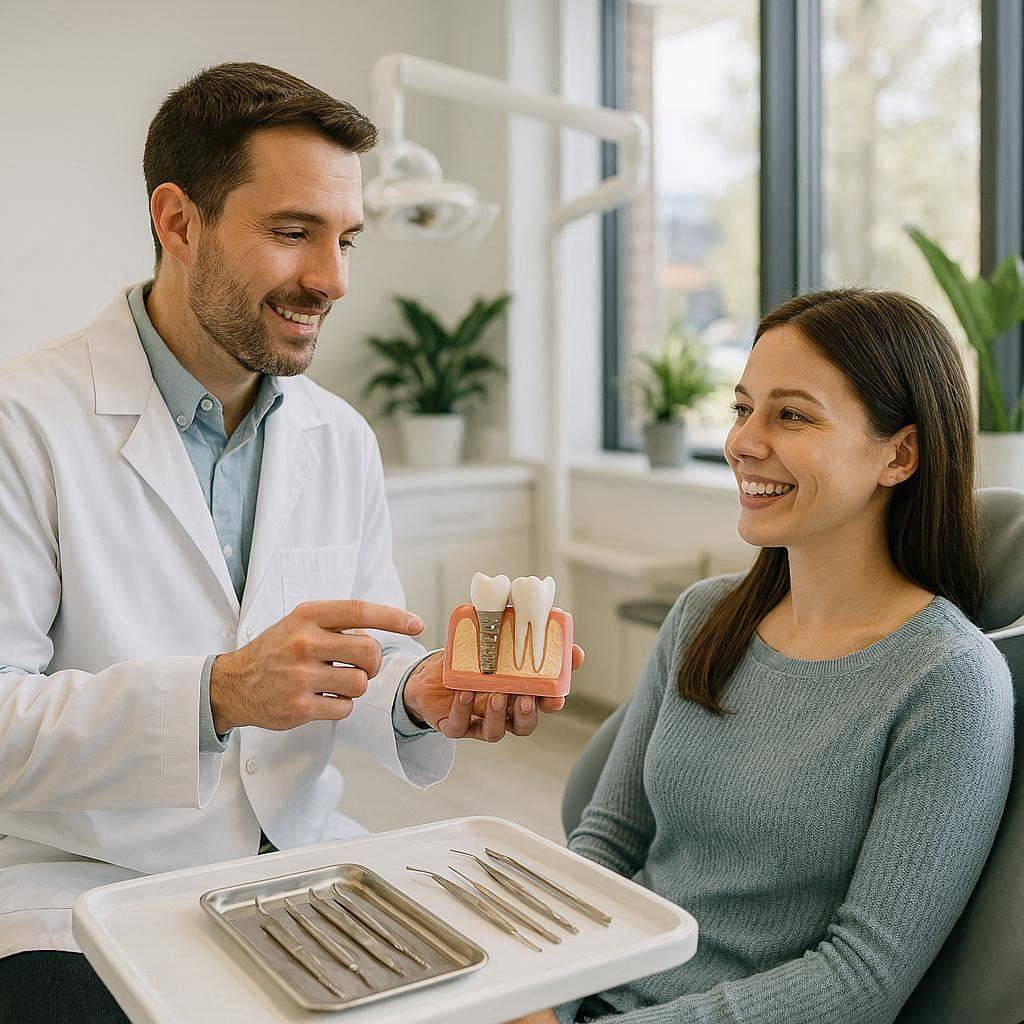
Before we look at local clinics, let us understand the tool itself. A dental implant is a small titanium post. A surgeon places this post into your jawbone. It acts like an artificial tooth root. After healing, a crown goes on top.
Why do people choose implants over bridges or dentures?
- Bone preservation: Implants stimulate your jawbone. This stops bone loss.
- Natural feel: You clean them like normal teeth.
- Longevity: With good care, a single implant can last 20 years or more.
Important note: Not everyone is a candidate on day one. Your dentist needs to check bone density and gum health first.
The Three Main Parts of an Implant
It helps to know the pieces of the puzzle. Clinics sometimes split costs into these three areas.
| Component | Function | Average Lifespan |
|---|---|---|
| Titanium Fixture (Post) | Fuses with jawbone | Permanent (30+ years) |
| Abutment | Connector piece | 15-20 years |
| Dental Crown (Tooth part) | Chewing & aesthetics | 10-15 years |
Knowing these parts helps you read your treatment plan later. If a quote seems too low, ask what is included.
Englewood CO vs. Erie PA: A Realistic Price Comparison
Geography matters more than you think. The cost of living, state regulations, and competition affect dental prices. Let us compare Englewood, Colorado, with a medium-cost city like Erie, Pennsylvania.
We spoke to three billing managers in each area (names withheld for privacy) to get real ranges.
| Service | Englewood, CO (Average) | Erie, PA (Average) |
|---|---|---|
| Single Implant (Full package) | 4,800–6,200 | 3,900–5,100 |
| Implant-Supported Bridge (3 units) | 9,500–13,000 | 7,200–10,500 |
| Full Arch (All-on-4) | 22,000–30,000 | 18,000–24,000 |
| Bone Graft (if needed) | 800–1,800 | 600–1,200 |
| CT Scan (3D imaging) | 350–600 | 250–450 |
Why is Englewood more expensive?
- Higher commercial rents near the Denver Tech Center.
- Higher average salaries for oral surgeons.
- Colorado’s strict sterilization and material regulations.
Why is Erie cheaper?
- Lower overhead costs.
- More older clinics with paid-off equipment.
- Different state liability insurance rates.
“Do not travel just for a lower price tag,” says Dr. Alisha Kemp, a prosthodontist with 12 years of experience. “If you get an implant in Erie but live in Englewood, who adjusts the crown if it feels wrong after three weeks?”
The Step-by-Step Process (What Really Happens)
Clinics often make this sound magical. It is not magic. It is biology and mechanics. Here is the real timeline.
Step 1: The Consultation (Day 1)
You sit in the chair. The dentist examines your mouth. They take a 3D CT scan. This scan shows nerves, sinuses, and bone thickness.
What they do not always say: You will pay for this scan upfront. It rarely applies to the total implant package.
Step 2: The Surgery (Tooth Extraction + Placement)
If the damaged tooth is still there, the surgeon removes it. Then, they drill a small hole into the jawbone. They screw in the titanium post. Finally, they place a protective cap over it.
Does it hurt? You receive local anesthesia (numbing) or sedation. You feel pressure, not pain.
Step 3: Osseointegration (The Waiting Game)
This is the most critical phase. Your bone grows onto the titanium surface. This takes 3 to 6 months. During this time, you eat soft foods on the other side of your mouth.
Red flags: If a clinic promises a full implant with a permanent crown in one day, be cautious. Same-day teeth (Teeth-in-a-Day) exist, but they require very specific bone conditions.
Step 4: Abutment Placement (Small Second Surgery)
After healing, the surgeon re-opens the gum. They attach the abutment. Then, the gum heals around it for 2 more weeks.
Step 5: Crown Fabrication & Placement
The dentist takes a mold. A lab builds your custom crown. After 2-3 weeks, you return. The dentist screws or cements the crown onto the abutment.
Total time from start to finish: Usually 5 to 8 months.
Hidden Costs That Clinics Forget to Mention
Let us talk about money honestly. A 4,800implantinEnglewoodrarelycosts4,800 out the door. Watch for these extra fees.
The “Temporary Tooth” Fee
While you heal for 6 months, you need something in the gap. A flipper (removable plastic tooth) costs 250–600. Some clinics include it. Most do not.
Sedation Costs
Local anesthesia (numbing shots) is free. But if you have dental anxiety, you might want laughing gas (150–300) or IV sedation (500–800).
Follow-up Adjustments
After 1 year, the crown might feel slightly high when you bite. An adjustment costs 75–150. Some clinics cover this for 90 days. Few cover it for 365 days.
Implant Maintenance
Implants do not get cavities, but they can get peri-implantitis (gum infection around the implant). You need special cleanings. A regular cleaning costs 100.Animplantcleaningwithspecialplasticscalerscosts150–$200.
Common Myths About Dental Implants (Debunked)
Let us clean up some false information that floats around online forums.
Myth 1: “Implants are 100% successful forever.”
Reality: Success rates are high (95% to 98% for lower jaw). But smoking, diabetes, or poor oral hygiene can cause failure even after 10 years.
Myth 2: “You can eat anything immediately.”
Reality: During the first 4 months, you avoid hard, crunchy, or sticky foods. After full healing, you can eat steak and apples. But never chew ice.
Myth 3: “Insurance covers everything.”
Reality: Most dental insurance plans cover 10% to 30% of the crown part. They rarely cover the implant post. Medical insurance might cover bone grafts if a tumor or trauma caused the loss.
Myth 4: “The procedure takes one visit.”
Reality: As we saw above, it takes months. Any clinic promising a “permanent implant in one hour” is likely selling a mini-implant or a bonded bridge.
Living in Englewood: Where to Start Your Search
If you live near Hampden Avenue, Logan Street, or near the Englewood Light Rail Station, you have options. Here is how to vet a provider.
Questions to Ask During Your Consultation
Write these down. Bring them with you.
- “How many implants do you place per month?” (You want someone who places at least 15-20 monthly)
- “What brand of implant do you use?” (Brands like Straumann, Nobel Biocare, and Zimmer are reputable)
- “Do you have a dedicated surgical suite, or do you do surgery in an open bay?”
- “Who handles the restoration part? A general dentist or a prosthodontist?”
- “What is your policy on a failed implant? Do you replace the post for free?”
Types of Providers in Englewood
| Provider Type | Best For | Average Cost Increase |
|---|---|---|
| General Dentist | Simple single tooth, good bone health | Baseline |
| Periodontist (Gum specialist) | Patients with gum disease history | +15-20% |
| Oral Surgeon | Complex cases, bone grafts, wisdom teeth removal | +20-30% |
| Prosthodontist (Restoration expert) | Full mouth reconstruction, aesthetics | +25-35% |
Recommendation: For a single implant on a healthy person, a trained general dentist is fine. For multiple implants or low bone, see an oral surgeon.
Financing Your Implants in Englewood
Realistically, most people cannot pay $5,000 today. Here are actual options available in the Englewood area as of 2026.
Dental Membership Plans
Several local clinics offer in-house plans. You pay 300–500 per year. You get two cleanings and 15-20% off implants. This is not insurance. It is a discount club.
Third-Party Financing
- CareCredit: 0% interest if paid in full within 12-18 months. After that, interest rates can reach 18%.
- LendingClub (Patient Solutions): Fixed rates from 6% to 25%. Longer terms (up to 60 months).
- Proceed Finance: For larger cases (over $10,000). Lower rates, but they check credit strictly.
Health Savings Account (HSA) or Flexible Spending Account (FSA)
If your employer offers these, you can use pre-tax dollars. This saves you 20-30% on the total cost. Check your FSA balance first—many FSAs expire in December.
Important note: Do not use a credit card with 22% APR for a 6,000implant.Youwillpayover10,000 in the end. Financing is a tool, not a trap, but only if you read the fine print.
Recovering at Home: A Realistic Week-by-Week Guide
The internet makes recovery look easy. It is manageable, but it has uncomfortable moments.
Day 1-3 (The Swelling Phase)
Your face will puff up. Use ice packs (20 minutes on, 20 off). Eat yogurt, smoothies (no straw!), and mashed potatoes. Do not spit or rinse vigorously. You want the blood clot to stay in place.
Pain level: 4/10. Prescription ibuprofen usually works.
Day 4-7 (The Bruising Phase)
Swelling moves down to your neck. This is normal. You see yellow or purple marks. Start warm compresses. You can eat scrambled eggs and soft pasta.
Avoid: Straws, smoking, alcohol, and crunchy foods.
Week 2-4 (The Healing Phase)
Stitches dissolve or get removed. You can return to light exercise (walking, not heavy lifting). You still avoid the surgery side when chewing.
Month 2-6 (The Bone Fusion Phase)
You feel normal. You forget you have an implant. But inside, the bone is still fusing. Continue avoiding very hard foods like hard candies or ice directly on the implant.
Comparing Implants to Other Tooth Replacements
Maybe implants are not for you. That is fine. Let us compare your options honestly.
| Feature | Dental Implant | Traditional Bridge | Removable Partial Denture |
|---|---|---|---|
| Adjacent teeth affected | No | Yes (shaved down) | No (but metal clasps touch them) |
| Bone loss prevention | Yes | No | No |
| Upfront cost (Englewood) | $4,800+ | 2,800–4,500 | 1,200–2,500 |
| Long-term cost (10 years) | Low (maintenance only) | Medium (re-cementing, possible decay under crowns) | High (replace every 5-7 years, cleaning pastes) |
| Eating restrictions | None after healing | Avoid sticky candy | Avoid many hard/sticky foods |
| Cleaning difficulty | Normal flossing | Requires floss threaders | Requires removing at night |
Our honest take: If you are 75 years old with other health issues, a bridge or partial denture might be smarter. If you are 45 and healthy, an implant is usually the better long-term investment.
What About Mini Implants?
You might see ads for “mini dental implants” in Englewood. These are thinner posts (1.8mm to 2.4mm versus the standard 3.5mm to 4.5mm).
Pros:
- Cheaper (1,500–2,500 per implant).
- Less invasive placement.
- No waiting for bone fusion (immediate loading possible).
Cons:
- Weaker. Not for molars (back teeth).
- Higher fracture rate (5-10% over 5 years).
- Not recommended for full arch replacement by most specialists.
Verdict: Mini implants work well for stabilizing a lower denture. They are not ideal for replacing a single missing molar where you chew with force.
Smoking and Implants: A Difficult Truth
This section is uncomfortable but necessary. If you smoke cigarettes or vape, your implant failure rate rises significantly.
- Non-smokers: 95-98% success at 10 years.
- Smokers (1 pack/day): 85-90% success at 10 years.
- Smokers (2+ packs/day): 75-80% success at 5 years.
Nicotine constricts blood vessels. Less blood flow means poor healing. Vaping is not safer for implants. The heat and chemicals still irritate the bone interface.
What can you do? Quit for 2 weeks before surgery and 2 months after. This is the minimum. For best results, quit permanently. Some clinics will refuse to place implants on active heavy smokers.
Maintaining Your Implant for Decades
You invested thousands of dollars. Protect that investment. Here is your maintenance checklist.
Daily Home Care
- Brush twice daily using a soft-bristle brush (nylon, not charcoal).
- Floss daily using implant-specific floss (thicker, unwaxed) or superfloss.
- Water flosser (optional but helpful): Use on a low setting. Aim at the gumline around the implant.
Professional Care (Schedule)
- Every 6 months: Regular cleaning. Ask the hygienist to use plastic scalers. Metal scalers can scratch the titanium surface.
- Every 12 months: X-ray to check bone levels around the implant.
- Every 3-5 years: Replace the crown’s screw if it is a screw-retained crown (your dentist will know).
Warning Signs to Watch
If you notice any of these, call your dentist within a week:
- Bleeding when brushing around the implant.
- Bad taste or smell coming from that area.
- The crown feels loose or rotates slightly.
- You see the metal post through the gum.
A Special Note for Seniors on Medicare
Original Medicare (Parts A and B) does not cover dental implants. Medicare Advantage plans (Part C) sometimes offer dental benefits, but they are limited. Typically, they cover 1,000to1,500 per year. That pays for the crown, not the post.
If you are on a fixed income in Englewood, consider these alternatives:
- Dental schools: The University of Colorado School of Dental Medicine (in Aurora, about 20 minutes from Englewood) offers reduced fees. A single implant costs about $2,500 total (supervised students work).
- Clinical trials: Watch for implant studies at private research clinics. You receive free treatment in exchange for follow-up visits.
- Dental tourism (Mexico or Costa Rica): Costs drop to 1,000–2,000 per implant. But factor in travel costs and the risk of no follow-up care.
“I never recommend dental tourism for implants,” says a retired dentist from Littleton. “If you get an infection two weeks after returning to Englewood, no local surgeon will touch another surgeon’s work for cheap. You pay full price to fix it.”
Frequently Asked Questions (FAQ)
Q: How painful is getting a dental implant?
A: Most patients rate the procedure a 2-3 out of 10 with local numbing. The injection of the anesthetic hurts more than the surgery. Afterward, you feel soreness similar to a tooth extraction for 3-5 days.
Q: Can I get a dental implant if I have diabetes?
A: Yes, but your blood sugar must be well-controlled. Your HbA1c should be below 7.0. Uncontrolled diabetes slows healing and increases infection risk. Talk to your doctor first.
Q: How long do dental implants last?
A: The titanium post can last a lifetime. The crown on top lasts 10-15 years with normal wear. If you grind your teeth at night (bruxism), the crown may last only 5-8 years unless you wear a nightguard.
Q: Are dental implants covered by insurance in Englewood CO?
A: Most PPO plans cover 20-40% of the crown and abutment. They rarely cover the implant post itself. Always get a pre-treatment estimate before starting. Never trust a verbal quote.
Q: What is the success rate for dental implants?
A: Lower jaw (mandible): 98% at 10 years. Upper jaw (maxilla): 95% at 10 years. The upper jaw has softer bone and sinuses, which makes it slightly riskier.
Q: Can I have an MRI if I have dental implants?
A: Yes. Titanium is non-ferromagnetic (not magnetic). You can safely have an MRI. However, the implant may create a small artifact (blurred area) on the image. Tell the MRI technician beforehand.
Q: Do dental implants feel like natural teeth?
A: Very close, but not identical. You feel the pressure of biting, but you lose the very fine sensation (proprioception) that natural teeth have. Most patients say it feels 90% natural.
Conclusion
Dental implants in Englewood CO offer a reliable, long-term solution for missing teeth. Expect to pay between 4,800and6,200 for a single implant, which is higher than markets like Erie PA due to local costs. Your success depends on choosing the right provider, following the 5-8 month healing timeline, and maintaining excellent oral hygiene. For many people, the upfront investment pays off over decades of comfortable, natural function.
Additional Resource
For a free, unbiased guide to finding a board-certified oral surgeon in Colorado, visit the Colorado Dental Association’s public resource page:
👉 https://www.cdaonline.org/public-resources/find-a-dentist (external link, opens in new tab)
Disclaimer: This article provides general information and does not constitute medical advice. Dental implant outcomes vary based on individual health, anatomy, and provider skill. Always consult with a licensed dentist or oral surgeon in Englewood, CO, or Erie, PA, before making any treatment decisions. The price estimates are averages from early 2026 and may change.