Tooth Implant Aftercare: Your Complete Guide to a Lasting Smile
Getting a dental implant is a big step toward restoring your smile and confidence. You have made an investment in your health. Now, the real work begins. How you care for your new tooth during the first few days and the months ahead will decide if it lasts for decades or fails early.
The good news? Implant aftercare is not complicated. You just need clear instructions and a little patience. This guide gives you everything you need to know. No confusing medical terms. No unrealistic promises. Just honest, practical advice you can follow at home.
Let us walk through the healing process together, step by step.
Understanding the Healing Process
Before you jump into the daily routine, you need to understand what is happening inside your mouth. A dental implant is a small titanium post that your surgeon places into your jawbone. This post acts like an artificial tooth root.
Over time, your bone grows around the titanium surface. This process is called osseointegration. It usually takes three to six months. During this time, the implant becomes firmly anchored. Only then can your dentist attach the final crown.
The healing process happens in two main phases:
- Early healing (first two weeks) – Your gum tissue closes over or around the implant. Bleeding and swelling are normal.
- Osseointegration (three to six months) – Bone cells attach to the implant surface. This is quiet healing. You may not feel anything, but critical changes are happening below the gumline.
If you disrupt the implant during either phase, the bone may not attach properly. The implant could loosen or fail completely. That is why following the aftercare rules is non-negotiable.
Important note: Healing times vary from person to person. Factors like your age, overall health, smoking habits, and bone density all play a role. Your dentist will monitor your progress with X-rays.
Immediate Aftercare: The First 24 Hours
The first day after surgery sets the tone for your entire recovery. Your mouth will be numb for a few hours. You may feel groggy from anesthesia. Bleeding is normal. Here is what you need to do hour by hour.
Protecting the Blood Clot
A blood clot forms in the surgical site. This clot is your best friend. It protects the underlying bone and implant. Do not disturb it.
- Do not spit forcefully for the first 24 hours.
- Do not use a straw for at least one week.
- Do not rinse your mouth aggressively.
- Do not poke the area with your tongue or finger.
If you lose the clot too early, you could develop a painful condition called dry socket. This is rare with implants but still possible. The pain can be intense.
Managing Bleeding
You will have some oozing from the surgical site. This usually stops within a few hours. Your dentist will place gauze pads over the area.
- Bite gently on the gauze for 30 to 45 minutes.
- If bleeding continues, replace with fresh gauze and bite again.
- A little pink tint in your saliva is fine. Bright red blood is not. Call your dentist if you see heavy bleeding after four hours.
Applying Ice Packs
Swelling peaks around 48 hours after surgery. Ice helps control both pain and inflammation.
- Apply an ice pack to your cheek near the implant site.
- Keep it on for 15 minutes.
- Take it off for 15 minutes.
- Repeat this cycle for the first six to eight hours.
- Continue ice therapy for the first 48 hours as needed.
What to Eat on Day One
Your mouth will be numb. Chewing is dangerous because you might bite your cheek or tongue without realizing it. Stick to liquids and soft foods that require no chewing.
| Safe options | Avoid these |
|---|---|
| Cold water | Hot coffee or tea |
| Smoothies (no seeds) | Carbonated drinks |
| Yogurt | Alcohol |
| Applesauce | Crunchy foods |
| Broth or clear soup (cool) | Spicy dishes |
| Protein shakes | Straws of any kind |
Pain Management
You will feel some discomfort once the anesthesia wears off. This is normal. Most people describe it as a dull ache, not sharp pain.
- Take over-the-counter pain relievers as your dentist recommends. Ibuprofen (Advil) and acetaminophen (Tylenol) work well together.
- Avoid aspirin. It thins your blood and can increase bleeding.
- Prescription pain medication is usually not necessary for single implants. But if you received it, take exactly as directed.
Rest and Activity
Your body needs energy to heal. Do not rush back to work or exercise.
- Rest with your head elevated on two pillows. This reduces swelling.
- Do not bend over or lift heavy objects for the first three days.
- Avoid strenuous exercise for at least one week. Increased blood pressure can trigger bleeding.
- You can walk around the house. Gentle movement is fine.
Days 2 to 7: The First Week
The worst is over. The numbness is gone. The bleeding has stopped. Now you enter a phase of active recovery. You will still have swelling and some soreness. But you can start doing more for yourself.
Cleaning the Area
Keeping the surgical site clean is critical. But you cannot brush it like a normal tooth. Not yet.
Days 2 to 3:
- Do not brush near the implant.
- Rinse gently with warm salt water. Mix one teaspoon of salt in a cup of warm water.
- Let the water flow over the area. Do not swish forcefully.
- Repeat after meals and before bed.
Days 4 to 7:
- You can start very gentle brushing around the implant.
- Use a soft-bristled toothbrush.
- Avoid the gumline directly above the implant.
- Continue salt water rinses three to four times daily.
- Your dentist may give you a special post-operative rinse called chlorhexidine. Use it exactly as prescribed.
What to Eat This Week
You can slowly add more foods back into your diet. But nothing hard, sharp, or sticky.
| Safe foods | Foods to avoid |
|---|---|
| Mashed potatoes | Nuts and seeds |
| Scrambled eggs | Chips and crackers |
| Oatmeal | Hard bread or rolls |
| Cottage cheese | Popcorn |
| Soft pasta | Chewy candy |
| Pudding and Jell-O | Steak or tough meat |
| Well-cooked vegetables | Rice (can get stuck) |
Swelling and Bruising
Swelling usually peaks on day two or three. Then it slowly goes down. You may also see some bruising on your cheek or neck. This is normal. The bruise may turn yellow or green as it heals.
- Continue using ice for the first 48 hours.
- After 48 hours, switch to warm compresses if swelling persists.
- Warm compresses increase blood flow and speed healing.
- Most swelling disappears by day seven.
Stitches and Follow-Up
Your dentist may use stitches that dissolve on their own. Or you may have non-dissolving stitches that need removal.
- Dissolving stitches fall out in 7 to 14 days. Do not pull them.
- Non-dissolving stitches are removed at your one-week follow-up visit.
- Do not skip this appointment. Your dentist needs to check the healing.
Signs of Infection
Infections after dental implants are rare but serious. Know the warning signs.
Call your dentist immediately if you notice:
- Fever over 100.4°F (38°C)
- Pus or discharge from the surgical site
- Increasing pain after day three (pain should decrease, not increase)
- Swelling that gets worse after 48 hours
- A bad taste in your mouth that does not go away
Important: Do not wait to see if these symptoms improve on their own. Infections can spread to your jawbone and cause implant failure. Early treatment with antibiotics solves most problems.
Week 2 to Week 6: The Intermediate Phase
You made it through the hardest part. The gum tissue has started to heal. You feel more normal. But your implant is still vulnerable. The bone has not yet bonded to the titanium surface. This is a quiet but critical period.
Returning to Normal Eating
You can expand your diet now. But proceed with caution.
Weeks 2 to 3:
- Add soft bread, pancakes, and well-cooked fish.
- Try soft fruits like bananas and ripe peaches.
- Avoid anything that requires heavy biting force.
Weeks 4 to 6:
- You can try slightly firmer foods like chicken, soft vegetables, and pasta with meat sauce.
- Still avoid very hard foods like nuts, hard candies, and crusty bread.
- Chew on the opposite side of your mouth whenever possible.
Brushing and Flossing
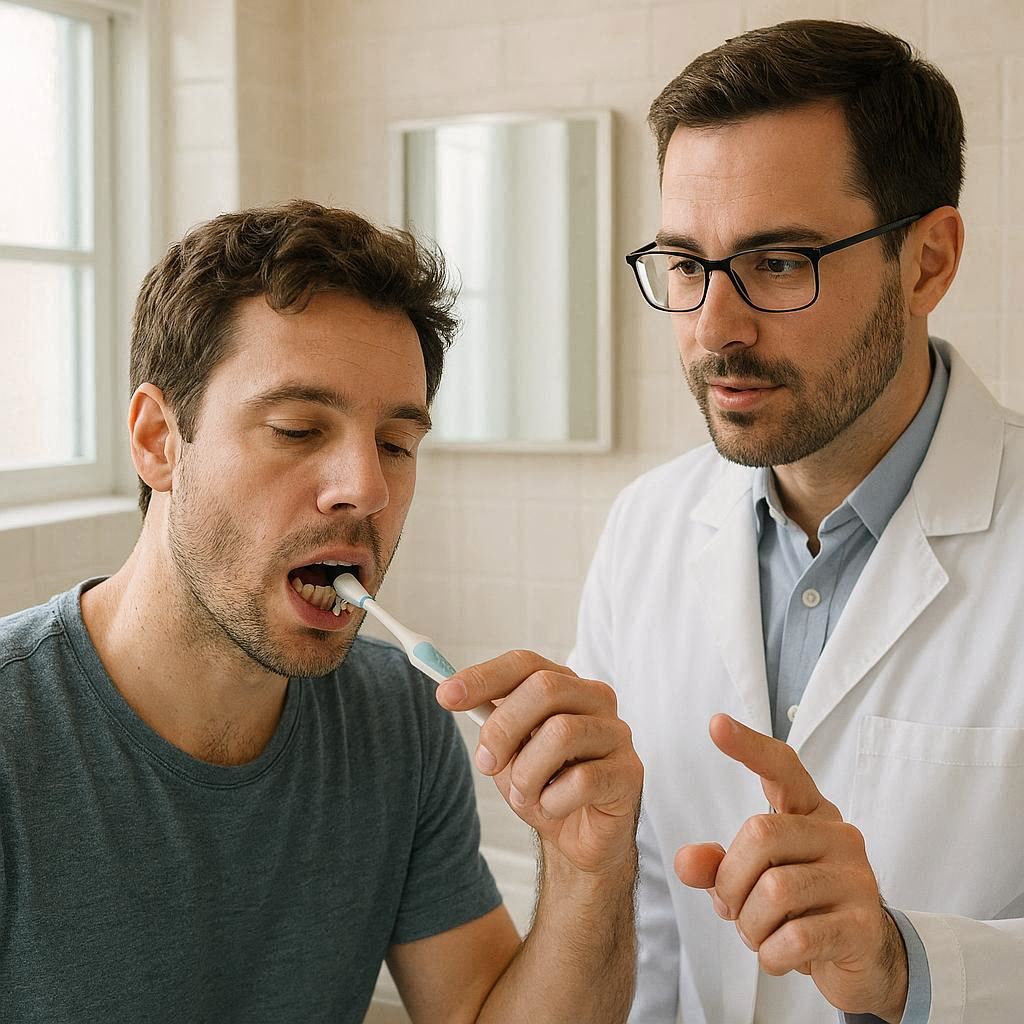
You can now brush the implant area normally. But use a gentle touch.
- Use a soft or extra-soft toothbrush.
- Brush at a 45-degree angle toward the gumline.
- Do not scrub hard. Gentle circles are enough.
- Your dentist may recommend a water flosser (water pik) on a low setting. This helps clean around the implant without trauma.
- Avoid traditional floss near the healing abutment. It can pull or loosen the healing cap.
Smoking and Alcohol
If you smoke, you need to have an honest conversation with yourself. Smoking dramatically increases implant failure rates.
- Nicotine reduces blood flow to the gums and bone.
- Less blood flow means slower healing and higher infection risk.
- Smokers have failure rates up to 15 to 20 percent. Non-smokers have success rates above 95 percent.
- If you cannot quit completely, at least stop for the first two weeks. Every smoke-free day helps.
Alcohol is less dangerous but still problematic.
- Alcohol can irritate the surgical site.
- It can interact with pain medications or antibiotics.
- Avoid alcohol completely for the first week.
- After that, occasional drinks are probably fine. But do not overdo it.
Physical Activity
You can slowly return to exercise.
| Week | Allowed activity |
|---|---|
| Week 2 | Light walking, stretching, yoga |
| Week 3 | Jogging, light weights (upper body only) |
| Week 4 | Most normal activities |
| Week 6 | Heavy lifting, contact sports |
Listen to your body. If you feel throbbing or pain at the implant site, stop and rest.
The Healing Cap
Most implants have a small metal or plastic cap called a healing abutment. This cap sticks up through your gum. It shapes the gum tissue for the final crown.
- Do not play with the cap with your tongue.
- Do not try to tighten it if it feels loose. Call your dentist instead.
- Food can get trapped around the cap. Rinse thoroughly after meals.
- The cap stays in place for three to six months.
The Long Game: Months 3 to 6
You may forget you even have an implant. That is good. But do not get complacent. Osseointegration is still happening. Bone cells are slowly attaching to the implant surface. This process is delicate.
Protecting the Implant
Your implant is strongest when biting straight down. It is weakest from side-to-side forces.
- Avoid chewing sticky foods like caramel or taffy on the implant side.
- Do not use your implant to open packages or hold objects.
- Be careful with crunchy foods like whole apples, carrots, and nuts. Cut them into small pieces first.
- If you grind your teeth at night, ask your dentist about a nightguard. Grinding can damage a healing implant.
Oral Hygiene Routine
By month three, you should have a solid cleaning routine.
Morning:
- Brush all teeth for two minutes.
- Pay special attention to the gumline around the implant.
- Use a fluoride toothpaste.
After meals:
- Rinse with water or an alcohol-free mouthwash.
- Check for food trapped around the healing abutment.
Before bed:
- Brush thoroughly again.
- Use a water flosser on the lowest setting.
- Interdental brushes (small cone-shaped brushes) work well for cleaning around the abutment.
Regular Check-Ups
Your dentist will see you every four to six weeks during healing. These visits are short but essential.
- The dentist will check for mobility (movement). Any movement is a bad sign.
- X-rays will confirm that bone is growing around the implant.
- Your gum health will be evaluated.
Do not skip these appointments. Early detection of problems saves implants.
When the Implant Feels Loose
This is rare but scary. A healing implant should never move. If you feel any wiggle or shifting:
- Do not panic. But do not ignore it.
- Stop chewing on that side immediately.
- Call your dentist the same day.
- Do not try to push it back into place.
- Do not remove anything yourself.
A loose implant usually means osseointegration failed. The implant may need to be removed. A new implant can often be placed after the bone heals.
Final Crown Placement: What Changes
At month four to six, your dentist will take an X-ray. If the bone looks good, you are ready for the final crown. This is an exciting day. But aftercare changes again.
The Process in Brief
- Your dentist removes the healing abutment.
- An impression is taken of your implant.
- A custom crown is made in a lab (one to two weeks).
- You return for crown placement.
- The crown is screwed or cemented onto the implant.
The procedure is painless. You will have local anesthesia for comfort.
After Crown Placement
The first 48 hours after crown placement are important.
- The crown may feel slightly high when you bite. This is normal for the first day.
- Your gums may be sore where the healing cap was removed.
- Stick to soft foods for two to three days.
- Avoid chewing directly on the new crown for the first week.
- If the crown feels too high after one week, call your dentist. They can adjust it.
Daily Care Changes
Now you have a permanent crown. You can brush and floss normally. But you must be more thorough.
Why implants need special care:
Natural teeth have a ligament that acts like a shock absorber. Implants do not. They attach directly to bone. This means bacteria can penetrate deeper and cause faster bone loss if you neglect cleaning.
Your new daily routine:
- Brush twice daily with a soft brush.
- Floss around the implant crown carefully. Use super floss or implant-specific floss.
- Use a water flosser daily. This is the single best tool for implant patients.
- Consider an interdental brush for the space between the crown and adjacent teeth.
- Visit your dentist every six months for professional cleanings.
Long-Term Maintenance: Making Your Implant Last
Dental implants can last 20, 30, or even 40 years. But only with proper care. Neglect them, and they fail like any other dental work.
The Three Biggest Threats
| Threat | Why it is dangerous | Prevention |
|---|---|---|
| Peri-implantitis | Bacterial infection destroys bone around the implant | Excellent daily cleaning + regular check-ups |
| Bruxism (teeth grinding) | Extreme forces crack the crown or implant | Nightguard, stress reduction |
| Poor oral hygiene | Plaque buildup causes gum inflammation | Floss, water flosser, professional cleanings |
Peri-implantitis: The Silent Killer
Peri-implantitis is the number one cause of late implant failure. It works like severe gum disease. Bacteria accumulate below the gumline. They trigger inflammation. The inflammation destroys bone. Over months or years, the implant loses support and becomes loose.
Early warning signs:
- Bleeding when you brush around the implant
- Red or purple gums around the implant
- Bad breath that will not go away
- A deep pocket around the implant (your dentist measures this)
Treatment:
- Deep cleaning below the gumline (special instruments)
- Antibacterial rinses
- In advanced cases, surgery to clean the implant surface
Prevention is the only real cure. Once bone is lost, you cannot grow it back around an implant.
Professional Maintenance Schedule
Do not rely on your home routine alone. Professional care is essential.
| Time since crown placement | Recommended visit |
|---|---|
| 6 months | Check-up + cleaning |
| 12 months | Check-up + cleaning + X-ray |
| Every 6 months thereafter | Check-up + cleaning |
| Every 12 months | Add an X-ray to monitor bone levels |
Tools You Should Own
Invest in these tools. They cost little compared to replacing a failed implant.
- Water flosser (Waterpik or similar) – Use on medium setting once daily.
- Interdental brushes – Choose the size that fits snugly around the implant.
- Super floss – Has a stiff end for threading under the crown.
- Soft-bristled toothbrush – Replace every three months.
- Alcohol-free mouthwash – Use after meals when you cannot brush.
Lifestyle Factors
Your daily habits outside the bathroom matter too.
Do:
- Eat a balanced diet with calcium and vitamin D.
- Stay hydrated. Dry mouth increases bacteria.
- Manage stress. Clenching and grinding destroy implants.
- See your dentist every six months without fail.
Avoid:
- Smoking or using any tobacco products.
- Chewing ice, hard candy, or pens.
- Using your teeth as tools (opening bags, holding objects).
- Skipping dental appointments because “nothing hurts.”
Special Situations and Concerns
Not everyone heals the same way. Some people have unique challenges. Here is how to handle the most common special situations.
Multiple Implants
If you received two, three, or a full arch of implants, the rules are the same but stricter. Your mouth has more trauma. Healing takes longer.
- Plan for at least one week of soft food only.
- Expect more swelling and bruising.
- You will need prescription pain medication more often.
- Cleaning becomes more difficult. Ask your dentist for a curved syringe to irrigate hard-to-reach areas.
- Recovery time may extend to eight weeks before eating normally.
Immediate Load Implants (Teeth-in-a-Day)
Some patients receive a temporary crown on the same day as implant placement. This is called immediate loading.
- These temporary crowns cannot handle full chewing force.
- Stick to an ultra-soft diet for six to eight weeks.
- Do not bite into anything with the front temporary crown.
- Cut all food into small pieces.
- These temporary crowns break easily. If one breaks, call your dentist. Do not try to fix it yourself.
Bone Grafting
Many implant patients also need a bone graft. The graft adds artificial or natural bone material to your jaw. This gives the implant something to hold onto.
Aftercare for bone grafts is similar but more delicate.
- Graft material can wash out of the site. Do not rinse forcefully for two full weeks.
- Avoid any suction in your mouth (no straws, no spitting, no smoking).
- Graft healing takes six to nine months before implant placement.
- You may have a membrane over the graft. Do not touch it.
Sinus Lifts
Upper back teeth (molars) are close to your sinus cavity. Sometimes your dentist lifts the sinus membrane to add bone. This is a sinus lift.
- Do not blow your nose for two weeks after surgery.
- Do not sneeze with your mouth closed. Sneeze openly.
- Avoid drinking from straws or creating suction.
- If you feel fluid going from your mouth into your nose, call your dentist. You may have a sinus communication.
Diabetes and Implants
High blood sugar slows healing and increases infection risk. But diabetics can still have successful implants.
- Keep your blood sugar under control before and after surgery.
- Inform your dentist of your A1C levels.
- Healing may take 25 to 50 percent longer.
- You may need antibiotics before surgery.
- Check your implant site daily for signs of infection. Diabetics have less sensation and may not feel pain.
Osteoporosis Medications
Some medications for bone health (bisphosphonates like Fosamax, Actonel, Boniva) increase the risk of a rare condition called medication-related osteonecrosis of the jaw (MRONJ) . This is when jawbone dies and fails to heal.
- Tell your dentist about all medications you take.
- Your dentist may consult with your prescribing doctor before surgery.
- Short-term use (under three years) has lower risk.
- IV bisphosphonates (used for cancer patients) have high risk. Implants are often avoided.
Warning Signs: When to Call Your Dentist
You will have some discomfort and weird sensations during healing. Most are normal. But some require immediate attention.
Call your dentist within 24 hours if you notice:
- Fever over 101°F (38.3°C)
- Pus draining from the site
- Swelling that spreads to your eye or neck
- Numbness that does not go away after 24 hours (nerve injury)
- Loose implant or healing abutment
- Uncontrolled bleeding (soaking through gauze after four hours)
Call your dentist during business hours if you notice:
- Pain that suddenly increases after getting better
- Bad taste that lasts more than three days
- Swelling that returns after going down
- Broken stitches before your follow-up visit
- Allergic reaction to medication (rash, hives, itching)
Normal sensations that do not require a call:
- Aching for three to five days
- Bruising on your cheek or neck
- Slight bleeding when brushing (first week only)
- A sharp edge on the healing abutment (this is normal)
- The feeling that the implant is “pushing” on adjacent teeth
The Cost of Neglect: Realistic Risks
Let us be honest about what happens if you ignore aftercare instructions.
Short-term neglect (first two weeks)
- Infection – Requires antibiotics. May need surgical drainage.
- Dry socket – Extremely painful. Requires medicated dressing.
- Implant exposure – Bone appears through the gum. Needs surgery to cover it.
- Lost graft material – Bone graft washes out. Delays treatment by six months.
Long-term neglect (months to years)
- Peri-implantitis – Bone loss around implant. Requires deep cleaning or surgery.
- Crown fracture – Biting too hard breaks the crown. Replacement costs 1,000to3,000.
- Implant fracture – Rare but catastrophic. Implant must be removed.
- Complete implant failure – Implant becomes loose. Removal and bone graft needed. Start over from zero.
Success rates with proper care
- Single implant: 95 to 98 percent success at 10 years
- Multiple implants: 90 to 95 percent success at 10 years
- With proper maintenance: Many implants last 30+ years
Success rates with poor care
- Smokers: 80 to 85 percent success
- Poor oral hygiene: 70 to 80 percent success
- No regular dental visits: 60 to 75 percent success
The difference is huge. Your daily habits determine whether your implant becomes a lifelong solution or an expensive lesson.
Quick Reference: Daily Aftercare Checklist
Print this page or save it to your phone. Follow it every single day.
First week checklist
- No spitting, no straws, no smoking
- Ice packs for first 48 hours
- Salt water rinses after meals
- Soft foods only (mashed potatoes, yogurt, soup)
- No exercise or heavy lifting
- Pain relievers as needed
- Keep head elevated when sleeping
- Take all prescribed antibiotics
Weeks 2 to 6 checklist
- Gentle brushing around implant with soft brush
- Salt water rinses 3 to 4 times daily
- Expand diet carefully (still avoid hard foods)
- Light exercise allowed after week 3
- Check for swelling or redness daily
- Attend follow-up appointments
Long-term maintenance (after crown)
- Brush twice daily for two minutes
- Water flosser once daily
- Interdental brush around implant weekly
- Professional cleaning every 6 months
- X-ray once per year
- No chewing ice or hard objects
- Nightguard if you grind teeth
Frequently Asked Questions (FAQ)
Q: How long does pain last after a tooth implant?
Most people have mild to moderate pain for three to five days. The worst pain is usually on day two. By day seven, most patients feel little to no discomfort.
Q: Can I drink coffee after dental implant surgery?
You should avoid hot drinks for the first 48 hours. Heat increases blood flow and can restart bleeding. After two days, you can have coffee, but let it cool to warm (not hot). Avoid adding sugar, which feeds bacteria.
Q: When can I eat normally after an implant?
You can eat soft foods immediately. Normal chewing (steak, sandwiches, salads) usually resumes around week six to eight. Full diet including hard foods like nuts and apples is safe after three months, but always cut hard foods into smaller pieces.
Q: How do I clean under my implant crown?
Use a water flosser on a low to medium setting. Aim the tip at the gumline from two angles (cheek side and tongue side). For tight spaces, use super floss or interdental brushes. Your dentist can show you the proper technique.
Q: Is it normal for my gums to bleed when I brush the implant?
For the first week, yes. After that, no. Bleeding after the first week usually means you are brushing too hard or not cleaning enough. Gingivitis around the implant is common but treatable. See your dentist if bleeding continues for more than 10 days.
Q: Can my dental implant get a cavity?
No. The crown is made of ceramic or porcelain, which does not decay. However, the gum tissue and bone around the implant can become infected (peri-implantitis). This is more dangerous than a cavity because it destroys the support structure.
Q: How much does it cost to fix a failed implant?
Removing a failed implant costs 500to1,500. A bone graft to repair the area costs 500to2,000. A new implant and crown costs 3,000to6,000. Total cost for starting over: 4,000to9,500. Prevention is far cheaper.
Q: Can I use an electric toothbrush on my implant?
Yes, electric toothbrushes are safe and effective. Use a soft brush head. Do not press hard. Let the brush do the work. Sonic toothbrushes are particularly gentle and effective for implants.
Q: How soon can I fly after dental implant surgery?
You can fly after 48 hours if you have no complications. Cabin pressure changes are not dangerous to the implant. However, if you had a sinus lift, wait at least one week before flying. The air pressure changes can stress the sinus membrane.
Q: What should I do if my implant crown feels loose?
Stop chewing on that side immediately. Call your dentist. A loose crown usually means the screw inside is loosening. This is fixable. Your dentist will tighten or replace the screw. Do not try to glue the crown back yourself.
Additional Resources
Link: American Academy of Implant Dentistry – Patient Education Library
This trusted resource offers videos, brochures, and articles about implant procedures, risks, and long-term success. You can also find a local implant specialist through their directory.
Conclusion
Tooth implant aftercare comes down to three simple things. First, protect the healing site during the first two weeks by avoiding hard foods, smoking, and aggressive cleaning. Second, build a daily hygiene routine that includes brushing, water flossing, and regular dental check-ups. Third, recognize warning signs like bleeding, swelling, or loosening early, and call your dentist without delay. Follow these principles, and your dental implant can serve you well for 30 years or more.
Disclaimer: This article provides general information for educational purposes only. It does not replace professional medical or dental advice. Every patient heals differently. Always follow the specific instructions given by your oral surgeon or dentist. If you experience severe pain, uncontrolled bleeding, or signs of infection, seek immediate medical attention.