ADA Code Used for Bone Graft and Membrane
If you have ever looked at a dental treatment plan or an insurance statement, you have probably seen a confusing mix of numbers and letters. Those are ADA codes. They matter more than most people realize.
For procedures involving bone grafts and membranes, choosing the right ADA code can mean the difference between a paid claim and a denial. It can also affect how much you pay out of pocket.
This guide walks you through everything you need to know. We keep things simple, clear, and practical. No confusing jargon. No unrealistic promises. Just honest, useful information.
What Are ADA Codes and Why Do They Matter?
The American Dental Association maintains a standardized list of codes. Dentists use these codes to describe specific procedures. Insurance companies use them to determine coverage.
Think of ADA codes like a common language. Instead of writing a long paragraph explaining a bone graft, your dentist enters a short code. That code tells the insurance company exactly what happened during your appointment.
Without the correct code, claims get rejected. With the wrong code, you might pay more than you should.
For bone grafting and membrane procedures, the codes are very specific. You cannot use a general surgical code. You need the exact code that matches the work performed.
How Codes Affect Your Treatment Plan
When your dentist creates a treatment plan, each procedure gets a code. Your insurance company reviews those codes. They check their policy to see if they cover each code.
Some codes are fully covered. Some are partially covered. Some are not covered at all.
That is why knowing the right code matters for both dental teams and patients. It helps everyone understand what to expect financially.
The Main ADA Codes for Bone Grafts
Bone grafting in dentistry happens for many reasons. You might need a graft before getting a dental implant. You might need one after an extraction to preserve the bone. You could also need a graft to treat gum disease.
Each situation uses a different ADA code.
Here are the most common bone graft codes you will encounter.
D4263 and D4264: Bone Replacement Grafts for Ridge Preservation
These two codes cover bone grafts placed into a socket right after a tooth extraction. The goal is to preserve the bone so you can place an implant later.
- D4263 – Bone replacement graft for ridge preservation. This code applies when the graft material comes from a source other than the patient. Most grafts fall into this category. The material might be synthetic, animal-derived (like bovine bone), or from a human tissue bank.
- D4264 – Bone replacement graft for ridge preservation. This specific code applies when the graft material comes from the patient. The dentist would need to harvest bone from another site in your mouth, usually your chin or the back of your lower jaw.
Why two codes for similar procedures? Because the material source changes the complexity and cost. Autogenous grafts (your own bone) require an extra surgical site. That takes more time and skill.
Important note: These codes are for ridge preservation after extraction. If the extraction happened weeks or months ago, different codes apply.
D7953: Bone Graft for Sinus Lift
A sinus lift is a specialized bone graft procedure for the upper back jaw. The maxillary sinuses sit right above your upper molars and premolars. When those teeth are missing for a long time, the sinus can drop down into the space where bone used to be.
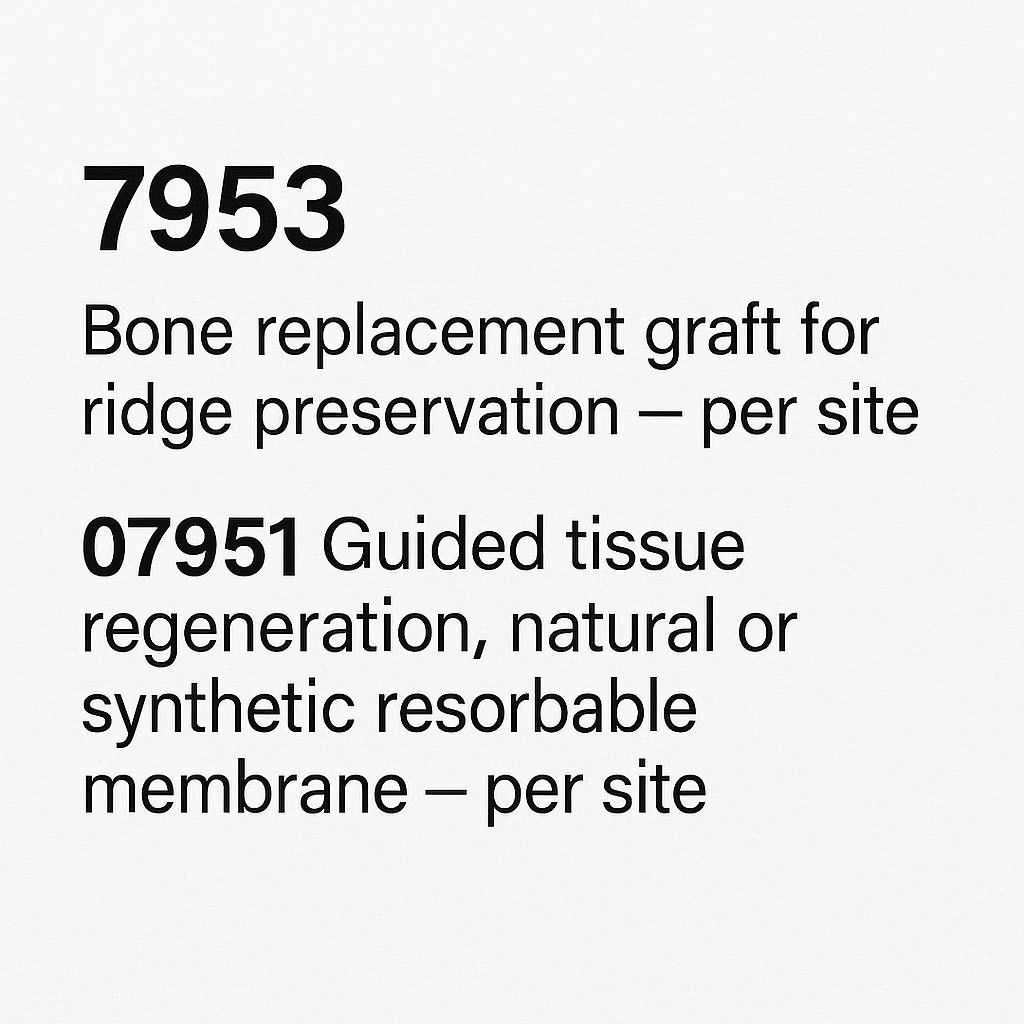
To place an implant, your dentist or surgeon needs to lift the sinus membrane and add bone graft material underneath. That procedure uses code D7953.
This code covers the graft itself. The sinus lift procedure has its own code too. Often, you will see both codes on the same treatment plan.
D7950: Osseous Graft (Periodontal)
This code covers bone grafts performed for gum disease treatment. When you have advanced periodontal disease, the bone supporting your teeth can erode. A graft can help replace that lost bone.
Unlike ridge preservation grafts, periodontal grafts happen around existing teeth. The goal is to save natural teeth, not prepare for implants.
Key distinction: D7950 is for bone loss caused by infection. D4263 and D4264 are for bone loss caused by tooth removal.
D7960: Frenulectomy (Not a Graft Code)
We include this only to prevent confusion. D7960 is sometimes mistakenly associated with grafting. It is not. It is a procedure to remove a frenum (the small tissue connecting your lip or cheek to your gums). Do not use this code for any bone graft.
The Main ADA Codes for Membranes
Membranes play a crucial role in guided bone regeneration. After placing a bone graft, your body wants to heal quickly. Soft tissue (gums) heals faster than bone. Without a membrane, gum tissue can grow into the graft area before the bone has a chance to form.
A membrane acts like a barrier. It keeps soft tissue out so the bone graft has time to work.
Here are the codes your dentist will use.
D4266 and D4267: Guided Tissue Regeneration (GTR) Membranes
These codes cover membranes placed during grafting procedures.
- D4266 – Guided tissue regeneration with a resorbable membrane. Resorbable membranes dissolve on their own over time. You do not need a second surgery to remove them. Most dentists use resorbable membranes today because they are convenient and predictable.
- D4267 – Guided tissue regeneration with a non-resorbable membrane. Non-resorbable membranes must be removed in a separate procedure. They are less common now but still used for certain complex cases. The removal typically happens about four to six months after placement.
Both codes include the membrane placement. They do not include the bone graft. The graft and membrane are billed separately. You will see two codes for the same surgical visit.
Membranes Without Grafts: Is That Possible?
Sometimes, a dentist places a membrane without a bone graft. This happens when the bone defect is very small. The membrane alone can guide natural bone healing.
In those rare cases, the same codes apply. D4266 or D4267 still describe the membrane placement. The graft code is simply not added.
How Bone Graft and Membrane Codes Work Together
Now we get to the heart of the matter. When you have both a bone graft and a membrane, you need to bill two separate codes.
Let us walk through a common example.
Scenario: You have a tooth extracted. Your dentist places a bone graft (D4263) and a resorbable membrane (D4266) over the graft.
Your treatment plan shows:
- D7210 – Extraction of the tooth (different code)
- D4263 – Bone graft for ridge preservation
- D4266 – Resorbable membrane for guided tissue regeneration
Three codes. One appointment. That is standard.
Why Not One Code for Both?
This is a frequent question. Some patients ask, “Why do I see two codes when you did one surgery?”
The answer is simple: insurance and tracking. A bone graft and a membrane are different procedures with different costs. The graft material costs money. The membrane costs money. The dentist’s time and skill for each part also differ.
Separate codes allow insurance companies to see exactly what you received. It also allows dentists to track outcomes. Did the graft work? Did the membrane dissolve properly? Separate codes help research and quality improvement.
Realistic Example of a Full Treatment Plan
Let us build a realistic example for a patient needing an implant in the lower first molar area.
Step 1 – Extraction and graft (one appointment)
- D7210: Surgical extraction of tooth #19
- D4263: Bone graft, non-autogenous (synthetic bone)
- D4266: Resorbable membrane
Step 2 – Healing period (four to six months)
Step 3 – Implant placement
- D6010: Surgical placement of implant body
Step 4 – Final restoration
- D6058: Abutment-supported porcelain crown
This is a typical, realistic sequence. No surprises. No hidden codes.
Comparative Table: Bone Graft ADA Codes
| ADA Code | Procedure Name | When Used | Graft Source | Typical Setting |
|---|---|---|---|---|
| D4263 | Bone graft, ridge preservation | After extraction, same visit | Non-autogenous (donor/synthetic) | General dental office or surgical suite |
| D4264 | Bone graft, ridge preservation | After extraction, same visit | Autogenous (patient’s own bone) | Surgical suite (more complex) |
| D7953 | Bone graft for sinus lift | Before upper implant placement | Any source | Surgical suite (specialist often) |
| D7950 | Osseous graft, periodontal | Around existing teeth with bone loss | Any source | Periodontal office |
Comparative Table: Membrane ADA Codes
| ADA Code | Procedure Name | Membrane Type | Removal Needed? | Commonly Paired With |
|---|---|---|---|---|
| D4266 | Guided tissue regeneration, resorbable | Dissolves naturally | No | D4263, D4264, D7950 |
| D4267 | Guided tissue regeneration, non-resorbable | Synthetic, does not dissolve | Yes (second surgery) | D4263, D4264, D7950 (less common now) |
Common Billing Scenarios and Their Correct Codes
Let us look at real situations you might encounter. Each scenario uses specific codes.
Scenario 1: Immediate Implant with Bone Graft and Membrane
Sometimes, a dentist places the implant at the same appointment as the extraction. This is called an immediate implant. A bone graft and membrane still might be needed around the implant.
In this case, you see:
- D7210: Extraction
- D6010: Implant placement
- D4263: Bone graft
- D4266: Membrane
Some dentists mistakenly think you cannot bill the graft with an immediate implant. You can. The graft fills small gaps around the implant. Just be sure the documentation explains why the graft was necessary.
Scenario 2: Socket Preservation Without Implant Planned
Maybe you are not sure about an implant. You just want to preserve the bone in case you change your mind later. Socket preservation is still valid.
- D4263: Bone graft
- D4266: Membrane
No implant code. No extraction code if the extraction happened at a prior visit.
Scenario 3: Periodontal Bone Graft
You have deep pockets around a molar. Your periodontist recommends a graft to save the tooth.
- D7950: Osseous graft
- D4266: Membrane (if needed)
Periodontal grafts do not always need a membrane. Small defects might heal fine without one. Your dentist will decide.
Scenario 4: Sinus Lift with Graft
You need an implant in the upper first molar area. The sinus is too close. Your surgeon performs a sinus lift and places graft material.
- D7951: Sinus lift via lateral window approach (the lift procedure)
- D7953: Bone graft for sinus lift
A membrane may or may not be used in sinus grafting. Some surgeons place a membrane over the lateral window. If they do, they bill D4266 or D4267 separately.
What Insurance Typically Covers (And What It Does Not)
Let us be honest about insurance coverage. Many patients assume their dental plan covers bone grafts and membranes fully. That is often not true.
Medical vs. Dental Coverage
Here is something many people do not know. Some bone graft procedures qualify for medical insurance coverage, not dental coverage.
When does this happen?
- Bone grafts related to trauma (accident, injury)
- Bone grafts related to tumor removal
- Bone grafts related to congenital defects (cleft palate, for example)
If you need a graft because of a medical condition, your medical plan might cover it. Your dentist or surgeon can help you determine which plan to bill.
For most routine grafts (ridge preservation, sinus lifts for implants, periodontal grafts), dental insurance applies.
Typical Dental Insurance Limits
Most dental plans have annual maximums. The average is between 1,000and2,000 per year. A single bone graft plus membrane can cost more than that.
Many plans also have missing tooth clauses. If you were missing the tooth before your plan started, they may not cover the graft or implant. Read your policy carefully.
Common Coverage Patterns
| Procedure | Typical Coverage | Notes |
|---|---|---|
| Ridge preservation graft (D4263) | 50% to 80% | Often subject to missing tooth clause |
| Membrane (D4266) | 50% to 80% | Sometimes bundled with graft by some plans |
| Sinus lift graft (D7953) | 50% or less | Many plans consider this “major” service |
| Periodontal graft (D7950) | 50% to 80% | Often requires pre-authorization |
Important note: These are averages. Every plan is different. Pre-authorization is your best friend.
Why Pre-Authorization Matters for Bone Graft and Membrane Codes
Before your dentist performs a bone graft, ask them to submit a pre-authorization to your insurance company.
A pre-authorization is not a guarantee of payment. But it gives you a written estimate of what your plan will cover based on the codes your dentist plans to use.
Without pre-authorization, you might receive a large bill you did not expect.
What to Look for in a Pre-Authorization Response
When you get the pre-authorization letter, check:
- Which codes the insurance company approved
- The allowed amount for each code
- Your estimated out-of-pocket cost
- Any limitations (like “only one membrane per site per five years”)
If something looks wrong, ask your dentist to appeal or resubmit with different codes.
Documentation Requirements for Bone Graft and Membrane Claims
Insurance companies look for specific documentation when they review claims involving D4263, D4264, D4266, D4267, D7950, or D7953.
Your dentist should include:
Radiographic evidence. X-rays showing the bone defect before grafting. Post-operative X-rays help too but are not always required.
Periodontal charting (for D7950 claims). The insurance company needs to see pocket depths and attachment levels.
A detailed narrative. This is a short letter explaining why the graft and membrane were necessary. For ridge preservation, the narrative might say, “Tooth #3 extracted due to fracture. Buccal plate was thin and fenestrated. Graft and membrane placed to preserve ridge dimensions for future implant.”
Intraoral photos. Some plans require photos of the defect before grafting. Check your specific plan’s requirements.
How Patients Can Verify Their Own Coverage
You do not have to rely entirely on your dentist’s office. You can do your own research.
Call the customer service number on your dental insurance card. Ask these specific questions:
- “Do you cover ADA code D4263 for a bone graft after an extraction?”
- “Do you cover ADA code D4266 for a resorbable membrane with that graft?”
- “Is there a missing tooth clause in my plan?”
- “What is my annual maximum, and how much have I used so far this year?”
- “Does this procedure require pre-authorization?”
Write down the answers. Get the representative’s name and the date of the call. Some plans record calls. Having a name helps if you need to dispute something later.
The Difference Between Resorbable and Non-Resorbable Membranes: Why Codes Matter
You might wonder why you should care about the membrane type. It matters because:
Cost. Non-resorbable membranes often cost more upfront. But you also pay for a second surgery to remove them. Your insurance might not cover the removal.
Healing time. Resorbable membranes disappear naturally. Non-resorbable membranes require a second procedure at four to six months.
Clinical indication. Non-resorbable membranes are sometimes better for large defects. They hold space more rigidly. But for most routine cases, resorbable membranes work perfectly.
Your dentist should explain which type they plan to use and why. Then you will see the corresponding code on your treatment plan.
Quotation from a Real Dental Insurance Coordinator
“After twelve years processing dental claims, I can tell you that D4263 and D4266 are among the most commonly miscoded procedures. Dentists use D4263 when they should use D7950. They use D4266 when they forget to bill it at all. The worst thing you can do is assume your codes are correct. Double-check every single one before submitting.”
— Sarah M., Certified Dental Insurance Coordinator
Mistakes to Avoid When Using ADA Codes for Bone Grafts and Membranes
Even experienced dental teams make errors. Here are the most frequent mistakes.
Mistake 1: Using D4263 for a Periodontal Graft
D4263 is specifically for ridge preservation after extraction. Do not use it for grafting around existing teeth. That requires D7950.
Mistake 2: Billing a Membrane Without the Graft Code
Some offices forget to bill the membrane code entirely. They include the cost of the membrane in the graft code. This is incorrect. The membrane is a separate procedure with its own code and fee.
Mistake 3: Billing Both D4266 and D4267 for the Same Site
You cannot bill two membranes for the same site at the same appointment. Pick one. Usually D4266.
Mistake 4: Using Outdated Codes
The ADA updates codes every year. Some older codes are no longer valid. Always check the current CDT (Current Dental Terminology) manual. As of this writing, the codes above are current. But confirm before submitting claims.
Mistake 5: No Documentation of Medical Necessity
Insurance companies deny claims without proper documentation. A simple X-ray is often not enough. Write a narrative. Explain the defect. Explain why a graft and membrane are necessary for successful treatment.
Helpful List: What to Bring to Your Pre-Treatment Consultation
Before your bone graft procedure, you will likely have a consultation appointment. Bring these items:
- Your dental insurance card and medical insurance card
- A list of current medications (including supplements)
- Any recent X-rays from other dentists
- A written list of questions about codes and costs
- A notebook to write down answers
- The name and phone number of your primary care physician (some plans require medical clearance)
What Patients Should Ask About Bone Graft and Membrane Codes
Do not be shy. Asking questions protects you financially and helps you understand your care.
Ask your dentist or their billing coordinator:
- “Which specific ADA code will you use for my bone graft?”
- “Which specific ADA code will you use for the membrane?”
- “Are both codes covered by my insurance based on a pre-authorization?”
- “What is the total fee for D4263 (or whichever code applies) before insurance?”
- “What is the total fee for the membrane code before insurance?”
- “Will you submit both codes to my insurance, or do I need to submit anything myself?”
- “If insurance denies either code, what is my financial responsibility?”
A good dental office answers these questions without getting defensive. If they cannot answer clearly, consider a second opinion.
How Technology Is Changing Bone Graft and Membrane Coding
Digital dentistry is evolving quickly. New technologies affect how we perform and code bone grafts.
3D printing. Some offices now print custom membranes and graft guides. The codes remain the same (D4266, D4267). But documentation should mention the use of digital planning.
Growth factors. Some bone grafts include growth factors like PRP (platelet-rich plasma) or rhBMP-2 (recombinant human bone morphogenetic protein). As of now, there is no separate ADA code for growth factors. Their cost is typically included in the graft code or billed as a miscellaneous material code (D9999).
Cone beam CT. This 3D X-ray is often necessary for sinus lifts and large grafts. The code for a cone beam is D0367 or D0380 depending on the specific scan. This is separate from graft codes.
The Future of ADA Coding for Bone Grafts and Membranes
The ADA updates the CDT code set every year. Changes for 2025 and beyond may include:
- More specific codes for different graft materials (synthetic vs. animal-derived vs. allograft)
- Separate codes for growth factor application
- Codes for computer-guided graft placement
For now, the codes we have discussed remain the standard. But always verify current codes before billing or estimating patient costs.
How to Appeal a Denied Bone Graft or Membrane Claim
Even with correct codes and documentation, insurance companies sometimes deny claims. Do not give up. You have the right to appeal.
Step-by-Step Appeal Process
- Request the denial letter in writing. Insurance companies must provide a reason for denial.
- Review the denial reason. Common reasons include “not medically necessary,” “missing tooth clause,” or “incorrect code.”
- Gather supporting documentation. Your dentist can help. You need X-rays, narrative, and sometimes published research showing the benefit of bone grafting.
- Write an appeal letter. Keep it professional and factual. Include the patient’s name, policy number, claim number, and the codes denied.
- Submit within the timeline. Most plans give you 60 to 180 days to appeal. Do not wait.
- Escalate if necessary. If the first appeal fails, request a second-level review. Some states allow external review by an independent third party.
Appeals work more often than people think. Do not assume a denial is final.
Important Note for Readers
Note: The ADA codes discussed in this guide are current as of the publication date. The American Dental Association updates the CDT code set annually. Always consult the most recent CDT manual or contact your dental insurance provider to confirm code accuracy before treatment or billing. This guide provides general information and does not constitute legal, medical, or billing advice. Your specific situation may require different codes or documentation.
Additional Resources for Bone Graft and Membrane Coding
For the most accurate, up-to-date information, refer to these trusted sources:
- CDT 2025: Current Dental Terminology – The official ADA code book. Available from the American Dental Association.
- American Academy of Periodontology (perio.org) – Offers coding guides specific to periodontal procedures including bone grafts and membranes.
- Your State Dental Society – Many state societies offer coding webinars and help desks for members.
Link to additional resource: American Dental Association – CDT Code Search Tool (Official ADA resource for looking up current codes)
Conclusion: Three Key Takeaways
Bone graft and membrane procedures use specific ADA codes that must match the clinical situation exactly. Always confirm codes before treatment and request pre-authorization from your insurance provider. Understanding these codes helps you avoid surprise bills and ensures your dental team documents your care correctly.
Frequently Asked Questions (FAQ)
1. Can a dentist bill D4263 and D4266 for the same tooth on the same day?
Yes. In fact, this is the standard for most ridge preservation procedures. One code covers the bone graft. The other covers the membrane. Both are necessary and separately billable.
2. Does insurance always cover D4266 (resorbable membrane)?
No. Some dental plans consider membranes experimental or not medically necessary. Always check your specific plan. Pre-authorization is strongly recommended.
3. What is the difference between D4263 and D7950?
D4263 is for bone grafts placed in an extraction socket immediately after tooth removal. D7950 is for bone grafts placed around existing teeth to treat bone loss from periodontal disease.
4. Can I use D4264 (autogenous graft) for a sinus lift?
No. D4264 is specifically for ridge preservation after extraction. For a sinus lift, use D7953 regardless of whether the graft material comes from you or a donor.
5. Why did my dentist use D4267 instead of D4266?
Your dentist may have chosen a non-resorbable membrane because of the size or location of your bone defect. Non-resorbable membranes hold space more rigidly but require a second surgery for removal. Ask your dentist to explain their reasoning.
6. What happens if my insurance denies my bone graft claim?
You have the right to appeal. Work with your dentist’s office to gather supporting documentation. Submit a formal appeal letter within your plan’s timeline (usually 60 to 180 days). Many denials are overturned on appeal.
7. Are bone grafts and membranes covered by medical insurance?
Sometimes. If the graft is needed due to trauma, tumor removal, or a congenital defect, your medical plan may provide coverage. For routine ridge preservation or implant preparation, dental insurance applies.
8. How much does a bone graft and membrane typically cost without insurance?
Costs vary widely by geography and provider. As a general range, D4263 (bone graft) often costs 400to1,200. D4266 (resorbable membrane) often costs 200to600. These are estimates only. Always request a written treatment plan with fees before proceeding.
9. Can I have a bone graft without a membrane?
Yes. Small defects sometimes heal fine without a membrane. Your dentist will decide based on the size and shape of the defect. If no membrane is used, no membrane code is billed.
10. How do I find a dentist who uses correct ADA coding?
Look for a dentist who accepts your insurance plan. Insurance credentialing requires some level of coding accuracy. You can also ask directly during a consultation: “How often do you perform bone grafts, and which codes do you typically use?” A confident, clear answer is a good sign.
Disclaimer: This article is for informational purposes only and does not constitute medical, dental, legal, or billing advice. ADA codes, insurance policies, and treatment protocols change over time. Always consult with a licensed dentist and your insurance provider before making decisions about your dental care. The author and publisher assume no responsibility for errors, omissions, or outcomes related to the use of this information.