cost of snap on smile vs veneers
Smile transformations are rarely a simple financial decision. They are emotional. They are deeply personal. And they often come with a swirl of marketing claims that blur the line between a quick aesthetic fix and a lasting dental investment. If you have been staring at your reflection, wondering how to close a gap, mask a stain, or reshape a tooth without breaking the bank, you have likely encountered two very different paths: a removable snap-on arch and permanent porcelain veneers.
On the surface, these options appear to compete only on price. But digging deeper reveals a story about self-perception, daily comfort, long-term value, and the hidden costs that never make it into the Instagram ad. This guide does not recycle talking points from dental brochures. It acknowledges that some readers simply cannot afford veneers right now, while others are saving deliberately and want to understand what they are truly buying. We avoid fake precision. We avoid dental horror stories designed to scare you. Instead, we provide a grounded, detailed, and human-centered comparison of the true cost of snap on smile vs veneers, including the financial, emotional, and practical dimensions that matter most when you are making a decision you will live with every single day.
Understanding the Two Worlds: Removable vs. Permanent
Before placing dollar signs next to each option, it helps to step back and clarify what these products actually are. Confusion often starts at the terminology level. One is a removable, non-invasive cosmetic cover. The other is a permanent, minimally invasive restoration. Their cost structures diverge because their fundamental nature is different.
What Exactly Is a Snap-On Smile?
A snap-on smile is a removable dental arch made from a thin, rigid resin or crystallized acetyl resin material. It fits over your existing teeth, snapping into place without any preparation, drilling, or adhesive. Think of it as a highly customized, dental-grade mask for your teeth. A dentist or a direct-to-consumer lab takes an impression of your mouth, and technicians fabricate a slim, tooth-colored appliance that covers imperfections ranging from discoloration to mild misalignment.
The appeal is immediate. No needles. No irreversible enamel removal. No recovery time. You can eat with some versions, but many users remove the appliance for meals. You clean it with a brush and soak it overnight. The cost is a fraction of cosmetic dentistry, and the entire process can happen in weeks rather than months. Yet the limitations are real. The appliance adds a subtle bulk to your teeth. Speech can require an adjustment period. And the lifespan, when worn daily, is measured in years, not decades.
The True Nature of Porcelain Veneers
Porcelain veneers are thin, custom-made shells of ceramic that a dentist bonds permanently to the front surface of your teeth. The process is irreversible. To create space and a natural emergence profile, the dentist removes a tiny amount of enamel—usually between 0.3 and 0.5 millimeters. Impressions go to a master ceramist, who layers porcelain to mimic the translucency and depth of natural tooth structure. At a second appointment, the veneers are tried in, adjusted, and bonded with a resin cement under a curing light.
Veneers do not come off. They function like natural teeth, withstand biting forces, and resist stain better than enamel. They can correct shape, size, color, and minor alignment issues simultaneously. The investment is substantial, not merely because of the porcelain, but because of the artistry, preparation, temporaries, and multiple visits involved. When maintained well, a set of veneers can last 15 to 20 years or longer before replacement becomes necessary.
“Choosing between a removable arch and veneers is not a choice between good and bad. It is a choice between two different philosophies of change—temporary and reversible, or permanent and integrated.”
The Core Price Breakdown: What You Actually Pay
Numbers without context mislead. A single figure for veneers means nothing without knowing how many teeth, which dentist, and what laboratory. A snap-on smile price fluctuates based on whether you choose a dental-supervised brand or a direct-to-consumer impression kit. Let us unpack these variables systematically.
Snap-On Smile Fees: Arch by Arch
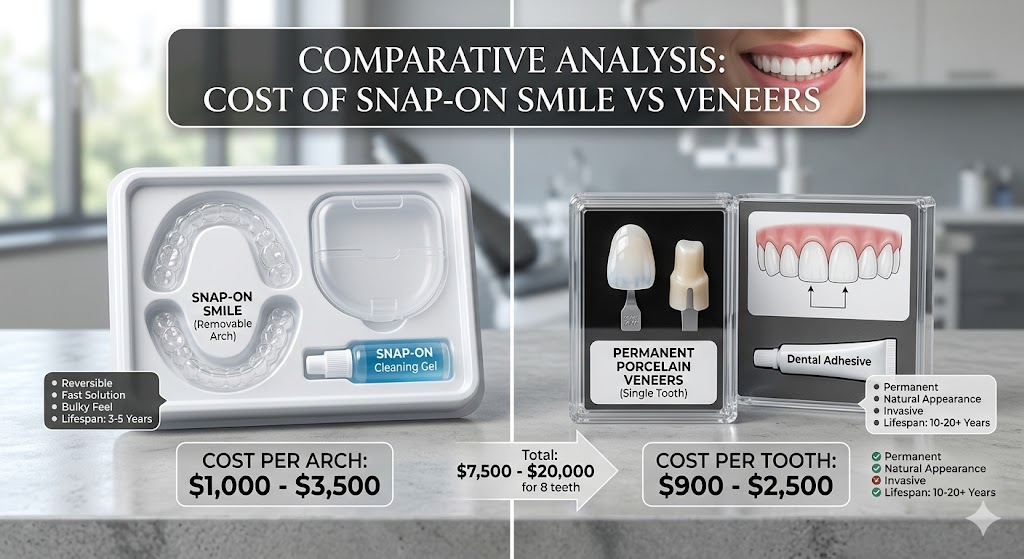
For a single arch, you can expect to pay between $500 and $2,200. The range is wide for good reason. At the lower end, you find online-only brands that ship you an impression kit, fabricate the appliance in a centralized lab, and mail you the finished product. These companies often charge between $500 and $900 per arch. At the upper end, you have dentist-fabricated options like the original Snap-On Smile brand, which can cost $1,200 to $2,200 per arch. Here, the dentist takes a precise impression, designs the smile collaboratively, and manages the fit.
Why the discrepancy? A direct-to-consumer impression carries a higher risk of inaccuracy. The materials used in budget appliances may be thinner or less durable resin. A dentist-managed process includes professional evaluation of your bite, gum health, and any underlying issues that could make a removable appliance uncomfortable or damaging. The dental-supervised fee includes the appointment time, the refined impression, and the accountability of a provider who can adjust or remake the appliance if something goes wrong.
Porcelain Veneers: The Per-Tooth Reality
Veneers are quoted per tooth, and the national average in 2026 lands between $1,200 and $2,800 per veneer. A full smile makeover typically involves 8 to 10 upper teeth, sometimes 6 to 8 lowers for a complete transformation. That places a full upper set in the range of $9,600 to $28,000. The extremes exist. A single veneer to fix one discolored tooth might cost $1,400. A full mouth reconstruction by a cosmetic dentist in a major coastal city can exceed $40,000.
The per-tooth fee bundles several invisible costs. It covers the diagnostic wax-up, the temporary veneers you wear while the permanent ones are fabricated, the laboratory fee for a master ceramist, the try-in appointment, and the final bonding. It also reflects the dentist’s skill. A general dentist placing veneers charges less than a prosthodontist or a member of the American Academy of Cosmetic Dentistry who has invested decades in postgraduate training. The fee is not just for the porcelain; it is for the eye behind the design.
Important note for readers: If a price for veneers seems unusually low—say, under $700 per tooth—pause and ask questions. That figure may not include temporaries, may use lower-cost laboratory materials, or may reflect a dentist who places veneers only occasionally. In dentistry, volume and specialization directly influence outcome consistency. This does not mean you must choose the most expensive provider, but extreme bargains in cosmetic dentistry almost always involve trade-offs you cannot see immediately.
The Comparative Table: Cost of Snap on Smile vs Veneers at a Glance
A clean side-by-side view clarifies what you are comparing. Use this table as a reference, not as a final calculator. Your location, dental health, and goals will shift these numbers.
| Feature | Snap-On Smile (Per Arch) | Porcelain Veneers (Per Tooth) |
|---|---|---|
| Price Range | $500 – $2,200 | $1,200 – $2,800 |
| Typical Full Smile Cost | $1,000 – $4,400 (both arches) | $9,600 – $28,000 (8–10 upper) |
| Procedure Length | 2–4 weeks (impression to delivery) | 4–8 weeks (prep, temps, bonding) |
| Tooth Preparation | None | Irreversible enamel removal (0.3–0.5mm) |
| Longevity | 1–4 years with daily wear | 12–20+ years with care |
| Stain Resistance | Moderate; resin can discolor | High; porcelain resists stain |
| Repairability | Replace entire appliance | Replace individual veneer |
| Effect on Natural Teeth | No permanent change | Permanent alteration |
| Smile Design Control | Good; collaborative with dentist | Excellent; ceramist artistry |
| Insurance Coverage | Rarely covered | Occasionally partial (if deemed restorative) |
This table reveals the essential tension. A snap-on smile costs less upfront but recurs as a repeated purchase. Veneers demand a significant initial outlay but amortize over decades. Neither approach is universally superior. The right choice depends on how you weigh immediate affordability against long-term permanence.
Hidden and Incidental Costs You Did Not Expect
The sticker price is rarely the final price. Both paths carry secondary expenses that emerge before, during, and after treatment. Failing to budget for these hidden costs can lead to resentment or, worse, abandoning the process halfway through.
For Snap-On Smile Users
The appliance itself seems straightforward, but additional spending often creeps in. First, there is the impression cost. If you go the dental route, the impression appointment and any diagnostic records may be billed separately from the appliance fee, adding $100 to $300. If you choose a direct-to-consumer kit and make an impression error, you may need to pay for a second kit or, eventually, visit a dentist to get a proper impression anyway.
Cleaning supplies represent an ongoing cost. You will need a non-abrasive cleanser, a soft brush dedicated only to the appliance, and a soaking solution. Over a couple of years, these supplies add $50 to $100 annually. More significant is the replacement cycle. If you wear the appliance daily, expect to replace it every 18 to 36 months as the material wears thin, develops micro-cracks, or loses its snug fit. A $1,400 snap-on smile that lasts two years costs roughly $58 per month. A $4,400 dual-arch replacement cycle every three years costs about $122 per month. These recurring costs rarely appear in marketing materials.
There is also a subtle professional cost. Wearing a removable appliance over teeth that have untreated decay or gum inflammation can trap bacteria and accelerate problems. You should maintain regular dental check-ups, and if your dentist identifies a cavity under the appliance, you will need to pay for that filling and potentially delay wearing the snap-on until the tooth is healthy. The appliance itself does not cause decay, but it demands that you keep the underlying teeth impeccably clean.
For Veneer Patients
Veneer patients face a different set of hidden costs, often concentrated in the preparatory and maintenance phases. Before any veneer touches your tooth, you may need a cleaning, a periodontal evaluation, and possibly treatment for grinding or clenching. If you exhibit signs of bruxism, your dentist may insist on a custom night guard to protect the porcelain, which adds $400 to $800. If your gums are inflamed, a deep cleaning or laser therapy might be necessary before impressions.
Temporaries are a line item some practices bundle and others bill separately. If charged apart, temporary veneers can cost $200 to $600 per arch. You will wear these for two to four weeks while the laboratory crafts your permanent set. They are essential for function and aesthetics during the waiting period, but they can be an unexpected line on the treatment plan.
Once the veneers are bonded, long-term maintenance kicks in. You cannot neglect professional hygiene visits. Many cosmetic dentists recommend three or four cleanings per year instead of the standard two, particularly if you have a history of gum recession. Each additional cleaning might cost $100 to $200 out of pocket. Eventually, a veneer may chip, debond, or need replacement. A single replacement veneer costs the same per-tooth fee as the original, or more if laboratory fees have risen. If one veneer fails at year 14 and the surrounding ones still look good, you face a matching challenge. The new veneer must blend seamlessly with aged, slightly worn neighbors.
Important note for readers: Always ask for a detailed treatment plan that separates the veneer fee from preparation, temporaries, and any adjunctive procedures. A transparent office will provide a line-by-line breakdown. If you receive only a lump sum, ask for clarity. The phrase “all-inclusive” should be defined in writing.
Materials Matter: Resin vs. Porcelain Under a Microscope
The cost difference is not arbitrary. It flows directly from the materials and the way they interact with light, force, and time.
Resin Appliances: Affordable but Porous
A snap-on smile is typically fabricated from a high-density acetyl resin. This material is strong enough to withstand flexing without fracturing during normal use. It is lightweight, which makes a full arch tolerable to wear. However, resin is inherently porous at a microscopic level. Over months, exposure to coffee, tea, red wine, and even certain spices leads to gradual discoloration. The material can also absorb oral bacteria, necessitating rigorous daily cleaning.
Resin lacks the optical depth of porcelain. It tends to be more opaque, which works well for masking dark stains but can create a slightly monochromatic appearance in bright sunlight. For many users, this look is entirely acceptable, especially if the underlying teeth are deeply discolored and the snap-on arch provides a uniform white smile. Yet it is important to understand that the material will not mimic the subtle translucency where the biting edge of a tooth seems almost transparent.
Dental Porcelain: The Art of Light
Porcelain, by contrast, is a glass-ceramic that can be layered and stained by a ceramist to replicate the optical properties of natural enamel. Light penetrates the surface, bounces within the ceramic layers, and reflects back, creating a vital, living appearance. Porcelain resists stain far better than resin because its surface is less porous and can be glazed to a smooth finish. It also tolerates temperature changes without warping and handles the functional forces of incising and chewing.
The price of porcelain reflects both the material itself and the labor-intensive process of creating it. A single veneer might pass through the hands of three or four technicians: one to pour the model, one to build the ceramic layers, one to stain and characterize, and one to finish and polish. When you pay for a veneer, you are paying for the time of these artisans, not just a block of material.
Durability and Life Expectancy: A Real-World Timeline
Warranties and theoretical lifespans differ from lived experience. People grind their teeth. They drink hot coffee. They forget their night guard. They use their teeth to open packaging. Real-world durability accounts for human behavior, not just material science.
The Snap-On Smile Lifecycle
With daily wear, a snap-on smile typically performs well for 12 to 36 months. Some users report extending the lifespan to four years by wearing the appliance only for social occasions rather than all day, every day. The arch can develop hairline cracks along the thin areas between teeth. The clasps that hug the molars can relax over time, reducing retention. Hot liquids warp the resin. Dropping the appliance on a hard floor can fracture it instantly.
When the appliance fails, you cannot repair it meaningfully. A crack propagates. A reline is not possible the way it is with a denture. You will need a new impression and a new appliance, restarting the cost cycle. This disposability is neither good nor bad inherently, but it must inform your budget. If you are 35 years old and plan to wear a snap-on smile for a decade, you might purchase four to six arches over that span. The cumulative cost could approach or exceed $10,000, a sum that begins to brush against the lower end of permanent veneer pricing.
The Veneer Longevity Equation
Porcelain veneers routinely last 12 to 20 years before the margins begin to show wear, staining, or minor chipping. Many patients keep their original veneers for 25 years or longer. The failure mode is usually not catastrophic fracture but gradual degradation at the margin where porcelain meets tooth. Saliva, bacteria, and staining fluids seep into this micro-gap over decades, and eventually the veneer may need replacement for aesthetic rather than functional reasons.
The key variable is occlusal force. If you grind your teeth and refuse to wear a night guard, you can fracture a veneer in months. If you protect them, they endure. This durability justifies the upfront cost for many people, but it also locks you into a lifetime of maintenance. You will replace veneers at least once in your life, likely at a higher future cost. Planning for that eventual expense is part of the financial calculation.
“A snap-on smile is a subscription to your smile. Veneers are a purchase. Both require maintenance payments, but the payment structure and timeline differ completely.”
The Experience Timeline: From Decision to Daily Life
Cost is not just money. It is also time, discomfort, and emotional energy. Mapping the journey for each option clarifies what you are committing to beyond the dollar figure.
The Snap-On Smile Journey
Week one involves taking an impression or visiting a dentist for one. If you use a mail-order kit, you spend an hour reading instructions, mixing putty, and holding the tray steady in your mouth. The psychological experience ranges from mildly amusing to frustrating. You ship the impression and wait. Two to three weeks later, a box arrives. You open it, rinse the appliance, and attempt to snap it into place. The first fit can feel tight, strange, or bulky. Speech sounds different. Saliva increases. You need a few days to adapt.
Within a week, most users acclimate. The brain accepts the new oral landscape. You learn to speak clearly. You decide whether to eat with the appliance in or remove it. The appliance becomes part of your morning routine: rinse, snap in, face the day. At night, you remove it, brush it, and soak it. The journey is one of rapid adaptation with no physical recovery, but also one of ongoing maintenance and mindfulness.
The Veneer Journey
The veneer process demands more of you upfront. The first appointment is diagnostic: photographs, impressions, a wax-up to preview the outcome. The second appointment involves preparation. Your dentist numbs your teeth, shapes the enamel, and takes a final impression. You leave with temporary veneers that feel slightly different from your natural teeth but look significantly better than the unprepared state. For two to four weeks, you live with these temporaries, testing the shape and giving feedback.
The try-in appointment is emotionally charged. The temporaries come off, the permanent veneers are placed with a try-in gel, and you look in a mirror. This is the moment to assess color, shape, and character. Adjustments can still be made, but major changes after bonding are costly. Once you approve, the dentist bonds each veneer, cleans the excess cement, and checks your bite. You leave with a transformed smile that feels permanent and integrated.
The physical recovery is minimal—perhaps some gum tenderness—but the psychological adjustment takes time. You see a new face in the mirror. Friends and colleagues react. You learn to trust your new smile. This journey is longer, more invasive, and more expensive, but it culminates in a result that demands no daily removal or special soaking rituals.
Oral Health Implications: What Each Path Does to Your Biology
Aesthetic decisions ripple into biological consequences. A responsible comparison must examine how each option interacts with gum tissue, enamel, and the oral microbiome.
Gum Health with a Removable Appliance
A snap-on smile covers the gumline to varying degrees. If the appliance margin rests on gum tissue, it can trap plaque and food debris. Over time, this can lead to gingival inflammation, bleeding, and recession if hygiene is not meticulous. Users must remove the appliance after eating, rinse their mouth, clean the appliance, and brush their natural teeth before reinserting it. Failing to do so creates a greenhouse environment for bacteria.
For individuals with existing periodontal issues, a removable appliance may exacerbate problems. The best candidates have healthy gums, no active decay, and a commitment to thorough daily cleaning. A dentist-supervised snap-on smile will be designed with appropriate tissue relief to minimize impingement, but no appliance is entirely risk-free for gum health.
The Irreversible Nature of Veneer Preparation
When a dentist prepares a tooth for a veneer, they remove a thin layer of enamel. This enamel does not regenerate. The tooth will always require some form of coverage—a replacement veneer or a crown—for the rest of your life. This permanent alteration is the most significant biological cost of veneers. The prepared tooth surface, though protected by bonded porcelain, becomes slightly more sensitive to temperature and more vulnerable to decay if the veneer margin ever leaks.
The upside is that a well-bonded porcelain veneer seals the tooth and can actually protect the underlying structure from wear and acid erosion better than natural enamel alone. The bond is so strong that the tooth-veneer unit functions as a single entity. Gum health around veneers depends on the precision of the margin placement and the patient’s hygiene. Smooth, well-polished margins tucked gently under the gumline do not inherently cause inflammation. Rough, over-contoured margins do.
Cosmetic Scope: What Each Option Can and Cannot Fix
A frequent misunderstanding is that these two options solve the same problems equally well. They do not. Their corrective capacity varies dramatically.
Snap-On Smile: The Great Camouflage
A removable arch excels at masking uniform discoloration, closing gaps, and creating the appearance of straight, uniform teeth. It can give the illusion of a completely new smile without touching the underlying structures. For someone with healthy but cosmetically flawed teeth—stained from tetracycline, mildly crowded, or peppered with gaps—a snap-on smile provides a dramatic aesthetic upgrade.
What it cannot do well is correct severe misalignment, large overbites, or significant jaw discrepancies. The appliance sits passively over the teeth. If your teeth are severely rotated, the snap-on arch may be bulky in that area. If you have a deep overbite, the appliance can interfere with your bite and feel uncomfortable. It also cannot lighten a single dark tooth without covering the entire arch, which may feel excessive for a localized problem.
Veneers: Precision Transformation
Veneers allow for individual tooth customization. You can change the length, width, shape, and color of each tooth independently. A ceramist can close a gap, correct a rotated tooth, lengthen worn incisors, and create a smile line that harmonizes with your lips and face. Because each veneer is fabricated separately, the result is highly tailored.
Veneers cannot correct severe malocclusion or replace missing teeth. They are not a substitute for orthodontics when the underlying bite is dysfunctional. In some cases, a dentist may recommend limited orthodontic treatment before veneers to position the roots and jaw properly. This adds cost and time but yields a more stable and aesthetic result. Veneers also cannot whiten the natural teeth around them. If you plan to whiten, do it before the veneers are fabricated so the ceramist can match the new shade.
The Psychology of Choice: Temporary Confidence vs. Permanent Identity
The cost of a smile transformation includes the psychological weight of the decision itself. People do not merely buy teeth; they buy how they feel when they speak, laugh, and pose for photographs.
Living with a Removable Smile
For many, the removability is liberating. You can return to your natural smile whenever you wish. You can upgrade your appliance as trends change. If you dislike it, you are not trapped. However, removability can also create a subtle divide between a “public” smile and a “private” one. Some users report feeling deceptive or anxious about the appliance shifting during conversation. The psychological experience varies widely: some embrace the appliance as a practical tool, like a contact lens, while others feel a lingering unease about its temporary nature.
The Identity Shift of Permanent Veneers
Veneers become part of you. You brush them. You floss them. You forget they are there. This integration is psychologically powerful. The new smile becomes your baseline, and after a few months, you stop thinking about it entirely. The downside is that if the result does not meet your expectations, the path back is arduous and expensive. This permanence demands a high level of trust in your dentist and a clear, shared vision of the outcome before preparation begins. The emotional cost of dissatisfaction with a permanent smile is far heavier than disappointment with a removable appliance you can simply stop wearing.
Financing, Insurance, and Making the Math Work
Most people do not pay cash for a full set of veneers. Understanding how payment structures differ between these options can reshape the perceived affordability.
Paying for a Snap-On Smile
Because the cost is lower, many patients pay with a credit card, health savings account, or flexible spending account. Some dental offices offer short-term payment plans, but given the relatively small dollar amounts, extended financing is less common. Direct-to-consumer brands sometimes offer installment payments through third-party lenders. Insurance almost never covers a cosmetic removable appliance, though there are rare exceptions when it is used as a provisional restoration during a larger treatment plan.
The Veneer Financing Landscape
Veneer practices often partner with healthcare financing companies like CareCredit, LendingClub, or GreenSky. Patients can spread the cost over 12, 24, or 60 months, sometimes with deferred interest if paid within a promotional period. These plans make veneers accessible to people who cannot write a $20,000 check but can manage $400 monthly payments. The risk lies in deferred interest clauses; if you miss the payoff deadline, accrued interest retroactively applies.
Some dental insurance plans provide partial coverage if a veneer is deemed medically necessary—for example, to restore a fractured tooth or to correct severe enamel hypoplasia. Purely cosmetic veneers are generally excluded. It is wise to submit a pre-authorization to your insurer to clarify coverage before committing. Even a few thousand dollars of insurance contribution can meaningfully shift the cost equation.
Important note for readers: When using third-party financing, read the terms thoroughly. Understand the interest rate, the monthly payment, and what happens if you miss a payment. A dental office should never pressure you into a financing agreement you do not fully understand.
The Influencer Effect: Separating Social Media from Clinical Reality
Social media has reshaped the conversation around both snap-on smiles and veneers. TikTok and Instagram are saturated with transformative before-and-after content, often stripped of context. Recognizing this influence is essential for making a grounded decision.
Direct-to-Consumer Marketing Tactics
Snap-on smile companies deploy polished ads featuring young, attractive models whose “results” are sometimes digitally enhanced or shot in ideal lighting. The messaging implies that for a few hundred dollars, you can achieve a celebrity smile in two weeks. Missing from these ads are discussions about fit, longevity, speech adaptation, and the reality that a thin resin shell cannot replicate the biomechanics of natural teeth. The marketing is aspirational, not clinical.
The Veneer Tourism Phenomenon
Dental tourism for veneers has exploded, with clinics in Turkey, Colombia, and Thailand offering full-mouth makeovers for $3,000 to $8,000—prices that undercut domestic care by 60% or more. The Instagram images are stunning. The reality is more complicated. Aggressive tooth preparation, sometimes shaving teeth down to pegs for crowns rather than conservative veneers, is a documented problem. If complications arise, your local dentist may be reluctant to manage another provider’s work. Travel costs, language barriers, and the absence of legal recourse add layers of risk that social media conveniently omits.
None of this is to say that all direct-to-consumer or international options are unsafe. Many are excellent. But the information asymmetry favors the marketer, not the patient. Approach any treatment that seems too inexpensive or too effortless with curiosity and skepticism, not with your wallet open.
A Candid Pros and Cons List
Lists help crystallize thoughts. Here is an honest, unvarnished look at the advantages and disadvantages of each approach, written without marketing spin.
Snap-On Smile
Pros:
- Zero tooth preparation; completely reversible
- Lower upfront investment; accessible to more budgets
- Quick turnaround; results in weeks
- Ability to “test drive” a new smile before committing to permanent work
- Useful as a temporary solution for events or while saving for veneers
Cons:
- Limited lifespan; requires replacement every few years
- Can feel bulky and affect speech initially
- Stains over time; material is less aesthetic than porcelain
- Traps debris against gums if hygiene is neglected
- Not suitable for severe misalignment or bite issues
Porcelain Veneers
Pros:
- Exceptional aesthetics; natural translucency and personalized shape
- Long lifespan; often 15 years or more with proper care
- Stain-resistant and durable against normal chewing forces
- Integrates into daily life; no removal or special soaking
- Corrects multiple issues (color, shape, minor alignment) simultaneously
Cons:
- High initial cost; significant financial commitment
- Irreversible enamel removal
- Requires a high level of dentist skill; variability in results
- Maintenance costs over a lifetime; eventual replacement necessary
- Not covered by insurance for purely cosmetic cases
Who Should Choose What: A Decision Framework
People often seek a simple answer: which one is better? The truth is that each serves a different life situation. Here is a framework for navigating your own circumstances.
Choose a Snap-On Smile If
Your teeth are fundamentally healthy but cosmetically imperfect. You value reversibility. You are not ready for the permanence or expense of veneers, either financially or emotionally. You want a solution for specific social situations—weddings, presentations, dating—rather than a 24/7 transformation. You accept that you will replace the appliance periodically and are comfortable with the daily removal and cleaning routine.
Choose Veneers If
You have saved intentionally for a permanent transformation. You want to wake up with a beautiful smile, not put one in. You have found a cosmetic dentist whose work you trust and whose aesthetic aligns with yours. You understand and accept the irreversible nature of the procedure. You are willing to maintain them with professional care and a night guard if needed. You see this as a long-term investment in your self-image and are prepared for the eventual replacement cost decades down the road.
The Dentist Factor: How Provider Choice Alters Cost and Outcome
Both paths depend heavily on the professional (or lack thereof) guiding the process. The provider variable is the single greatest determinant of satisfaction, regardless of the material chosen.
Dentist-Supervised Snap-On Smiles
When a dentist designs a snap-on smile, they evaluate your oral health first. They check for decay, gum disease, and bite issues that could compromise the appliance. They take a precise impression that captures the soft tissue contours accurately. They work with a high-quality lab that uses premium resin. They adjust the appliance at delivery to ensure comfort and retention. All of this adds cost but drastically improves the experience and reduces the risk of gum irritation or poor fit.
The Cosmetic Dentist Continuum for Veneers
The term “cosmetic dentist” is unregulated. Any general dentist can claim it. The difference between a provider who places a handful of veneers per year and one who places hundreds is profound. A high-volume cosmetic dentist has refined their preparation technique, works with elite ceramists, and understands smile design principles like the golden proportion, lip dynamics, and phonetics. Their fees are higher, but so is their consistency. When researching, look at before-and-after galleries of actual patients, not stock photos. Read reviews that mention attention to detail and post-treatment support. Schedule consultations with more than one provider and compare their visions, not just their prices.
Lifestyle Integration: Daily Rituals and Long-Term Habits
A smile transformation reshapes your daily habits. Understanding these rituals before committing prevents resentment later.
Living Day-to-Day with a Snap-On Smile
Your morning includes brushing your natural teeth and rinsing the appliance. You snap it in. Breakfast might be eaten with or without it, depending on your preference and the manufacturer’s guidelines. After meals, you excuse yourself to the restroom to remove, rinse, and clean the appliance. You cannot sip red wine or coffee endlessly without staining the resin. At night, you remove it, brush it with a soft brush and mild cleanser, and drop it into a soaking solution. You sleep without it, giving your gums a break. This routine becomes second nature, but it requires discipline.
The Veneer Lifestyle
Veneers demand less daily attention but more long-term protection. You brush and floss normally. You avoid using your teeth as tools—a habit you should abandon anyway. You wear a night guard if prescribed. You attend hygiene appointments more frequently. You become mindful of habits like chewing ice or biting fingernails, not because veneers are fragile, but because repairing them is expensive. The veneer lifestyle is about preservation, not restriction.
Geographical Cost Variations: Why Location Matters
Dental fees are not uniform. The cost of living in a region, the saturation of cosmetic dentists, and local laboratory fees all shape the final price.
Major Metropolitan Areas
In cities like New York, Los Angeles, San Francisco, and Miami, expect veneer fees at the upper end of the spectrum, often $2,200 to $2,800 per tooth for a top-tier provider. Snap-on smile fees from a dentist in these areas may run $1,500 to $2,200 per arch. The premium reflects higher overhead, higher laboratory costs, and greater demand for cosmetic services.
Suburban and Rural Practices
In smaller markets, veneers may range from $1,200 to $1,800 per tooth, and snap-on smile appliances from $800 to $1,400 per arch. The quality can be equally high, particularly if the dentist has invested in continuing education and works with a national laboratory. Traveling to a lower-cost region for treatment is an option, though it complicates follow-up care.
International Destinations
As mentioned, dental tourism offers the lowest sticker prices. A full set of veneers in Costa Rica or Turkey may cost $3,000 to $8,000. Some clinics provide excellent care. Others cut corners. The true cost must include flights, accommodations, time off work, and the risk management of potential complications. If you pursue this path, research the clinic’s credentials, read independent reviews on multiple platforms, and have a local dentist lined up for follow-up before you depart.
The Replacement Cycle: A Long-Range Financial Model
One of the most overlooked aspects of the cost of snap on smile vs veneers is the replacement timeline. Let us model a 20-year scenario to illuminate the long-term financial picture.
20-Year Snap-On Smile Projection
Assume a dual-arch, dentist-supervised snap-on smile costing $3,500 every three years. Over 20 years, you will purchase approximately seven sets, at a total cost of around $24,500, not accounting for inflation or cleaning supplies. If you opt for a direct-to-consumer version at $800 per arch replaced every 18 months, you might spend $21,000 over two decades. These figures demonstrate that the “cheap” option is not necessarily cheap over a lifetime.
20-Year Veneer Projection
Assume an initial investment of $20,000 for 10 upper veneers. Add a night guard for $600. Add annual maintenance costs (extra cleanings, replacement of a single veneer at year 12 due to accidental damage) of roughly $2,500 over 20 years. The total approaches $23,100. At year 20, your veneers may still be functional, though likely approaching replacement. If you replace them at a higher future cost, the cycle continues. The financial difference over two decades is narrower than the upfront figures suggest, though the timing and nature of spending differ considerably.
This model is illustrative, not predictive. It assumes ideal care and no major complications. It does, however, challenge the narrative that snap-on smiles are always the budget choice and veneers are always the luxury splurge. Over a long enough timeline, the cost converges.
The Emotional Value of a Smile: An Intangible Asset
We cannot ignore the qualitative dimension. People who invest in their smile often describe a transformation that transcends dollars: they smile in photographs, they date more confidently, they project assurance in professional settings. Neither option has a monopoly on this outcome. Both a well-fitted snap-on smile and a masterfully crafted set of veneers can unlock a version of yourself that feels more aligned with who you want to be.
The difference lies in how that confidence is sustained. A snap-on smile offers confidence you can remove. Veneers offer confidence that is fused to you. For some, the ability to remove the smile is a relief. For others, the permanence is the entire point. Neither experience is more valid. The key is to know yourself well enough to predict which version of confidence will feel most authentic.
Common Myths and Misconceptions
Let us address several pervasive myths that cloud this decision.
Myth: Snap-on smiles damage your teeth.
Reality: A properly fitted, clean snap-on smile does not inherently damage teeth. Neglecting oral hygiene while wearing one does. The appliance itself is passive.
Myth: Veneers look fake and bulky.
Reality: Poorly done veneers can look fake. Expertly crafted veneers are indistinguishable from natural teeth. The “chiclet” look comes from over-bulking and monochromatic shading, not from the material itself.
Myth: Snap-on smiles are only for older people.
Reality: People of all ages use them, from young adults covering congenital staining to professionals who want a cosmetic boost without surgery.
Myth: Once you get veneers, you cannot go back.
Reality: You cannot recover the removed enamel, but you can replace veneers or, in some cases, transition to crowns if necessary. The commitment is to keeping the teeth covered, not necessarily to a specific type of restoration.
Myth: The most expensive dentist is always the best.
Reality: Price correlates loosely with experience and demand, but it is not a guarantee. A mid-career dentist in a small city may produce stunning work at a moderate fee. Evaluate the portfolio, not the price tag.
Questions to Ask Before You Decide
Armed with the information in this guide, you can now approach consultations with sharper questions. Here is a list you might bring to your appointment:
- What is included in the quoted fee—temporaries, adjustments, follow-up visits?
- May I see before-and-after photos of patients with cases similar to mine?
- What material will be used, and why do you recommend it for my situation?
- What is the expected lifespan, and what factors might shorten it?
- What happens if a snap-on appliance breaks or a veneer debonds?
- How many of these procedures have you performed?
- What maintenance schedule do you recommend?
- Do you offer a warranty or a complimentary adjustment period?
- What financing options are available, and what are the precise terms?
- If I am unhappy with the result, what is your revision policy?
A Word on Combining Both Approaches
An under-discussed strategy is using a snap-on smile as a transitional device. Some patients wear a snap-on smile for a year or two while saving for veneers. This approach lets you experience a transformed smile, refine your aesthetic preferences, and walk into the veneer consultation with clarity about what you want. It is not wasteful; it is strategic. The snap-on smile becomes a diagnostic tool, a temporary scaffold for your future permanent smile.
Discuss this pathway with your dentist. They can design the snap-on smile to test certain shapes and proportions that might later inform the veneer design. Not every patient wants or needs this two-phase approach, but for those who are unsure about committing to a permanent look, it offers a psychologically low-risk entry point.
Conclusion
The cost of snap on smile vs veneers extends far beyond the initial price tag. A snap-on smile offers affordability, reversibility, and rapid results, but demands recurring replacement and daily maintenance. Veneers require a significant upfront investment and permanent enamel alteration, yet provide decades of seamless, integrated beauty. Over a 20-year horizon, the cumulative costs of both options can converge in surprising ways, revealing that your choice should be driven less by the entry fee and more by your values around permanence, daily routine, and long-term oral health. By understanding the materials, hidden expenses, biological implications, and emotional dimensions, you can make a decision that feels not only financially sound but deeply aligned with the person you wish to see in the mirror.
Frequently Asked Questions
Is a snap-on smile comfortable enough for all-day wear?
Most users adapt within a week. The appliance feels snug and adds slight bulk, but custom-fit versions from a dental impression are designed for extended wear. If discomfort persists, your dentist can adjust the appliance.
Can I eat normally with a snap-on smile?
Manufacturers often permit eating with the appliance, but many users prefer to remove it for meals to avoid staining and trapping food. Hard, sticky, or extremely hot foods can damage the resin.
Do veneers ruin your natural teeth?
When done conservatively, the preparation removes a minimal amount of enamel. The veneer protects the tooth. However, the process is irreversible, and the tooth will always need coverage.
How do I clean a snap-on smile?
Rinse it after meals, brush it gently with a soft toothbrush and non-abrasive cleanser, and soak it overnight in a recommended solution. Avoid toothpaste, which can scratch the resin.
Can I whiten my veneers if they stain?
Porcelain does not respond to whitening agents. Surface stains can be polished off during a dental cleaning. If the porcelain itself has discolored, replacement is the only solution.
What happens if a veneer falls off?
It is uncommon but possible. Save the veneer and call your dentist immediately. They can usually rebond it if it is intact and the tooth is healthy. Do not attempt to glue it yourself.
Is the snap-on smile impression kit hard to use?
Some people find it straightforward; others struggle. The biggest risk is a distorted impression, which leads to a poor fit. If you are unsure, having a dentist take the impression is safer.
How many veneers do I really need?
This depends on your smile line and goals. Most cosmetic cases involve 8 to 10 upper teeth. Your dentist will show you your smile in a photograph and help you count how many teeth are visible.
Can I switch from a snap-on smile to veneers later?
Yes, absolutely. Many patients use a snap-on smile as a temporary solution while planning and saving for permanent veneers.
Additional Resource
For a deeper understanding of the dental materials and the science behind cosmetic restorations, you may wish to explore the patient education library provided by the American College of Prosthodontists. It offers detailed, clinically accurate information about veneers, crowns, and removable prosthetics written by board-certified specialists. Visit their patient resources at www.prosthodontics.org.
Disclaimer: This article is for informational purposes only and does not constitute dental or financial advice. Costs and treatment outcomes vary based on individual circumstances, geographic location, and provider expertise. Always consult with a licensed dental professional to discuss your specific oral health needs and to obtain an accurate treatment plan and cost estimate.