monolithic zirconia vs layered zirconia
You sit in the dental chair, and your dentist mentions you need a crown. Then come the words “zirconia,” “monolithic,” or maybe “layered.” It can feel like a foreign language. You just want something that works, looks natural, and lasts. This guide walks you through the two main types of zirconia restorations in a way that makes sense, without the confusing dental jargon. By the end, you will understand exactly why a dentist might choose one over the other, and you will feel confident discussing your options.
We will explore how these materials work in the real world. We will look at durability, appearance, cost, and the best situations for each one. This is not a quick marketing pitch for one type. It is an honest, deep look at the pros and cons, because the right choice depends entirely on your unique mouth, your habits, and your priorities.
Understanding Modern Dental Zirconia
To grasp the difference between monolithic and layered zirconia, you first need to understand what zirconia actually is in dentistry. Zirconia is a ceramic material, specifically zirconium dioxide. Think of it as a super-strong, white crystal that technicians can shape into teeth. It arrived in dentistry as a solution to a big problem: people wanted metal-free restorations that could survive the brutal forces of chewing in the back of the mouth.
Before zirconia, all-ceramic crowns often fractured under heavy biting pressure. Zirconia changed that. Its base strength comes from a unique physical property called transformation toughening. When a crack starts to form, the material actually changes its crystal structure at the crack tip, expanding slightly to seal the crack shut. It essentially fights back against damage. This makes it incredibly tough, much tougher than older porcelains.
However, early dental zirconia had a chalky, opaque look. It was strong but did not look like a real tooth. Real teeth have translucency. Light passes through them a bit, especially near the edges. So, the industry developed two paths to solve this. One path keeps the block 100% solid and strong but plays with chemistry to improve looks. The other path uses a strong base with a prettier coating on top. This is the fundamental fork in the road between monolithic and layered zirconia.
What is Monolithic Zirconia? The Solid Performer
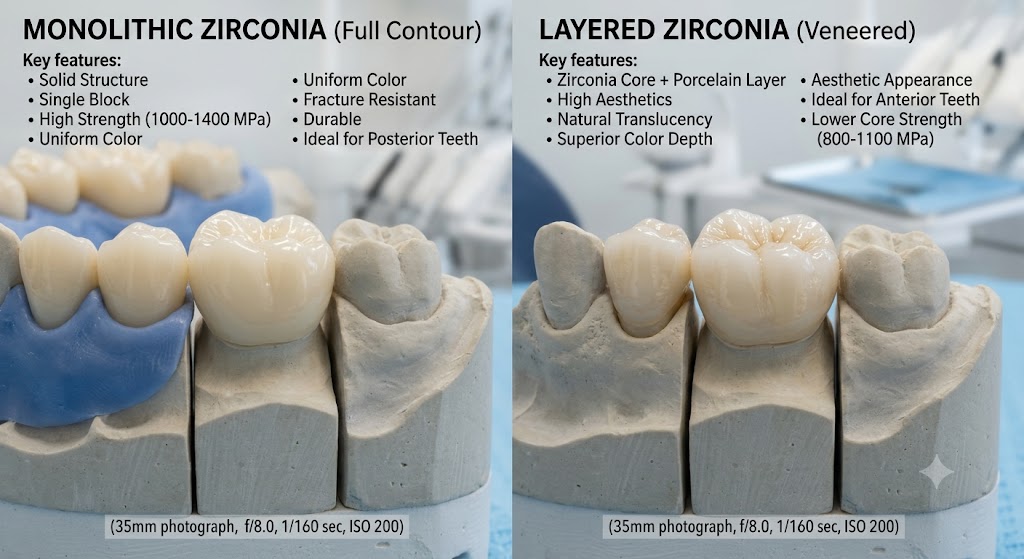
Monolithic zirconia is exactly what its name suggests. “Mono” means one, and “lithic” means stone. It is a restoration milled entirely from a single, solid block of zirconia. There are no layers fused onto it. No separate porcelain added on top for decoration. The entire crown, bridge, or veneer is one homogeneous piece from core to surface.
Think of it like a solid marble statue. If you were to chip it, the inside looks exactly the same as the outside. The color runs all the way through. This is the defining characteristic of monolithic zirconia. The restoration gets its final color from the material itself, often enhanced by dipping the milled shape in special coloring liquids before the final firing in a furnace. Modern versions come in pre-shaded blocks, known as multi-layer or gradient zirconia. These blocks shift smoothly from a darker shade at the bottom to a lighter, more translucent shade at the top, mimicking a natural tooth root and tip.
Because a monolithic restoration is one solid piece, it has no weak internal interfaces. There is no boundary where a weaker layer sits on top of a stronger one. This creates the highest possible strength you can get from a zirconia restoration. Dentists love this option when absolute toughness is the top priority.
Key characteristics of monolithic zirconia:
- Fabricated from a single, solid block of zirconia ceramic
- No added porcelain layering on the outside
- Exceptional flexural strength, often exceeding 1000 MPa
- High resistance to chipping and fracturing
- Requires minimal tooth preparation in many cases
- Translucency is improving with newer generations but is generally lower than layered versions
What is Layered Zirconia? The Aesthetic Specialist
Layered zirconia takes a different approach. It acts like a hybrid restoration. The inner part, or the framework, consists of strong zirconia. This provides the strength and fit. A technician then applies a specialized glass-based porcelain powder by hand onto this framework, layer by layer. After each application of wet powder, they fire it in a furnace. This process builds up the outer shape and final look of the tooth.
This is a classic technique borrowed from the days of metal-ceramic crowns, but using a white zirconia base instead of a dark metal one. The white base is a huge advantage because it does not block light like metal. The technician builds depth, texture, and character by using different porcelain powders to mimic the way real enamel and dentin interact with light. They might use a more opaque porcelain deep down, a translucent one at the edge, and add subtle color effects like tiny white flecks or a slight blueish hue at the incisal edge.
The result can be stunningly beautiful. A master technician can create a tooth that is almost indistinguishable from a natural one. However, this beauty comes with a structural trade-off. You now have two different materials bonded together. The porcelain layer is much weaker and more brittle than the solid zirconia underneath. The interface between them is a potential spot for failure.
Key characteristics of layered zirconia:
- Consists of a strong zirconia framework with hand-applied porcelain
- Superior aesthetics with high translucency and custom shading
- Allows detailed characterization by the dental technician
- Flexural strength is lower overall due to the weaker outer layer
- Higher risk of chipping or delamination of the porcelain
- Requires a slightly thicker reduction of the tooth to accommodate both layers
Monolithic Zirconia vs Layered Zirconia: A Side-by-Side Breakdown
The best way to understand a complex comparison is to see the facts side by side. The table below gives you a clear, honest snapshot of how these two materials stack up in critical areas. This is not about declaring a winner; it is about matching the material to the patient’s needs.
Core Comparison Table
| Feature | Monolithic Zirconia | Layered Zirconia |
|---|---|---|
| Composition | One solid piece, no joints or layers. | Strong zirconia core + weak porcelain outer layer. |
| Flexural Strength | Extremely high (typically 700–1200 MPa). | High for the core, low for the porcelain layer (80–100 MPa). |
| Risk of Chipping | Very low. No separate layer to chip off. | Moderate to high. The porcelain layer can fracture under stress. |
| Aesthetic Potential | Good to very good. Excellent for posterior teeth. | Excellent. Best for mimicking complex natural tooth structure. |
| Translucency | Lower, but improving with newer cubic and gradient materials. | High in the porcelain layer, especially at the incisal edge. |
| Tooth Preparation | Conservative. Requires less drilling of the natural tooth. | More aggressive. Needs space for the core and the porcelain. |
| Opposing Tooth Wear | Historically high, but modern polished zirconia is much gentler. | Gentle. Porcelain wears similarly to natural enamel. |
| Best Use Case | Posterior crowns and bridges, bruxism patients, implant-supported cases. | High-aesthetic anterior cases, smile zone single crowns and veneers. |
This table shows the essential compromise. Monolithic prioritizes safety and longevity. Layered prioritizes ultimate beauty. Your specific clinical situation will pull you toward one side of this table.
The Strength Factor: Why It Matters for Back Teeth
When you chew, your back molars deliver a tremendous amount of force. We are talking about hundreds of pounds of pressure per square inch. If a crown has a hidden structural weakness, the daily cycle of chewing will eventually find it. This is where the monolithic vs. layered conversation gets serious.
Monolithic zirconia has a phenomenal flexural strength that routinely surpasses 1,000 MPa. To put that in perspective, the strongest natural tooth structure, your enamel, might be around 250-300 MPa. This means a well-made monolithic crown is several times stronger than what nature gave you. For a patient who grinds or clenches their teeth, a condition called bruxism, this strength is not just a nice bonus; it is a requirement. The sheer mass of solid zirconia absorbs and distributes the loads without bending. As mentioned earlier, its transformation toughening mechanism actively stops micro-cracks from spreading.
“When we see a patient with a history of broken teeth or cracked restorations, we immediately think of monolithic zirconia. It is the closest thing to an indestructible option we have in esthetic dentistry.” — A sentiment commonly echoed in restorative dental practice.
With layered zirconia, the internal core is still very strong. The problem is the outer layer. Feldspathic porcelain, the type used for layering, is beautiful but relatively fragile. Its flexural strength is usually between 80 and 110 MPa. Under heavy, concentrated stress, this porcelain layer can chip off, a failure mode technically called “chipping” or “delamination.” When this happens, the inner core gets exposed. The core might still be intact, but the restoration is now sharp, rough, and unaesthetic. It usually needs to be entirely replaced. Studies over the years have consistently shown a higher clinical complication rate for layered zirconia compared to monolithic, almost entirely due to this chipping problem.
For a front tooth, the forces are different. They are mostly shearing, angled forces when you bite into a sandwich or an apple. The load is lighter. But for molars and premolars, where crushing vertical force dominates, the single-unit strength of monolithic is a clear physical advantage.
Aesthetic Showdown: Front Teeth and the Smile Zone
Let’s move from the back of the mouth to the front. Here, the rules change. The forces are lower, but the visual demands are sky-high. No one sees your second molar when you smile, but everyone sees your central incisors. In this zone, the conversation about monolithic vs. layered zirconia becomes much more nuanced.
Layered zirconia has traditionally been the champion of the smile zone. A skilled ceramist can work magic. They don’t just make a white tooth shape. They build internal layers that replicate dentin mamelons, the little bumps on the edge of a new tooth. They add opalescent effects, where the tooth looks slightly blue in reflected light and slightly orange in transmitted light. They can tint the deep cervical area near the gum line a subtle, warm yellow-ochre to root the crown into the gum tissue. They can mimic hypocalcification spots or the slight transparency of the biting edge. This level of custom artistry allows a single central incisor crown to disappear perfectly between two natural teeth.
The phrase we often hear is “The dentist frames it. The ceramist paints it.” Layered zirconia provides the blank canvas and the framework for that painting.
But monolithic zirconia has not stood still. The technology has advanced dramatically. The first-generation monolithic blocks were white and opaque. They looked like a piece of chalk or a ceramic sink. Now, we have high-translucency (HT) and ultra-translucency (UT) zirconia blocks. These newer materials use a higher proportion of cubic-phase crystals, which allow light to pass through much more effectively.
Furthermore, manufacturers now produce multi-layered, pre-shaded blocks. These blocks are pressed from powders that graduate smoothly. The cervical end of the block has a richer, darker, more dentin-like shade and lower translucency. The incisal end has a lighter enamel shade and higher translucency. When a technician mills a crown from this block, they carefully position the design inside this color gradient. The result is a monolithic crown that has a built-in, natural-looking color transition.
For many premolars, canines, and even lateral incisors, a high-quality multi-layer monolithic crown can look absolutely fantastic. In some light, it can be hard to tell the difference. However, when you need to match a single, highly visible central incisor with very specific internal characteristics, a master ceramist using the layered technique often still holds a slight edge. The final decision often comes down to the patient’s expectation level. A perfectionist might still lean toward the layered option.
Durability Over Time: What the Research Tells Us
A dental crown is not a short-term purchase. You expect it to last a decade or more. To make a smart choice, you need to look at how these materials behave after years of service in a wet, bacterial, force-heavy environment like the mouth.
Long-term studies on monolithic zirconia are overwhelmingly positive. The survival rate—meaning the crown is still in the mouth and functioning even with a minor issue—is extremely high, often cited at 95-100% over 5 to 10 years. The success rate—meaning the crown is perfect, with no issues—is also very high. The main failure mode for monolithic restorations is not a problem with the material itself, but a biological issue like the cement washing out or the tooth underneath developing decay.
For layered zirconia, the survival rate is also high, but the success rate is notably lower. This discrepancy comes from technical complications. The porcelain chipping mentioned earlier is the primary culprit. A large review of clinical studies might show a survival rate of 95% for a layered zirconia crown at 5 years, but a success rate closer to 80% because of small chips that the dentist polishes down or larger chips that require repair. The interface between the porcelain and the zirconia core is a chronic source of trouble. The two materials cool at different rates after firing, creating internal stresses. Over years of thermal cycling from hot coffee to ice cream, this bond can degrade.
Another consideration is how the crown affects the tooth it bites against. Natural enamel is the gold standard. Early monolithic zirconia had a reputation for being abrasive and wearing down the opposing teeth. This was true when the surface was left rough or glazed. However, the modern protocol is crucial here. We must polish the surface of a monolithic crown to a high gloss after any adjustment. A highly polished, smooth monolithic zirconia surface is actually very kind to opposing enamel, sometimes causing wear similar to that of natural enamel itself. A rough surface, on the other hand, acts like sandpaper.
Layered porcelain has a similar hardness to natural enamel, so the wear pattern is predictable and generally gentle, provided the surface is smooth. The key takeaway here is that surface finish matters just as much as the base material.
A Note from the Editor
Before we dive deeper into the specific clinical scenarios, I want to pause for a second. This article can seem like a pure science lesson at times. But remember the human point. The goal is a healthy, confident smile that lets you eat a steak or laugh out loud without thinking about your teeth. As you read the next sections, think about your own mouth. Do you grind your teeth? Do you open bottles with them? Are you trying to fix one front tooth? Your honest answers are the secret to making the right choice.
Which One is Right for You? Clinical Scenarios
Context is everything. A structural engineer does not use the same material to build a suspension bridge and a glass coffee table. The same principle applies here. Let’s walk through specific patient profiles and match the material to the mouth.
The Bruxer or Heavy Clencher
You wake up with a sore jaw, or your partner complains about the grinding sound at night. Your teeth show flat, shiny wear facets.
The Winner: Monolithic Zirconia.
This is the clearest clinical decision. Placing a layered porcelain crown in a heavy bruxer is a recipe for a callback and a broken restoration. The porcelain layer will not survive the lateral, sustained forces. You need the homogeneous toughness of a solid block. Monolithic zirconia can withstand these forces without chipping, and it acts as a protective helmet for the underlying tooth.
The Single Central Incisor Replacement
You lost one front tooth in an accident. The two teeth next to it are perfectly natural, with complex internal color patterns.
The Winner: Layered Zirconia (likely).
This is the most demanding aesthetic situation in dentistry. A monolithic crown, even a high-end multi-layer one, may look too uniform or slightly “dead” compared to a vibrant natural tooth. A master ceramist using layered porcelain can recreate specific internal effects, line angles, and incisal halos to achieve a perfect match. The lower biting force in the front of the mouth makes the risk of chipping an acceptable trade-off for the superior beauty.
Full Mouth Rehabilitation
You need to rebuild many or all of your teeth due to severe wear, acid erosion, or a bad bite.
The Winner: Monolithic Zirconia.
When you are reconstructing an entire arch, you need a material that can be milled with absolute precision for a perfect fit and that can manage the heavy forces of a new, balanced bite. Monolithic restorations are incredibly strong, cause minimal wear on opposing teeth when polished, and modern options look beautiful across a full set. Achieving consistent, high-end layering on 28 teeth is also prohibitively expensive and time-consuming.
A Posterior Bridge
You are missing a lower first molar, and the teeth on either side need crowns to support the fake tooth.
The Winner: Monolithic Zirconia.
The connector points between the crowns and the false tooth are under immense tensile stress. The single-piece strength of monolithic zirconia makes it the ideal material to withstand this flexural stress without fracturing at the connectors. A layered bridge would risk the porcelain chipping right at these critical points.
The Patient with a Deep Overbite
Your lower front teeth ride up high on the inside surface of your upper front teeth.
The Winner: Monolithic Zirconia.
Space is tight. A layered crown requires more tooth reduction to create room for both the core and the porcelain. In a deep bite situation, there is often not enough space, and the dentist might end up placing the porcelain layer in compression, which it hates. A thin, strong monolithic crown can be made much more conservatively, preserving more of the natural tooth.
The Importance of the Bond: Cementation Protocols
How a crown is glued into place has a monumental impact on its final strength. The bond to the tooth is the silent hero or the hidden villain in every restoration.
Monolithic zirconia has a distinct advantage here because of resin cements. Due to its translucency (especially newer generation monolithic materials), some light can pass through it. This allows the dentist to use a dual-cure or light-cure resin cement. These cements form a microscopic, tenacious bond to the tooth structure. This bond adds to the overall strength of the tooth-crown complex. It seals out bacteria and helps hold everything together. The protocol is well-established and reliable.
Layered zirconia presents a problem. The opaque zirconia core blocks light. The feldspathic porcelain on top also scatters light. A light-cured cement underneath is risky because the light might not reach all the way through the opaque framework. The cement might not harden completely, leaving a soft, weak layer. For this reason, dentists often use a self-adhesive resin cement or a conventional glass ionomer cement with layered zirconia. While these are still good, they don’t provide the same absolute level of bond strength and seal as a properly light-cured adhesive resin.
This is a subtle but important point. The monolithic crown, the one that is already stronger by design, can also receive the strongest possible chemical bond to your tooth. The layered crown, which is inherently weaker, must often settle for a less retentive cement option. This double advantage of high material strength and high bond strength tilts many clinicians toward monolithic solutions for challenging situations.
The Fabrication Process: From Design to Delivery
Understanding how these restorations are made clarifies why they look and act so differently. The journey from a blank block to a finished tooth is a mix of digital precision and human art.
The Monolithic Workflow
- Digital Scan: The dentist scans the prepared tooth, or takes an impression that is poured into a stone model and then scanned in the lab.
- CAD Design: A technician uses software (CAD) to design the anatomical shape of the final tooth. They set the margin, the contour, and the bite contact points.
- Shade Selection and Block Choice: This is a critical step. The technician chooses a pre-shaded block with a color and translucency gradient that matches the patient’s needs. The design is digitally positioned inside this virtual block to get the right color at the right spot.
- Milling: A CNC machine grinds the shape out of the solid block. This takes 10 to 30 minutes.
- Sintering: The milled crown is chalky, oversized, and fragile in this “green” state. It goes into a high-temperature furnace that reaches around 1500°C for several hours. The part shrinks by about 20-25% and becomes dense and super-strong.
- Finishing: The technician stains the surface with a brush, applies a thin glaze, and fires it one last time. The final step is often a high-polish on any areas that will contact the opposing teeth.
The Layered Workflow
- Digital Scan and Framework Design: Similar to monolithic, but the technician designs a reduced anatomical shape. This is the “coping” or internal core. It’s smaller than the final tooth, making space for porcelain.
- Milling and Sintering the Core: A strong, often more opaque block of zirconia is milled and sintered.
- First Opaque Layer: The technician applies a wash layer of porcelain to mask the white core and create a bond.
- Dentin Layering: A thick, pasty porcelain powder is mixed with water and built up by hand in layers to create the base color and shape of the tooth. It is fired.
- Enamel Layering: A more translucent layer is applied on top of the dentin layer to mimic the outer shell of a tooth. It is fired again.
- Corrective Firing: The porcelain shrinks during firing. The technician will add more porcelain to perfect the shape, fire again, and repeat this cycle multiple times.
- Characterization and Glazing: Tiny specks, stains, and a final glaze layer are added for texture and shine.
The labor involved is the key difference. Monolithic relies on the engineered block. Layered relies on the technician’s hands. If the technician is an artist, the layered crown sings. If the technician is simply applying material mechanically, the result can be bulky, over-contoured, and still prone to chipping.
Economic Realities: Cost and Value
Price is a legitimate factor in healthcare. You need to know what you are paying for and if the extra cost adds real value for your situation.
Monolithic zirconia crowns are less expensive to produce. The digital workflow is efficient. A technician can design and mill a crown in minutes and then spend time on staining and polishing. The material cost is a single block. Because the process is faster and less reliant on high-level artistic skill, the lab fee is lower. This saving is often passed on to the patient. You get a highly durable, good-looking restoration for a moderate price.
Layered zirconia crowns are premium products, and the price reflects this. The lab fee is significantly higher. The process requires multiple firings, expensive porcelain powders, and, most importantly, the time of a highly skilled ceramist. This is artisanal labor. You are not just paying for a piece of ceramic; you are paying for the expertise to make it look alive. For a single tooth in the front of the mouth, this cost might be fully justified by the aesthetic result. For a back molar that no one sees, it is harder to make that value argument.
“I have patients who are happy to pay a premium for the absolute best aesthetics on a front tooth. But when it comes to a second molar, they almost universally choose the monolithic. They know it’s a ‘workhorse’ tooth, and they want the strongest, most affordable solution.” — A perspective from a treatment coordinator.
A final economic point to consider is the cost of failure. A chipped porcelain layer on a layered crown usually means a full replacement. A new crown means a new dental bill. The lower risk of chipping with monolithic material gives it a potentially better long-term value, even ignoring the lower up-front cost. This is the “buy once, cry once” principle applied to dentistry.
A Closer Look at New-Generation “Hybrid” Materials
The boundary is getting blurry. We are seeing new materials that don’t fit neatly into the old categories. This is good news for patients.
One category is the gradient monolithic block described earlier. These use a clever arrangement of different zirconia generations—like 3Y-TZP for strength at the bottom and 5Y-PSZ for translucency at the top—all in one solid block. They fuse these different chemistries together without a sharp interface. The result is a true monolithic restoration that has an internal aesthetic gradient. This is a direct challenge to the old rule that monolithic is only for back teeth.
Another innovation is the speed-sintering monolithic material. These are zirconias designed to be sintered in minutes, not hours. This allows a dentist to offer a “same-day crown” using in-office milling machines. The tooth is prepared, scanned, designed, milled, and sintered all in one long appointment. You skip the temporary crown and the second visit. This is impossible with layered porcelain. The speed is a huge quality-of-life benefit, but the material options for these ultrafast cycles are still catching up to traditional furnace-sintered monolithic in terms of ultimate strength.
Some labs also offer a “cut-back” technique, which is a true hybrid. They mill a full-contour monolithic crown, then manually cut back the front surface and apply a thin layer of porcelain just on the facial side. This aims for the strength of a monolithic connector at the back, with the beauty of layered porcelain at the front. It’s a best-of-both-worlds attempt, but it introduces a hand-applied interface on the face, which reintroduces the chipping risk, albeit in a low-force area.
Step-by-Step: How a Patient Can Make an Informed Decision
Making a choice between these two can feel overwhelming. Use this practical, step-by-step guide during your conversation with your dentist.
- Identify the Tooth Location.
- Is it a front tooth (incisor, canine) or a back tooth (premolar, molar)?
- Front teeth: aesthetics rule. Both are in play.
- Back teeth: strength rules. Monolithic has a significant advantage.
- Assess Your Functional Risk.
- Do you grind or clench your teeth?
- Have you ever broken a tooth or a crown before?
- Do you chew ice or have a heavy bite?
- If the answer to any is yes, lean heavily toward monolithic.
- Evaluate Your Aesthetic Needs.
- Is this a single tooth surrounded by natural teeth?
- Do you have a very high lip line that shows a lot of gum and tooth?
- Are you restoring multiple teeth, where a uniform look is more acceptable?
- A demanding single-front-tooth case favors layered. A full arch or a back tooth favors monolithic.
- Consider the Space.
- Ask your dentist if there is enough space between the prepared tooth and the opposing one.
- If space is tight, a conservative monolithic crown preserves more tooth structure.
- Discuss Long-Term Value vs. Initial Cost.
- Factor in the potential cost of repairing or replacing a chipped porcelain layer down the road.
- A layered crown might require a higher maintenance budget over a lifetime.
Use this simple decision-aid checklist:
- I need maximum strength for a back tooth or a bridge.
- I grind or clench my teeth.
- I want a same-day option if possible.
- I want the most affordable option with the lowest risk of breakage.
- If you ticked any of these, discuss monolithic zirconia with your dentist.
- I need to perfectly match a single, highly visible front tooth.
- I am willing to invest more money for the highest possible artistry.
- Strength is not my main concern; it is all about the smile.
- I am restoring a tooth with no heavy chewing forces.
- If you ticked any of these, layered zirconia could be worth the investment.
Summary and Final Verdict
The debate between monolithic zirconia and layered zirconia is not a fight for a single champion. It is a beautiful example of having the right tool for the right job. Dentists today have a toolkit with two distinct, excellent options.
Monolithic zirconia has won the battle of reliability, strength, and long-term predictability. It is the undisputed king for posterior teeth, patients who grind, and full-arch reconstructions. Its aesthetics, once its weakness, have advanced so far that it can satisfy the visual demands of all but the most exacting front-tooth cases. It is a triumph of engineering.
Layered zirconia remains the gold standard for artisan-level aesthetics. When you need to match one front tooth in a sea of perfectly natural neighbors, a skilled ceramist with layered porcelain can achieve a lifelike vitality that no machine-made block can yet replicate. Its use case has narrowed, but for that specific, high-aesthetic challenge, it is still the superior choice.
Ultimately, your dentist’s clinical judgment, paired with your personal priorities, will guide the way. Trust a decision based on honest function and realistic aesthetics, not on technical hype. The best crown is the one that keeps your tooth healthy, strong, and beautiful for the longest possible time.
Frequently Asked Questions
Is monolithic zirconia metal-free?
Yes, it is 100% ceramic. It contains no metal at all, making it an excellent choice for patients with metal allergies or those who simply want a metal-free mouth.
Can you see a difference between monolithic and layered zirconia in the back of the mouth?
Almost never. The lighting back there is so low and the visual angle so poor that a high-quality, pre-shaded monolithic crown will look exactly like a natural tooth. The functional benefit far outweighs any invisible aesthetic difference.
Which type lasts longer?
Statistically, monolithic zirconia has a lower complication rate. The absence of a chippable porcelain layer gives it a significant advantage in long-term success, especially in the grinding environment of the mouth. A layered crown can last just as long if all the forces and conditions are perfect, but it is more vulnerable to accidental damage.
Is the tooth preparation more painful for a layered crown?
The preparation itself is not more painful, as you are completely numb. However, a layered crown usually requires a more aggressive reduction of the tooth, which can mean the dentist shaves down more healthy tooth structure. This is less conservative. Monolithic crowns are often friendlier to the tooth.
Why would anyone still choose layered zirconia if it chips more?
Because in a small number of very specific, visible front-tooth cases, the superior, lifelike aesthetics are worth the small risk of future chipping for that particular patient. The patient accepts the trade-off.
Additional Resource
For a deeper, independent look at the clinical evidence, you can visit the Cochrane Library (www.cochranelibrary.com) and search for “zirconia crowns.” The Cochrane Oral Health Group publishes systematic reviews of the research, providing a gold standard of reliable information, free from industry marketing bias.