Sinus Lift Dental Implant Cost: Prices, Procedures, and Peace of Mind
Imagine sitting in a dental chair, the faint scent of clove oil in the air. You have been nursing a gap in your upper jaw for years. Maybe a tooth was extracted long ago, and you are finally ready to reclaim your full smile with a dental implant. The consultation seems straightforward until the dentist pulls up your panoramic X-ray, points to a gray, cloudy area above your molar, and says, “Your sinus cavity is too low. The bone is insufficient. We need to discuss a sinus lift before we can place the implant.”
That moment often brings two immediate, heart-racing questions: “Is this major surgery?” and, more practically, “How much is this going to cost me right now?”
You are not alone in asking these questions. A sinus lift, technically called a sinus augmentation, is one of the most common bone grafting procedures in modern implant dentistry. Without it, many patients simply do not have enough vertical bone height to anchor an implant in the posterior upper jaw. The body is clever; when a tooth is missing, the floor of the maxillary sinus (that air-filled space under your cheekbones) tends to expand downward, eroding the ridge of bone we need to hold a titanium post securely. The sinus lift reverses this. It gently lifts the sinus membrane and places bone graft material underneath, creating a stable foundation.
Understanding the sinus lift dental implant cost involves unpacking multiple layers: the examination fees, the surgical fee for the lift itself, the type of bone graft material used, the implant placement, the restoration on top, and the geographic location where you receive care. This guide will lead you through every financial, clinical, and logistical detail. We will avoid sugarcoating. We will provide real price ranges, discuss insurance loopholes, and share strategies to make this investment manageable without compromising your health.
Let us begin this journey with transparency. By the end, you will know exactly what questions to ask your surgeon and how to budget for a procedure that quite literally lays the groundwork for a lifetime of smiling, chewing, and speaking with confidence.
Understanding the Hidden Anatomy: Why Bone Disappears
Before we dive into dollar signs and line-item receipts, a brief tour of your own anatomy will make the costs logical. The maxillary sinus sits above the roots of your upper premolars and molars. It is lined with a delicate membrane, known as the Schneiderian membrane, and it functions to lighten the skull, humidify air, and give resonance to your voice.
When a tooth is extracted, the body begins a process called resorption. Without the mechanical stimulation of chewing, the alveolar bone (the ridge that holds teeth) shrinks. Simultaneously, the sinus cavity may pneumatize — a natural tendency to expand into that vacant space. Over months and years, you might end up with only two or three millimeters of bone separating the oral cavity from the sinus. A standard dental implant usually requires at least eight to ten millimeters of vertical bone height for stability and long-term success. When the gap is too small, a sinus lift becomes the biological solution.
Important Note: Not every upper jaw implant needs a sinus lift. If you still have sufficient bone height, your surgeon proceeds directly to implant placement. The cost of a sinus lift only enters the picture when diagnostic imaging confirms a deficiency.
The Core Breakdown: Sinus Lift Dental Implant Cost by Component
Many patients search for a single sticker price, but the sinus lift dental implant cost is an ecosystem of services. You are paying for surgical expertise, materials, facility fees, anesthesia, and the final crown. Let us separate these pieces so you can see where your money goes.
1. The Diagnostic Phase (Imaging and Consultation)
Every treatment plan starts with data. A two-dimensional panoramic X-ray often serves as the screening tool. However, for a sinus lift, most ethical surgeons insist on a Cone Beam Computed Tomography scan. A CBCT provides a three-dimensional view, measuring exact bone width, height, and density, and revealing the health of the sinus membrane. It also maps vital structures like blood vessels.
- Panoramic X-ray: $60 – $150
- CBCT Scan: $150 – $500
- Comprehensive Examination and Consultation: $75 – $250
Some practices bundle the imaging into the surgical fee if you proceed with treatment. Others charge it separately. Always ask for clarity. A thorough diagnostic phase is the blueprint. Cutting corners here is like building a house without a foundation survey.
2. The Sinus Lift Procedure Itself
The surgical fee for the sinus augmentation is the most significant variable. This fee reflects the surgeon’s skill, the technique used, and the complexity of your case.
There are two primary approaches:
Lateral Window Sinus Lift
This is the traditional, more invasive approach used when substantial bone height is needed (often less than 4–5 mm of remaining bone). The surgeon creates a small, oval window in the side wall of the sinus, carefully elevates the membrane, packs in the graft material, and closes the site with sutures. Precision is critical; a perforation of the membrane can complicate healing. The healing period before implant placement is typically 6 to 9 months.
Transalveolar (Osteotome) Sinus Lift
Sometimes called a “crestal” or “indirect” sinus lift, this less invasive technique accesses the sinus floor through the site of the future implant. The surgeon drills to within a millimeter or two of the sinus floor, then uses specially designed instruments (osteotomes) to gently tap and fracture the bone upward, lifting the membrane incrementally. Graft material may or may not be added. This method works when you need only a modest increase in bone height (usually 2–5 mm) and allows simultaneous implant placement in some cases. Healing is generally faster.
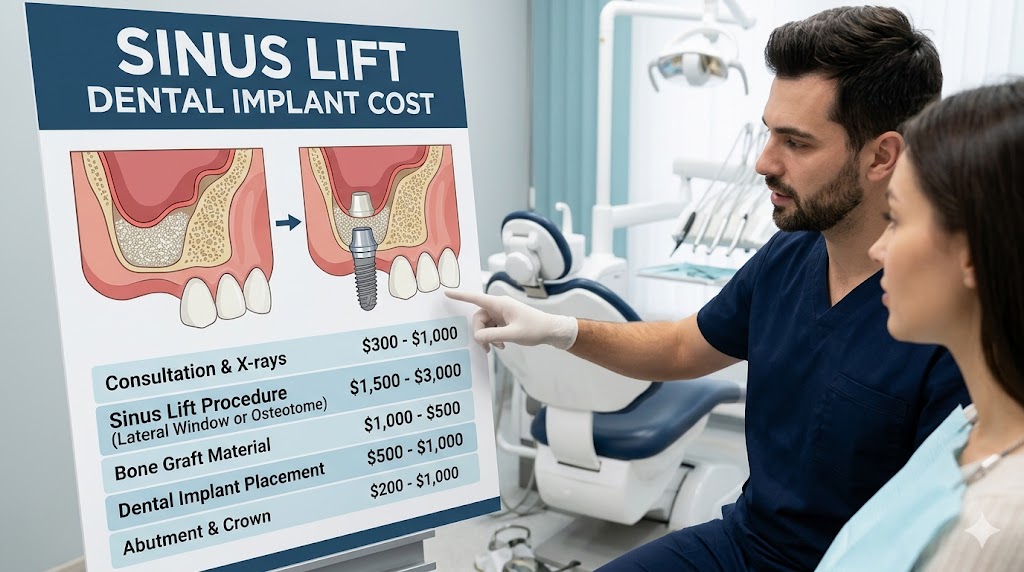
- Lateral Window Sinus Lift (per side): $1,500 – $4,500
- Transalveolar Sinus Lift (per side): $800 – $2,500
These ranges represent the surgeon’s fee. They do not yet include the bone graft material itself.
3. Bone Graft Material Costs
The graft material is the biological scaffold. It fills the space beneath the lifted membrane, encouraging your own cells to migrate and form new, living bone. Several types of graft exist, and their costs differ markedly.
- Autograft: Bone harvested from your own body (often the chin, jaw ramus, or hip). This involves a second surgical site, increasing discomfort and surgical time. It remains the gold standard biologically because it is osteogenic (contains living cells). However, due to the added morbidity and cost of a secondary site, pure autografts are used less frequently for sinus lifts today unless a large volume is needed.
- Allograft: Donor human bone from a tissue bank. It is meticulously processed, sterilized, and safe. It provides an excellent scaffold. The cost is moderate.
- Xenograft: Animal-derived bone, most commonly bovine (cow). This material is processed to remove all organic components, leaving a mineral matrix nearly identical to human bone. It resorbs very slowly, providing long-term space maintenance. Xenograft is widely popular for sinus lifts.
- Alloplast: Synthetic bone substitutes, such as calcium phosphates or bioactive glasses. They are purely synthetic, eliminating any hypothetical risk of disease transmission, and their cost can be controlled.
- Platelet-Rich Fibrin or Plasma: Some surgeons draw a small amount of your blood, spin it in a centrifuge, and extract a concentrated layer of growth factors and platelets. This PRF is mixed with the particulate graft or placed as a membrane. It may add $200 to $500 to the procedure but can accelerate healing and reduce infection risk.
| Graft Material Type | Estimated Cost Range (per site) | Key Characteristics |
|---|---|---|
| Allograft (Donor Human) | $400 – $900 | Excellent scaffold; avoids second surgical site. |
| Xenograft (Bovine) | $350 – $800 | Very slow resorption; gold standard for sinus volume. |
| Alloplast (Synthetic) | $300 – $700 | Unlimited supply; no organic risk. |
| Autograft (Self) | $800 – $2,500+ | Includes hospital/surgical fees for donor site; highest biological potential. |
| PRF/PRP Add-on | $200 – $500 | Concentrated growth factors; often used as a membrane. |
Surgeons frequently combine materials. A common scenario involves a xenograft mixed with PRF and covered with a resorbable collagen membrane to contain the particles. That membrane adds an additional $150 to $400.
4. The Dental Implant Placement
After the sinus lift, you must heal. Once new bone has formed and matured (verified by a follow-up CBCT), you return for implant placement. The implant itself is a titanium or zirconia screw placed into that hard-won bone. The cost here covers the implant fixture, the surgical placement, and the healing abutment.
- Single Dental Implant (Surgical Placement): $1,000 – $2,500
- Implant Fixture (hardware cost to the clinic): $250 – $600
Some practices offer a bundled implant and sinus lift fee if they perform the osteotome technique where the implant is placed at the same time as the lift. For a lateral window approach, the implant placement is almost always a separate surgical appointment and a separate fee, occurring months later.
5. The Abutment and Crown Restoration
The implant is the root. The crown is the tooth. An abutment connects them. This phase occurs after the implant has integrated with the bone (osseointegration), typically 3–6 months post-placement.
- Custom Abutment: $400 – $800
- Implant Crown (Porcelain fused to metal or Zirconia): $1,200 – $2,800
Zirconia crowns, known for their aesthetics and strength, command the higher end of that range. The type of crown and the laboratory fabricating it heavily influence this final stretch of the investment.
Putting It All Together: Realistic Total Cost Scenarios
Let us synthesize these line items into tangible, real-world totals. The following scenarios illustrate what you might expect to pay for a sinus lift dental implant cost from initial exam to final crown. These assume treatment in a private practice in a typical American metropolitan area.
Scenario A: The “Crestal” Minimally Invasive Path
You need a single upper molar replaced. You have 6 mm of bone. Your surgeon determines a transalveolar sinus lift with simultaneous implant placement is viable. You choose a xenograft bone substitute.
- Diagnostic Work-up (CBCT, Exam): $350
- Osteotome Sinus Lift + Graft: $1,600
- Implant Fixture and Placement: $1,800
- Healing Phase: 4–6 months
- Custom Abutment + Zirconia Crown: $2,200
- Estimated Total: $5,950
Scenario B: The Classic Lateral Window Path
You have only 2 mm of bone height. You need a lateral window sinus lift, followed by a lengthy healing period, then implant placement, and finally restoration.
- Diagnostic Work-up (CBCT, Exam): $400
- Lateral Window Sinus Lift + Xenograft + Membrane: $3,200
- Healing Phase: 7–9 months
- Implant Placement Surgery: $1,900
- Healing Phase: 4 months
- Custom Abutment + Zirconia Crown: $2,300
- Estimated Total: $7,800
Scenario C: The Complex Reconstructive Case
You have minimal bone in both height and width, possibly a history of periodontal disease, and your sinus membrane thins out dangerously. Your surgeon plans a lateral window approach with a mix of allograft and PRF, and a titanium-reinforced membrane. Later, you receive two implants to support a bridge.
- Diagnostic Work-up (CBCT, digital scans): $500
- Lateral Window Lift + Allograft/PRF Mix + Ti-Membrane: $4,500
- Healing Phase: 8 months
- Two Implants Placement: $3,600
- Healing Phase: 4 months
- Two Custom Abutments + 3-Unit Zirconia Bridge: $5,000
- Estimated Total: $13,600
These numbers do not exist to alarm you. They exist to arm you. Walking into a consultation with a mental framework of $6,000 to $14,000 for a complete sinus lift implant journey allows you to listen critically to a treatment plan, recognize fair pricing, and identify outlier fees.
Geographic Influence: Why Your Zip Code Changes the Quote
In the world of dental fees, location is not just a detail; it is a loud, echoing factor. A lateral window sinus lift in a rural clinic in Ohio may cost $1,800, while the same procedure performed by a board-certified oral surgeon in a Beverly Hills high-rise can touch $6,000. This does not inherently mean one surgeon is better than the other, but it does reflect overhead costs: commercial lease rates, laboratory technician salaries, regulatory compliance costs, and professional liability insurance.
Rough Multiplier by Region (Relative to National Average):
- Rural and Suburban Midwest/South: 0.75x – 0.90x
- Major Metropolitan Texas/Florida cities: 1.0x – 1.2x
- Northeast Corridor (NYC, Boston, DC): 1.3x – 1.8x
- West Coast Major Cities (LA, SF, Seattle): 1.4x – 2.0x
Medical Tourism Note: Some patients seek care in countries like Mexico, Costa Rica, or Hungary. Prices can be drastically lower, perhaps $800 for a sinus lift and $600 for an implant. You must weigh the travel costs, the difficulty of managing complications from afar, and the rigorousness of sterilization protocols. Many such clinics offer excellent care, but your due diligence must be exhaustive. Should a post-operative infection arise back home, your local dentist may not have access to the implant parts needed for repair, potentially leading to additional costs that erase the initial savings.
The Insurance Labyrinth: Coverage, Exclusions, and Medical Billing
Dental insurance in many countries, particularly the United States, operates on a structured limitation model. It is designed to offset the cost of basic prevention and simple restorative work, not complex surgical reconstruction. Let us be direct: a significant portion of the sinus lift dental implant cost will likely be an out-of-pocket responsibility.
Dental Insurance Typical Structure
- Annual Maximum: Often $1,000 to $2,000 per year. This cap has not risen meaningfully in decades.
- Sinus Lift Classification: Many plans classify a sinus augmentation as a “major” procedure. If covered at all, they might reimburse at 50% of their “usual and customary” fee, which is often far below the actual surgeon’s charge.
- Implant Coverage: Implant coverage is increasingly common, but many plans still label implants as “cosmetic” or impose a 12-month missing tooth clause (meaning they will not cover an implant for a tooth that was missing before the policy started).
- The Waiting Period: Some policies require 6 to 12 months of continuous coverage before major procedures become eligible.
Let us build a practical insurance math example. You have a plan with a $1,500 annual maximum and 50% coverage for major services. Your sinus lift costs $3,200. In a perfect world, 50% coverage would yield $1,600, but your $1,500 annual max caps it. The plan might pay $1,500, and you pay $1,700 out of pocket. However, that $1,500 payment then exhausts your annual maximum. The implant and crown, scheduled in a different calendar year, could tap into that year’s maximum separately. Strategic timing of surgery across two calendar years (say, the sinus lift in November and the implant in February) can help you maximize these modest benefits.
Medical Insurance Possibility
The sinus is an anatomical structure that falls under the purview of medical insurance (otolaryngology). When a sinus lift is medically necessary — perhaps due to a traumatic injury, a congenital defect, or a pathology like a cyst removal — your medical policy may cover the hospitalization or surgical portion. This is a complex billing path. You will need a surgeon familiar with filing medical claims, complete with ICD-10 diagnosis codes (such as K08.21 for minimal atrophy of the mandible, or specific sinus conditions) and CPT procedure codes. Medical insurance typically does not cover the implant or the crown, but covering the sinus lift bone graft can save thousands. Always inquire if your oral surgeon has experience billing medical insurance for maxillofacial reconstruction.
“The biggest shock for patients isn’t the total cost. It’s discovering that their insurance maximum has been $1,500 since 1995, while dental inflation has marched on. Plan your timing. Use your calendar-year maximums. And ask if your surgeon can file medical cross-coding.”
— A seasoned treatment coordinator in a periodontal practice
Factors That Inflate or Deflate the Final Cost
Beyond geography and technique, several specific clinical and logistical factors nudge the sinus lift dental implant cost higher or lower.
Factors That Increase Cost
- Membrane Perforation Risk: A thin, delicate sinus membrane is harder to lift without tearing. Surgeons may use specialized instruments, longer surgical time, or a larger collagen membrane to repair a perforation. Some practices charge a small additional fee if extensive membrane repair is required.
- Previous Failed Grafts: Scar tissue and dense, avascular bone from a previous failed graft make revision surgery technically demanding.
- Active Sinus Infections: If you have chronic sinusitis, your surgeon may require clearance from an ENT specialist and a course of antibiotics or even sinus surgery before proceeding, adding separate medical costs.
- Sedation Choices: A local anesthetic injection is included in most surgical fees. However, nitrous oxide ($50–$150), oral conscious sedation ($200–$400), or IV sedation ($400–$800+) will add to your total. Many patients understandably prefer IV sedation for a lateral window procedure.
- Special Membranes: A standard collagen membrane costs $150–$300. If your bone defect has a shape that requires a titanium-reinforced membrane or a custom titanium mesh to hold the graft in space, add $500 to $1,200.
Factors That Decrease Cost
- Dental School Clinics: University dental and oral surgery clinics perform sinus lifts and implants at reduced fees, sometimes 40–60% less than private practice. Board-certified or board-eligible surgeons supervise senior residents. The trade-off is time: appointments are longer, and you may have less continuity of provider.
- Bundled Cash Discounts: Private practices often offer a 5–10% discount if you pay the full surgical fee in cash or by check at the time of treatment, saving them credit card processing fees and billing staff time.
- Simple Osteotome Technique: When applicable, avoiding a lateral window saves considerable surgical time and material cost.
- Corporate Dental Memberships: Some corporate dental chains offer in-house membership plans where you pay an annual fee for a discount on procedures. A 20% discount on a $3,200 sinus lift saves $640, potentially making the membership well worth it.
A Detailed Walk Through the Lateral Window Procedure and Its Direct Cost Drivers
Understanding exactly what happens in the surgical suite demystifies the fees. Let us walk through a lateral window sinus lift, the highest-cost variant, step by step.
Step 1: Anesthesia and Access
After IV sedation takes hold, the surgeon injects a local anesthetic containing epinephrine. This numbs the area and reduces bleeding. An incision is made along the gum tissue on the cheek side of the upper jaw, and the gum is reflected to expose the underlying bony wall of the sinus. A surgical assistant retracts the tissue. Cost driver: Surgical team time, sterile setup.
Step 2: Creating the Window
Using a piezoelectric surgical unit (which cuts bone with ultrasonic vibrations but spares soft tissue) or a high-speed surgical drill, the surgeon carefully outlines a small, hinged rectangular or oval window in the lateral bone. Piezosurgery devices cost tens of thousands of dollars but reduce the risk of membrane perforation. Practices that invest in this technology may have higher fees, but they often correlate with lower complication rates. Cost driver: Capital investment in surgical technology, surgeon’s precision skill.
Step 3: Elevating the Membrane
This is the heart of the procedure. Using delicate, spoon-shaped curettes, the surgeon gently separates the sinus membrane from the bony floor. The membrane rises like a tent. The space created becomes the pouch for the new bone. If a tiny tear occurs, a collagen patch or resorbable membrane is placed over it. Cost driver: Time; severe perforations require repair strategies that extend the procedure and material usage.
Step 4: Packing the Graft
The chosen bone graft material, often slightly moistened with saline or PRF liquid, is carefully packed into the void. The surgeon fills the space fully but avoids over-packing, which could compress the membrane. Cost driver: Graft material volume and type. A large sinus may require two vials of xenograft instead of one.
Step 5: Closing and Healing
A collagen membrane is draped over the bony window to guide healing and prevent soft tissue cells from invading the graft. The gum tissue is repositioned and sutured. The patient receives post-operative instructions. The graft will now undergo a process called “creeping substitution,” where the body resorbs the graft material and replaces it with living bone. Cost driver: Membrane choice, sutures.
Step 6: The Waiting Period
You wait. For 6 to 9 months, the graft matures. You wear a temporary removable tooth if aesthetics demand it, but no pressure is applied to the graft site. A follow-up CBCT at month 6 confirms bone density. Only then is the implant placed.
This detailed look makes one thing clear: you are not simply paying for a material. You are paying for a meticulously orchestrated biological event, enabled by a surgeon who knows the exact tactile feedback of a membrane lifting cleanly from bone.
The Transalveolar Approach: A Less Costly, Elegant Solution
Not everyone needs the full lateral window. The transalveolar (crestal) technique deserves its own spotlight because it often allows simultaneous implant placement, collapsing the timeline and the cost. Here, the surgeon drills the implant osteotomy to within 1–2 mm of the sinus floor. Using osteotomes of increasing diameter, they gently tap upward, creating a controlled “greenstick” fracture of the sinus floor. The membrane elevates with the bone fragments, and graft material can be pushed up through the prepared hole. The implant is then placed immediately into this lifted site.
The advantages are tangible:
- Single surgical site.
- Less post-operative discomfort.
- Shorter total treatment time (often one surgery instead of two).
- Lower overall sinus lift dental implant cost, frequently shaving $1,000 to $2,500 off the total compared to a staged lateral window case.
The limitation is simple: you need enough residual bone (usually at least 5 mm) to achieve primary stability of the implant at the time of placement. If your bone is too thin, the implant will wiggle, and the risk of failure skyrockets. An ethical surgeon will not choose the crestal approach just to save you money if your anatomy dictates a lateral window. Graft failure and implant loss are far more expensive to correct.
The Abutment and Crown: The Final Touch You Actually See
After the implant fuses with your hard-won bone, your wallet enters the restorative phase. Some patients, exhausted by the surgical bills, consider cutting corners on the crown. This is a mistake. A poorly designed crown can cause cement sepsis (inflammation from excess cement), open contacts that trap food, or a fracture of the abutment screw.
Stock vs. Custom Abutments
A stock abutment is a pre-fabricated, off-the-shelf titanium connector. A custom abutment, designed on CAD/CAM software and milled from a solid block of titanium or zirconia, supports the crown contours perfectly. Custom abutments cost more ($500–$800 versus $150–$300 for stock) but allow for proper emergence profile and cleansability.
Screw-Retained vs. Cemented Crowns
A screw-retained crown attaches directly to the implant with a screw. It offers retrievability. If the porcelain chips or the implant needs inspection years later, the dentist can unscrew the crown without destroying it. A cemented crown mimics a traditional tooth but risks leaving cement behind. Many surgeons prefer screw retention for posterior areas. The cost difference is minimal, but the long-term maintenance implications are significant.
The Hidden Fee You Never Expected: Complications and Their Management
Medical and dental procedures come with biological uncertainty. Let us discuss the honest potential for additional costs, not to frighten, but to ensure your contingency planning is solid.
Sinus Membrane Perforation
A tear occurs in roughly 10–20% of lateral window cases. Small perforations are managed with a resorbable collagen membrane placed over the tear. The graft proceeds uneventfully. Larger tears may cause the surgeon to abort the procedure entirely, suture the area, and reschedule in 3–4 months after healing. If the tear is repaired and the graft placed successfully, there may be a small additional material charge ($200–$400) for the extra membrane. If the procedure is aborted, you may face a fee for surgical time used, but you should not be charged for the full graft. Clarify this “aborted procedure” policy with your surgeon before surgery.
Post-Operative Sinusitis
Sometimes the graft material or the swelling blocks the tiny ostium that drains the sinus into the nasal cavity. You may develop a sinus infection. Treatment involves decongestants, antibiotics, and possibly a referral to an ENT. An antibiotic course costs relatively little ($20–$200), but if an ENT needs to perform a sinus drainage procedure, that adds a separate medical bill.
Graft Failure
If the graft fails to revascularize, it can sequester. Signs include persistent drainage, pus, or an opening between the sinus and mouth. Graft failure necessitates removal of the graft material, a healing period, and a second grafting attempt. Some surgeons offer a reduced fee for re-grafting, but the cost of new materials often stands.
Implant Failure
Even after a successful sinus lift, an implant might fail to integrate. Risk factors include smoking, uncontrolled diabetes, or parafunctional habits like grinding. An implant that fails early is removed, and the site heals. A new implant can usually be placed later, but you incur a new fixture fee and possibly additional grafting.
Smoking and Healing: A Financial and Biological Equation
Let us speak plainly. Smoking is the single greatest modifiable risk factor for failure in sinus lift and implant procedures. Nicotine causes vasoconstriction, starving the graft site of oxygen and healing cells. Studies show implant failure rates in smokers can be two to three times higher than in non-smokers. Some surgeons refuse to perform elective sinus lifts on active smokers.
If you smoke, you must commit to a strict cessation window — typically starting two weeks before surgery and continuing for at least eight weeks after, or ideally indefinitely. The financial implication is stark: spending money on a sinus lift and then compromising the healing through smoking is akin to lighting your investment on fire. If you need smoking cessation aids (patches, medication, counseling), factor that modest cost into your total budget. It will be the best money you ever spent toward your dental health.
Financing the Gap: How Patients Actually Pay
The gap between what insurance pays and what you owe can feel like a canyon. Here are the tools real patients use to cross it.
Health Savings Accounts and Flexible Spending Accounts
If your employer offers an HSA or FSA, you can set aside pre-tax dollars to pay for medical and dental care. This effectively gives you a 20–35% discount, depending on your tax bracket. You must have the plan set up and funds accumulated before treatment, or at least understand your plan’s reimbursement timing.
In-House Payment Plans
Many oral surgery practices offer in-house financing for established patients. They might split the sinus lift fee into three monthly payments with little to no interest. This arrangement keeps the debt off your credit report.
Third-Party Medical Credit Cards
CareCredit, Alphaeon Credit, and Lending Club offer credit lines specifically for healthcare expenses. They often advertise “6 or 12 months no interest if paid in full” promotions. Be extremely careful here. These are deferred interest plans. If you miss a payment or fail to pay the entire balance within the promotional window, interest is charged retroactively from day one at a high annual percentage rate (often 26.99%). Only use these if you have rock-solid certainty in your ability to repay within the terms.
Personal Loans and Credit Union Loans
A personal loan from a credit union may offer a fixed, lower interest rate compared to medical credit cards. The repayment term can stretch over several years, making the monthly payment manageable. The total interest paid increases over time, but this option provides predictability.
Charitable and Sliding-Scale Clinics
For low-income individuals, some Federally Qualified Health Centers (FQHCs) and non-profit dental clinics offer oral surgery services on a sliding fee scale based on income. These centers may have long waiting lists, but the cost savings can be life-changing.
| Payment Method | Typical Term | Interest Rate | Best For |
|---|---|---|---|
| HSA/FSA Funds | Immediate | None (pre-tax savings) | Anyone with available balance. |
| In-House Payment Plan | 3–6 months | 0% or low | Patients with moderate cash flow. |
| CareCredit (Promotional) | 6–12 months | 0% (deferred) | Disciplined budgeters who can pay in full within the term. |
| Credit Union Loan | 2–5 years | 6% – 12% | Those needing longer repayment. |
| Dental Tourism | Immediate | Varies | Healthy patients comfortable with travel and follow-up logistics. |
Choosing Your Surgeon: Cost vs. Expertise
The sinus lift dental implant cost is inextricably linked to the provider’s training and experience. Three main specialties perform these procedures:
Periodontists are experts in the supporting structures of teeth (gums and bone). They complete a three-year residency after dental school focusing on periodontal disease, bone grafting, and implant placement. Many periodontists perform sinus lifts routinely and have a deep understanding of soft tissue management.
Oral and Maxillofacial Surgeons complete a four-to-six-year hospital-based surgical residency. They manage complex facial trauma, pathology, and reconstructive surgery. Their training includes extensive sinus surgery. For complex cases involving large sinus pathology or revision of failed lifts, an oral surgeon’s medical background offers an added layer of safety. Their fees often reflect their hospital-based training.
General Dentists with advanced implant training also perform sinus lifts. Some general dentists take extensive continuing education and have outcomes comparable to specialists, particularly for simple crestal approaches. Their fees may be lower than those of specialists. The key question for a general dentist is: “How many of these specific procedures have you performed, and what is your complication rate?”
The Consultation Test: The best surgeons welcome questions about cost. They provide a detailed, written treatment plan with all procedure codes. They explain the difference between a specialist’s fee and a corporate chain’s advertised price. If a provider is vague about fees or pressures you to sign up with a high-pressure sales pitch, walk away. A sinus lift is not a timeshare. It is a sophisticated surgical investment in your health.
A Helpful List: 15 Smart Questions to Ask During Your Consultation
Write these down. Take them to your appointment. A prepared patient earns the respect of a skilled surgeon and receives clearer answers.
- “Is a lateral window or a transalveolar approach planned for my anatomy, and why?”
- “Will you use a CBCT scan to measure my bone height and membrane health?”
- “What specific type of bone graft material do you recommend for my case, and what are its advantages?”
- “Can you provide me with a single, all-inclusive treatment plan fee sheet that covers the facility, anesthesia, and follow-up visits?”
- “What is your protocol if the sinus membrane tears during surgery? Is there an additional charge for membrane repair?”
- “How many sinus lift procedures do you perform in an average month?”
- “Do you offer any cash discount or in-house payment plans?”
- “Will you place the implant at the same time as the sinus lift, or will we need separate surgeries?”
- “What are the exact diagnostic codes you would use, and do you bill medical insurance for the sinus portion?”
- “What are your smoking cessation requirements?”
- “How do you manage post-operative pain, and what prescriptions do you typically provide?”
- “Can I see before-and-after X-rays of similar cases you have treated?”
- “What is the follow-up schedule to confirm the graft has turned into viable bone?”
- “Is the implant crown fee included in this quote, or do I need to coordinate with my general dentist for the restoration?”
- “What are the signs of a failing graft that I should watch for at home?”
Post-Operative Recovery: Protecting Your Investment
The first 72 hours after a sinus lift set the stage for healing. You spent thousands of dollars creating a new foundation. Your post-op behavior determines whether that foundation calcifies into dense bone or washes away.
The Crucial First Week:
- Do not blow your nose. If you must sneeze, open your mouth wide so the pressure does not build in the sinus.
- Do not use a straw. The suction can dislodge the clot and destabilize the graft.
- Sleep with your head elevated on two pillows.
- Avoid heavy lifting, bending over, or vigorous exercise.
- Take all prescribed antibiotics and use saline nasal spray gently as directed.
- You may have some bloody discharge from the nose on the first day. This is normal. Brisk, active bleeding is not; call your surgeon.
Dietary Guidelines:
Stick to a soft, cool, or lukewarm diet. Yogurt, smoothies (eaten with a spoon, not through a straw), scrambled eggs, mashed potatoes, and protein shakes are your allies. Avoid small, granular foods like rice or seeds that can get trapped in the suture line. Hydration is critical, but drink carefully from a cup.
Sinus Precautions Long-Term:
The sinus membrane is resilient, but it appreciates gentle treatment. Avoid scuba diving or flying with a severe head cold soon after surgery, as rapid pressure changes can stress the healing graft. Most surgeons clear patients for normal air travel within a week or two, but clear this with your own provider.
Comparative Table: Sinus Lift vs. Other Bone Grafting Procedures
It helps to see how a sinus lift compares, both clinically and financially, to other bone grafting procedures you might hear about.
| Procedure | Purpose | Typical Site | Cost Range (Graft Only) | Healing to Implant |
|---|---|---|---|---|
| Sinus Lift (Lateral) | Increase vertical bone below sinus floor | Posterior Upper Jaw | $1,500 – $4,500 | 6–9 months |
| Sinus Lift (Crestal) | Minor vertical bone gain below sinus | Posterior Upper Jaw | $800 – $2,500 | 0–4 months (often simultaneous) |
| Ridge Augmentation | Rebuild width and height of jaw ridge | Anywhere | $600 – $2,500 | 4–6 months |
| Socket Preservation | Graft placed immediately after extraction | Extraction Socket | $300 – $800 | 3–4 months |
| Block Bone Graft | Large defect requiring a block of bone | Jaw ridge (often front) | $2,000 – $4,500 | 4–6 months |
This table clarifies that a sinus lift sits in the middle-to-upper tier of grafting costs, reflecting its technical sensitivity and the volume of material required.
The Emotional Cost and the Value of Experience
We can itemize graft particles, CT scans, and titanium screws, but a spreadsheet does not capture the emotional weight of spending a family vacation’s worth of money on a tooth. It is okay to feel conflicted, anxious, or frustrated. Dental disease is not a moral failing. Bone loss is a biological reality for anyone who has lost a tooth. Acknowledging the frustration is the first step to moving past it.
The value here is not merely cosmetic. A posterior upper implant restored on a healthy sinus lift allows you to chew properly on both sides of your mouth. Unilateral chewing causes uneven wear, muscle tension, and TMJ strain. It allows you to eat fibrous vegetables, nuts, and lean proteins without restriction. Nutrition improves. A complete arch maintains the vertical dimension of your face. Without posterior support, the bite can collapse, leading to cracks and fractures of front teeth.
One patient, a 58-year-old teacher named Linda, shared during a follow-up visit: “I thought I could live with the gap. I didn’t realize how much I had shifted my diet. I stopped eating salad. I stopped smiling fully in photographs. The cost was high, yes, but my daily life opened back up. It was a restoration of function, not just a tooth.” This testimony captures the real-world return on this investment.
Pediatric and Young Adult Considerations
A sinus lift is rare in young patients, but it occasionally appears in the context of congenitally missing teeth (such as the maxillary lateral incisors or premolars) or traumatic avulsion of a tooth at a young age with subsequent bone loss. In a teenager or young adult, the sinus is still developing, and the body heals with breathtaking speed. The surgical approach may be more conservative. The cost structure remains similar, but the long-term value proposition is even higher: a graft placed at age 20 can serve an implant that lasts 50 or 60 years with proper care. Parents should ensure their young adult children understand the critical, non-negotiable importance of hygiene around the site for life.
Maintenance: The Cost You Cannot Ignore
Your financial relationship with your implant does not end when the crown is cemented. To avoid losing your investment to peri-implantitis (an infection of the bone around the implant), you must commit to maintenance.
Annual or Biannual Hygiene Visits: $150 – $350 per year
Peri-Implant Probing and Radiographic Check: included or small surcharge
Occlusal Guard (if you grind): $500 – $1,200 for a custom night guard to protect the crown and implant from overload forces.
Potential Crown Replacement: Over 15–20 years, the implant crown may chip or wear. Plan for eventual replacement at a similar cost to the original crown.
Budgeting roughly 1–2% of the initial treatment cost annually for maintenance is a sound financial rule of thumb. This proactive spending prevents catastrophic, expensive failures.
Realistic Alternative: If a Sinus Lift Is Not Financially Feasible Right Now
Honesty demands we address the reader who, after reading this far, knows the sinus lift dental implant cost sits beyond their current means. Does this mean you must remain toothless? No. There are alternatives, each with its own compromise.
Short Implants: Some implant systems feature shorter, wider fixtures that can anchor in as little as 4–5 mm of bone without a sinus lift. They are not always suitable for every bite force or bone density pattern, but their success rates have improved markedly.
Zygomatic Implants: These are long, angled implants that anchor into the dense zygomatic bone (cheekbone), bypassing the sinus entirely. They require an extremely skilled surgeon, and the cost per implant is high ($3,000–$6,000 for the surgical component), but they can support a full arch of teeth without any sinus lift.
Removable Partial Denture: A well-made, lightweight partial denture can replace a posterior missing tooth for $800–$2,000. It does not require surgery. The compromise is stability, food trapping, and the lack of bone stimulation. It is an acceptable provisional solution while you save for a more permanent fix.
Conventional Bridge: If the teeth adjacent to the space are already heavily restored, a traditional bridge ($2,500–$5,000) avoids the sinus lift entirely. The biological cost is the reduction of healthy tooth structure on the adjacent abutment teeth. Weigh this cost carefully. Implants preserve adjacent tooth structure.
A Note on Technology and Future Trends
Innovation marches forward. Ultrasonic bone surgery has already reduced membrane perforation rates. In the future, recombinant human bone morphogenetic protein, a synthetically produced protein that stimulates bone formation, may reduce the need for harvested graft material. Currently, its high cost and off-label status for routine sinus lifts limit widespread use, but insurance coverage patterns may shift. Additionally, artificial intelligence-driven treatment planning software will likely reduce surgical errors and refine implant positioning, potentially lowering complication-related costs. These trends suggest that while the baseline cost will not plummet, the value — safety, predictability, and reduced chair time — will continue to improve.
Building Your Personal Budget: A Worksheet in Words
Let us close the numbers discussion with a practical exercise. Take out a piece of paper or open a blank note on your phone. Write down these items and fill them in as you gather quotes from your specific surgeon.
One-Time Costs:
- Diagnostic Imaging (CBCT): $______
- Sinus Lift Surgical Fee: $______
- Bone Graft Material Fee: $______
- Membrane or Special Materials: $______
- Anesthesia/Sedation Fee: $______
- Implant Placement Surgery: $______
- Abutment: $______
- Crown: $______
- Gross Total: $______
Offsets and Reductions:
- Dental Insurance Payout: ($______)
- Medical Insurance Payout: ($______)
- Cash Discount (if applicable): ($______)
- Net Out-of-Pocket: $______
Annual Maintenance Budget:
- Hygiene and Check-ups: $______
- Night Guard (if needed): $______
This exercise transforms a scary, abstract number into a tangible, controllable plan. You can phase the spending across calendar years to maximize insurance. You can adjust the crown timeline to build up an HSA balance.
A Final Word on Value Over Price
Price is the number on the ledger. Value is what that number buys over a lifetime. A well-executed sinus lift and implant can outlast the patient. The literature speaks of 20, 30, and even 40-year success rates exceeding 90% for implant-supported crowns. Very few other things you buy offer that kind of longevity. When you pay for a sinus lift, you are not renting a tooth. You are buying back the full use of your jaw, the confidence in a steakhouse, the freedom to laugh without a hand instinctively covering your mouth.
Seek thorough diagnostics. Seek an honest surgeon who uses a microscope or high magnification, who values sterility, and who offers a fair, transparent fee schedule. The lowest price often comes with corners cut. The highest price does not guarantee perfection. Fair, transparent pricing coupled with proven skill is the sweet spot.
Conclusion
The sinus lift dental implant cost represents a layered investment in surgical skill, biological materials, diagnostic technology, and precision artistry. It ranges broadly from roughly $5,900 for a simple simultaneous approach to over $13,600 for complex, staged reconstruction, heavily influenced by technique, graft type, geography, and sedation. Patients who navigate this path successfully approach it with a clear budget, strategic insurance timing, and a commitment to protecting their healing investment through lifestyle adjustments. Ultimately, restoring lost vertical bone height is not merely an expense — it is a long-term foundation for oral function, nutritional freedom, and lasting self-assurance.
Frequently Asked Questions
1. Can a sinus lift and dental implant be done on the same day?
Yes, in select cases. If you have at least 5 mm of bone height and your bone density is good, a transalveolar (crestal) sinus lift can often be performed alongside immediate implant placement. Your surgeon must achieve solid primary stability of the implant at the time of surgery. If bone is minimal (less than 4 mm), a lateral window lift is necessary, and the implant is typically placed 6 to 9 months later.
2. How painful is a sinus lift?
Pain perception varies, but most patients report discomfort similar to a tooth extraction, managed well with prescribed pain relievers and anti-inflammatory medication. The primary sensation is pressure and mild swelling in the cheek and upper jaw. The key discomfort rule is the inability to blow your nose for several weeks, which can feel stuffy. Following your surgeon’s post-operative instructions rigorously reduces pain and complications.
3. Does dental insurance cover the sinus lift portion?
Some plans cover a portion if sinus augmentation is classified as a major surgical procedure, but reimbursement is usually capped by an annual maximum of $1,000 to $2,000. The bone graft material itself may be excluded or assigned a downgraded allowance. For patients whose sinus lift is required due to trauma or pathology, medical insurance may cover a significant part of the surgery under medical billing codes.
4. What happens if I do not do a sinus lift and just get an implant anyway?
Placing a standard-length implant into insufficient bone height perforates the sinus membrane and leaves the implant tip exposed in the sinus cavity. This destabilizes the implant, causes infection, and guarantees failure. No ethical surgeon will knowingly place an implant into the sinus. Shorter implants may be an alternative, but they have specific biomechanical requirements.
5. Can I fly after a sinus lift?
Most surgeons advise waiting 5 to 7 days before air travel. The cabin pressure changes in an airplane can cause expansion of air within the sinus, potentially stressing the suture line and the freshly elevated membrane. Once initial healing is underway and you can gently equalize ear pressure, flying becomes safer. Always get personal clearance from your surgeon.
Additional Resource: Link
For further independent reading on bone grafting procedures, dental implant materials, and radiographic planning, visit the American Academy of Periodontology’s patient information library at: https://www.perio.org/for-patients/
Disclaimer: This article is intended for informational and educational purposes only. It does not constitute medical or dental advice, diagnosis, or treatment plans. Costs provided are estimates based on typical ranges and may vary significantly depending on your specific clinical condition, geographic location, and the treating clinician. Always consult directly with a licensed dental professional for an individualized evaluation and accurate price quote. Never delay seeking professional care based on information read online.