ADA Dental Code for a Nesbit Partial
Navigating dental billing can feel like learning a second language. You want to provide the best care for your patients, but you also need to ensure your practice receives proper reimbursement. One area that often causes confusion is coding for removable partial dentures, especially smaller, specialized appliances like the Nesbit partial.
This guide focuses entirely on the Nesbit partial. You will learn the precise code, understand its proper application, and discover how to avoid common billing pitfalls. We will explore the clinical scenarios that justify its use, break down the components of a successful insurance claim, and answer the questions you didn’t even know you had.
The information here is practical. It is meant for dentists, office managers, billing specialists, and even patients who want to understand their treatment plans better. You will leave this article with a clear, actionable understanding of how to handle the financial side of a Nesbit partial.
What Exactly is a Nesbit Partial Denture?
Before we get to the code, you need a clear picture of the appliance itself. A Nesbit partial is not a full denture. It is not even a standard partial denture. It is a very specific, unilateral removable prosthesis.
Think of it as a dental bridge you can take out. It replaces one, two, or sometimes three missing teeth on the same side of the arch. The appliance clasps onto the teeth adjacent to the empty space. It sits entirely on one side of your mouth, usually in the back (posterior) region. You will often hear it called a “one-sided partial” or a “flipper” for the back teeth. While a “flipper” usually refers to a temporary anterior appliance, the principle is similar for a Nesbit: it is small, acrylic-based, and often used as an interim solution.
Key Characteristics of a Nesbit Partial
Identifying the appliance correctly is the first step to coding it correctly. A true Nesbit partial has these distinct features:
- Unilateral Design: The entire appliance rests on one side of the dental arch. There is no metal framework crossing the palate or the front of the mouth.
- Tooth-Borne Support: It relies completely on the neighboring teeth for retention and support. Clasps, usually made of wrought wire, grip the abutment teeth.
- Acrylic Base: The base and the replacement tooth (or teeth) are made from pink denture acrylic. This makes it lightweight and easy to adjust.
- Limited Span: It typically replaces a single posterior tooth. You can extend the design to replace two or three missing teeth in a row, but this pushes the limits of the appliance’s stability.
- Removable: The patient can insert and remove it. This is a crucial distinction from a fixed bridge.
When Would a Dentist Prescribe This Appliance?
You might wonder why a dentist would choose this over a fixed bridge or an implant. The reasons are often practical and patient-specific.
- Interim Solution: A patient loses a tooth and needs a replacement immediately for aesthetics or to prevent tooth movement while they wait for a surgical site to heal for an implant. The Nesbit fills the gap during this transitional period.
- Cost Constraints: A fixed bridge or a dental implant represents a significant financial investment. A Nesbit partial provides an affordable way to replace a missing tooth.
- Adolescent Patients: A young patient loses a permanent posterior tooth due to trauma or congenital absence, but their jaw growth isn’t complete. An implant would be premature. A Nesbit acts as a space maintainer and functional replacement until they are old enough for a definitive restoration.
- Contraindications for Surgery: Some patients cannot undergo implant surgery due to medical conditions. A removable partial becomes the only non-invasive alternative.
- Temporary Replacement During Healing: After an extraction, a socket needs time to heal before a bridge or implant can be started. A Nesbit, often made in advance, can be inserted the same day of the extraction.
Clinical Limitations and Risks You Must Know
Honesty about the appliance’s limitations is crucial for informed consent. You need to tell your patient that a Nesbit partial is not a permanent, long-term solution in most cases. The unilateral design, while convenient, creates risks.
The appliance is small and can become dislodged. If a patient accidentally swallows or aspirates the partial, it becomes a medical emergency. You must document that you have discussed this risk thoroughly. Also, the metal clasps can put torque on the abutment teeth, potentially loosening them over time. The acrylic resting against the gum tissue can cause inflammation if not kept meticulously clean. This is a transitional device, and you should frame your conversations around its temporary nature.
The Official ADA Dental Code for a Nesbit Partial
You have a clear understanding of the appliance. Now, you can focus on the exact billing code. The American Dental Association publishes the Code on Dental Procedures and Nomenclature (CDT Code). This is the standard code set for documenting dental treatment in the United States.
The code you will use for a Nesbit partial falls under the category of Removable Partial Dentures.
D5213: Maxillary Partial Denture – Cast Metal Framework with Resin Denture Bases
This code is for an upper removable partial denture with a metal base and plastic teeth/gums. A traditional Nesbit is acrylic, so this code typically does not apply to a standard Nesbit.
D5214: Mandibular Partial Denture – Cast Metal Framework with Resin Denture Bases
This is the lower-jaw equivalent of the code above. Again, a pure acrylic Nesbit does not fit here.
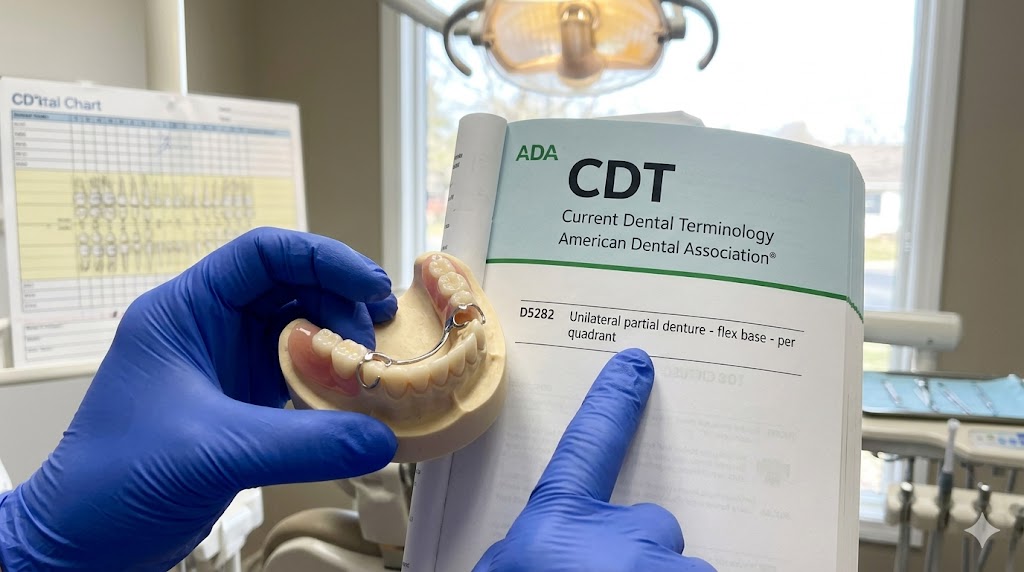
The Correct Code: D5282 – Removable Unilateral Partial Denture
This is the code you need. D5282 is defined by the ADA as a “Removable Unilateral Partial Denture – One Piece Cast Metal, Including Clasps and Teeth.” Wait, does this definition perfectly match the acrylic Nesbit you know? Let’s be precise. The strict definition specifies a cast metal one-piece framework. A classic Nesbit is primarily acrylic with wire clasps. However, in dental billing, D5282 has become the universally accepted and cross-referenced code for any laboratory-fabricated, unilateral, removable partial denture, including an acrylic Nesbit.
The descriptor “one piece cast metal” refers to the most stable, ideal version of this appliance. Insurers understand that acrylic versions serve the same functional purpose and typically process the claim under D5282. You should use this code for a definitive Nesbit partial.
D5710: Rebase – Complete Maxillary Denture
No. This is for full dentures.
D5711: Rebase – Complete Mandibular Denture
No. Also for full dentures.
D5720: Rebase – Maxillary Partial Denture
You would use this if you are rebasing a pre-existing partial, not when billing for the initial fabrication.
D5721: Rebase – Mandibular Partial Denture
Same logic applies here. This is a rebase of a lower partial, not the new appliance code.
D5820: Interim Partial Denture (Stayplate)
This is the code for a provisional or temporary appliance, often given immediately after an extraction while the tissue heals. For billing, a Nesbit can be considered either a definitive unilateral partial (D5282) or a more temporary version (D5820), depending on the clinical intent. We will address this distinction shortly.
Code Clarification Table
| CDT Code | Description | Typical Use Case | Relevance to Nesbit |
|---|---|---|---|
| D5282 | Removable Unilateral Partial Denture – One Piece Cast Metal, Including Clasps and Teeth | Definitive, lab-processed unilateral partial. | Primary code for a standard Nesbit. |
| D5820 | Interim Partial Denture (Stayplate) | Temporary, often same-day, acrylic appliance for aesthetics/healing. | Used for a temporary version, not intended to be a final, durable restoration. |
| D5213 | Maxillary Partial Denture – Cast Metal Framework | Upper, bilateral cast metal partial with acrylic bases. | Not applicable to a unilateral Nesbit. |
| D5214 | Mandibular Partial Denture – Cast Metal Framework | Lower, bilateral cast metal partial with acrylic bases. | Not applicable to a unilateral Nesbit. |
D5282 vs. D5820: Making the Critical Distinction
This is where most of the confusion originates. You have a unilateral, tooth-borne, removable acrylic appliance in your hand. It replaces one tooth. Is it a D5282, or is it a D5820? The code choice depends entirely on the treatment intent and the expected longevity of the appliance.
When to Use D5282 (The Definitive, Unilateral Partial)
Bill D5282 when you intend the appliance to serve as the patient’s defined, long-term solution for the missing tooth. This does not mean it will last 30 years. It means there is no other restorative phase planned imminently. You are making a durable, lab-processed prosthesis. The acrylic is processed using a heat-cure method, creating a denser, stronger, and more color-stable material. The tooth is high-quality denture acrylic, and the clasps are precisely adapted. You expect this appliance to last for several years with proper care.
- Intent: Long-term replacement.
- Material: Heat-processed, high-quality acrylic.
- Lab Process: Full laboratory fabrication, flasking, and processing.
- Patient Expectation: “This is your permanent removable tooth.”
When to Use D5820 (The Interim, Temporary Partial)
Bill D5820 when the Nesbit is a short-term placeholder on the path to a definitive restoration. The most common scenario is an immediate post-extraction appliance. You extract the tooth, and the patient leaves with the replacement tooth already in place. This is purely for aesthetics, comfort, and space maintenance during the 3-6 month healing period. Another scenario is an adolescent patient who will receive an implant when they are older. The appliance is temporary by design. You often make this using a cold-cure or self-cure acrylic, which is not as strong or color-stable as heat-cured acrylic. It is more porous and prone to staining and breakage.
- Intent: Short-term, transitional replacement.
- Material: Often self-cure or cold-cure acrylic.
- Lab Process: Can be a simple sprinkle-on technique or a quick lab process.
- Patient Expectation: “This temporary tooth will get you through the healing phase before we do the implant/crown/bridge.”
Reimbursement and Frequency Limitations
This distinction has financial consequences. Payers know that a D5820 is a less expensive, temporary service. The reimbursement rate is lower. Crucially, many insurance plans have frequency limitations for D5820. They might only cover one interim partial per tooth area in a certain time frame (e.g., 5 years). If you bill a temporary partial when a definitive one is needed, the patient may lose their future benefit for a more permanent appliance.
You must also be aware of the limitation on D5282. Most plans will not reimburse for a new D5282 on the same tooth surface within a 5- or 7-year period. Proper coding protects the patient’s future benefits.
| Factor | D5282 (Definitive) | D5820 (Interim) |
|---|---|---|
| Primary Intent | Long-term tooth replacement. | Short-term placeholder during healing or growth. |
| Material | Heat-cured, dense acrylic. | Often self-cure acrylic. |
| Durability | Higher strength, better color stability. | More porous, prone to fracture and discoloration. |
| Typical Lab Fee | Higher. | Lower. |
| Insurance Reimbursement | Higher fee. Subject to “permanent” prosthesis limitations. | Lower fee. Subject to interim prosthesis frequency limits. |
| Future Plan | No planned definitive restoration in the immediate future. | Definitive implant, bridge, or partial denture planned within 6-18 months. |
Clinical Narratives: The Secret to Claim Approval
You will not get far with a code alone. A D5282 claim for a Nesbit partial will trigger a red flag for many insurance processors. Why? Because a cheaper alternative—a bilateral partial (D5213/D5214)—often exists, or they question the medical necessity of a unilateral appliance. Your narrative, included in Box 35 of the claim form, is your weapon against denial.
What Makes a Powerful Narrative?
A good narrative tells the story of the specific tooth. It doesn’t just say “patient needs partial.” It provides clinical proof of why this specific treatment is the only appropriate option.
Narrative Template for a Unilateral Nesbit Partial
You can adapt this template for your claims. It provides the logical sequence a claims reviewer needs.
Patient presents with a missing tooth #30. Adjacent teeth #29 and #31 are sound, intact, and not scheduled for restorative treatment. The contralateral arch is stable and fully dentate. A conventional bilateral partial denture is not indicated due to the health of the remaining dentition and would constitute overtreatment. A fixed bridge is contraindicated as it would require unnecessary preparation of virgin tooth structure on #29 and #31. An implant is not a current option due to financial considerations. Therefore, a unilateral removable partial denture (Nesbit) is treatment planned to restore masticatory function, prevent mesial drift and supra-eruption, and provide posterior occlusal stability.
Examples of “Good vs. Bad” Narratives
- Bad Narrative: “Tooth #19 missing. Needs Nesbit.”
- Why it fails: It provides no justification. It doesn’t answer the “why this treatment?” question.
- Better Narrative: “Missing #19. Opposing tooth is present. Nesbit to prevent supra-eruption.”
- Why it’s better: It adds a functional reason.
- Best Narrative: “Patient presents with a unilateral edentulous space in the #19 position. Abutment teeth #18 and #20 exhibit sound enamel and dentin with no existing restorations and are caries-free upon radiographic and clinical examination. Placement of a fixed partial denture would violate the structural integrity of these healthy abutments. A single-tooth implant is the ideal treatment but is financially prohibitive for the patient at this time. A conventional cast-metal removable partial denture with a major connector is contraindicated as all other quadrants are intact. D5282, a removable unilateral partial denture, is selected as a conservative, tooth-preserving, and financially viable solution to restore function and stabilize the occlusion.”
- Why it’s best: This narrative systematically eliminates other treatment options with clinical facts. It directly counters the insurance company’s potential arguments.
Navigating the AMA Level II HCPCS Codes (Medical Billing)
You primarily work in a dental office, so CDT codes are your focus. However, sometimes a patient’s medical insurance might be billed for a dental procedure. This happens in cases of trauma, congenital anomalies, or oral surgery related to a medical condition. If you find yourself needing to bill medical insurance for a tooth replacement, you need to understand the HCPCS Level II codes.
HCPCS Codes Relevant to Removable Partials
Unlike CDT codes, medical codes for partial dentures are not as granular. They do not specifically differentiate a unilateral Nesbit from a conventional bilateral partial. You will likely use a broad code and then describe the appliance in the narrative.
- D5876: The primary code for a conventional metal partial denture in a medical cross-coding scenario is often a general code for a partial denture. The exact code can depend on the payer’s local coverage determination.
- L5000: This code describes a “Partial foot, shoe insert with longitudinal arch, metatarsal pad.” No, this is not a joke about your foot. I include this to make a crucial point: never guess a medical code. L5000 is an orthotic/prosthetic code. Confusing dental and medical codes will lead to immediate denials.
- General Prosthetic Codes: You might use a general code for a “maxillofacial prosthesis” if the tooth loss is due to a congenital condition or surgical resection, but this is far beyond the scope of a simple Nesbit.
The Reality of Medical Billing for a Nesbit
In my experience, billing medical insurance for a standard Nesbit partial is exceptionally rare and rarely successful. Medical payers see tooth replacement as a dental service. Unless the tooth loss is directly tied to a covered medical trauma or a congenital craniofacial anomaly, the claim will be denied. Stick to the CDT code. Your expertise is in oral health, and the dental code set is designed for your workflow. Attempting to force a medical code for a purely dental restorative service is a recipe for frustration and administrative waste.
Step-by-Step: How to Build a Clean Claim for D5282
Let’s get practical. You are holding the completed Nesbit partial and the patient is scheduled for delivery. Your claim needs to be perfect. Here is a checklist.
- Verify Patient Eligibility and Benefits.
Do not skip this step. Call the insurer. Ask specifically about coverage for major restorative services, Class IV prosthodontics, or, most precisely, “unilateral partial dentures, code D5282.” Find out the frequency limitation (once per 5 years? 7 years?). Know the patient’s deductible, co-pay percentage, and annual maximum remaining. A claim for a major procedure hitting a depleted annual maximum is a waste of your time. - Use the Correct Diagnosis Code.
On a dental claim, you often code the condition. While not always required by all payers, using the correct ICD-10 code on your claim strengthens its clinical validity. The most applicable codes for a single missing posterior tooth are:- K08.419: Partial loss of teeth due to trauma, unspecified class.
- K08.429: Partial loss of teeth due to caries, unspecified class.
- K08.439: Partial loss of teeth due to periodontal disease, unspecified class.
Select the code that matches the original reason for the tooth extraction.
- Attach a Digital Radiograph.
A picture is worth a thousand words. A bitewing radiograph clearly showing the single edentulous space with healthy, unrestored abutment teeth powerfully supports your narrative. It proves that a bridge would violate healthy tooth structure and that the remaining dentition is intact, negating the need for a bilateral partial. - Include Your Persuasive Narrative.
Use the “Best Narrative” template from the previous section. Type it cleanly into the remarks field (Box 35 on the 2019 ADA Claim Form). Make the processor’s job easy. - Attach a Copy of the Signed Laboratory Prescription.
This is an often-overlooked but powerful tool. Your lab slip shows the exact instructions, proving a custom, lab-fabricated device was made. It helps justify a higher fee compared to a simple, in-office processed temporary. - Keep a Comprehensive Informed Consent Form in the Patient’s Chart.
While you don’t submit this with the claim, a signed form specifically mentioning the risks of a small, removable unilateral appliance (especially aspiration) is vital if a medical emergency occurs and a medical claim needs to be filed subsequently.
The Patient Conversation: Setting Expectations on Cost
You will be the one to present the treatment plan. The financial conversation can be awkward, but it is critical for a healthy practice. The code D5282 represents a definitive service, and your fee should reflect the lab cost, your chair time, and the value of the restoration. Be transparent.
“Based on your unique situation, losing a single back tooth, the most conservative way to replace it is a removable partial we call a ‘Nesbit.’ It clips onto the teeth next to it and will stay in place to let you chew. For the billing, we use the dental code D5282 for a unilateral partial denture. Your insurance estimates they will cover a certain amount, and your estimated out-of-pocket portion is [Amount]. This is a durable, lab-made appliance designed to last for several years. It is not a temporary flipper. We will review all care instructions and risks at the delivery appointment.”
This clear, three-sentence approach defines the appliance, defines its permanence, and gives the financial picture without using jargon like “D5282” until you need to.
Potential Complications and How to Address Them in Your Records
The Nesbit partial is a legitimate and useful dental appliance, but you know it is not without its risks. Documenting these conversations protects you and informs the patient.
Aspiration or Swallowing Risk
This is the most significant acute risk. The appliance is small. A loose or ill-fitting clasp can allow it to dislodge during sleep or eating. Your informed consent must explicitly state that the patient understands this risk and agrees to keep the appliance secure and out of reach of sleeping hours if there is any doubt. If a patient has a history of neuromuscular issues, a severe gag reflex, or cognitive decline, the Nesbit is likely contraindicated. Document that discussion.
Periodontal and Abutment Tooth Stress
Clasps on natural teeth collect plaque. They also create torquing forces. You must tell the patient that meticulous home care around the abutment teeth is non-negotiable. If they return for hygiene visits with red, puffy tissue around the clasps, you have a path to reinforce the message. You also need to note that long-term use can lead to mobility of the clasped teeth. This is why you described it as a “definitive” solution for this phase of their life, but perhaps not a lifetime solution.
Breakage of the Acrylic
The appliance will break if dropped on a hard floor. The tooth may pop off. A standard repair of a fractured acrylic base falls under a different code (D5510, repair of broken complete denture base, or D5620 repair cast partial framework, though D5620 is technically for metal). For an acrylic Nesbit, you would likely use D5520, “Repair broken complete denture base – per unit.” It’s important to note this for the patient so they are not surprised by a separate fee if an accident occurs.
Important Note for Patients: A Nesbit partial is a medical device, not just a piece of plastic. You should treat it with the same care you would give an expensive pair of eyeglasses. Always store it in water or a denture case when not in your mouth. Never wrap it in a tissue, as that is the number one reason these get accidentally thrown away. A replacement can be costly, as it involves a new impression, a new lab prescription, and a new D5282 billing cycle. You are responsible for its safekeeping.
The Future of Partial Denture Design and Coding
Dentistry is not static. Digital workflows are changing how we make even simple removable partials. You might scan an arch with an intraoral scanner and send the STL file to a lab that 3D-prints the Nesbit partial in a flexible, bio-compatible resin. This digital workflow is incredibly exciting for patient comfort and precision.
How does this affect coding? The end result is still a removable, tooth-borne, unilateral partial denture. As of the current CDT code set, the material of fabrication (whether traditional heat-cured acrylic, cast metal, or 3D-printed resin) does not change the base code. You still use D5282. The code describes the type and purpose of the appliance, not the manufacturing method. You should not create a new, unlisted code for a digitally made Nesbit. Always use D5282 and detail the digital fabrication method in your lab prescription and clinical notes. If, in the future, a separate code for digitally fabricated removable partials is introduced, it will be published in the annual CDT manual. For now, D5282 is your correct and only choice for a definitive unilateral partial.
Frequently Asked Questions About the Nesbit Partial Code
Q: Can I use D5282 for an anterior tooth?
A: Technically, D5282 is for a removable unilateral partial denture, and the code does not specify an arch location restriction in a way that excludes anterior teeth. However, the classic “Nesbit” is a posterior appliance. For an anterior tooth, the design is often a “flipper” (interim partial denture, D5820) or a small, tooth-borne partial. If you are making a definitive, lab-processed, unilateral anterior partial with clasps, D5282 is the most accurate code. You must explain the unconventional use clearly in your narrative, noting the clinical reasons for not choosing a more conventional fixed or removable bilateral prosthesis.
Q: What if the patient has two single missing teeth on different sides? Can I bill two D5282s?
A: No. Two separate edentulous spaces in different quadrants constitute a bilateral condition. Billing two separate unilateral partials would be incorrect, as the standard of care is a single bilateral appliance (D5213 or D5214). It would be an unbundling of services. The only exception would be an extremely compelling clinical reason, documented with radiographs and a lengthy narrative, proving that a single bilateral appliance is anatomically or medically contraindicated. Prepare for an almost certain denial if you attempt this.
Q: My lab bill says “acrylic partial.” Is that a D5282?
A: Not necessarily. The lab is describing the material, not the code. An “acrylic partial” can be a unilateral Nesbit (D5282), a temporary flipper (D5820), or even a full acrylic bilateral partial. You must determine the clinical intent. If it is a definitive, unilateral appliance replacing a posterior tooth, D5282 is correct. If it is a temporary placeholder before an implant, it is D5820.
Q: The insurance paid the claim but downcoded it to D5820. What should I do?
A: This is a common insurer tactic. They are saying, “We acknowledge a service was provided, but we deem it a temporary one.” If your clinical intent and records clearly support a definitive D5282 appliance (a heat-cured, durable partial with no planned definitive treatment), you should appeal. Send the lab prescription showing heat-cured processing, a clinical photo of the definitive appliance, and a fresh narrative re-stating the long-term treatment plan. Your fee for a definitive service is higher than a temporary one, and you deserve the proper reimbursement.
Additional Resource
For the most current and official information on CDT codes, including any future revisions or clarifications to D5282, refer directly to the source: the American Dental Association’s online resource at https://www.ada.org/en/publications/ada-catalog/cdt. This is the authoritative, up-to-date guide for every dental billing professional.
Conclusion
The correct ADA dental code for a definitive Nesbit partial is D5282, representing a removable unilateral partial denture. The key to successful claims lies in distinguishing this definitive, lab-processed appliance from a temporary interim partial (D5820) based on clinical intent and material. A powerful, detailed narrative that justifies why a bilateral appliance or a fixed bridge is contraindicated remains the single most effective strategy for securing insurance approval and delivering uncompromised patient care.
Disclaimer
This article provides information on dental coding based on the current CDT code set and standard billing practices. It is intended for educational purposes only. Coding requirements, insurance coverage policies, and reimbursement rates vary significantly between payers and plans. You should always verify specific patient benefits, frequency limitations, and medical necessity documentation requirements with the individual insurance carrier before initiating treatment. The information presented here does not constitute legal or professional billing advice. You must use your independent clinical and professional judgment when selecting procedure codes and preparing claims. No guarantee of payment is implied.
FAQ
What is the main difference between a Nesbit partial and a standard partial denture?
A Nesbit partial is unilateral, replacing teeth on just one side of the arch and clipping to adjacent teeth. A standard partial is bilateral, using a metal framework that crosses the palate or floor of the mouth for stability, replacing teeth on both sides.
Is the ADA code for a Nesbit partial the same for upper and lower teeth?
Yes, the CDT code D5282 is used for a definitive, unilateral partial in both the maxillary (upper) and mandibular (lower) arch. There are no separate codes for the upper and lower versions of this specific appliance.
Can a Nesbit partial be considered a permanent tooth replacement?
While it can be a long-term, definitive solution under the D5282 code, it is not truly permanent in the way an implant is. It is a durable, lab-processed removable appliance intended to last for years, but it is distinct from a provisional or temporary “flipper.”
Why does my insurance require a narrative with the D5282 code?
Insurers often require a detailed narrative because a unilateral partial is a less common and less stable solution. They need to know why a conventional bilateral partial (which engages more teeth for stability) or a fixed bridge is not a more appropriate and cost-effective treatment in their view. Your narrative proves medical necessity.