
can you have invisalign in the military
Straightening your teeth while serving your country involves a unique set of rules. You cannot simply walk into a civilian dentist and start treatment. The military views elective medical procedures through a very specific lens: readiness. If you are an active-duty member, a reservist, or a future recruit, you need to understand exactly how clear aligner therapy fits into a military career.
This guide breaks down the reality of getting treatment with transparent dental trays while in the Army, Navy, Air Force, Marine Corps, and Coast Guard. We leave no question unanswered. We look at the rules for boot camp, the realities of deployment, the financial obligations, and the strict chain of command you must follow.
We have structured this information to serve as your primary roadmap. You will find precise policy breakdowns, direct comparisons between military and civilian treatment paths, and honest discussions about the risks. By the end of this deep dive, you will have absolute clarity on whether pursuing treatment is possible, advisable, or strictly forbidden during your specific phase of service.
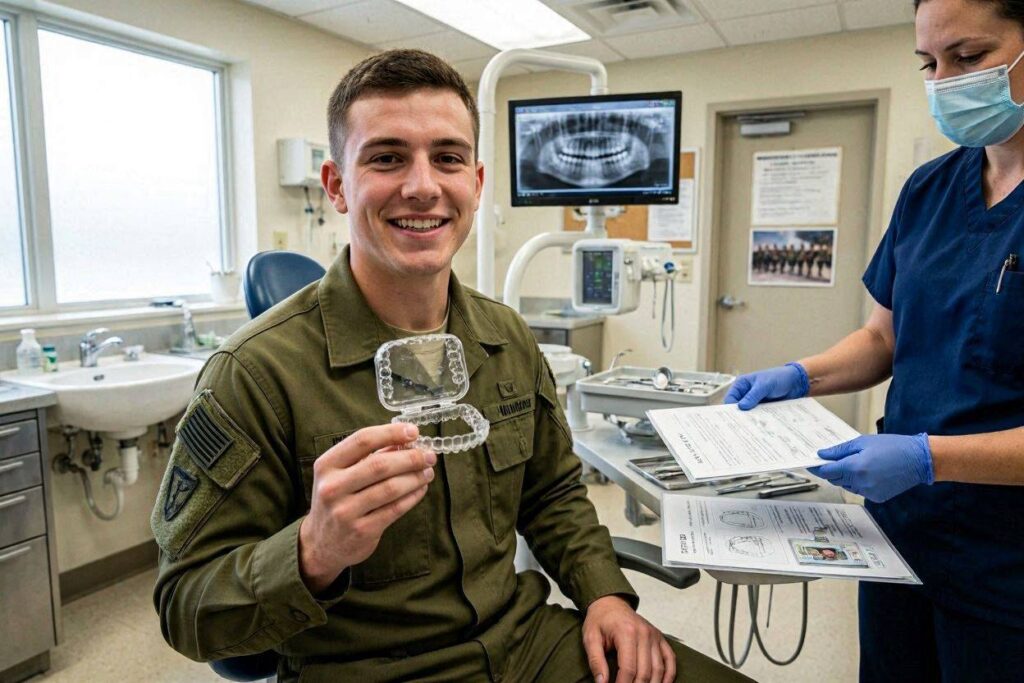
Understanding the Military’s Stance on Elective Dentistry
The military health system exists to maintain a fighting force. It does not operate like a civilian insurance provider whose primary goal is individual well-being. The standard is “dental readiness.” A service member is dentally ready when they are free of emergency conditions likely to cause pain or infection within twelve months. Cosmetic preference and mild to moderate malocclusion rarely fall into this category.
Military dentists focus on restorative care. They fill cavities, perform root canals, and treat gum disease. Orthodontic treatment, whether with brackets and wires or transparent aligners, falls under elective care. This classification triggers a cascade of administrative hurdles. You cannot schedule elective treatment without command approval. You cannot initiate care that might make you non-deployable without a clear plan and waiver.
Transparent aligner systems like Invisalign occupy a gray area in military policy. They are orthodontic appliances. Policy treats them with the same suspicion as traditional braces. However, their removable nature introduces both advantages and significant operational risks. A commander may view the need to remove trays before eating as a minor inconvenience or an unacceptable distraction in a field environment. Understanding this tension between personal health goals and operational necessity forms the foundation of your journey.
Dental Readiness Classes: Where Do You Stand?
The Department of Defense assigns every service member a dental classification. These classes dictate your deployability. Your class status directly impacts whether you can even request orthodontic treatment.
- Class 1: You have a healthy mouth. No treatment is required. You are worldwide deployable.
- Class 2: You have minor conditions. Your oral health is good, but you need routine cleaning or small fillings. You are deployable.
- Class 3: You have urgent or emergency conditions. You need treatment immediately. You are not deployable until you resolve the issue. Active orthodontic treatment often puts you here.
- Class 4: You have not had a dental exam in the required timeframe. Your status is unknown. You are generally not deployable until you complete the exam.
Most recruits start as Class 2. Service members with untreated cavities or gum disease fall into Class 3. An orthodontic patient actively moving teeth will almost always hold a Class 3 designation during the active movement phase. The military treats any risk of broken brackets or lost aligners as a potential emergency. A service member with a mouthful of shifting teeth because they lost a tray in the field becomes a liability. Commanders want their people in Class 1 or Class 2. This simple reality explains most of the resistance you will encounter.
Can You Join the Military with Invisalign?
We must address the recruitment phase first. If you are currently wearing transparent aligners and plan to enlist or commission, you face an immediate obstacle. You cannot ship to initial entry training with active orthodontic appliances in your mouth. This rule is nearly universal across all branches.
The MEPS Physical and Dental Screening
The Military Entrance Processing Station (MEPS) provides a thorough medical and dental screening. Doctors and dentists examine you to determine your fitness for service. They look for disqualifying conditions. Active orthodontic treatment, including Invisalign, is disqualifying for entrance into active duty.
The reasoning is straightforward. Basic training is an intense, controlled environment. You do not have the time, privacy, or sanitation facilities to manage clear aligner trays. You eat in a mess hall with strict time limits. You spend weeks in the field. A dental emergency caused by lost or broken orthodontic equipment pulls a recruit away from training. The military cannot recycle a recruit endlessly due to a preventable elective issue.
You have two options. You can finish your orthodontic treatment entirely and receive the final retainer before you ship. Your orthodontist must write a letter confirming that active treatment is complete and that no appliances remain bonded to your teeth. You will typically need to provide this documentation to the MEPS dentist. The second option is to have your orthodontist remove the attachments and halt treatment. You stop wearing trays. You accept that your teeth may shift back. This is a hard choice, but many have made it to pursue a calling in service. You can always resume treatment after you reach your first permanent duty station.
A Note on Delayed Entry Programs
Some individuals sign a contract and enter a delayed entry program (DEP). They commit to shipping at a future date, sometimes months later. If you are in the DEP and currently wear aligners, you must still complete or halt treatment before your ship date. The standard at the actual departure for basic training is the only one that matters. Do not assume you can finish “just a few more trays.” The military does not grant waivers for a few remaining aligner weeks. You either finish fully or stop cold turkey.
Active Duty Orthodontic Policies Across All Branches
Once you reach your first permanent duty station, the landscape changes. The military may now pay for your treatment, or you may receive permission to pursue private treatment. The rules differ sharply between the branches. We examine each one in detail. The central question is always: “Can you have Invisalign in the military while serving on active duty?” The answer is yes, but with severe restrictions.
Army Guidelines for Clear Aligner Therapy
The Army provides the most structured pathway for orthodontics. Army Regulation 40-35 and the Army Dentistry Policy govern care. The Army uses a scoring system to determine eligibility. A military orthodontist evaluates your teeth using the Handicapping Labio-Lingual Deviations (HLD) index. This index measures the objective severity of your malocclusion. A high score indicates a functional problem. A low score indicates a cosmetic concern.
The Army only provides funded treatment for soldiers who score above a specific threshold. The cases must be genuinely handicapping. A slight gap between your front teeth will not qualify. A severe overbite, a crossbite that causes jaw pain, or crowding that makes hygiene impossible might qualify. If you score too low for military-funded care, the Army will not pay a dime. You may, however, seek civilian treatment at your own expense.
Command approval remains non-negotiable. You must inform your chain of command. Your commander signs a form acknowledging that you understand the risks, the potential for non-deployability, and the financial responsibility. If the military is paying, the Army orthodontist will discuss treatment options. If Invisalign is clinically appropriate for your case, the military provider may offer it. They choose the system. They do not automatically default to traditional braces. Digital scanning technology has made its way into Army clinics, and some providers embrace the removable tray approach for compliant soldiers.
If you go the private route and pay cash, you must still coordinate with a military dentist. A civilian orthodontist will want to bond attachments to your teeth. The military dentist must agree that the presence of these attachments does not compromise your dental readiness or create a risk you cannot manage. You will sign a waiver acknowledging that the military bears no responsibility for the private treatment. You must maintain perfect hygiene. The Army will not tolerate decay caused by careless aligner wear. A note of caution: field exercises in the Army can last thirty days or more. You must develop a plan to clean and store your trays in austere environments.
Air Force Rules on Invisalign Treatment
The Air Force often shows more willingness to embrace elective care, but the core restrictions remain. The Air Force Instruction 44-102 governs medical and dental care. The Air Force categorizes orthodontics as elective. They also use a severity index to approve care at military dental clinics. The Air Force orthodontic specialists evaluate airmen using the same HLD index.
The Air Force dental service generally restricts active orthodontic care, including Invisalign, for airmen who have less than twelve months of retainability at their current base. You must have enough time on station to complete the active phase of treatment before you receive a permanent change of station (PCS) order. Orthodontists hesitate to start treatment on a patient who might leave in six months. Transferring care between military providers is difficult and often results in delays and compromised results.
If you qualify, the Air Force dentist will explain the options. In some cases, a base dental clinic can provide clear aligners directly through military lab services. More often, they issue a referral to a civilian network provider through the TRICARE Active Duty Dental Program. This referral is only for funded, approved cases. You cannot simply demand a referral because you want straighter teeth. If the Air Force denies your request for funded treatment, you can pay out-of-pocket, following the same command notification and waiver process as the Army.
Air Force deployments present a particular challenge. Airmen often deploy to established bases with running water and reliable electricity. This makes aligner care easier compared to Army infantry deployments. Yet you still face twelve-hour shifts in a flight suit. You need to manage your trays during meals in a dining facility. Operational tempo (optempo) in the Air Force is high. Aircrew members have additional restrictions. A pilot wearing aligners must ensure the trays do not interfere with oxygen mask fit or communication clarity. A flight surgeon will likely need to clear the treatment plan.
Navy and Marine Corps Standards
The Navy provides dental care to sailors and Marines. The Bureau of Medicine and Surgery (BUMED) sets the orthodontic policy. The Navy, like the Army, uses a severity index. The bar is high. Navy dentists prioritize sailors who serve on ships. Life on a ship complicates aligner wear. The tight quarters, limited sink access, and unpredictable schedule work against the discipline required for successful Invisalign therapy.
The Navy often views removable orthodontic appliances with suspicion for sailors assigned to sea duty. If you drop a tray on the deck, it is gone. If you lose your case in a rack, you have no backup. Shipboard dentists have seen aligner patients fail. They may therefore prefer traditional fixed braces for sailors they treat. The brackets are locked on. You cannot lose them. You maintain them with meticulous hygiene, but the appliance does not depend on your constant attention.
The Marine Corps presents the harshest environment for clear aligner therapy. Marines operate in the field. They train dirty. They go without showers for weeks. The Marine Corps ethos of readiness makes any elective treatment a hard sell. A Marine infantryman may find it nearly impossible to maintain aligner hygiene during a combined arms exercise or a deployment to a remote location. The Corps will likely not fund cosmetic orthodontics for Marines. They must have a severe functional problem to gain approval. Even then, military providers may recommend traditional braces over removable trays for durability. A Marine who pays privately must have a frank conversation with their platoon sergeant and commander about the realities of field hygiene. You cannot put dirty hands in your mouth without risking infection. You cannot skip meals because you fear removing your trays in a tactical environment.
Coast Guard Orthodontic Pathways
The Coast Guard operates under the Department of Homeland Security during peacetime but abides by military dental readiness standards. The Coast Guard dental clinics function similarly to Navy clinics. They use a priority system based on operational necessity. Orthodontic treatment is available for severe, handicapping conditions that affect a member’s ability to perform duties.
Coast Guard cutters present challenges identical to Navy ships. Port calls offer a chance to clean trays thoroughly, but underway periods demand strict discipline. The Coast Guard often moves members between small, remote units. The continuity of orthodontic care can break if the member transfers from a sector with a large clinic to a small boat station with only a part-time dentist. The Coast Guard generally encourages members to seek treatment only if they can complete it at one duty station. Transferring orthodontic care as a military member always creates friction. The Coast Guard’s small size and dispersed footprint magnify this friction.
Step-by-Step: How to Request Invisalign Through Your Chain of Command
Navigating the bureaucracy requires patience and attention to detail. You must follow a specific sequence. Cutting corners leads to a denial at best and non-judicial punishment at worst. The military chain of command does not appreciate surprises about medical or dental issues that affect unit readiness.
Step 1: The Initial Dental Exam and Consultation
Your journey begins in the dental chair. Schedule a routine examination with your base dental clinic. Do not immediately ask about Invisalign when the hygienist calls you back. Let the dentist complete the exam. When the dentist asks if you have any concerns, state clearly that you are interested in orthodontic evaluation. Explain that you believe your teeth alignment affects your ability to chew, causes jaw pain, or creates hygiene problems. Focus on function. Do not frame your request around cosmetic desires like wanting a “perfect smile.” The military system responds to medical necessity, not aesthetic preference.
The military dentist will assess your dentition. They may take panoramic X-rays. They will document your Class status. The dentist will provide an honest opinion about whether you might qualify for a referral based on the severity index. If the dentist sees a clear qualifying case, they will initiate a referral to the nearest military orthodontist or to a civilian network provider. If they believe you do not meet the threshold, they will tell you. At that point, you can shift to the private-pay option.
Step 2: The Orthodontic Evaluation and Treatment Plan
If you receive a referral, the specialist conducts a full examination. This includes photographs, digital scans or impressions, and cephalometric analysis. The orthodontist produces a treatment plan. This plan specifies the estimated duration, the number of trays, and the expected outcome. The orthodontist states whether Invisalign or fixed braces suit your case better.
If the military is funding the treatment, the orthodontist submits the plan for approval. This administrative step confirms that the case meets severity requirements and that funds are available. If the military denies funding, you receive that determination in writing. You then decide whether to pursue private treatment. You must obtain a copy of the treatment plan to take to a civilian provider. This step ensures the civilian orthodontist understands any unique military requirements.
Step 3: Command Notification and the Elective Treatment Waiver
This step is the most critical. You must draft a memorandum for your commander. The memo explains that you seek elective orthodontic treatment. It states whether the military or you will fund it. It lists the estimated duration. It explicitly addresses the impact on your deployability. You must acknowledge that you will enter a Class 3 dental status during active treatment. You must state that you accept the responsibility for any complications.
Your commander will review the memo. They may ask you questions. They will assess your position within the unit. An intelligence analyst with a stable desk job may receive swift approval. A Special Forces candidate with an upcoming selection course may receive a firm denial. The commander’s primary concern is unit readiness. If they believe your treatment creates a risk, they will deny the request. A denial is lawful. The military does not guarantee you access to elective procedures. You must accept the commander’s decision. Attempting to bypass the chain of command constitutes a serious offense.
Step 4: Treatment Initiation and In-Processing Documentation
Once you have command approval and a treatment plan, the clinical work begins. The civilian or military provider bonds the composite attachments to your teeth. You receive your first set of trays. You must immediately return to the military dental clinic. You inform them that you have started treatment. The dental technician updates your records to reflect your new Class 3 status and adds notes about your specific situation. This is critical. If you deploy without updating your records, you risk being separated from your unit for a condition you failed to report.
You must also provide a copy of your treatment plan to your unit’s medical readiness NCO. This non-commissioned officer tracks the medical and dental status of every soldier, airman, sailor, or Marine. They ensure the commander always knows who is deployable and who is not. Keep them informed of any changes in your treatment, such as an extended timeline.
Deployment and Field Exercises: The Crucial Reality Check
The pristine environment of a dental clinic does not resemble a deployment. You must plan for the worst-case scenario. The military sends you places with dust, mud, and limited clean water. You will experience irregular sleep schedules and high stress. In these conditions, meticulous tray hygiene becomes a genuine challenge. Failing to meet the challenge leads to rapid tooth decay, gum infection, and a failed orthodontic outcome.
Hygiene in Austere Environments
You may live in a tent for nine months. The nearest sink might be a hundred meters away. You need to carry a deployment hygiene kit specifically for your aligners. This kit includes a sturdy case with a mirror, a small bottle of antibacterial hand soap, a collapsible cup, and a separate toothbrush for cleaning trays. Never use bottled drinking water to rinse your trays in a water-scarce environment. Use potable water from a designated source. Do not scrub the trays with toothpaste in the field. Toothpaste is abrasive and will cloud the plastic, making the trays more visible.
You must establish a ritual. Every time you eat, you wash your hands first. You remove the trays and place them immediately in the case. You never wrap them in a napkin. You never put them in your pocket. After eating, you rinse your mouth vigorously, clean the trays carefully with the dedicated brush and clear soap, and reinsert them. This process takes discipline under fire. Late-night meals, sudden alerts, and sheer exhaustion will test your commitment. If you cannot maintain this standard, you should not deploy with active orthodontic treatment. Discuss with your orthodontist the possibility of pausing treatment and wearing a passive retainer until you return.
Managing Attachments in the Field
The small composite buttons bonded to your teeth create friction points. They make flossing more difficult. In the field, you may skip flossing for a day or two, but plaque accumulates rapidly around attachments. You risk developing white spot lesions, which are permanent areas of decalcification. You must pack floss threaders or interdental brushes. You must clean around each attachment meticulously, even when exhausted.
An attachment may break. A hard piece of field rations or an accidental knock can shear a composite button off. If you lose an attachment, the tray no longer exerts the correct force on that tooth. Your treatment deviates from the plan. You need to document the loss. Inform your unit medic or corpsman. Report to a dentist as soon as possible. The military dentist may be able to replace the attachment if you have the proper materials available, which is unlikely in a forward operating base. More likely, you will receive instructions to continue wearing the tray and follow up when you return to a larger base. The setback prolongs your treatment.
The Non-Deployable Status Problem
Active orthodontic patients are generally non-deployable unless a specific waiver exists. This status creates resentment in a unit. Your fellow service members must shoulder your workload. The commander balances the unit’s mission against your personal choice to straighten your teeth. Some commanders flatly refuse to allow orthodontic treatment for soldiers in deploying units. They have the authority to do so. You may need to wait until your unit returns from deployment to begin treatment.
If you are approved for deployment while in treatment, you need a large supply of trays that cover the entire deployment period plus a buffer. Your orthodontist must agree to release this many trays at once. Some civilian providers hesitate because they want to monitor progress more frequently. You must negotiate this before you start treatment. The military will not ship aligner trays to a combat zone via special logistics. You take what you need with you. If you lose them, you are out of luck.
Financial Reality: Who Pays for Your Straight Teeth?
Military orthodontic benefits are not generous. The system funnels resources to the most severe cases. Most service members who want Invisalign will pay for it out of their own pocket. Understanding the financial landscape prevents disappointment and debt.
TRICARE and Active Duty Dental Program (ADDP)
The TRICARE Active Duty Dental Program covers medically necessary orthodontic care for active duty members. “Medically necessary” means the condition meets the HLD index threshold. The insurance does not cover treatment for cosmetic purposes. The ADDP uses network civilian providers when base facilities cannot provide the care. If a military orthodontist determines that your case qualifies, the treatment is fully funded. You pay nothing out of pocket for the Invisalign trays or the fixed braces. This includes retainers at the end of treatment.
This fully funded path is exceptional. It exists for severe overbites, underbites, crossbites, and extreme crowding that impairs function. A slight diastema, a gap between your two front teeth, does not qualify. The military orthodontist is the gatekeeper. Their professional judgment is final. You cannot appeal to TRICARE as a civilian would appeal to an insurance company. The system is internal to the military.
Out-of-Pocket Costs: The Civilian Provider Route
If the military deems your case cosmetic, you join the majority of service members who pay privately. You can visit any civilian orthodontist. The cost of clear aligner therapy varies by region and case complexity. You can expect to pay between three thousand and seven thousand dollars. Some civilian providers offer a military discount. Always ask. This discount recognizes the financial constraints of junior enlisted pay grades.
You must pay the full cost. The military will not reimburse you later. Some dental discount plans marketed to military families offer minor reductions, but they do not change the fundamental reality. This is a significant financial commitment for an E-4 or O-2. You should consider it only if you have no high-interest debt and a solid emergency fund. The worst outcome is beginning treatment and then facing a financial emergency that forces you to stop wearing aligners. Your teeth would regress, and you would lose your entire investment.
Here is a breakdown of potential costs you might encounter on the private-pay path:
| Cost Item | Estimated Range | Notes |
|---|---|---|
| Initial Consultation & Records | $0 – $300 | Many civilian orthodontists offer free initial exams for military. |
| Comprehensive Invisalign Treatment | $3,500 – $7,500 | Includes all trays, attachments, and monitoring for a standard case. |
| Case Complexity Surcharge | $500 – $1,500 | Applied for severe crowding or bite issues requiring longer treatment. |
| Replacement Trays (Lost/Damaged) | $100 – $300 per tray | A critical cost in military life where loss is more likely. |
| Final Vivera Retainers (Set of 4) | $400 – $800 | Essential for maintaining results after active treatment. |
| Accelerated Orthodontic Add-Ons (e.g., Propel) | $500 – $1,000 | Rarely advisable for military due to invasiveness and follow-up needs. |
The responsibility for payment rests solely with you. Do not begin treatment unless you have a clear plan to cover the full cost, even if you receive unexpected PCS orders or separate from service. Understand that a civilian orthodontist near a military base is familiar with sudden deployments and transfers. Ask the office manager how they handle cases when a patient must move mid-treatment. Some will transfer your digital scans to a new provider at your next duty station. You will likely pay a transfer fee and the new provider may charge for a new clinical exam and any remaining treatment.
The Invisalign vs. Traditional Braces Decision in Uniform
Military life adds weight to a decision that civilians often make based purely on aesthetics. You must consider operational practicality. Removable trays offer a sleek appearance but demand personal accountability. Fixed braces are highly visible but soldier-proof. The military dentist or your private orthodontist will guide you, but you should understand the trade-offs before you sit in the consult chair.
Key Factors in the Military Context
The choice between clear aligners and metal braces is not a simple lifestyle preference. It is a readiness decision. A special operations soldier will almost always find a commander and dentist recommending against clear aligners. The risk of loss, the hygiene difficulty in a hide site, and the need for constant discipline make fixed braces a more reliable, if less comfortable, option.
A staff officer working in the Pentagon faces a completely different reality. They have a private office, access to a bathroom with running water, and a predictable schedule. For them, clear aligners offer a discreet way to achieve orthodontic correction without the visual impact of metal brackets in a professional meeting with senior leaders. The removable nature allows them to eat during official dinners without trapping food in brackets.
Comparative Analysis for Service Members
To help you visualize the decision, we compiled a direct comparison. This table weighs the specific demands of military life against each treatment type.
| Feature | Invisalign (Clear Aligners) | Traditional Braces (Metal/Ceramic) |
|---|---|---|
| Visual Profile | Nearly invisible. Preferred by senior NCOs and officers in public-facing roles. | Highly visible. “Brace face” stigma persists, but compliance is automatic. |
| Hygiene in the Field | Extremely difficult. Requires clean hands, safe water, and case for every meal. High risk of decay if discipline fails. | Difficult but passive. You brush and floss around brackets. No parts are removed and lost. |
| Risk of Loss/Damage | High. Trays are easily lost, cracked, or contaminated in tactical environments. You are dead in the water without them. | Low. Brackets can debond but remain attached to the wire. The appliance is always working. |
| Pain & Irritation | Mild to moderate. No soft tissue cuts from wire poking. Preferred for those doing combatives or contact training. | Higher. Ulcers from brackets and poking wires are common. Dental wax is a constant companion. |
| Emergency Dental Risk | Trays lost = immediate cessation of active force. Teeth may shift rapidly. Class 3 status complicated. | Bracket popped off or wire poking = non-emergent but painful. Easily temporarily fixed in field. |
| Commander Perception | Can be seen as high-maintenance. “Why does this soldier need special bathroom breaks?” | Understood as a fixed medical device. More likely to be accepted as standard treatment. |
Special Circumstances: Reserves, National Guard, and Separating Members
The rules extend beyond active duty. Reserve and Guard members navigate a hybrid world of military expectation and civilian freedom. Those preparing to leave service face a unique opportunity window.
Reservists and National Guard Members
You may not be on active duty, but you are subject to the Uniform Code of Military Justice during drill weekends and annual training. Your dental readiness status still matters. You are required to maintain deployable dental health. If you begin civilian orthodontic treatment during your civilian time, you must still report it to your unit.
Imagine you start Invisalign as a civilian. Your orthodontist bonds attachments to your teeth. You then report for your two-week annual training at Fort McCoy. You are now in a field environment. Your commander did not know you had attachments on your teeth. The readiness NCO did not update your records. You suddenly present a dental readiness problem. This is a failure to communicate. You must notify your unit medical section as soon as you start treatment. The simple act of sending an email with a copy of your treatment plan protects you.
During your active duty periods, you must adhere to all operational rules. You must maintain hygiene. You must carry your case. If you deploy, you fall under the same restrictions as an active-duty member. The fact that you started as a “civilian” holds no weight in theater. You may find that your Guard unit denies you deployment or sends you home early if your orthodontic status cannot be resolved. Guard and Reserve members must be especially careful about the timing of treatment relative to upcoming mobilizations.
The Separation and Transition Window
If you plan to separate from active duty within six to twelve months, you have a strategic decision to make. You can delay starting private orthodontic treatment until you have transitioned fully into civilian life or your new veteran status. This approach eliminates all the military bureaucratic obstacles. You can begin treatment without command approval, without waiver forms, and without the threat of sudden deployment derailing your plan.
However, some separating members want to exploit their final months of TRICARE coverage or access to base dentists. Active duty dental benefits end on your separation date. If a military orthodontist has approved you for treatment, the military will not start a new funded case if you cannot complete the active phase before you separate. They do not start what they cannot finish. If you are already in treatment and paid privately, you can continue. You simply transfer your records to a civilian provider after you take off the uniform for the last time.
A wise approach is to get a final military dental exam, request a copy of your panoramic X-ray, and ask for any digital scans. Take these records to a civilian orthodontist. You will save on initial records fees. Start your Invisalign treatment thirty days after you separate. The freedom of civilian life allows you to focus on your smile without the Sword of Damocles that is a last-minute deployment order.
Potential Pitfalls and How to Navigate Them
Medical and dental situations in the military are fraught with risk. The system often burdens the individual with consequences for administrative gaps. You must be your own advocate.
The PCS (Permanent Change of Station) Nightmare
You start Invisalign at Fort Liberty. You are on tray ten of forty. You receive orders for Joint Base Lewis-McChord. You report in ninety days. This scenario breaks orthodontic care regularly. Military-funded care is slightly easier to transfer. The losing military clinic communicates with the gaining military clinic. However, military dentists often dislike taking over another provider’s active case. The new dentist may disagree with the treatment plan.
For private-pay patients, the burden is entirely on you. You must find a new Invisalign provider in Washington state who will accept a transfer case. You contact the new provider before you move. You send them your records. You ask bluntly about transfer fees. Some orthodontists refuse transfer cases from other doctors. They want to start from their own clinical diagnosis. This means a new set of scans and possibly repaying for part of the treatment. You may face a bill of several thousand dollars to complete treatment that was “almost paid off” at your last location. Invisalign’s proprietary system does allow for transfer within its network, but the clinical oversight changes. Always budget an extra two thousand dollars for a potential PCS-related transfer if you are in a high-mobility military occupational specialty.
Sudden Deployment Orders
You are a privately paying patient wearing Invisalign. Your unit receives a no-notice deployment order. You have thirty days to prepare. Your civilian orthodontist cannot provide forty weeks of trays on a moment’s notice. The trays are fabricated in a lab and shipped in batches. You may only have four or six weeks of trays in hand.
You must immediately request an emergency appointment. Explain the situation bluntly. The orthodontist may agree to order an accelerated batch from Invisalign’s lab, citing a hardship. Invisalign can sometimes expedite. If they cannot, you may have to switch to a passive retainer for the deployment duration. This means you stop active tooth movement. You wear a tray that simply holds your current position. You resume active trays when you return. This prolongs treatment significantly, but it is the only safe option. Do not attempt to wear a single tray for months as a “retainer.” The plastic will degrade, crack, and harbor bacteria. You will get sick. The tray will fail.
Disciplinary and Leadership Risks
Choosing an elective cosmetic treatment while in a tough, high-optempo unit can damage your standing. Your peers may see you as selfish. Your leadership may view your request as a sign that you are not fully committed to the team’s brutal schedule. This is an unfair but real aspect of military culture. You must weigh the social cost. In some infantry battalions, asking for time to attend orthodontic appointments is a non-starter. You need to read the room. A wise service member discusses the idea with a trusted NCO before formally submitting a memo. They test the waters. If the reaction is scornful laughter, you may choose to wait until you move to a more forgiving assignment.
A Sample Commander’s Memorandum for Elective Orthodontics
To give you a practical tool, here is a template for the memorandum you will need. Keep it direct and factual. Do not plead. Do not overshare your cosmetic dreams. State the facts. Acknowledge the risk.
MEMORANDUM FOR RECORD
SUBJECT: Request for Elective Orthodontic Treatment (Invisalign)
- I, [Your Full Name, Rank, MOS/Rate/AFSC], respectfully inform the command of my intent to begin elective orthodontic treatment using clear aligners.
- The military dental clinic has evaluated my dentition and [determined I do not meet the HLD threshold for funded care / approved me for funded care]. I will pursue treatment [through a civilian provider at my own expense / through the military system].
- The treatment is estimated to last [Number] months. During active tooth movement, my dental readiness class will likely change to Class 3. I understand this renders me non-deployable by standard policy unless a specific waiver is granted.
- I accept full financial responsibility for any costs not covered by the government, including all follow-up, replacement trays, and retention care. I understand the military is not liable for complications arising from elective private treatment.
- I request approval to attend necessary medical appointments during duty hours and will coordinate with my immediate supervisor to minimize impact on the mission.
[Your Signature Block]
Maintaining Results: The Retainer Phase and Your Career
You finished your trays. Your teeth are straight. The military orthodontist or civilian provider removes your attachments. You are not done. You now enter the retention phase, which lasts for a lifetime. The military has a direct interest here. If you fail to wear your retainer, your teeth shift back. Severe relapse could return you to a non-deployable Class 3 status, potentially hindering your career years after you thought the problem was solved.
Military dentists see relapse frequently. A service member completes orthodontics as a junior officer. They get busy. They lose their retainer. Ten years later, as a major, their teeth are severely crowded again. They now need re-treatment. You must treat your retainers as essential equipment. Keep them in a hard case. The standard Vivera retainers or Essix-style trays from Invisalign are durable but not indestructible. Order a backup set immediately. Your military lifestyle guarantees you will lose or break a set at some point.
You will continue to wear the retainers nightly. Pack them on every deployment. They do not require the same rigorous daytime hygiene routine. Clean them in the morning with a retainer cleaning tablet. This habit protects the investment you made—whether that investment was financial, time, or the goodwill of your chain of command.
Additional Resource: Where to Find Official Policy
Regulations change. Budget constraints shift policy. The most authoritative source of information is always your servicing military dental clinic. The dentist and the dental technician know the current local policy and the personality of the approving authority. Do not rely solely on online forums or anecdotes from other service members.
You should access the official Defense Health Agency website for the Active Duty Dental Program. This site provides updated contact numbers for the TRICARE Dental Program contractor. You can call and ask for a breakdown of the HLD index criteria if you want to understand your chances before sitting down with a military dentist. Always cross-reference any internet advice, including this guide, with the current publications and instructions available through your unit’s medical readiness section. The most valuable phone call you can make is to the dental clinic’s front desk, where a technician can tell you the exact process for the current fiscal year.
Frequently Asked Questions
Can drill sergeants make me remove my Invisalign during basic training?
Yes. You are not allowed to have Invisalign in basic training. If you somehow arrived with trays, the drill sergeants would order you to discard them. You would not have time or authorization to wear them. You must finish or halt treatment before shipping.
Does the military pay for Invisalign for dependents?
The TRICARE Dental Program for dependents covers orthodontics up to a lifetime maximum, typically around $1,750. The program covers traditional braces and Invisalign equally. The benefit does not cover the full cost. Parents pay the difference. The active-duty member’s treatment is separate and governed by the ADDP.
What if I just want Invisalign for a minor gap and I am willing to pay privately? Will my commander approve it?
Possibly. Much depends on your unit culture and your commander’s attitude. A minor gap correction is cosmetic. If you are in a non-deployable billet or a training command, you have a better chance. If you are in a deployable combat unit, the commander may deny the request out of principle. The commander has the authority. You can present your case maturely, but you must accept the decision.
I lost my last aligner on a two-week field exercise. What now?
Contact your orthodontist immediately. Do not go backwards in your tray sequence without their guidance. In many cases, they will tell you to go back one tray and order a replacement. Do not stay in the dirty field without any tray for days. Your teeth will start to shift. Have a fellow soldier bring your previous tray from your barracks if possible.
Can I join the military with permanent retainers bonded behind my teeth?
Yes. A fixed permanent retainer is not an active orthodontic appliance. It does not move teeth. MEPS generally accepts candidates with fixed retainers as long as no active tooth movement is occurring and no attachments remain. You must declare it during your dental screening. The dentist will note it in your records.
Conclusion
You can receive clear aligner treatment while serving in the military, but the path requires administrative persistence and operational honesty. The system prioritizes warfighting readiness over cosmetic preference, demanding a severity threshold for funded care and strict command approval for any elective procedure. Deployments, field hygiene realities, and sudden permanent change of station orders pose genuine risks that you must mitigate before you start. Treat this decision as a calculated professional move, coordinate transparently with your chain of command and dental team, and you will navigate the process without compromising your standing or your smile.


