can you bring toothpicks on a plane
We have all been there. You are packing your carry-on bag, trying to remember every little item. You toss in a book, your headphones, a snack, and then you hesitate. You hold a small, seemingly harmless box of toothpicks. A sudden wave of uncertainty hits you. Can you bring toothpicks on a plane? It feels like a trick question. Something so small and mundane must be allowed, right?
The short answer is yes, you can generally bring toothpicks on a plane. The Transportation Security Administration, or TSA, does not ban ordinary wooden toothpicks. But the complete story involves a few important nuances. The rules shift slightly depending on whether you pack them in a carry-on or a checked bag. The type of toothpick, like a plain wooden one versus a sharp metal dental pick, also matters.
This guide dives deep into every aspect of flying with toothpicks. We will explore official agency rules, practical packing advice, and even international regulations. We want you to move through the security checkpoint with total confidence. No one wants a hold-up over a tiny sliver of wood. Let’s unpack everything you need to know to keep your smile clean and your journey smooth, all while staying on the right side of airport security.
The Straightforward Answer from the TSA
Let’s start with the most direct source. The TSA maintains a very helpful online tool. It is often called the “What Can I Bring?” database. We checked this official resource to get a definitive response. The query is simple: can you bring toothpicks on a plane?
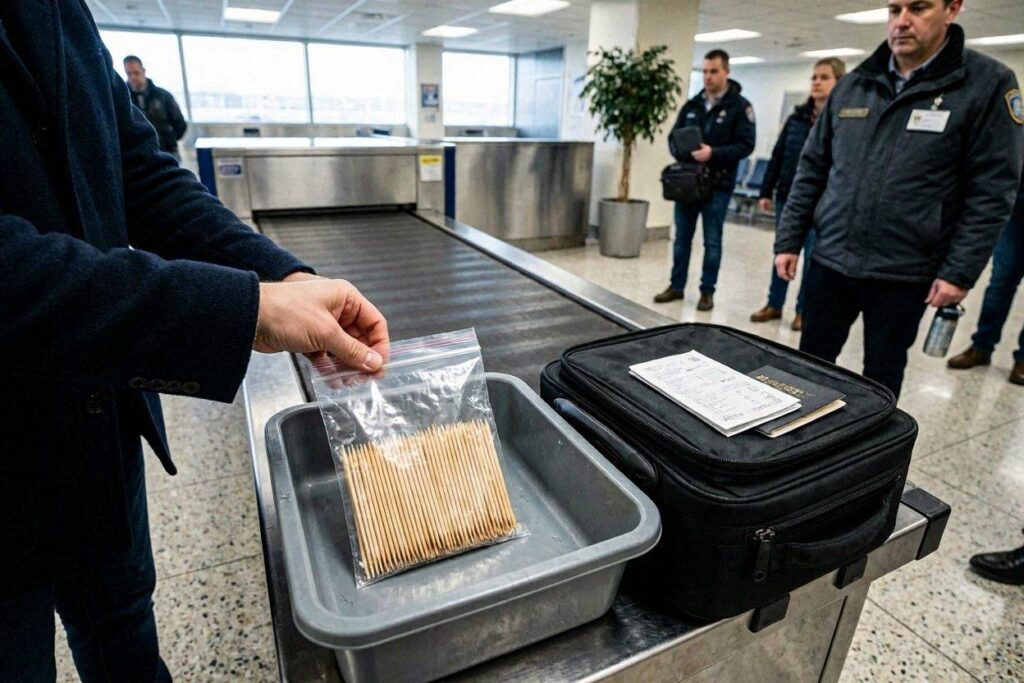
According to the TSA, wooden toothpicks receive a green light. You can pack them in your carry-on bag. You can also place them in your checked luggage. There is no quantity limit listed for standard, non-hazardous toothpicks. A simple box of the wooden picks you find at a grocery store will not violate any security protocol. The officers see these items every single day. They pose no significant threat to the safety of the aircraft or its passengers.
But the word “generally” carries a lot of weight in airport security. The final decision always rests with the TSA officer at the checkpoint. They have the authority to prohibit any item if they believe it presents a security risk. A toothpick seems innocent. Yet an officer might flag it if it looks modified, unusually weapon-like, or suspicious in some way. This happens very rarely. Still, understanding this nuance helps set realistic expectations. Now, let’s break down the specific luggage rules.
Carry-On Luggage: Your Seat-Mate for Oral Care
Most travelers care most about their carry-on bag. You want access to a toothpick after a mid-flight meal or snack. Packing them in your personal item or carry-on suitcase is perfectly fine. A standard pack of cellophane-wrapped wooden toothpicks will slide right through the X-ray machine without a second glance from security personnel.
Imagine the scene. You finish a turkey sandwich at 30,000 feet. You discreetly retrieve a single, clean toothpick from your bag. You solve a minor discomfort. This is a common practice. Airlines even hand out disposable flossers or picks on some long-haul international flights. The presence of these items in the cabin is normal and uncontroversial.
Wooden vs. Plastic Toothpicks in the Cabin
Security officers train to detect threats, not to confiscate harmless personal care items. A standard wooden toothpick is simply not a threat. The same logic applies to plastic dental picks or flossers. The small piece of floss stretched across a plastic bow is not a restricted item. You can bring a whole bag of disposable floss picks.
The reasoning is clear. These items lack a sharp, blade-like edge. You cannot effectively slash or stab with a typical wooden toothpick. It would break long before causing any real damage. TSA rules focus on replicas of weapons, actual knives, and sharp objects that exceed a certain length. Toothpicks fall far below that threshold.
The Curiosity of the Pointed Tip
You might wonder about the sharp point. After all, a toothpick can prick a finger. The TSA draws a firm line between a point and a blade. A blade, like a knife or a box cutter, possesses a sharpened edge designed to cut. A toothpick has a point designed to dislodge food particles. Scissors with blades shorter than 4 inches from the pivot point are even allowed in carry-ons. A toothpick, with its non-cutting point, is far less concerning.
So, go ahead. Pack a small travel pack in your purse. Tuck a few inside your toiletry kit. Keep them in your backpack’s front pocket. The cabin is a toothpick-friendly zone. Just be mindful of using them discreetly. No one wants to watch a fellow passenger perform an elaborate dental excavation in seat 14B.
Checked Luggage: The No-Worry Zone
If you do not need your toothpicks during the flight, toss them into your checked bag. You will encounter zero problems. The rules for checked luggage are far more relaxed for non-hazardous items. You can pack a family-sized box of 500 toothpicks. You can pack an economy pack of multi-colored plastic picks. The X-ray scanners and manual bag checks for checked luggage primarily look for explosives, lithium batteries, and prohibited sporting goods.
A dense block of wooden toothpicks might look interesting on a scan. A security officer might inspect your bag. They will open it, see a harmless box of toothpicks, and close it again. They will not confiscate them. There is simply no regulation against it. The TSA explicitly states that sharp objects in checked bags should be sheathed or securely wrapped to prevent injury to baggage handlers and inspectors. An unopened box of toothpicks is already securely wrapped. A loose pile of dirty, used toothpicks presents a sanitation issue, not a security one. Always pack them in a container.
The Flammable Solid Myth
A strange urban legend sometimes circulates online. It suggests that wood is a flammable solid and therefore prohibited in checked luggage. This is a misinterpretation of the rules. The TSA and the Department of Transportation classify flammable solids as materials that cause fire through friction, self-reactive substances, or solid desensitized explosives. Matches, readily combustible materials, and certain metal powders fall under this category. A standard wooden toothpick does not. It requires a significant and sustained external flame source to ignite. It is not classified as a hazardous material. Pack your wooden toothpicks in your checked suitcase with confidence.
The Metal Toothpick Exception: A Special Case
Now we must address a crucial distinction. The conversation changes dramatically when we move from wooden toothpicks to metal toothpicks. A reusable metal toothpick is a very different object in the eyes of security. These items are often made of stainless steel or titanium. They feature a sharp, needle-like point. Some even come in a small carrying case that resembles a pen.
Can you bring a metal toothpick on a plane? The answer is more cautious. A metal toothpick possesses the characteristics of a sharp object. It is rigid, pointy, and strong enough to pierce skin easily. An officer could look at a titanium toothpick and see a potential stabbing instrument. This sounds extreme. But the officer’s job is to imagine worst-case scenarios.
TSA Perspective on Metal Dental Picks
The TSA does not specifically list “metal toothpick” in its database. This absence creates a gray area. The database is not an exhaustive list of every single item in existence. Officers receive training on broad categories. A metal toothpick could fall under the umbrella of a “sharp object” or a “tool.” Many metal toothpicks have a textured gripping end that looks like a miniature awl or pick.
The final call rests with the agent. One officer might see a common dental hygiene tool and wave it through. Another might see a dangerous, spike-like object and prohibit it. The risk of confiscation increases significantly with metal toothpicks. If you cherish your handmade, artisan titanium toothpick, do not risk it in your carry-on. Place it securely in your checked luggage. The checked bag environment neutralizes any perceived threat. No one can use it as a weapon while the plane is in the air.
Here is a quick comparison to make this clear:
| Feature | Standard Wooden Toothpick | Metal/Reusable Toothpick |
|---|---|---|
| Material | Soft wood, splinters easily | Rigid steel or titanium |
| Risk Profile | Low. Seen as a common, disposable item. | Moderate. Resembles a sharp tool or needle. |
| Carry-On Fate | Almost always allowed. Safe to pack. | Risky. Subject to officer’s interpretation. Potential confiscation. |
| Checked Bag Fate | Always allowed. Pack in a box or case. | Always allowed. The safer choice for travel. |
| Practical Use | Single-use, easily broken. | Multi-use, very durable, precisely sharp. |
Traveler’s Tip: If you are devoted to your metal toothpick, buy a pack of disposable wooden ones for the journey. This eliminates all stress at the security checkpoint. You will breeze through without a moment’s worry.
The Flossing Factor: Dental Floss and Picks
Let’s expand the discussion to other oral care items. You rarely worry about just a toothpick. You think about floss, floss picks, and other interdental cleaners. The good news is universal. Standard dental floss in a plastic dispenser is perfectly fine for carry-on bags. The small, built-in metal cutter on the dispenser is tiny and fully enclosed. It does not constitute a threat.
Disposable floss picks, the small plastic harps with a piece of floss stretched across, are also fine. They are not sharp. You might see a TSA officer hold one up briefly, but they will quickly recognize the familiar shape. They see thousands of these every week. They belong in the same category as toothbrushes and combs—safe, mundane personal care objects.
What About Water Flossers?
A modern traveler might carry a portable water flosser. This device uses a stream of water to clean between teeth. The device itself is a small electronic appliance. The TSA allows electric toothbrushes and water flossers in carry-on bags. You must follow the standard rules for liquids and batteries.
If your water flosser uses a lithium-ion battery, it must go in your carry-on bag. You cannot place loose lithium batteries in checked luggage. The water reservoir must be empty as you pass through security. You can fill it with water after you reach your gate or on the plane. The 3-1-1 liquids rule applies only to the total volume of your liquid containers, not to an empty reservoir. However, if you carry mouthwash to use with the flosser, that bottle must be 3.4 ounces (100ml) or less and fit inside your single quart-sized liquids bag.
Quick Reference List: Oral Care Items and Carry-On Rules
- Standard Wooden/Plastic Toothpicks: Allowed in carry-on and checked bags. No limits.
- Metal/Reusable Toothpicks: Highly recommended for checked bags only. Potential risk in carry-on.
- Dental Floss (String): Allowed in carry-on and checked bags. The tiny metal cutter is permitted.
- Disposable Floss Picks (Harp Style): Allowed in both. No known restrictions.
- Electric Toothbrush: Allowed in carry-on. Batteries must follow battery rules (carry-on for lithium).
- Water Flosser: Allowed. Empty the reservoir before the screening checkpoint.
Navigating Security with Confidence
How you pack influences how you screen. TSA officers appreciate organized bags. A cluttered, overstuffed backpack full of electronics, snacks, and a jumbled mess of personal items looks suspicious on the X-ray. A neat, compartmentalized bag looks efficient. When an officer can quickly identify every item on the screen, your bag moves through faster.
Place your oral care items in a clear toiletry bag. A transparent pouch allows the officer to see the toothbrush, the toothpaste, the floss, and the small box of toothpicks instantly. This visual clarity often prevents a manual bag check. The officer does not need to unzip your bag and rummage through your private items to identify a dark, ambiguous shape on the monitor. The clear pouch answers their question before they even ask it.
This practice serves you well. It keeps your belongings private and secure. It speeds up the screening process for everyone in line behind you. And it ensures that your plain wooden toothpicks do not become the subject of a five-minute investigation that ends with, “Oh, they’re just toothpicks.”
Special Considerations for International Travel
TSA rules govern departures from and travel within the United States. But aviation is a global network. You might connect through airports in Europe, Asia, or the Middle East. Or you might start your journey in another country. The rules for carry-on items are largely harmonized globally. The International Civil Aviation Organization (ICAO) provides guidelines that most countries adopt.
Generally, international security agencies mirror the TSA’s stance on toothpicks. The European Union Aviation Safety Agency (EASA) and the UK’s Civil Aviation Authority (CAA) all permit common wooden toothpicks. However, the interpretation for a sharp metal dental tool can be even stricter in some jurisdictions. An agent in London Heathrow or Tokyo Narita might have a zero-tolerance policy for any sharp, needle-like object, even one used for dental care.
Agricultural and Customs Regulations
Your toothpicks might face a different kind of scrutiny at the border: customs. This is not a security issue but an agricultural one. Wood is an organic material. It can theoretically harbor pests or diseases. Countries like Australia and New Zealand have incredibly strict biosecurity laws. If you pack a large, ornate wooden toothpick holder or a box of artisanal picks made from untreated foreign wood, you must declare them.
A standard, commercially packaged box of toothpicks from the grocery store is a processed wood product. It poses almost no risk and customs officers wave it through. But if you are carrying a hand-carved wooden toothpick set from a remote village, declare it upon arrival. The agriculture officer will inspect it. They may even confiscate it if the wood shows signs of insect boring or decay. The goal is to protect the country’s ecosystem. Honesty is always the best policy at customs.
Here is a brief look at how a common item like a wooden toothpick is treated by different global security agencies:
| Security Agency | Region | Standard Wooden Toothpick (Carry-On) | Metal Dental Pick (Carry-On) |
|---|---|---|---|
| TSA | United States | Allowed | Discretionary; Risky |
| CATSA | Canada | Allowed | Discretionary; Likely Prohibited |
| EASA (EU) | European Union | Allowed | Often Prohibited |
| UK CAA | United Kingdom | Allowed | Likely Prohibited |
| Aus Gov (Home Affairs) | Australia | Allowed | Strongly Discouraged/Prohibited |
Important Note: No international guide can ever replace checking the specific rules of the country you are visiting. Always review the official website of the relevant airport security agency before you fly. A few minutes of research can save a real headache.
The Practical and Medical Cases for Toothpicks
Many travelers carry toothpicks for reasons beyond simple preference. Some individuals have dental work that demands regular cleaning. Braces, bridges, and wide gaps between teeth can trap food constantly. A chunk of spinach stuck in a fixed retainer for a ten-hour flight is a recipe for misery and embarrassment. For these passengers, a toothpick is a necessary medical-like item.
TSA guidelines do not specifically address toothpicks as medical devices. They do not need to. The rules already permit them. But for peace of mind, you could pack them inside a small pouch with your toothbrush, prescription toothpaste, and orthodontic wax. This groups your dental necessities together. If an officer ever did ask a question, you could simply say, “These are for my dental appliance.” This immediately explains the item and its purpose.
The Sensory and Habit Aid
Another often overlooked use is sensory regulation. Some people use a toothpick as an oral fidget. It gives them something safe to lightly chew on, helping them focus or manage anxiety. A long flight is a high-anxiety environment. The constant engine hum, the crowded cabin, and the stale air can be stressful. A clean, disposable toothpick can serve as a quiet, discreet coping tool.
An officer does not need to know this personal backstory. The item itself is permitted regardless of its use case. But knowing that the reason is valid and shared by many people can empower you. You are not doing anything wrong. You are taking care of your physical or mental comfort.
Debunking the “Terrorist Tool” Myth
Popular culture has given the humble toothpick a dark, exaggerated legend. We have all seen action movies. The hero is captured, stripped of all weapons, and thrown into a cell. He then reveals a toothpick, secretly hidden, and uses it to pick a lock, disarm a bomb, or disable a guard. This cinematic trope has planted a tiny seed of worry in the minds of some travelers. Will security see me as a movie villain?
Rest assured, security officers live in the real world, not a Hollywood script. They receive data-driven training. There is no recorded history of a major aviation security incident involving a single wooden toothpick. The TSA compiles statistics on threats. Blades, explosives, firearms, and incendiaries dominate that data. A toothpick is not a blade. It is not an explosive. The lock-picking scene from a film is pure fiction. A wooden toothpick would snap instantly in a lock mechanism.
An officer worrying about a toothpick would be a profound misallocation of attention. They are scanning for the dense mass of a weapon, the wiring of an improvised explosive device, or the outline of a prohibited firearm. A thin sliver of wood barely registers on the scan. It is simply not on the threat matrix. So, you can abandon that cinematic fantasy. The TSA will not view you as a secret agent.
What Happens If an Officer Flags Your Item?
Let’s play out a realistic scenario. You pack a metal toothpick in your carry-on, and an officer stops your bag. What happens next? The process is calm and routine. Your bag enters the X-ray tunnel. The operator sees something. They cannot immediately identify it. The conveyor belt stops. A TSA officer points at the monitor and calls for a bag check.
An officer approaches you politely. “Whose bag is this?” they ask. You claim your bag. “We need to take a closer look. Do you have any sharp objects inside?” they might inquire. You remember your metal toothpick. You say, “Yes, I have a metal toothpick in a small case.” The officer asks you to open the bag and locate the item. You do so.
The officer examines the metal toothpick. They assess its length, sharpness, and rigidity. At this point, they make a decision. They may determine it is fine and hand it back to you. The officer might say, “This is permitted. Have a nice flight.” Alternatively, the officer might say, “I’m sorry, this item is too sharp. It’s not allowed through. You have a few options.”
Your options at this secondary screening point are limited. You can:
- Voluntarily surrender the item to the TSA. They will dispose of it.
- Exit the checkpoint, return to the airline ticket counter, and check your bag with the item inside.
- If the airport offers a mailing service, you can mail the item to your home or destination.
- Give the item to a non-traveling companion who saw you off.
You cannot argue your way through this decision. The officer’s authority is final and non-negotiable at the checkpoint. If you choose to abandon the item, you lose it forever. This is why our recommendation is so firm: pack metal toothpicks in your checked luggage from the start. Eliminate the possibility of an uncomfortable choice at the security line.
A Deep Dive into Toothpick Materials
To understand the rule’s logic, it helps to look at the toothpick itself. A standard wooden toothpick is a marvel of mundane engineering. It is usually made from birch wood. It tapers to a point, but the wood is brittle. The structural integrity is minimal. Apply lateral pressure, and it snaps. Stab it into a firm surface, and the tip crumbles. This inherent fragility is its security credential.
Plastic dental picks are slightly more robust. The plastic stem is flexible. You can bend it back and forth repeatedly. The pick end is usually a curved, blunt point or a small, slightly sharpened triangle. It is designed to scrape soft plaque, not to pierce. The floss pick variant adds a piece of taut string. None of these design elements create a functional weapon. A security officer can feel this instinctively. They can bend the plastic pick and see its harmless nature.
Metal toothpicks represent an entirely different design philosophy. They solve the problem of fragility. A manufacturer makes them from surgical-grade stainless steel. The point is ground to a precise, durable tip. You can apply significant pressure. The tip will not deform. The knurled grip section ensures it will not slip from your fingers. This tool can function as an awl, a scribe, or a piercing instrument. The security concern is not hypothetical. The object’s physical properties align with a class of prohibited items.
This material analysis reveals the logical foundation of the seemingly arbitrary rules. Security is a science of physical properties. Is it rigid? Is it pointy? Can it pierce skin? If the answer is yes to all three, it enters a gray zone. The wooden toothpick answers no to the first and third questions. The plastic one answers no to the third. The metal one answers yes across the board. This is the difference.
Travel Kits and Preparedness
For the frequent traveler, building a small, TSA-compliant comfort kit is a wise move. You can dedicate a single small pouch to oral and personal care. This kit stays in your carry-on permanently. You never unpack it. You just refill it. This ensures you never forget a critical item and never find yourself in an unfamiliar airport buying an overpriced alternative.
What goes into this ultimate travel oral care kit?
- A small, travel-sized toothbrush with a cover.
- A 3.4-ounce tube of toothpaste.
- A spool of regular dental floss or a bag of disposable floss picks.
- A small, sealed box of standard wooden toothpicks.
- A travel-sized bottle of alcohol-free mouthwash (3.4oz or less).
- Orthodontic wax if you wear braces.
- A small dental mirror (plastic, not glass, for safety and weight).
Pack all liquids in your single quart-sized, clear, zip-top bag. Keep the dry goods in the oral care pouch. This system is flawless. When you pass through security, you pull out the liquids bag. The oral care pouch stays in your backpack. The screeners see a clean, organized set of recognizable items. They do not see a tangled mess of mystery objects. This strategy makes you a faster, more efficient traveler.
The Environmental Angle: Disposable vs. Reusable
A modern traveler also carries the weight of environmental consciousness. A single-use plastic or wooden toothpick creates waste. A metal, reusable toothpick seems like the more sustainable choice. This creates a conflict for the eco-minded traveler who wants to carry-on their metal dental tool.
This conflict has an easy resolution. You can separate your travel habits from your home habits. At home, absolutely use your durable metal toothpick. Maintain your zero-waste lifestyle. For the compressed, high-stakes environment of air travel, give yourself permission to use a small number of disposable toothpicks. The sustainability cost of one or two wooden toothpicks during a day of travel is infinitesimally small. The environmental cost of driving back to the airport to retrieve a confiscated metal tool is far greater. The production of a new metal toothpick after confiscation also consumes significant resources.
Alternatively, you can find a middle ground. Place your reusable metal toothpick in your checked luggage when you fly. Use it at your destination and during your return. Checked luggage is the perfect place for durable, life-lasting tools. You just cannot access them in the cabin. Pack a few biodegradable wooden toothpicks in your carry-on for immediate post-meal needs. This dual-system approach satisfies both your desire for sustainability and the practical demands of security protocols.
Flying with Kids and Unique Snacks
Families traveling with children often carry a circus of small items. Snacks spill, and sticky fingers reach everywhere. A parent might pack toothpicks for a specific food item, like a small container of cut fruit or cheese cubes. These small wooden skewers, often with decorative frills on the end, are just toothpicks with flair.
The TSA treats them exactly the same. A frilled plastic cocktail pick is not a weapon. It is a party supply. You can bring them for your in-flight picnic. Just be mindful of the sharp point and your child’s safety. Turbulence can happen without warning. A child holding a sharp toothpick during a bumpy patch could cause an accidental injury. Always supervise the use of toothpicks by children on a plane. Pack them away securely after use.
The same rule applies to novelty toothpicks. Perhaps you have a dispenser that looks like a tiny animal, spitting out a single pick. Or a vintage case. These cases are fine. The officers will be more interested in the conversation piece than concerned by its contents. Just ensure any container holding toothpicks is easily openable if an inspection is required. A locked, solid metal case filled with dense, unidentifiable objects will trigger a manual search.
The Final Word on Safety and Common Sense
Airport security is a collaborative effort. It works best when travelers act with awareness and consideration. The officers do not want to take your personal property. They want to ensure a safe flight for everyone. When you pack thoughtfully, you make their job effortless. A transparent bag of mundane oral care items is a beacon of harmlessness. It silently communicates that you are a prepared, low-risk traveler.
Think of it from the officer’s perspective. They see hundreds of backpacks an hour. The bags packed by seasoned travelers look a certain way. They are orderly. Electronics are easily accessible. Liquids are in the proper bag. Sharp or ambiguous items are stored in checked luggage. These bags sail through. The bags packed by inexperienced or careless travelers are chaotic. They contain prohibited items buried deep under layers of clothes. These bags cause delays, stress, and confiscations.
Aim to be the seasoned traveler, even if it is your first flight. Putting your cheap box of wooden toothpicks in your carry-on and your fancy metal one in your checked bag is a tiny decision that reflects a larger travel philosophy. It is about respecting the shared space of the airport. It is about reducing friction in a high-stress environment. It is about taking control of the little details so your journey feels effortless.
Summary and Final Takeaway
You can travel with complete peace of mind knowing that standard toothpicks are not a threat to your security screening process. Toss a box in your bag, and focus on the journey ahead. The rules are consistent and clear for everyday oral care items. A little common sense in packing goes a long way toward a hassle-free flight. Keep the sharp metal tools in your checked luggage, and keep the simple wooden picks in your pocket.
Frequently Asked Questions
Can I bring a whole box of wooden toothpicks in my carry-on bag?
Yes. The TSA places no limit on the quantity of standard wooden toothpicks. A full, unopened retail box is perfectly acceptable in your carry-on luggage.
Will a TSA officer confiscate my plastic floss picks?
No. Standard plastic floss picks are not considered sharp or dangerous objects. They are a common personal care item and will pass through security without any issues.
What should I do if I accidentally packed a metal toothpick in my carry-on and it gets flagged?
You must comply with the officer’s decision. Your options are to surrender the item, give it to someone outside security, or go back to the airline counter to check your bag. You cannot force the item through.
Do international flight rules differ for toothpicks?
The rules are largely the same for standard wooden toothpicks. However, for metal toothpicks, many international agencies are stricter and will almost certainly prohibit them in the cabin. Check local rules before you fly.
Is dental floss with a built-in metal cutter allowed in my pocket?
Yes, it is permitted. The small metal cutting edge is enclosed and not considered a threat. You can keep it in your pocket or carry-on bag.
Can I use a toothpick on the airplane openly?
Yes, you can. However, using a toothpick is a personal grooming activity. Doing it discreetly is a common courtesy to your fellow passengers. Avoid making a visible production of the task.
Additional Resource
For the most current and official ruling on any item before you fly, we highly recommend using the TSA’s live resource. You can ask them directly and get a real-time answer.
- Ask TSA on Twitter/X: @AskTSA
- TSA “What Can I Bring?” Tool: Tsa.gov/travel/security-screening/whatcanibring
Disclaimer: The information provided in this article is for general guidance only. Airport security rules can change. The final decision on whether an item is allowed through the checkpoint rests entirely with the TSA officer or the local security authority on duty. We strive for accuracy but cannot guarantee it against unannounced policy updates or individual officer discretion.