Can Dental Implants Be Done in One Visit?
You may have lost a tooth recently. Or perhaps you have been struggling with dentures for years. Now, you are scrolling through the internet, looking for a permanent solution. You want to fix your smile, but you are incredibly busy. You cannot imagine taking months off from social events or work. Then, you see a headline that seems too good to be true: “Get Teeth in a Day.” Immediately, the question pops into your mind: Can dental implants be done in one visit?
The direct answer is yes, but the full reality requires careful explanation. Many people confuse the surgical placement of an implant with the full restoration of a tooth. A dental implant is a titanium post that replaces a tooth root. A crown is the white, visible part that looks like a tooth. You can often receive a temporary tooth in one visit. However, the complete, final, non-removable tooth usually requires more time for healing.
This guide will take you behind the curtain of flashy marketing. We will explore the revolutionary techniques that allow for immediate loading. We will discuss who qualifies, the risks, the costs, and the biological limits of the human body. By the end of this deep dive, you will know if “Teeth in a Day” is a realistic option for your health or just a marketing slogan.
Understanding the Biology: Why Implants Usually Take Time
Before we discuss speed, we must understand biology. A dental implant is not just a screw inserted into the bone. It is a medical device that your body needs to accept. The biological process that makes implants work is called osseointegration.
In the 1950s, a Swedish orthopedic surgeon named Per-Ingvar Brånemark discovered something remarkable. He placed titanium chambers into rabbit bones to study blood flow. When he tried to remove them, he found the bone had fused so tightly to the titanium that it was impossible to separate without breaking the bone. He called this phenomenon osseointegration. This discovery changed modern dentistry forever.
How Osseointegration Works
When a surgeon places a titanium post into your jawbone, the body begins a healing cascade. Blood forms a clot around the implant. Then, stem cells and osteoblasts (bone-building cells) migrate to the surface. They begin laying down new bone matrix directly onto the titanium surface. This is not just a mechanical grip. It is a living, biological bond. The bone cells physically attach to the microscopic roughness of the implant.
This process takes time. In a dense lower jawbone, it might take three to four months to achieve stable integration. In the softer upper jawbone, it can take four to six months or longer. If you put too much pressure on the implant during this critical period, you risk a failure. The microscopic blood vessels can tear, and instead of bone, a fibrous scar tissue capsule forms around the implant. Once that happens, the implant has failed. It must be removed.
The Traditional Protocol
The classic protocol, pioneered by Brånemark, is a two-stage surgical approach:
- Stage One: The surgeon makes an incision in the gum, drills a precise hole in the bone, and places the implant. Then, the gum is stitched completely over the buried implant. You cannot see the implant. It heals protected under the gum for months.
- Uncovering: After the healing period, the surgeon makes a small incision to expose the top of the implant. A small “healing abutment” or cap is placed to shape the gum tissue.
- Stage Three: Finally, the dentist takes impressions and fabricates the permanent crown.
This method has a success rate of over 95 percent for healthy patients. It is the gold standard. It relies on keeping the implant absolutely immobile and free from chewing forces. But for patients who hate wearing a flipper (a temporary plastic denture with a fake tooth), this wait is agonizing. This is where the one-visit concept comes in.
Defining “One Visit”: What Exactly Is Done in a Day?
The phrase “Can dental implants be done in one visit” is slippery. It means different things to different providers. Let us clarify the terminology so you are not misled by advertising. We need to distinguish between the surgical extraction, the implant placement, and the tooth restoration.
Most “same-day” procedures actually refer to the transition from a failing tooth to a temporary crown in a single appointment. You walk in with a bad tooth and walk out with a temporary, fixed tooth on an implant. However, you will still need to return months later to get the final, high-strength permanent crown.
The Three Interpretations of “One Visit”
- Immediate Placement and Immediate Loading (The True Same-Day Tooth): You have a failing tooth. The dentist extracts the tooth, places the implant immediately into the extraction socket, and attaches a temporary crown to the implant all in the same appointment. This is what most people imagine when they ask the question.
- Immediate Placement with Delayed Loading (The Hidden Implant): The dentist extracts the tooth and places the implant in one visit. However, they do not put a tooth on it. They cover the implant with gum. You walk out with a removable temporary tooth (like a flipper) or nothing. This is one visit for the surgery, but you still wait months for a tooth.
- The “All-on-4” Full Arch Rehabilitation: This applies to patients who are losing or have lost all their teeth in a jaw. The surgeon places four to six implants. A full, fixed arch of temporary plastic teeth is screwed onto those implants on the same day. You get a full set of teeth in one visit, but again, these are temporary.
For the rest of this article, we will primarily focus on the first scenario—the single missing tooth replaced in one day. This is the most common source of confusion.
Important Note for Readers:
When a clinic advertises “Teeth in a Day,” they almost always provide a temporary prosthetic. Your permanent teeth will be made three to six months later. The final restoration costs extra and requires additional appointments. Never assume the first set is permanent unless explicitly stated.
The Immediate Placement Protocol: When You Can Save Time
For a true single-visit implant tooth, two major events must happen at the same appointment: the extraction and the implant placement. This is called immediate placement. Then, a tooth must be attached to the implant. This is immediate loading. Let us break down the surgical nuances of immediate placement.
The Ideal Extraction
Tooth extraction leaves a hole in the bone called a socket. Traditionally, dentists wait for this socket to heal and fill with new bone (about eight to twelve weeks) before placing an implant. However, immediate placement skips this waiting period. The implant is inserted right into the fresh socket.
For this to work, the extraction must be “atraumatic.” This means no crushing of the bone, no breaking of the socket walls, and complete removal of any infection or cyst. Dentists use specialized tools called periotomes. These are thin blades that slice the periodontal ligament fibers without pushing against the bone. They essentially tease the tooth out without expanding the socket.
Anatomy of the Socket
Think of the socket like a house with four walls. A tooth has one to four roots. Once the root is out, you are left with a bony hole. If one of those walls is cracked or missing, the implant surgeon has a problem. Without a wall, there is no container to hold the bone graft or to stabilize the implant. The “jumping distance”—the gap between the implant surface and the bone wall—must be small enough (ideally less than 2 millimeters) for natural bone to bridge it. If the gap is too large, the implant sits loose, and fibrous tissue will fill the gap.
The Role of Bone Grafting
Even in a perfect extraction, there is often a gap between the implant and the buccal (cheek-side) wall of the socket. Dentists routinely pack this gap with bone graft material. Bone graft acts like a scaffold. It maintains the volume of the ridge and prevents your body from rapidly resorbing the wall. If you skip the graft, the cheek-side plate of bone can melt away, leaving the threads of the implant exposed. That is an aesthetic disaster and a structural failure.
In one-visit scenarios, the graft is placed, a temporary tooth is screwed in, and the gum is stitched loosely around it. The temporary tooth itself protects the graft and the clot.
Immediate Loading: Placing a Tooth Right Away
The most controversial part of the “one visit” equation is immediate loading. This means connecting a tooth to the implant on the same day the implant is placed. The implant industry has battled over this concept for decades. Let us explore the biomechanics to understand why it works, and why it sometimes fails.
The Micromovement Threshold
Per-Ingvar Brånemark taught that any movement of the implant during healing would be fatal. The theory was that if the implant moves more than 100 to 150 microns, the cells responsible for bone formation (osteoblasts) would turn into cells that create scar tissue (fibroblasts). However, modern research has refined this understanding. It is not movement itself, but the type and magnitude of micromovement that matters.
Splinting and the Critical Role of Stability
For immediate loading to succeed, the implant must be “rock solid” at the time of placement. Surgeons measure this using a metric called Insertion Torque Value (ITV). This measures the friction and mechanical grip of the implant in the bone. Most clinicians require an insertion torque of at least 35 Newton centimeters (Ncm) to consider immediate loading. Some cautious surgeons demand 45 Ncm or higher.
- High Primary Stability (35-70 Ncm): The surgeon can place a temporary tooth, but they must ensure the bite is completely open. This means the tooth should not touch the opposing teeth during chewing. If it touches, the patient will apply force, causing micromotion and failure.
- Low Primary Stability (Less than 25 Ncm): The implant is stable but not tight. Immediate loading is very risky. A surgeon who values their success rates will bury the implant or place a removable temporary instead.
A significant danger arises when a surgeon places a temporary tooth on an implant with borderline stability. In the first two to four weeks, the bone around the implant dies back slightly—a process called osteonecrosis and remodeling. The implant actually becomes weaker during weeks three to six before it gets stronger. If you overload it during this “danger zone,” it will fail.
Splinting Implants Together
For full-arch cases (All-on-4), the strategy works because the implants are splinted together by a rigid bar of acrylic or metal. If one implant wants to wiggle, the other three hold it steady. This cross-arch stabilization reduces the force on any single implant. For a single tooth, you have no such luxury. The single implant stands alone against the full force of your jaw. This is why single immediate implants have a slightly lower survival rate in some studies compared to buried, unloaded implants.
Expert Perspective:
“The term ‘Teeth in a Day’ is a reality, but it is not a promise. It is a risk-benefit analysis. I only do it when the biological parameters are absolutely perfect. If the socket is damaged or the bone is soft, we revert to a two-stage approach. The patient’s long-term health outweighs the convenience of one appointment.” — A Prosthodontist’s view on immediate loading.
Comparative Analysis: Traditional vs. One-Visit Implants
To make this crystal clear, let us look at a direct comparison. This table highlights the differences in approach, time, and risk.
| Feature | Traditional Two-Stage Implant | One-Visit Immediate Implant |
|---|---|---|
| Extraction to Surgery | Socket heals for 2-4 months. | Same visit. Tooth out, implant in. |
| Appointments | Surgery, uncovering, impression, delivery. (4-6 visits). | Surgery & Temporary delivery. Final delivery. (3-4 visits). |
| Temporary Tooth | Removable flipper or nothing. Pressure on gums. | Fixed, screw-retained temporary. No pressure on gums. |
| Healing Micro-motion | None. Gum covers implant. | High risk if temporary tooth hits the opposite teeth. |
| Bone Grafting | Often easier; healed site. | Mandatory in most cases; jump-gap fill. |
| Soft Tissue (Gum) Aesthetics | Predictable. Scalloped gums heal nicely. | Harder to predict. Gum may recede. |
| Success Rate (Survival) | 96-98% over 10 years. | 93-96% over 10 years (in strict selection). |
| Psychological Impact | High anxiety during toothless wait. | Instant gratification; preserved self-esteem. |
As you can see, the traditional method edges ahead slightly in raw predictability. However, the psychological benefit of walking out with a fixed tooth cannot be overstated. For a patient in a high-profile job or a wedding coming up next week, the small trade-off in risk might be worth it.
Candidacy: Are You a Good Fit for One Visit?
Not everyone can have dental implants done in one visit. The selection criteria are strict. Dentists who ignore these criteria are gambling with your health. Before agreeing to a same-day procedure, ensure you pass the following candidacy checklist.
1. The State of the Infection
You cannot place an implant into a pus-filled socket. If you have a large abscess, a cyst, or active draining pus, the dentist must resolve the infection first. Some dentists will extract the tooth, thoroughly scrape the socket, and place the implant. However, this is a judgment call. If the infection has eaten away the buccal bone plate, immediate placement is usually aborted.
2. Quality and Quantity of Bone
You need good, native bone beyond the root tips. The implant must extend 3 to 5 millimeters beyond the extraction socket to grab solid bone. This “apical anchorage” is what gives primary stability. If your tooth root was short, or if there is a nerve (inferior alveolar nerve) or sinus cavity close by, the surgeon might not have enough bone to screw the implant into. In these cases, a bone augmentation surgery (sinus lift or block graft) is necessary first. These surgeries add months to the timeline and disqualify you from same-day teeth.
3. Gum Biotype
Do you have a thick or thin gum type? If you have a thin, scalloped gum “biotype,” you are at higher risk for gum recession around an immediate implant. When a tooth is extracted, the blood supply to the cheek-side bone drops dramatically. That bone dies back. If the gum is thin, this bony death is exposed, creating a “black triangle” or grayness at the gumline. Thick, flat gums mask this recession better.
4. Smoking Status
Smoking is a massive risk factor for immediate implant failure. Nicotine constricts blood vessels. Healing requires rich blood flow. If you smoke more than ten cigarettes a day, most ethical surgeons will refuse to do an immediate load and may even delay the surgery to let your mouth recover from the extraction first. You must be honest about your habit.
5. Parafunctional Habits
Do you clench or grind your teeth (bruxism)? You might not even know it. If you wake up with sore jaws or headaches, you might be a grinder. Immediate loading relies on the patient not touching the tooth. A grinder exerts massive unconscious force on their teeth during sleep. This force will destroy the osseointegration process. A night guard is mandatory, but often even that isn’t enough to save an immediate implant in a severe bruxer.
Who Is Usually Excluded?
- Heavy smokers unable to quit temporarily.
- Patients with uncontrolled diabetes (HbA1c over 7.5).
- Patients on intravenous bisphosphonates (bone drugs).
- Patients with a history of head and neck radiation.
- Pregnant women (elective surgery should be delayed).
The One-Visit Dental Implant Procedure Step by Step
Let us walk through the actual appointment. This is what it feels like to get a tooth in one day. Knowing the steps demystifies the process and reduces fear.
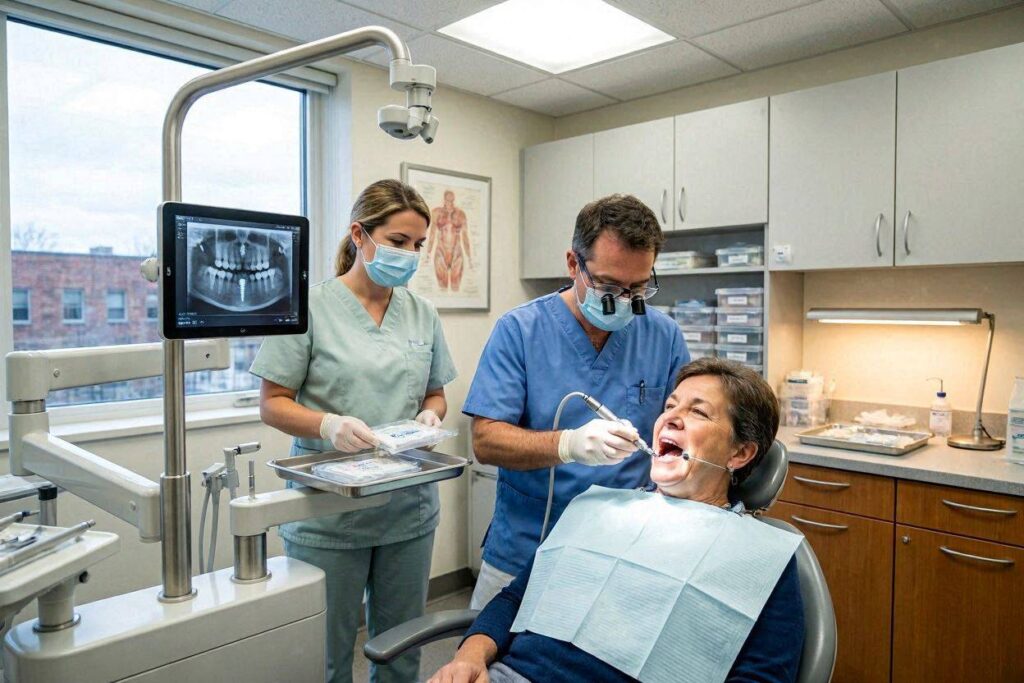
Phase 1: Preparation and Anesthesia (30 Minutes)
You arrive at the office. If you opted for sedation, the team sets up an IV or gives you an oral sedative. Most patients do well with profound local anesthesia alone. The dentist administers a series of injections to numb not just the tooth, but the surrounding bone and gum tissue thoroughly.
Phase 2: Atraumatic Extraction (15-45 Minutes)
The surgeon uses a periotome. They gently sever the tiny ligament fibers holding the tooth. They try to keep the tooth intact. If the tooth cracks, the process becomes tedious. Every root fragment must be removed without damaging the bony walls. Once the tooth is out, the surgeon inspects the socket with a high-powered surgical light. A socket that looks like a clean, bloody hole with four intact walls is perfect.
Phase 3: Curettage and Debridement (10 Minutes)
The socket is scraped clean with special curettes. All granulation tissue—the soft, infected pulp tissue or cyst remnants—is removed. The dentist irrigates the socket with saline or chlorhexidine. This is a critical step. Leaving behind inflammatory tissue is a guarantee of future failure.
Phase 4: The Osteotomy (15 Minutes)
This is the actual drilling of the bone. The surgeon uses a sequence of drills, starting thin and gradually widening. They use a surgical guide or a digital stent to ensure the implant goes into the exact position. The angle must avoid the void of the old tooth socket. The implant should engage the palate-side wall or the bone 5 millimeters below the socket. The sound of the drill is audible, but there is no pain.
Phase 5: Implant Placement (5 Minutes)
The titanium implant is screwed into the prepared site. The surgeon checks the Insertion Torque Value. Let us say it reads 50 Ncm. The surgeon grins. “Good primary stability.” The implant is locked in. It is not moving. A small healing cap or a temporary abutment post is screwed into the implant.
Phase 6: Bone Grafting and Membrane (15 Minutes)
The gap between the implant and the cheek-side wall is packed with bone graft. A collagen membrane or a platelet-rich fibrin (PRF) membrane is placed over the graft. This membrane acts like a band-aid. It prevents gum cells (which grow fast) from invading the graft before bone cells (which grow slowly) can fill it.
Phase 7: The Temporary Crown (30-60 Minutes)
This is where the “visit” differs. If you are getting a tooth today, the dentist takes an intraoral digital scan of the implant position. A milling machine in the office grinds a block of acrylic or composite into a temporary tooth. The dentist then screws this tooth onto the implant. They check the bite with articulating paper. They must ensure that when you bite down, there is at least a sheet-of-paper gap between your new tooth and the opposite teeth. No contact during chewing. If the dentist leaves the tooth high, the entire mission fails.
You leave with a fixed tooth. It looks real. It is solid. But it is acrylic, not polished porcelain. It is designed for gentle eating and smiling, not for chewing steak.
The Full-Arch Transformation: All-on-4 in One Day
The “one visit” concept is most dramatic, and most life-changing, for patients who are losing all their teeth or struggling with loose dentures. The full-arch immediate load, often marketed as All-on-4 or Teeth in a Day, deserves its own detailed examination. This is a complex medical procedure, not a cosmetic one.
The Economics of Speed
Patients with terminal dentition (teeth that are all failing) face a terrible choice. A conventional approach requires extractions, bone grafting, six months of healing, implant placement, another six months of healing, and then dentures. During this year, the patient suffers with loose, ill-fitting temporary dentures that cause pain and embarrassment.
The All-on-4 concept bypasses this suffering. It uses angled implants to overcome bone deficiencies. By tilting the back implants at 30 to 45 degrees, the surgeon can anchor into denser bone and avoid the sinus cavities or nerve canals. This specific angle also increases the “spread” of the implants, creating a wider support base for a full bridge.
The One-Day Bridge
The bridge you receive on the day of surgery is a provisional prosthesis. It is typically a milled acrylic bar with denture teeth bonded on. It is fixed with screws, not glue. The plastic teeth are not as strong as zirconia or porcelain. But they serve two vital functions:
- They restore your smile and chewing capacity immediately.
- They act as a splint, locking the implants together. If your jaw tries to move one implant, the whole rigid bar distributes the force across all four or six implants. This is the safety net that makes immediate loading possible for full arches.
Conversion to Final Restoration
After four to six months, you return. The temporary bridge is unscrewed. The implants are tested for integration. New impressions are taken. A final bridge, made of titanium wrapped in porcelain or a solid block of milled Zirconia, is fabricated. This final bridge is vastly more durable and hygienic. You will chew with this for decades. The one-day visit gave you back your life; the six-month visit perfects it.
Digital Dentistry: The Game Changer for One-Visit Workflows
The rise of one-visit implants correlates directly with the digital revolution in dentistry. Twenty years ago, taking an impression of an implant right after surgery was messy. Blood and saliva would contaminate the impression material. The lab took weeks. Today, digital dentistry turns this into a seamless ballet.
Intraoral Scanners (IOS)
Devices like the iTero or Trios scanner use a wand to take thousands of images per second. They stitch together a 3D model of your teeth and the implant position without goopy molds. This is priceless. For a same-day tooth, the scanner captures the exact orientation of the implant’s internal hex or connection. The software instantly aligns this scan with the pre-surgery CBCT scan.
Cone Beam Computed Tomography (CBCT)
A CBCT scan is the secret weapon. It is a 3D X-ray. Before the tooth is ever pulled, the surgeon virtually places the implant in the bone using planning software. They check the bone density, the proximity to nerves, and the optimal angle. This “guided surgery” allows them to order a surgical guide—a 3D-printed plastic stent that directs the drills exactly as planned. If the plan says the implant will sit in solid bone with 50 Ncm of torque, the reality is much more likely to match.
CAD/CAM Milling
Once the surgeon places the implant, the camera sends the data to a design station. The dentist designs the temporary tooth on the screen. Then, the design goes to an in-house milling machine. A puck of acrylic is carved by diamond burs into a perfect temporary crown within 15 minutes. This speed is what makes the single-day workflow possible. Without an in-house mill, the scan goes to a lab, and you wait days. That defeats the purpose.
The Risks and Complications of Speed
A transparent conversation about one-visit implants must address the risks. Marketing often glosses over these to sell a service. We will not do that. Your health depends on informed consent.
1. Implant Failure to Integrate
This is the primary risk. The implant simply does not fuse to the bone. It becomes loose. You notice pain, redness, or a feeling that the tooth is “clicking.” The dentist removes it. This happens roughly 5 to 10 percent of the time in immediate loading cases, compared to 2 to 3 percent in delayed loading. However, when it happens, the bone around the socket often loses significant volume. You might need a large bone graft before trying again.
2. Gum Recession and “The Gray Shadow”
A tooth root has a thick wall of bone and a ligament. An implant has no ligament and relies on a thinner bone plate. When the cheek-side bone dies back—which it often does by 1 to 2 millimeters—the gum follows. Suddenly, the titanium of the implant shows through the gum. It looks gray. Or a black triangle opens up between the implant crown and the natural tooth next to it. This is a cosmetic disaster. Traditional healing partly mitigates this by allowing the bone to remodel before the gum is manipulated. Immediate loading is less forgiving.
3. Fracture of the Temporary
If the bite is slightly off, the patient will hit the temporary tooth during lateral chewing movements. Acrylic temporaries can snap. The screw can break. If the screw breaks inside the implant, it is a huge headache to remove. Usually, the entire implant is rendered useless. This is why a strict “soft diet” is mandatory.
4. Cement-Induced Peri-implantitis (A Hidden Danger)
Sometimes, a dentist does not screw the temporary on but cements it. Excess cement that squishes under the gum is a ticking time bomb. Even a fleck of cement can cause a massive inflammatory reaction, killing the bone around the implant. One-visit implants that are cement-retained carry a significantly higher long-term risk if the cement is not meticulously flushed out.
Comparison of Temporary Retention Methods
| Retention Method | Risk of Screw Loosening | Risk of Cement Sepsis | Retrievability |
|---|---|---|---|
| Screw-Retained | Higher (requires retightening). | None. | Excellent (unscrew easily). |
| Cement-Retained | Lower. | High if excess cement remains. | Difficult (may require drilling). |
For one-visit cases, screw-retained temporaries are overwhelmingly the standard of care.
The Cost Factor: What One-Visit Implants Really Cost
The question “Can dental implants be done in one visit” is often driven by a desire to save time, but also a hope to save money by consolidating appointments. Does it save money? Not usually. It often costs the same or more.
Breakdown of Fees
A traditional implant is billed in stages.
- Extraction and bone graft ($300 – $800).
- Implant placement ($1,500 – $2,500).
- Abutment and Crown ($1,500 – $2,500).
A one-visit immediate implant combines the first two and adds a technical fee for the temporary.
- Extraction, graft, implant placement, and temporary crown ($3,500 – $5,000).
- Final Abutment and Crown ($1,500 – $2,500).
The total cost usually ends up slightly higher due to the specialized training, the digital equipment, and the high-value materials (bone graft, membrane) used in the surgery.
The “All-on-4” Investment
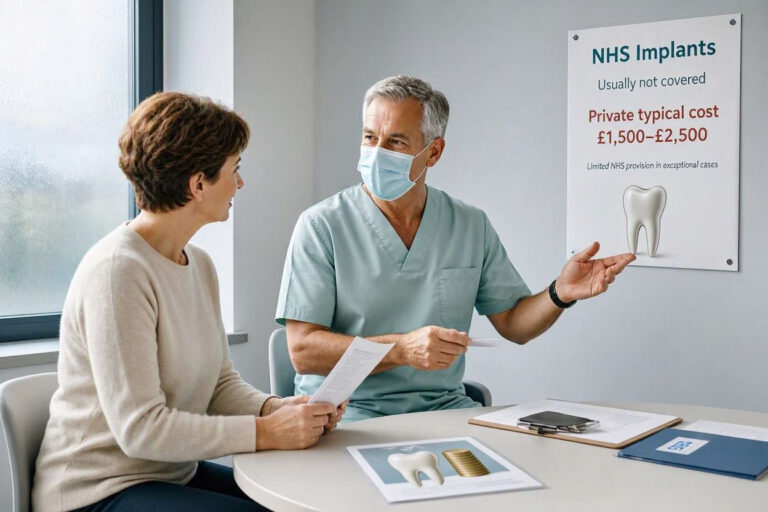
A single-arch “Teeth in a Day” procedure often ranges from $20,000 to $35,000 per arch. This includes the extractions, the implant placement, the sedation, and the provisional fixed bridge. The final Zirconia bridge usually adds another $5,000 to $10,000 to the final bill. It is a serious investment. However, it is often cheaper than doing 8 individual implants and multiple bone grafts.
Recovery and Aftercare: The 48-Hour Rule
You have walked out with a new tooth. Congratulations. But the surgery has just begun. The first 48 hours are critical.
The Clot
The blood clot in the socket and around the implant is precious. Do not do anything to dislodge it. No spitting, no sucking through straws, no vigorous rinsing. If you spit, the negative pressure pulls the clot out of the socket. The bone gets exposed. A “dry socket” on an immediate implant is a double disaster, potentially exposing the entire implant body.
Diet
You must commit to a liquid and very soft diet for the entire duration of healing—often three months. No chewing on the implant side. Not even soft bread. When you chew on the other side, the forces transfer through the skull and can still disturb the implant. Patients who ignore the diet instruction are the ones who show up with a wiggly implant at week four.
Oral Hygiene
Keeping the site clean is a paradox. You cannot brush the surgical site, but you cannot let it get infected. Dentists prescribe an antimicrobial rinse (chlorhexidine 0.12 percent). You gently hold it over the site and let it dribble out. No swishing.
Important Warning:
If your temporary tooth feels “tall” or “high” the next day, call your dentist immediately. Do not wait a week. A high spot generates lateral force. Lateral force kills integration. You need an emergency adjustment.
Long-Term Expectations: Temporary vs. Permanent
A major misconception arises when patients fall in love with their “same-day” teeth. They question why they need a new, expensive permanent one in six months. “It looks great,” they say. “Why change it?”
The Plastic Problem
The acrylic used for immediate temporaries is porous. It stains easily. It absorbs mouth fluid and bacteria. Over months, it begins to smell. The surface wears down. More importantly, an acrylic crown lacks the strength of a milled porcelain or Zirconia crown. If you bite into a fork tine or a crunchy crouton, the temporary can shatter. The internal implant connection can deform.
The Gum Sculpting
The temporary crown serves as a sculpting tool. It supports the gum during healing. But the gum around the temporary is often puffy and inflamed due to the surgical trauma. When it heals, it shrinks. The temporary usually looks bulky or has gaps by month four. The permanent crown is made to fit the matured, healed tissue perfectly.
Material Choices for the Final
- Porcelain-Fused-to-Metal (PFM): A classic. Strong, but can show a gray margin if gums recede.
- Solid Zirconia: Extremely strong. Aesthetic. The best choice for posterior (back) teeth and full arches.
- Lithium Disilicate (Emax): The most beautiful. Translucent. Best for single front teeth. Stronger than acrylic but not as strong as Zirconia for bridges.
Finding the Right Provider for Same-Day Implants
The skill of the provider is the most important variable, far more important than the implant brand. Inserting an implant safely and immediately loading it safely are two different skill sets. Many general dentists can place implants. Fewer have the surgical finesse for atraumatic extractions and the prosthetic knowledge for immediate temporization.
Credentials to Look For
- Board Certification: A Diplomate of the American Board of Oral Implantology/Implant Dentistry (ABOI/ID) or an Oral Surgeon with a residency.
- Prosthodontist: A specialist in restoring teeth. They often work with an oral surgeon. The team approach is often best.
- Digital Workflow: Ask if they use an in-house mill and CBCT. If they are sending impressions to a lab three towns away, your “one visit” might turn into two or three.
The Interview
Do not be afraid to ask hard questions.
- “What percentage of your single-tooth immediate implants survive past five years?”
- “What is your rescue plan if the implant fails? Do I have to pay for the redo?”
- “Do you cement or screw-retain the temporary?”
If they give vague answers or guarantee 100 percent success, be cautious. Look for a provider who explains the risks calmly and presents the traditional alternative honestly.
Good to Know:
Medical tourism for “Teeth in a Day” is booming in countries like Mexico, Costa Rica, and Turkey. While the price tag is lower, the timeline is often compressed. Ask yourself: Who will manage the complications? If a screw breaks or an implant fails three weeks after you return home, your local dentist will charge a premium to fix someone else’s rushed work.
The Psychological Impact: More Than Just a Tooth
When asking “Can dental implants be done in one visit?”, we focus on the technical side, but the human side is equally vital. A front tooth lost to an accident is a psychological trauma. Patients often report avoiding social gatherings, covering their mouths when they laugh, and a significant drop in self-confidence.
Walking out of the clinic on the same day with a fixed tooth is a psychological liberation. There is no period of “hiding.” There is no feeling of mutilation. The immediate restoration preserves the architecture of the face, the lips, and the smile. For many, this immediate restoration of identity is worth the surgical risk.
However, the mental rollercoaster can be intense. The “post-surgical remorse” sets in on day three. The swelling peaks. The temporary feels foreign. You might panic that it is failing. This is where patient education—knowing that this is normal healing—is essential.
The Biology of Aesthetics: The Pink Score
A successful one-visit implant is not just about bone. It is about the pink tissue around the tooth. A “Papilla Score” or Pink Esthetic Score (PES) measures how natural the gums look. The papilla is the little triangular bit of gum between teeth.
If you lose a tooth due to trauma or infection, the papilla often disappears instantly. “Black triangles” appear. The one-visit implant cannot magically regrow that papilla. In fact, loading the implant immediately can sometimes restrict blood flow to the thin gum between teeth, causing it to shrink. Surgeons often combine immediate placement with connective tissue grafts (taking a slice of tissue from the roof of your mouth) to thicken the gums. This adds complexity to the “one visit” but improves the final look. If you are a perfectionist regarding cosmetics, you might prefer the traditional slow approach with optimized gum grafting stages.
Technology Spotlight: The Smart Implant
We are entering an era where technology actively monitors the healing of one-visit implants. New “smart implants” have embedded sensors that transmit data to a dentist’s smartphone. They can measure the micro-motion of the implant in real-time during the healing phase. If the patient is chewing too hard, the sensor detects the overload and sends an alert.
Photogrammetry is another breakthrough for the same-day full arch. Instead of goopy impressions, specialized cameras take precise 3D maps of the implant positions in seconds. This cuts down the time the soft tissues are exposed to air, reducing swelling and accelerating the day-of procedure. These technological leaps are consistently pushing down the failure rates of immediate loading.
Case Studies: The Spectrum of One Visit
To illustrate the real-world application, let us look at three hypothetical but typical scenarios.
Case 1: The Ideal Candidate
Patient: 30-year-old female, non-smoker, excellent health. Fractured a healthy upper premolar root.
Situation: The root split, but there is zero infection. Bone levels are pristine.
Procedure: Atraumatic extraction. 4.5 mm implant placed into the palate wall. Insertion torque 45 Ncm. Immediate screw-retained temporary crown.
Outcome: Perfect integration. The patient wore the temporary for four months, then received a final Emax crown. Excellent aesthetics.
Case 2: The Salvage Job
Patient: 55-year-old male, long-term infection on a front tooth.
Situation: The infection has eaten through the cheek-side bone plate. The surgeon sees a hole in the bone.
Procedure: The tooth is removed. The surgeon places a slow-resorbing bone graft and a membrane. The implant is placed, but only into the basal bone at the bottom of the socket. It is stable (30 Ncm), but the surgeon refuses to load it. A removable temporary is provided. The gum is stitched over.
Outcome: Success after six months. The delay saved the case. Had the dentist placed a tooth, the bone graft would have failed, and the implant would be visible in the gum.
Case 3: Full Arch Escape
Patient: 65-year-old female, heavy smoker (1 pack/day), loose denture.
Situation: She wants “All-on-4.” She has severe bone loss in the lower jaw.
Procedure: The surgeon places four implants, two of which are angled to avoid the nerve. Stability is high. She gets a fixed plastic bridge in one day. She promises to stop smoking.
Outcome: She quits smoking. The implants integrate. At six months, she receives a titanium-acrylic hybrid bridge. If she had continued smoking, two of the four implants would likely have failed under load.
Debunking Marketing Myths
The internet is full of misleading claims about dental implants in one visit. Let us set the record straight on a few specific points.
- Myth: “It’s a permanent tooth in one hour.”
Truth: It’s a temporary tooth. The permanent tooth takes months to fabricate and costs extra. - Myth: “No downtime.”
Truth: You will have swelling, bruising, and a strict soft diet for months. You cannot go straight back to a steakhouse. - Myth: “Guaranteed for life.”
Truth: The crown or bridge has a lifespan of 10 to 15 years usually. The implant can fail. Maintenance is required. - Myth: “Lasers make it heal faster.”
Truth: Lasers can help with soft tissue healing (gums) but do not speed up the bone integration with the titanium. The bone takes as long as it takes.
Maintenance: Protecting Your One-Visit Investment
Assuming you successfully integrated your same-day implant and received your final crown, the journey isn’t over. Maintenance is the often-forgotten chapter of the implant story.
Peri-implantitis
Just like natural teeth get gum disease, implants get peri-implantitis. It is a pathological condition where bacteria cause inflammation and bone loss around the implant. It is particularly dangerous because an implant lacks the natural ligament “seal” that teeth have. Bacteria have a straight shot down to the bone. Once the smooth surface of the implant is exposed, decontamination is difficult.
Professional Hygiene
You must see a hygienist every three to six months. They use special non-metal scalers (plastic or titanium scalers) that do not scratch the implant crown. A scratched surface collects bacteria. They also check the screw’s integrity. A loose screw acts like a loose tooth in the socket and must be re-tightened before it fractures.
At-Home Care
Flossing is not enough. You need a Waterpik irrigator with a non-metal tip to flush around the implant. Interdental brushes dipped in chlorhexidine gel also work. If you invested $5,000 in a tooth, investing $100 in hygiene tools is logical.
Conclusion
- Can dental implants be done in one visit? The answer is a confident yes for extracting a tooth, placing the implant, and securing a temporary crown in a single appointment; however, you must understand that this temporary tooth requires strict care and a subsequent visit to receive the final, permanent crown after the jawbone has healed.
- The success of a same-day implant hinges entirely on strict biological criteria including low infection risk, high bone density, and absolute stability during placement, meaning not every patient qualifies, and rushing the process against a dentist’s advice can compromise the final result.
- While the immediate psychological boost of walking out with a fixed tooth is transformative, the long-term durability and aesthetics depend equally on the final restoration months later and a rigorous lifetime commitment to specialized hygiene and professional maintenance.
Frequently Asked Questions (FAQ)
1. Is the surgery painful?
The surgery itself should be pain-free due to powerful local anesthesia. Sedation options are available for anxiety. The peak pain occurs 24 to 48 hours after the numbing wears off. Ice packs and prescribed anti-inflammatories manage this effectively.
2. Can I eat normally the same day?
No. You must stick to a liquid or extremely soft diet for the first week, and soft foods for months. You absolutely must not chew on the temporary implant tooth. If you bite into a piece of bread with that tooth, you risk mechanical failure of the implant.
3. What happens if the immediate implant fails?
The dentist removes the loose implant. The site usually requires a bone graft to rebuild the destroyed socket. You must wait four to six months for the graft to heal before attempting a new implant. This often results in a total timeline of over a year.
4. Does dental insurance cover one-visit implants?
Insurance usually covers the extraction and a portion of the crown. It rarely covers the premium for the immediate loading technique or the advanced 3D imaging. You will likely pay a significant out-of-pocket gap.
5. Is “All-on-4” better than individual implants?
It is not a matter of “better” but of “indicated.” All-on-4 is a solution for patients with no teeth or failing teeth. It is a cost-effective way to avoid a full set of 8 to 10 implants. For a single missing tooth, a single implant is the standard.
Additional Resources:
For a visual explanation of the osseointegration process and guided surgery, visit the American Academy of Implant Dentistry’s educational video library.
[Link: https://www.aaid.com/]
Disclaimer:
This article is for educational and informational purposes only. It is not a substitute for professional dental advice, diagnosis, or treatment. Always seek the advice of your dentist or other qualified health provider with any questions you may have regarding a medical condition or elective surgery.