What is a Hybridge Dental Implant?
Losing most or all of your teeth changes your life in ways that go far beyond the dinner table. Simple pleasures like laughing with friends, smiling for a family photo, or biting into a crisp apple can become sources of anxiety and discomfort. For decades, the main solution was a removable denture. Then came traditional dental implants. But in recent years, a specific treatment protocol has gained significant attention for offering a middle ground between complex individual implant cases and removable plates. That protocol is called Hybridge.
This guide walks you through every detail you need to know. We’ll explore the technology, the process, the costs, the recovery, and, most importantly, the lived experience of patients who choose this path. Think of this article as a trusted friend sitting at your kitchen table, explaining how this works in plain, honest language.
Understanding the Core Concept
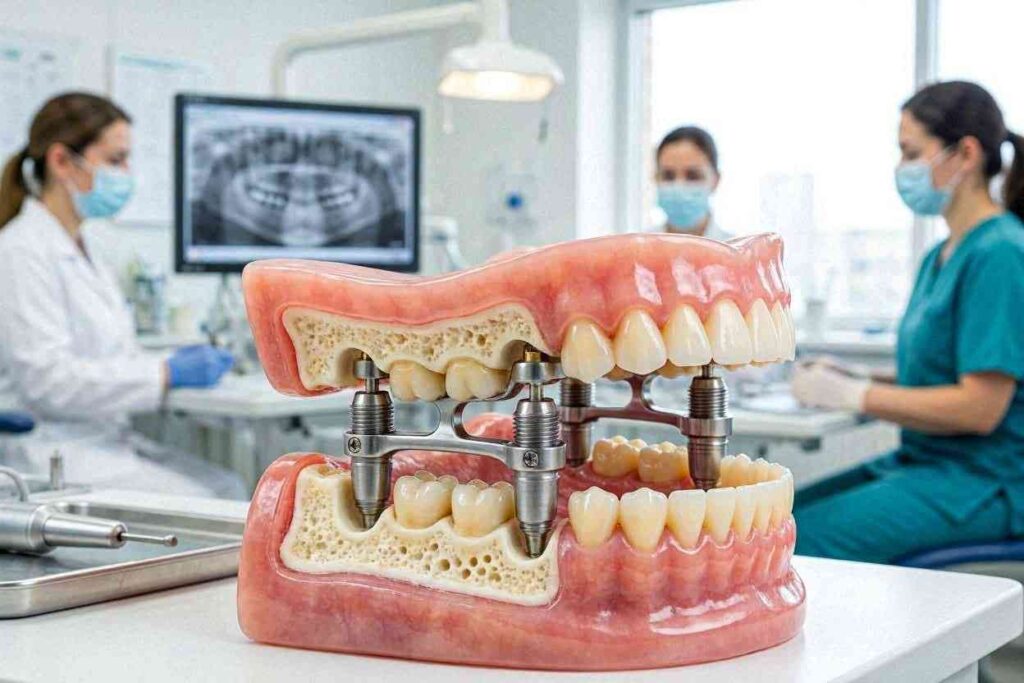
Many people hear the term “Hybridge” and assume it is a specific brand of implant or a unique piece of hardware. That isn’t quite accurate. Hybridge is a certified treatment protocol. It combines advanced diagnostic technology with a specific surgical and restorative workflow to replace a full arch of failing or missing teeth. The final result is a fixed, screw-retained bridge supported by a minimal number of dental implants.
The philosophy behind this approach is simplicity and predictability. Rather than placing an implant for every single missing tooth, the clinicians use a systematic method. They identify the best available bone, place a small number of implants, and attach a custom-designed full-arch bridge to those implants. The bridge is not removable by the patient. Only a dentist can take it out. This gives people a level of stability and confidence that closely mimics natural, healthy roots.
The Problem It Solves
Traditional dentures rest on the gums. They can slip, click, and cause sore spots. They also fail to stop the gradual bone loss that occurs after tooth extraction. The jawbone needs the stimulation of tooth roots—or artificial roots in the form of implants—to maintain its density. When you remove the teeth and don’t replace that stimulation, the bone slowly shrinks. This leads to the “sunken” facial appearance many people associate with long-term denture wear.
A Hybridge full-arch restoration directly connects to the jawbone via implants. This connection prevents the bone loss. It also eliminates the need for a bulky plastic palate covering the roof of the mouth. You taste your food better. You speak more clearly. Your confidence returns because the teeth stay locked in place.
The Origin and Philosophy of the Hybridge Protocol
Understanding where Hybridge came from helps clarify why it exists. Traditional full-arch implant techniques often required lengthy surgeries, extensive bone grafting, and a year or more of treatment. While effective, those methods were inaccessible for many patients due to cost, fear of surgery, or medical conditions that made extensive grafting risky.
The Hybridge protocol emerged as a streamlined, patient-friendly alternative. Clinicians who practice this system follow a strict set of procedures. They use specific imaging technology, precise surgical guides, and standardized laboratory processes. The goal is efficiency. By reducing the number of steps and appointments without sacrificing quality, the protocol makes fixed full-arch teeth attainable in a shorter timeframe.
“What really sets the Hybridge protocol apart is the emphasis on predictability. Every step, from the first CT scan to the final screw-retained bridge, follows a repeatable formula designed to minimize complications and maximize long-term success.” — A restorative dentist familiar with the full-arch workflow.
This philosophy doesn’t mean cutting corners. It means removing guesswork. When you enter a clinic that offers this protocol, you are entering a system that has mapped out the journey in advance.
How Hybridge Differs from Traditional Dental Implants
To truly answer “What is a Hybridge Dental Implant?”, you must compare it to what most people know as traditional implants.
A traditional single-tooth implant replaces one missing tooth. The dentist places a titanium post in the bone, attaches an abutment, and crowns it with a porcelain tooth. This process works wonderfully for one or several missing teeth. But when a patient is missing all of their teeth in one arch, placing six, eight, or even ten individual implants becomes highly invasive, extremely expensive, and often unnecessary.
Traditional full-arch implant methods often go by names like “All-on-4” or “All-on-6.” These concepts share similarities with Hybridge. However, the Hybridge protocol differentiates itself through its standardized diagnostic phase, the specific materials used for the temporary and final bridges, and the strict conversion process from failing dentition to a fixed temporary bridge, often in a single day.
Below is a comparative table that lays out the key differences clearly.
Treatment Comparison: Traditional Approaches vs. Hybridge Protocol
| Feature | Traditional Denture | Traditional Single Implants (Full Arch) | Hybridge Protocol |
|---|---|---|---|
| Stability | Low. Can shift, click, or fall out. | High. Each tooth is independently fixed. | Very High. Full-arch bridge is screwed into multiple implants. |
| Bone Preservation | Minimal. Bone loss continues over time. | Excellent. Each implant stimulates the bone. | Excellent. Implants integrate and halt bone loss. |
| Number of Implants | 0 | 6 to 10+ per arch. | Usually 4 to 6 per arch. |
| Removability | Patient removes it daily. | Fixed. Only the dentist can remove it. | Fixed. Only the dentist can remove it. |
| Palate Coverage | Yes. Full acrylic coverage on the upper. | No. No bulky plastic. | No. Open palate for taste and comfort. |
| Treatment Time | Weeks. | 6 months to 1+ years with grafting. | Often a temporary bridge is placed on implant surgery day. Final bridge in 3–6 months. |
| Hygiene Access | Easy. Brush the denture outside the mouth. | Challenging. Flossing around many individual crowns. | Easier. Clean under the bridge with specialized floss or water flosser. |
| Cost Factor | Lowest initial cost. | Highest cost. | Moderate to High. Less than many individual implants. |
| Surgical Impact | None. | High. Multiple surgical sites. | Lower. Fewer implant sites. Often avoids grafting. |
As the table illustrates, the Hybridge protocol attempts to find a sweet spot. It avoids the discomfort and insecurity of a removable plate. It also avoids the complexity and cost of a mouthful of individual crowns. It is a strategic restoration.
Who Is an Ideal Candidate?
Not everyone qualifies for this protocol immediately. However, many people who believe they have “no bone left” discover they are candidates after a proper evaluation. The systematic approach often allows surgeons to use available bone and avoid grafting, even in cases of moderate bone loss.
Key Candidate Indicators
- You are missing all or most of your teeth in one jaw.
- Your remaining teeth are failing due to decay, gum disease, or fractures.
- You currently wear a full or partial denture and hate the movement and discomfort.
- You have enough bone volume to support implants, or the surgeon can place them in angled positions to maximize contact.
- You want a fixed, non-removable solution.
- You are generally healthy enough for a minor oral surgical procedure.
- You don’t smoke heavily, or you are willing to quit (as smoking severely impairs healing).
Medical Considerations
Uncontrolled diabetes, recent radiation therapy to the jaw, or certain bone disorders can affect healing. A responsible provider conducts a thorough medical review. They won’t promise a miracle if your body cannot heal around the implants. However, many chronic conditions, when well-managed, do not rule you out.
Important Note: This protocol is not a quick fix for a single missing tooth. It is a full-arch solution. If you need just one or two teeth replaced, a traditional single implant approach remains the gold standard. Hybridge shines when an entire arch requires reconstruction.
The Initial Consultation: No More Guesswork
The journey begins with a conversation. But unlike traditional consultations that rely on two-dimensional X-rays and a bit of guesswork, the Hybridge protocol relies heavily on digital data.
The Role of Cone Beam CT Scanning
A critical step involves a Cone Beam Computed Tomography (CBCT) scan. This machine rotates around your head, capturing detailed 3D images of your jawbone, nerves, sinuses, and existing teeth. For you, this means no goopy impressions during the diagnostic phase. For the clinician, it means seeing exactly how much bone exists in three dimensions.
The scan reveals the path of the inferior alveolar nerve in the lower jaw—a vital structure that absolutely must be avoided during implant placement. In the upper jaw, it shows the location of the sinus cavities. The precision here eliminates the “exploratory” nature of older surgical methods.
Digital Smile Design
Beyond the bone, the consultation focuses on you. What did your smile look like when you were younger? What do you want it to look like now? The clinical team often takes photographs and digital scans of your face and existing smile. They can create a virtual preview of your new teeth. This process, often called Digital Smile Design, ensures the final bridge supports your lips properly, shows the right amount of tooth when you smile, and complements your facial structure. You get a voice in the shape, size, and shade of your new teeth.
The Surgical Phase: Implant Placement Day
One of the most appealing aspects of the Hybridge approach is the efficiency of the surgical day. Many providers call this the “Teeth in a Day” concept.
Pre-Surgical Preparation
Before surgery day, the lab fabricates a custom surgical guide based on the CBCT and digital scans. This guide is a rigid piece of plastic that fits over your gums and remaining teeth. It has holes precisely angled and positioned to direct the surgeon’s drill. The surgeon doesn’t have to freehand the placement. They follow the guide, which significantly reduces the risk of hitting a nerve or placing an implant in suboptimal bone.
The Procedure Step-by-Step
- Anesthesia and Comfort: You arrive in the morning. The team administers local anesthesia and often provides sedation options ranging from oral medication to IV sedation. You feel no pain during the procedure.
- Removal of Failing Teeth: If you have any remaining damaged teeth, the surgeon extracts them carefully.
- Bone Preparation and Implant Placement: Using the surgical guide, the surgeon prepares precise channels in the bone. They place four to six titanium implant posts. In the lower jaw, four implants often suffice. In the upper jaw, five or six may provide better support due to softer bone density.
- Placement of Multi-Unit Abutments: Instead of burying the implants under the gum, the surgeon attaches special connectors called multi-unit abutments. These remain protruding slightly above the gum line.
- Delivery of the Immediate Temporary Bridge: The lab has already created a prefabricated, screw-retained temporary bridge based on your pre-surgical digital design. The surgeon attaches this bridge to the abutments and secures it with tiny screws. You walk out with a full set of fixed, non-removable plastic teeth.
Why an Immediate Bridge Matters
You never leave the office without teeth. This moment is psychologically enormous. You see your new smile immediately. The temporary bridge also acts as a splint, stabilizing the implants during the critical initial healing phase. It protects the surgical sites and allows you to transition from your old dentition without a day of embarrassment.
The Temporary Bridge: Function and Limitations
While that immediate bridge looks fantastic compared to failing teeth or no teeth, you must remember it is temporary. The material is a high-quality acrylic. It isn’t built for steak and hard nuts.
The Healing Diet
During the first three to six months, the implants must fuse with the jawbone in a process called osseointegration. The implant surface literally bonds with the living bone cells. Any micromovement can disrupt this fragile process and cause an implant to fail.
To protect the implants, you must follow a soft-food diet strictly at first, advancing slowly to firmer foods as instructed by your surgeon. Think scrambled eggs, mashed potatoes, smoothies, pasta, and soft fish. Avoid tearing motions. Don’t bite into a whole apple or a tough baguette with the front teeth. Cut everything into small pieces and chew gently.
“I was so excited to have teeth that didn’t move that I wanted to eat a burger on day two. My dentist sat me down and explained that the first three months are the most critical. I stuck to soup and soft pasta, and those implants are now rock-solid years later.” — A patient reflecting on the healing phase.
The Final Hybridge Restoration
After osseointegration is confirmed, the transformation happens. You return to the clinic for the final bridge delivery phase. This bridge is nothing like the temporary.
Material Choices: Strength and Beauty
Most final Hybridge bridges use one of two high-performance frameworks:
- Zirconia (Monolithic or Layered): This is an incredibly strong, white ceramic. Modern zirconia offers exceptional durability and a beautiful, natural translucency. It resists chipping and staining.
- Titanium-Polymer Hybrid: A precision-milled titanium framework provides the ultimate strength and passive fit. The clinician bonds a high-tech pink acrylic to the framework to simulate gum tissue, with individual composite or acrylic teeth embedded in place. This option absorbs chewing forces slightly more like a natural tooth socket, which some clinicians prefer for long-term joint health.
The Fabrication Process
Using digital impressions or physical models of your mouth and the integrated implants, a master lab technician designs your final smile. Every tooth position, contour, and bite relationship gets digitally mapped. A milling machine then carves the bridge from a solid block of zirconia or metal. For titanium-polymer bridges, the technician hand-layers the teeth and gum acrylic onto the titanium bar.
The final bridge undergoes a meticulous try-in. You look at the shape and color. The dentist checks the fit of the framework with a verification jig to ensure it slides onto the multi-unit abutments perfectly, without any tension. A passive fit is non-negotiable. Any strain on the framework can transfer stress to the implants and jawbone.
Once everyone approves the aesthetics and fit, the dentist torques down the retention screws to a precise measurement and seals the screw access holes with Teflon tape and composite resin. Your new teeth are now a permanent part of you, removable only at your maintenance appointments.
Daily Life with a Full-Arch Fixed Bridge
Living with a Hybridge restoration is the closest experience to having natural, healthy teeth again. But it isn’t maintenance-free.
Speaking and Eating
You will quickly adapt. The lack of a bulky palate allows your tongue to touch the roof of your mouth naturally, so speech improves dramatically compared to a denture. Eating is a revelation after the healing phase. You can chew with significant force. You can bite into a sandwich. You can enjoy a crisp salad. The bridge doesn’t wobble.
The Non-Negotiable Hygiene Routine
While the prosthetic teeth won’t get cavities, the gums and implant sites absolutely require care. Plaque and food debris accumulate around the abutments and under the bridge.
Your daily toolkit should include:
- A soft-bristled electric or manual toothbrush.
- Superfloss or a floss threader with a stiff end to thread floss under the bridge.
- A water flosser with a non-metal tip, set to a moderate pressure, to flush out debris from under the bridge.
- Interdental brushes (proxy brushes) to gently clean around the implant abutments.
Failure Is Silent: Implant failure doesn’t happen because the titanium breaks. It happens because bacteria cause peri-implantitis, an infection that destroys the bone around the implant. You might not feel pain until significant bone has melted away. This is why daily hygiene and professional maintenance are an absolute requirement, not a suggestion.
Hybridge vs. Traditional Full-Arch Options: A Deeper Dive
We created a quick comparison table earlier. Let’s dig deeper into the nuances, especially because people often confuse Hybridge with the general concept of “All-on-4.”
The All-on-4 Confusion
“All-on-4” is a treatment concept pioneered by implant manufacturer Nobel Biocare. It specifically involves placing four implants, with the back two tilted at an angle to avoid the sinus or nerve. Hybridge is a protocol that can utilize various implant numbers (often 4, 5, or 6) and angles. The key difference lies in the standardized workflow and laboratory process.
A dentist doing a generic full-arch case might use different components, different impression techniques, and a different lab every time. The Hybridge protocol mandates specific components and a highly integrated lab communication system. This standardization aims to create repeatable, high-quality results regardless of which certified clinic performs the procedure.
The Graftless Advantage
One major draw is the “graftless” approach whenever possible. Traditional implants often require bone grafting if the jaw is thin. Grafting adds months and cost. The Hybridge protocol uses the available bone strategically. By tilting the posterior implants and using longer implants that engage the dense bone at the base of the jaw, surgeons can often skip grafting entirely. This makes surgery less traumatic and faster to heal.
Understanding the Investment: Costs and Value
Let’s address the elephant in the room. This is a premium treatment, and it comes with a significant price tag. However, understanding what drives the cost helps you see the value.
The Fee Structure
Most clinics charge a comprehensive fee for a Hybridge arch. This fee almost always bundles:
- The diagnostic workup (CBCT scan, digital planning).
- The surgical extraction of remaining teeth.
- The implants themselves and the surgical placement.
- The multi-unit abutments.
- The immediate temporary bridge (placed on surgery day).
- The final, high-performance bridge.
- All post-operative visits within a defined healing period.
This bundled fee provides clarity. You know the cost of the arch upfront, without receiving surprise bills for each visit or component.
Cost Range Factors
A single arch can range significantly based on geography and the experience of the clinician. In many U.S. markets, a single Hybridge arch might fall between $20,000 and $35,000 or more. Multiple arches or combined upper and lower treatment often reduce the per-arch cost slightly.
Factors influencing your specific cost:
- Geographic Location: Urban, high-cost-of-living areas command higher fees.
- Diagnostic and Surgical Complexity: A case requiring sinus lifts or extensive grafting, though less common with this protocol, will increase the fee.
- Final Material Choice: A monolithic zirconia bridge has a different lab fee than a titanium-polymer hybrid.
- Anesthesia and Sedation: IV sedation provided by an anesthesiologist adds cost compared to oral sedation.
Financing and Insurance
Standard dental insurance rarely covers the full cost. It may cover a portion equal to a traditional denture or a standard crown. The office’s financial coordinator will help you determine your benefits. Many clinics offer third-party financing plans through companies like CareCredit or LendingClub, allowing you to break the cost into manageable monthly payments. Don’t view this as an expense. View it as an investment in your health, nutrition, social confidence, and long-term jawbone preservation.
A Realistic Look at Pain and Recovery
Any discussion of oral surgery brings up fear of pain. Let’s set realistic expectations.
The First 48 Hours
You will have swelling and some bruising. The peak of inflammation usually occurs around day two or three. Your surgeon prescribes pain medication and strong anti-inflammatory drugs. Most patients describe the discomfort as manageable and significantly less than they feared. Ice packs applied to the face in 20-minute intervals work wonders for the first 24 hours.
The First Week
Stitches may feel annoying. You stick strictly to cold and lukewarm liquids and very soft foods. The temporary bridge will feel bulky, as if something is stuck to your teeth. Your tongue needs time to adjust. Speech may sound a bit lispy for a few days.
Beyond the First Week
Most people return to a desk job within two to four days. Physical labor might require a longer rest. The real recovery is the mental adjustment to the feel of the fixed bridge. It isn’t painful; it’s just new. Within two to three weeks, the bridge begins to feel like a natural part of your body.
Long-Term Maintenance: Protecting Your Investment
Your new smile can last decades, but it doesn’t care for itself. Think of it like a fine automobile. You wouldn’t drive a luxury car for 10 years without changing the oil. Similarly, you cannot ignore your dental implant maintenance.
Professional Recare Visits
You need to see your dental professional at least twice a year, sometimes more frequently. These visits are not just “cleanings.” The clinician will:
- Remove the bridge to inspect the abutments and the tissue for inflammation.
- Clean the bridge thoroughly in an ultrasonic bath.
- Examine the integrity of the screw channels and the occlusion (bite).
- Take a periapical X-ray to check bone levels around the implants.
- Clean the abutments and re-seat the bridge with new screws if necessary.
These visits are critical and often have a separate fee from your initial comprehensive treatment fee. Ask your clinic about annual maintenance plans.
Psychological and Social Transformation
Most articles focus on the technical parts. But the human result is the real story. If you have worn a floppy denture or hidden a crumbling smile for years, the psychological weight is immense. You stop smiling. You cover your mouth when you laugh. You decline dinner invitations. You avoid kissing. You literally stop living fully.
The transformation protocol doesn’t just restore teeth; it restores identity. The day a patient looks in the mirror and sees a solid, beautiful smile, something shifts. They stand up straighter. They laugh without thinking. They book the family photo session. They apply for the job. This confidence injection is the most valuable, least quantifiable outcome of the entire process.
Potential Risks and Honest Complications
No medical procedure is risk-free. An honest guide must address the potential dark side, not to scare you, but to prepare you.
Surgical Risks
- Infection: Rare but possible. Good oral hygiene and prescribed antibiotics mitigate this.
- Implant Failure: An implant can fail to integrate. Smokers and those with uncontrolled diabetes face higher failure rates. If one implant fails, the surgeon can sometimes remove it, allow the site to heal, and place another, often without disrupting the final bridge plan too severely if the other implants remain solid.
- Nerve Damage: This is the most dreaded complication in lower jaw surgery. The inferior alveolar nerve can be bruised or damaged, leading to temporary or permanent numbness in the lower lip and chin. The use of precise CBCT planning and surgical guides reduces this risk to almost zero, but a responsible clinician will still discuss this with you.
Prosthetic Complications
- Bridge Fracture: The final zirconia or titanium framework is incredibly strong, but the acrylic gum tissue or the tooth material can chip if subjected to severe trauma (a fall, a car accident, or chronic grinding without a night guard).
- Screw Loosening: The tiny screws that hold the bridge can loosen over time. You will notice a slight wobble. This is a straightforward fix for the dentist—simply re-tightening the screw. Ignoring it can lead to a screw fracture, which is a more difficult repair.
The Importance of Choosing the Right Provider
The success of your case depends more on the hands and mind behind the protocol than on the protocol itself. Hybridge certification means the dentist has undergone specific training. But you must still do your homework.
Questions to Ask During Your Consultation
- How many full-arch cases have you completed?
- Do you place the implants surgically, or does an oral surgeon handle the surgical phase? (Both models exist and work well, but you should know who is doing what.)
- Can I speak with former patients or see case photos of work you have personally performed?
- What is your policy if an implant fails or the bridge breaks within the first year?
- What warranty comes with the final bridgework?
A confident, experienced clinician will welcome these questions. They want you to feel secure and educated. If a provider dismisses your concerns, seek a second opinion. This is a lifelong commitment to your mouth. Trust is paramount.
A Day in the Life: Before and After
To humanize the statistics, consider a composite sketch of a typical patient journey.
Morning Before Surgery: You wake up with loose, broken teeth. You rinse with a prescribed mouthwash. You feel butterflies in your stomach but also a flutter of hope. You put on comfortable clothes. A family member or friend drives you to the clinic.
The Procedure: You sit in the chair. The IV line goes in, or you take the sedative pill. You feel a deep calm. You remember the dentist checking the fit of the temporary. You remember nothing else. The next thing you know, you wake up with a fixed smile. It’s over.
Going Home: You look in the car mirror. You see teeth. Solid, white, straight teeth. You smile, and the smile looks like you again. You get home with a bag of soft foods, a cold compress, and a list of instructions. You rest. The healing begins.
Three Months Later: You eat a salad with grilled chicken. You chew without thinking about it. You bite into a sandwich. You realize you haven’t thought about your teeth in days. That mental silence is the ultimate success.
Hybridge and Oral Health: The Bone Connection
Let’s revisit the biological miracle of osseointegration. Without this process, implants would simply be fancy screws. The titanium surface is treated to encourage bone cells to latch onto it and grow directly against the metal. This doesn’t just provide a strong anchor; it signals to the body that this part of the jaw is still “in use.”
The body responds by maintaining the bone matrix. Unlike a removable denture that accelerates bone resorption, the loaded implant preserves the vertical height and width of the jaw. This preserves the facial profile. You maintain the distance between your nose and chin. Your lips stay supported. You don’t develop the “witch’s chin” or deep marionette lines around the mouth that characterize long-term denture wearers.
Additional Resources for Your Research
Educating yourself is the most powerful step you can take. Besides this guide, look for peer-reviewed journals on implant dentistry. Organizations like the American Academy of Implant Dentistry (AAID) and the International Congress of Oral Implantologists (ICOI) provide valuable public resources.
Visit the American Academy of Implant Dentistry for more information
You can also search for “Hybridge certified providers” in your area to find clinicians who specifically adhere to this protocol and schedule multiple consultations. Talking to two or three providers will help you understand the variations in approach and cost.
Frequently Asked Questions
How is Hybridge different from snap-on dentures?
Snap-on dentures (overdentures) rest partly on the gum and snap onto locator attachments. Patients remove them daily. A Hybridge bridge is completely fixed and does not rest on the gums in the same pressure-applying way; only a dentist removes it.
Will my insurance cover the Hybridge protocol?
Medical and dental insurance rarely cover the entire cost. Many plans cover the lower-cost alternative (traditional dentures) and apply that benefit amount toward your comprehensive fee. The clinic’s team usually helps investigate your specific benefits.
Can I upgrade from a traditional denture to a Hybridge bridge?
Yes. Many patients convert from a long-term denture to a fixed implant bridge. The key determinant is the amount of residual jawbone. A CBCT scan will reveal if you have enough bone or if you might require a preliminary grafting phase.
How many implants hold a full upper bridge?
Typically, five to six implants support an upper full-arch bridge. The bone in the upper jaw is less dense than the lower jaw, so spreading the support across more implants often improves the long-term prognosis and reduces the cantilevered force on the back teeth.
What happens if a tooth chips on the bridge?
The repair approach depends on the material. Chipped acrylic or composite teeth on a titanium-polymer bridge can often be repaired by the dentist by bonding new material directly in the mouth. Chipped zirconia is more complex and may require the bridge to be returned to the lab for repair or replacement, depending on severity.
Does the procedure hurt after the numbing wears off?
You will experience soreness and swelling, similar to a tooth extraction. Most patients find the prescribed pain medication and anti-inflammatories keep them comfortable. The peak discomfort usually passes within 48 to 72 hours.
Can I sleep without a night guard?
No. The clinician will fabricate a night guard to protect your bridge and implants from nocturnal grinding (bruxism). You must wear it religiously. Grinding forces can damage the bridge materials and overload the implants over time.
How long does the final bridge last?
With meticulous home care and regular professional maintenance, a final Hybridge restoration can last 15 years or much longer. The acrylic components on a titanium-polymer bridge may need replacement or repair sooner than the framework itself.
Conclusion
The Hybridge full-arch protocol offers a life-changing solution for those struggling with failing teeth or uncomfortable dentures by combining advanced digital planning with a surgically efficient workflow. It delivers a fixed, non-removable bridge on a minimal number of implants, restoring not just a smile but also the function, comfort, and facial support that natural teeth provide. By understanding the timeline, managing the healing phase responsibly, and committing to lifelong maintenance, patients invest in a durable solution that can literally redefine daily living for decades to come.
Disclaimer: This article is for informational purposes only and does not constitute medical or dental advice. Every individual’s oral health situation is unique. Consult directly with a licensed and qualified dental professional to determine the best treatment plan for your specific needs and medical history. Never disregard professional medical advice or delay seeking it based on something you have read here.