Are Veneers and Dental Implants the Same?
If you have been researching ways to fix your smile, you have probably seen the terms “veneers” and “dental implants” popping up everywhere. At first glance, they might seem similar. Both involve dentistry. Both can make your teeth look better. Both are not cheap.
But here is the simple truth: veneers and dental implants are not the same thing. Not even close.
They solve different problems. They use different materials. They require different surgeries (or no surgery at all). And they last for different lengths of time.
This guide will walk you through everything you need to know. By the end, you will be able to look at your own smile and know exactly which option—if either—is right for you. No confusing dental jargon. No fluff. Just clear, honest answers.
What Exactly Is a Dental Veneer?
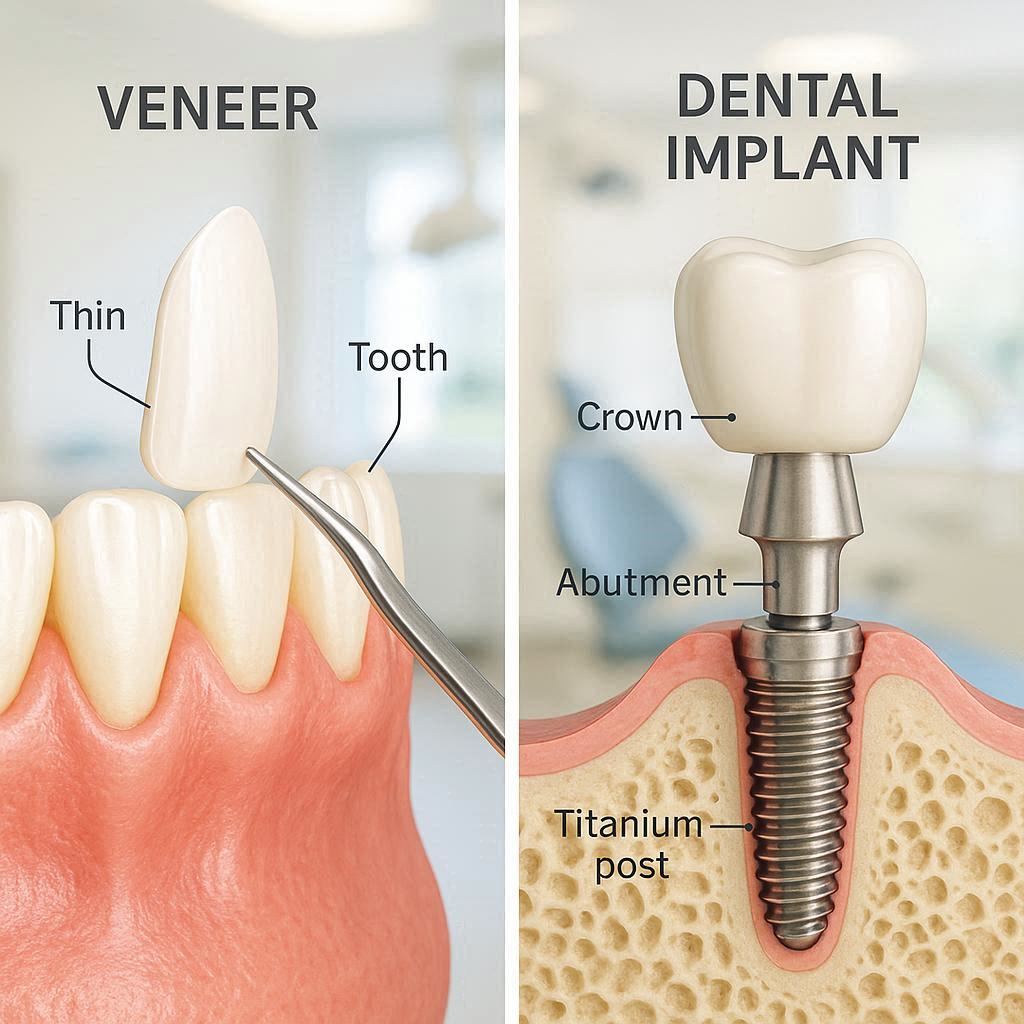
Let us start with the basics. A veneer is like a thin shell. Think of it as a mask for the front of your tooth.
A dentist bonds this shell to the existing tooth. You do not remove the tooth. You keep your natural tooth root and most of the natural tooth structure. The veneer simply covers the front surface to change its appearance.
The Real-Life Purpose of a Veneer
Veneers are cosmetic. That is their main job. They hide problems that make you feel self-conscious when you smile.
You might get a veneer if:
- You have a tooth that is chipped or cracked
- You have a tooth that is permanently stained (bleaching does not work)
- You have a small gap between two teeth
- You have a tooth that is slightly misshapen or too small
- You have minor crowding that you do not want to fix with braces
Notice something important. All these problems are about looks. Veneers do not fix a tooth that is dying. They do not fix a tooth that is rotten. They do not fix a missing tooth.
Two Main Types of Veneers
Porcelain veneers are the most popular choice. They resist stains very well. They reflect light just like natural tooth enamel. They last between 10 and 15 years with good care. But they are more expensive, and the process is permanent because your dentist must remove a thin layer of enamel from your natural tooth.
Composite resin veneers are a more affordable alternative. Your dentist builds them directly onto your tooth using a tooth-colored material. They usually last between 4 and 8 years. They are easier to repair if they chip. However, they stain more easily and are not as strong as porcelain.
The Veneer Procedure: What Actually Happens
Getting veneers usually takes three visits.
First visit: You talk with your dentist about what you want to change. They examine your teeth and gums to make sure veneers are a good option for you.
Second visit: Your dentist numbs the area. Then they remove a very thin layer of enamel from the front of your tooth. For porcelain veneers, this is about 0.3 to 0.5 millimeters. That is roughly the thickness of a fingernail. Then they take a mold of your tooth and send it to a lab. You wear temporary veneers for one or two weeks.
Third visit: Your dentist removes the temporary veneers. They clean your natural teeth. Then they bond the permanent veneers into place with a special cement. A curing light hardens the cement immediately. You walk out with a new smile.
Important note: The enamel removal is irreversible. Once you get porcelain veneers, you will need some kind of covering on those teeth for the rest of your life.
What Exactly Is a Dental Implant?
Now let us talk about implants. A dental implant replaces an entire tooth. Not just the part you see. The whole thing.
An implant has three parts:
- A titanium post (surgically placed into your jawbone)
- An abutment (a small connector piece)
- A dental crown (the visible fake tooth)
The Real-Life Purpose of a Dental Implant
Implants are not primarily cosmetic. They are restorative. That means they fix a serious medical problem: missing teeth.
You might get a dental implant if:
- You have lost a tooth due to injury
- You have lost a tooth due to severe decay
- You have lost a tooth due to gum disease
- You are tired of dealing with a denture or a dental bridge
- You want to stop your other teeth from shifting into the empty space
An implant does something that a veneer cannot do. It replaces the root of the tooth. That root is important. When you lose a tooth, your jawbone starts to shrink in that spot. An implant stops that bone loss because the titanium post fuses with your living bone. That process is called osseointegration.
The Implant Procedure: What Actually Happens
Getting an implant takes much longer than getting veneers. Plan for several months.
First visit (surgery): Your oral surgeon or dentist numbs the area. They make a small cut in your gum. Then they drill a tiny hole into your jawbone and place the titanium post. Then they close the gum over the post. You go home and wait.
Healing phase (3 to 6 months): This is the most important part. Your bone grows around the titanium post and locks it into place. You cannot rush this step. If you try, the implant will fail.
Second visit (abutment placement): Once the implant is stable, your dentist makes another small cut to expose the top of the post. They attach the abutment. Then they let your gum heal around it for another two weeks.
Third visit (crown placement): Your dentist takes a mold of your mouth. A lab makes your custom crown. Then your dentist screws or cements the crown onto the abutment. You now have a new tooth that looks, feels, and functions almost exactly like a natural tooth.
Important note: Some people can get “same-day implants” or “teeth-in-a-day.” But that is not for everyone. Most people still go through the traditional multi-month process.
The Side-by-Side Comparison Table
Let us make this crystal clear. This table shows the biggest differences at a glance.
| Feature | Veneers | Dental Implants |
|---|---|---|
| What it replaces | Only the front surface of a tooth | The entire tooth (root + crown) |
| Natural tooth required | Yes. You must have a healthy tooth underneath | No. The tooth is completely missing |
| Surgery required | No. Just minor enamel removal | Yes. Oral surgery to place titanium post |
| Typical lifespan | 10-15 years (porcelain) / 4-8 years (composite) | 20-30+ years (often a lifetime) |
| Average cost per tooth | $900 – $2,500 (composite) / $1,500 – $5,000 (porcelain) | $3,000 – $6,000 (single implant + crown) |
| Procedure time | 2-3 weeks from start to finish | 3-9 months from start to finish |
| Pain level | Minimal to none | Moderate (during healing) |
| Insurance coverage | Rarely covers (cosmetic) | Often covers part (restorative) |
| Does it stop bone loss? | No | Yes |
Can You Get Veneers on an Implant?
This is a common point of confusion. People assume that because both products look like pretty white teeth, you can mix and match them.
Here is the reality: You cannot put a veneer on a dental implant.
Why? Because a veneer needs a natural tooth underneath. The bonding cement sticks to natural enamel. That bond is strong but not magical. An implant crown is made of porcelain or zirconia. Veneer cement does not stick to those materials the same way it sticks to natural enamel.
What you can do is put a crown on an implant. That crown can look just as beautiful as a veneer. But it is not called a veneer. It is called an implant crown.
Some people get veneers on their natural teeth next to an implant. That is perfectly fine. But the implant itself will always have a crown, not a veneer.
Which One Is Right for You? A Decision Flow
No two smiles are the same. But you can ask yourself a few simple questions to narrow down your choice.
Ask Yourself Question #1: Do I still have the tooth?
Yes, I have the tooth. It is just ugly. → You are a candidate for veneers (or crowns, or bonding, or whitening). Implants are not for you because you are not missing a tooth.
No, the tooth is completely gone. → You are a candidate for an implant (or a bridge, or a partial denture). Veneers cannot help you because there is nothing to stick them to.
Ask Yourself Question #2: Is my tooth healthy?
Yes, my tooth is healthy. I just hate how it looks. → Veneers are a great option. So are crowns or orthodontics. Talk to your dentist.
No, my tooth has a big cavity or a crack that goes deep. → You probably need a crown, not a veneer. If the tooth is beyond saving, you might need an extraction and then an implant.
Ask Yourself Question #3: What is my budget and timeline?
I want fast results and I have $2,000 to spend on one tooth. → Composite veneer.
I want the most durable option and I can wait a few months. → Porcelain veneer or implant, depending on whether you still have the tooth.
I want a permanent solution and money is not the main concern. → Implant (if missing a tooth). Porcelain veneer (if the tooth is present).
Ask Yourself Question #4: How do I feel about surgery?
The idea of someone drilling into my jawbone makes me very uncomfortable. → Avoid implants. Stick with veneers, crowns, bridges, or dentures.
I am fine with surgery if it means a better long-term result. → Implants are worth considering.
Five Situations Where Veneers Are the Better Choice
Let us get specific. Real people. Real problems. Real solutions.
1. The Stained Tooth That Won’t Whiten
Sarah is 34 years old. She took tetracycline antibiotics as a child. Her teeth are grayish-brown in patches. Whitening strips did nothing. Professional bleaching helped a little but not enough.
For Sarah, veneers are an excellent choice. Her teeth are healthy. They are just discolored at a deep level that bleach cannot reach. Porcelain veneers will cover those stains completely.
2. The Chipped Front Tooth
Marcus is 28 years old. He tripped while running and chipped his front tooth. The chip is small but very noticeable when he speaks.
A single composite veneer can fix this in one visit. Cost: around $300 to $600. That is much cheaper than an implant, and he keeps his natural tooth root.
3. The Gap Between Two Teeth
Linda is 41 years old. She has a small gap between her two front teeth. It never bothered her before, but now she feels self-conscious in video calls.
Veneers can close that gap without braces. Her dentist will place two veneers (one on each tooth) and make them slightly wider in the middle. The gap disappears in two weeks.
4. The Worn-Down Smile
David is 55 years old. He has been grinding his teeth for decades. His front teeth are now short and flat. They look like they belong to someone much older.
Veneers can restore the original length and shape of his teeth. However, he must wear a night guard to protect them. Otherwise, the veneers will crack from the same grinding habit.
5. The “Before Wedding” Makeover
Jessica is 29 years old. She is getting married in one month. She has several small cosmetic issues: one slightly crooked tooth, one old filling that turned dark, and one tooth that is shaped like a cone.
Veneers are perfect for her timeline. She can get eight veneers on her upper front teeth in three weeks. Her wedding photos will look exactly how she imagined.
Five Situations Where Dental Implants Are the Better Choice
These are completely different scenarios.
1. The Tooth Knocked Out in an Accident
Mike is 22 years old. He plays recreational hockey. A puck hit him in the mouth and knocked out his front tooth completely. The tooth could not be saved.
Mike needs an implant. There is no tooth left to put a veneer on. A dental bridge would work, but that requires grinding down the two healthy teeth next to the gap. An implant does not touch those healthy teeth.
2. The Failed Root Canal
Patricia is 58 years old. She had a root canal on a lower molar ten years ago. Now that tooth is cracked vertically. The crack goes down into the root. No dentist can save it.
Patricia will have the tooth extracted. Once it heals, she can get an implant. A veneer was never an option because the tooth was already dead and failing.
3. The Long-Term Denture Wearer
Robert is 67 years old. He has worn a lower denture for fifteen years. He hates it. The denture clicks when he talks. It floats up when he eats. He cannot taste his food properly.
Robert is a perfect candidate for implant-supported dentures. Four to six implants hold the denture firmly in place. He will not need veneers because he has almost no natural teeth left.
4. The Single Missing Molar
Emma is 32 years old. She had a back molar extracted two years ago because of a deep cavity. She did not replace it. Now the tooth above it has started drifting downward. The teeth next to the gap have tilted.
Emma needs an implant to stop that damage. The implant will hold the space open. It will also preserve her jawbone in that area. Veneers cannot help because the tooth is gone.
5. The Person Who Wants “One and Done”
Kevin is 45 years old. He hates going to the dentist. He wants a solution that he never has to think about again.
A dental implant, cared for properly, can last 40 years or more. That is as close to “forever” as modern dentistry gets. Porcelain veneers typically need replacement after 10 to 15 years. For Kevin, the implant is worth the upfront surgery.
The Cost Breakdown: Veneers vs Implants
Money matters. Let us talk real numbers in the United States. These are averages. Your actual cost will depend on where you live, who you see, and what your insurance covers.
Veneer Costs
- Composite veneer (direct): $250 to $1,500 per tooth
- Porcelain veneer (traditional): $1,500 to $5,000 per tooth
- Porcelain veneer (no-prep, like Lumineers): $800 to $2,500 per tooth
Most people get between four and ten veneers at once. That means a full smile makeover with porcelain veneers often costs $8,000 to $25,000.
Implant Costs
A single dental implant with crown breaks down like this:
- Implant post surgery: $1,500 to $2,500
- Abutment: $300 to $600
- Crown: $1,000 to $3,000
- Total single implant: $3,000 to $6,000
Multiple implants cost less per tooth. For example:
- Two adjacent implants: $5,000 to $10,000 total
- Four implants for a lower denture: $12,000 to $20,000 total
- Full mouth implants (All-on-4): $25,000 to $50,000 per arch
Which One Is Actually Cheaper?
Over the short term, veneers are cheaper. One composite veneer costs less than one implant.
Over the long term, the math changes. A dental implant lasts 30+ years. A porcelain veneer lasts 10 to 15 years. If you are 30 years old, you might replace those veneers two or three times in your life. Those replacement costs add up.
That said, implants are not always “worth it” for purely cosmetic problems. If your tooth is healthy and you just want to change its color, a veneer is the correct choice. An implant would require removing a perfectly good tooth. No ethical dentist would do that.
Note: Dental insurance usually covers part of the cost of implants because they are restorative. Veneers are almost never covered because insurance companies call them cosmetic. Check your policy carefully.
Longevity and Maintenance: What to Expect Years Later
Let us look at the real world. What happens five years after your treatment? Ten years? Twenty years?
Veneers After 5 Years
- Porcelain veneers still look excellent. No staining.
- Composite veneers might show some edge wear and minor staining around the gums.
- Your natural teeth behind the veneers are still healthy if you brush and floss properly.
- You might notice that your gums have receded slightly, exposing the margin where the veneer meets the tooth. That margin can trap plaque if you do not clean it well.
Veneers After 10 Years
- Porcelain veneers may need replacement soon. The bonding cement can weaken. Some edges might chip.
- Composite veneers are likely chipped, stained, or both. Most need replacement by year eight.
- Some people develop cavities at the margin between the veneer and the tooth. Those cavities require a whole new veneer or even a crown.
- Your bite might have changed, causing uneven pressure on certain veneers.
Implants After 10 Years
- Most implants are still rock solid. Success rates for implants after ten years are over 95%.
- The crown on top might show some wear, especially if you grind your teeth. Crowns can be replaced without touching the implant post.
- Your gum tissue around the implant might have receded slightly. This can expose a dark metal line if you have a cheaper crown with a metal base.
- You brush and floss normally. No special tools are needed except for floss designed for implants.
Implants After 20 Years
- The implant itself is likely still fused to your bone. Implant failure after the first year is very rare.
- You may have replaced the crown once or twice, depending on how hard you bite.
- Your jawbone in that area remains healthy because the implant stimulated the bone all those years.
- You might need a “gum graft” if your gums receded too much and exposed the threads of the implant.
Maintenance Summary Table
| Maintenance Task | Veneers | Implants |
|---|---|---|
| Brush twice daily | Yes | Yes |
| Floss daily | Yes (carefully) | Yes (special floss) |
| Avoid biting hard objects (ice, pens) | Yes (will chip) | Yes (will crack crown) |
| Night guard if you grind | Essential | Recommended |
| Professional cleaning every 6 months | Yes | Yes |
| Replace every… | 10-15 years (porcelain) | Crown: 15-20 years / Post: lifetime |
Risks and Complications You Should Know
No dental procedure is risk-free. Here is the honest truth about what can go wrong.
Veneer Risks
Sensitivity to hot and cold. This is very common after enamel removal. It usually goes away within a few weeks. Sometimes it lasts for months. Rarely, it is permanent.
Veneer detachment. The bonding cement fails. Your veneer pops off while you are eating an apple. A dentist can usually re-bond it the same day.
Tooth decay underneath. If the veneer margin is not perfect, bacteria can get in. You will not see the cavity because the veneer covers it. By the time you feel pain, the decay may be deep. This can lead to a root canal or tooth loss.
Irreversible change. Once you remove enamel, you cannot go back. If you hate your veneers, you cannot simply “remove them” and have your old teeth back. You would need new veneers or crowns.
Gum disease risk. Poorly fitting veneers trap plaque. Your gums become red, swollen, and bleeding. Over time, that leads to gum recession and bone loss.
Implant Risks
Implant failure (early). The implant does not fuse with the bone. This happens in about 2-5% of cases. Smokers have a much higher failure rate. People with uncontrolled diabetes also have higher risk.
Infection. The surgical site can get infected. Symptoms include increasing pain, swelling, fever, and a bad taste in your mouth. Antibiotics usually fix it. Severe infections may require removing the implant.
Nerve damage. Implants placed in the lower jaw near the nerve can cause numbness in your lip, chin, or tongue. This is rare with experienced surgeons but possible. Sometimes the numbness is permanent.
Sinus problems. Upper jaw implants can poke into your sinus cavity. This causes sinus infections, facial pain, and a feeling of pressure. A sinus lift surgery before the implant can prevent this.
Gum recession around the implant. Over time, your gums may shrink away from the implant crown. This exposes the metal abutment or the threads of the implant. It looks ugly and can trap food.
Peri-implantitis. This is like gum disease but around an implant. Bacteria infect the gum and bone around the implant. It slowly destroys the bone. If not treated, the implant becomes loose and must be removed. This is the number one cause of late implant failure.
Important: Both veneers and implants require a commitment to excellent oral hygiene. They are not “set it and forget it” solutions.
Frequently Asked Questions (FAQ)
Can I whiten my veneers or implants?
No. Veneers and implant crowns do not respond to bleach. If you want whiter teeth, you must whiten your natural teeth before getting veneers or crowns. Afterward, the artificial teeth will stay the same color while your natural teeth change.
Do veneers or implants hurt more?
Implants hurt more during the healing phase. You will have swelling and discomfort for several days after implant surgery. Veneers involve minimal pain. Most people get veneers with only local numbing and feel fine the same day.
Can I get veneers if I grind my teeth at night?
Yes, but you must wear a night guard. Grinding will crack porcelain veneers within months. Composite veneers will wear down even faster. Without a night guard, you are wasting your money.
Can I get an implant if I smoke?
Yes, but your failure rate is much higher. Smokers have implant failure rates of 10-20% compared to 2-5% for non-smokers. If you can quit for two months before and after surgery, your chances improve significantly.
Are veneers reversible?
No. Porcelain veneers require enamel removal. That enamel never grows back. Composite veneers require minimal to no enamel removal, but they still change the tooth surface.
Are implants reversible?
No. The surgery removes bone to place the titanium post. If you remove the implant, you are left with a hole in your bone. You could get another implant in the same spot, but you cannot “go back” to having a natural tooth there.
Which one looks more natural?
Both can look completely natural when done by an expert. Porcelain veneers reflect light exactly like natural enamel. Implant crowns are also made of porcelain. The difference is that an implant has no periodontal ligament, so it feels different when you bite. Most people cannot tell by looking.
Can I eat normally with veneers?
Yes, but avoid biting hard things with your front teeth. Do not use your veneers to open packages, bite ice, or crack nuts. Eat apples by cutting them into slices. Corn on the cob is fine if you cut the kernels off.
Can I eat normally with implants?
Yes, absolutely. Once healed, an implant functions like a natural tooth. You can bite into an apple or eat a steak. The crown is strong. Just do not abuse it.
How do I find a good dentist for veneers or implants?
Look for before-and-after photos of real patients. Read reviews on Google and Yelp. Ask about warranties (some dentists guarantee veneers for 5-10 years). For implants, look for a specialist like a periodontist or oral surgeon. General dentists can do implants too, but specialists have more training.
Additional Resource
For more detailed, evidence-based information, visit the American Academy of Cosmetic Dentistry (AACD) official website:
https://www.aacd.com
You can also review patient education materials from the American Dental Association (ADA) at:
https://www.ada.org/en/resources
Conclusion
Veneers cover existing teeth to fix cosmetic problems like stains, chips, and gaps. Dental implants replace entire missing teeth, including the root, to restore function and stop bone loss. Choose veneers if you have a healthy but unattractive tooth, and choose implants if you have a missing tooth that needs a permanent solution.