How Long Does the Snow Teeth Whitening Kit Last?
Investing in an at-home teeth whitening system feels good until a nagging worry creeps in: will this kit whiten my teeth for a month and then run dry, leaving me with a half-finished result? When you purchase a Snow Teeth Whitening Kit, you are not just buying a plastic tray and an LED light; you are buying a finite volume of whitening serum. Understanding the longevity of that serum, the durability of the hardware, and the realistic timeline of results is essential for calculating the true value of the product.
The question “How long does the Snow Teeth Whitening Kit last?” has two distinct meanings. First, how many individual whitening sessions are in one box? Second, how long do the results remain visible once you achieve your desired shade? This article will answer both questions with precision. We will analyze the milliliter volume of the wands, the required dosage per session, the shelf life of the chemistry, and the maintenance protocols that extend the cosmetic outcome. By the end, you will know exactly when to reorder and how to avoid wasting a single drop.
Understanding the Snow Kit Components and Their Lifespan
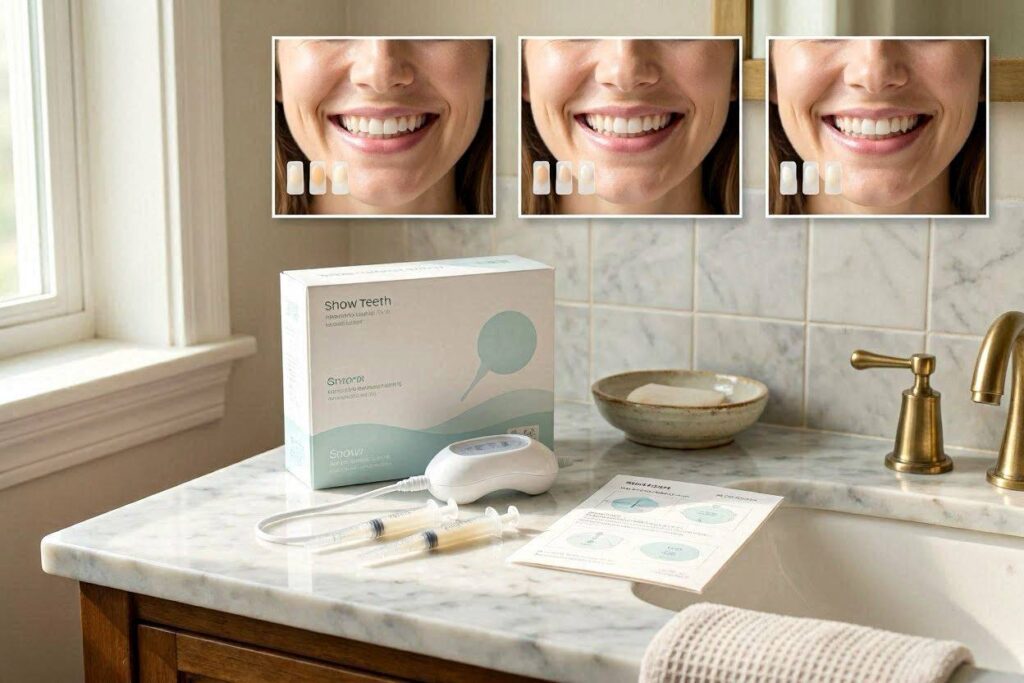
A standard Snow Teeth Whitening Kit is not a monolithic product; it is an assembly of consumable chemicals and durable electronics. Their respective lifespans vary dramatically.
The Whitening Wand (The Consumable Core):
The flagship Snow kit typically includes one or two “Max Strength” or “Magic” whitening wands. Each wand contains a specified volume of serum. The standard wand holds approximately 5 to 10 milliliters of gel, depending on the generation of the product. The company’s marketing suggests that one wand provides up to 20-30 applications, enough for 10-15 days of twice-daily treatment, or a full 21-day “challenge” cycle if applied carefully.
The LED Mouthpiece (The Hardware):
Snow’s mouthpiece is an electronic device with a specific number of activation cycles. It uses proprietary LED and, in some models, sonic vibration technology. The internal lithium battery is rated for a specific number of charge cycles, typically far exceeding the lifespan of the wands. A well-maintained Snow mouthpiece can last 2-3 years of continuous use before the battery degrades to the point of requiring frequent recharging.
The Desensitizing Serum (The Aftercare):
Some kits include an ancillary wand or paste for post-whitening care. This product is generally used less frequently and in smaller amounts than the whitening gel, so it tends to outlast a single whitening cycle, often covering two full treatment cycles before needing replacement.
Session Math: How Many Full Treatments Per Wand?
The manufacturer’s claim of “up to 30 treatments” assumes a near-microscopic application. In reality, user behavior and biology determine the true number. A “treatment” in Snow’s terms means applying a thin, even coat to the front six to eight anterior teeth—the smile teeth. If you attempt to whiten the full arch from premolar to premolar on both top and bottom, you will use significantly more gel.
Let’s break down the realistic math. A 5ml wand contains 5,000 microliters. A single, carefully applied layer on the upper and lower anterior teeth requires roughly 150 to 200 microliters (a volume roughly equivalent to three to four small rice grains). At a consumption rate of 175 microliters per session, a 5ml wand mathematically provides approximately 28 sessions. This aligns closely with Snow’s marketing.
However, this math assumes zero product waste. In practice, a small amount of gel remains on the brush tip, you might over-apply slightly on the first few teeth, and a fraction of the gel inevitably gets diluted by saliva and spat out during removal. Realistic yield from one wand is typically 18 to 24 daily sessions. If you follow the standard protocol of 21 days of daily use, one wand is often enough to complete a single treatment cycle, but you will be scraping the inside of the applicator barrel by the final days.
For those with stubborn stains or who wish to whiten all premolars and canines aggressively, a single kit may only provide 10-14 days of full-coverage treatment. Snow anticipates this by offering multi-wand bundles or subscription refills, acknowledging that a true “full whitening course” often consumes more than one starter wand.
Shelf Life: The Expiration of Whitening Chemistry
Even if you ration your serum perfectly, chemical degradation marches forward. The active ingredient in most Snow wands is hydrogen peroxide. Hydrogen peroxide is thermodynamically unstable and naturally decomposes into water and oxygen over time, even in a sealed container.
Unopened Wand:
A factory-sealed, unopened Snow wand stored at room temperature (away from direct heat and sunlight) typically carries a shelf life of 12 to 18 months from the date of manufacture. The expiration date is printed on the box or the wand itself. Before this date, the manufacturer guarantees the stated concentration of peroxide. Using a wand that is 2 months past its expiration date but has been stored in a cool, dark drawer is unlikely to be harmful; it will simply be less potent, as a significant portion of the peroxide will have degraded into inert water.
Opened Wand:
Once you break the seal and introduce air and oral bacteria (via the brush tip touching teeth), the clock accelerates. The brush tip can wick moisture back into the barrel, hydrolyzing the remaining peroxide. An opened wand has an effective usable lifespan of 30 to 60 days. After this period, you will likely notice the gel becoming watery and thin, and the whitening results diminishing markedly. You should discard the wand 60 days after opening, regardless of how much gel remains, to prevent applying a contaminated or completely degraded product.
Comparative Table: Snow Kit Longevity by Component
| Component | Capacity/Volume | Expected Number of Uses | Replacement Cycle | Signs of Exhaustion |
|---|---|---|---|---|
| Whitening Wand (5ml) | ~175µl per full-arch session | 18–28 sessions (1 cycle) | Every 30–60 days after opening | Watery consistency, no foaming, zero sensitivity change. |
| LED Mouthpiece | 80–120 minutes per full charge | 15–20 sessions per charge | 2–3 years (battery lifespan) | Dimming of LED lights, rapid battery drain, no power. |
| Desensitizing Serum | 5–10ml tube | 40–60 spot applications | 3–6 months after opening | Separation of liquid and paste, lack of soothing effect. |
| Charging Cable | N/A | N/A | Life of kit if handled gently | Frayed wires, intermittent connection. |
The Anatomy of a Whitening Cycle: Primary Treatment
Snow’s marketing revolves around the “21-Day Challenge.” Understanding this timeline helps contextualize how long the kit lasts in terms of daily routine.
Phase 1: Rapid Brightening (Days 1-7):
Users apply the serum for 10 to 30 minutes daily. During this phase, the peroxide penetrates the enamel and targets the most superficial extrinsic stains. Color change is typically rapid and visually gratifying. Serum consumption is high because the stain load is large.
Phase 2: Deep Stain Oxidation (Days 8-14):
The peroxide now reaches the intrinsic dentin stains, those deep-set yellow chromophores that have accumulated over years. The color shift slows, creating a “plateau effect.” Some users become discouraged and over-apply, wasting serum unnecessarily. This is the critical phase where precise dosage is most important.
Phase 3: Stabilization (Days 15-21):
The tooth shade nears its natural whiteness ceiling. Continued application serves to stabilize the oxidized state and fully express the result. Serum usage here can be reduced to a “maintenance” amount without sacrificing progress.
By the end of day 21, a single starter wand is usually nearly or completely depleted. If your staining was severe, the wand likely ran out around day 18, leaving the last few days with lighter, less potent residue.
Result Longevity: How Long Does the Whiteness Last?
This is the second interpretation of the question, and arguably the more important one. You have finished a kit; your teeth are gleaming. How many months pass before the yellow creeps back? Snow is not a permanent treatment because you continue to consume pigmented foods and beverages.
Without Maintenance:
If you finish a 21-day cycle, achieve your dream shade, and immediately return to drinking three cups of black coffee a day without any whitening touch-ups, the results will begin to fade within 1 to 2 months. The newly oxidized dentin will slowly re-stain, and the superficial enamel pellicle will accumulate new chromophores. Within 3 to 4 months, you will lose roughly 40-50% of the initial shade improvement.
With Weekly Maintenance:
Snow designed their system as a “lifestyle product” precisely for this reason. By applying the serum for just 10 minutes once per week after the initial cycle, you can maintain the results almost indefinitely. Under a weekly maintenance protocol, a single refill wand can last 4 to 6 months, as you are only using a fraction of the volume per month. This is the most economically efficient way to use the system.
Extending the Life of Your Snow Kit: Practical Protocols
Maximizing the lifespan of the wand and the results requires a systematic approach that goes beyond what’s written in the quick-start guide.
Serum Conservation Technique:
Do not paint the gel onto the tray. Paint it directly onto the dry teeth first, and then insert the tray. This ensures 100% of the active peroxide is in contact with the enamel and not smeared uselessly across the plastic of the tray where it never touches the tooth. Use a single, continuous stroke per tooth, not a scrubbing motion. The brush tip should deposit a film, not a frothy lather.
Proper Wand Hygiene:
After every use, wipe the brush tip with a clean, dry tissue before recapping. Do not rinse the wand tip under water. Introducing tap water into the barrel speeds up the hydrolytic decomposition of the peroxide. Store the wand standing upright, tip-down, in a cool medicine cabinet. This prevents air bubbles from settling at the applicator base and causing uneven oxidation of the gel.
Mouthpiece Battery Care:
Lithium-ion batteries degrade fastest at extreme states of charge. Do not leave the mouthpiece plugged in and charging 24/7. Charge it fully, unplug it, and allow the battery to drain to approximately 20% before recharging. Store the mouthpiece in a dry place. Moisture ingress from a wet bathroom counter can corrode the internal electronic contacts long before the battery fails.
The Cost-Per-Session Analysis
Understanding the kit’s lifespan leads directly to a cost-per-use calculation, which is the most honest measure of value. Assume a full Snow kit costs $150 and contains one wand (24 real-world sessions) and an LED mouthpiece with a 3-year life expectancy. If you buy one kit per year to refresh your wands, and your mouthpiece lasts 3 years, the amortized math works out as follows:
- Initial Hardware Investment (Mouthpiece): The $150 kit effectively includes a $60 mouthpiece (averaged over time) and a $30 wand.
- Annual Refill Cost: A replacement wand or a multi-pack refill kit typically costs around $30-$40. If you do one 21-day cycle and then 6 months of weekly maintenance, you might go through two wands per year ($70 total).
- Cost Per Session: Over 100 whitening sessions across a year, the cost per session drops to approximately $0.70 to $1.00.
Compare this to a single in-office laser whitening session costing $400-$600 that lasts a comparable duration without constant maintenance. The kit’s lifespan economics favor the consistent, long-term user who methodically maintains their results, not the one-time user who lets the kit sit in a drawer for a year until the gel expires.
What Happens When the Wand “Runs Out” But Doesn’t Look Empty?
A common frustration with the Snow wand design is that the opaque or frosted barrel makes it difficult to see the exact remaining volume. You will twist the click-pen mechanism and hear it turning, but no gel dispenses onto the brush. Users often assume the pen is broken or that there is a hidden reservoir.
The pen mechanism is a screw-driven piston. When the piston reaches the top of the barrel, the pen is mechanically empty. However, a thin film of gel always remains coating the inside of the barrel and the brush channel. To access the absolute last 3-4 sessions’ worth of gel, remove the brush tip and the inner stopper plug. Use a thin, clean cotton swab or an interdental brush to gently scrape the inside of the barrel. You can collect enough gel for a single, full-arch emergency session. This is not a long-term solution, but it prevents waste when you are a day or two short of finishing a cycle.
The Environmental Factor: Heat and Sunlight
The longevity of the peroxide in the wand is exquisitely sensitive to environmental conditions. A chemical kinetic rule of thumb is that the rate of peroxide decomposition doubles for every 10°C (18°F) increase in temperature. If you store your Snow kit in a bathroom that steams up during hot showers, the internal temperature can spike to 35-40°C (95-104°F). A wand stored in a hot bathroom will lose its potency 2-3 times faster than one stored in a stable, cool 20°C (68°F) bedroom drawer.
Similarly, UV light catalyzes peroxide breakdown. The opaque wand packaging is designed to block light, but the clear brush tip is not. Store the wand in a dark place. Never leave it on a sunny windowsill. If you travel with your kit, do not check the wand in luggage that will sit on a hot airport tarmac; pack it in carry-on in a climate-controlled cabin.
Conclusion
- A single Snow whitening wand delivers 18 to 24 realistic full-arch applications, enough to complete one 21-day primary treatment cycle with disciplined, conservative application, and the LED mouthpiece is a durable electronic lasting multiple years.
- The whitening results from a completed cycle begin fading within 1-2 months without maintenance, but a single weekly 10-minute touch-up extends the cosmetic outcome for 6 months or more, making a refill wand last far longer in the maintenance phase.
- Maximizing kit longevity hinges on proper storage in a cool, dark, dry environment, a clean brush tip, and a direct-tooth application technique that eliminates wasted gel lost to the tray.
Frequently Asked Questions
Can I use Snow Whitening Kit past its expiration date?
Using an unopened wand a few weeks past its stamped expiration date is generally safe—the peroxide will have partially degraded, so the gel will be less effective, not toxic. An opened, 6-month-old wand should be discarded entirely, as bacterial contamination and complete chemical inactivation make it both ineffective and unhygienic.
How do I know if my LED mouthpiece is dying?
The most reliable sign is a drastic reduction in operating time after a full charge. If the mouthpiece initially ran for 120 minutes and now powers off after 20 minutes, the lithium battery is reaching the end of its cycle life. Also, visually inspect the LED lights through a phone camera; a dying LED array may have visible dead spots.
Why does my wand gel turn watery after a month?
This indicates that moisture has wicked into the barrel, likely from saliva on the brush tip or from rinsing the tip under water. The moisture dilutes the viscous glycerin base and catalyzes the breakdown of the peroxide into water and oxygen, leaving a thin, useless liquid behind.
Does using the Snow kit twice a day make the wand last longer or shorter?
It makes the wand deplete faster in real-time days. However, chemically, the peroxide molecules do not care about the clock on the wall. The total number of sessions the wand can provide is fixed by the total mass of peroxide. Twice-daily application simply consumes that fixed resource in a condensed period.
Is it worth buying a second kit just for the mouthpiece?
No. Snow sells replacement wands and even mouthpieces individually through their website. Unless the bundled promotion makes the full kit cheaper than the sum of a mouthpiece plus two wands, do not accumulate redundant LED hardware you do not need.
Additional Resource:
For an in-depth understanding of the peroxide chemistry that governs the shelf life of your whitening kit, the American Chemical Society provides a robust overview of hydrogen peroxide stability and decomposition. <a href=”https://www.acs.org/molecule-of-the-week/archive/h/hydrogen-peroxide.html” target=”_blank” rel=”noopener noreferrer”>ACS: Hydrogen Peroxide Molecule of the Week</a>
Disclaimer: This article is for informational and educational purposes only. It does not constitute medical or dental advice. Product lifespans and formulations can vary by batch and manufacturer specifications. Always follow the specific instructions included with your Snow Teeth Whitening Kit and consult with a dental professional if you have concerns about whitening treatments.
Meta Description: A comprehensive comparison of carbamide peroxide vs. hydrogen peroxide for teeth whitening. Discover the potency, application time, sensitivity risks, and which agent is best suited for your lifestyle and stain type.
Which Is Better for Teeth Whitening: Carbamide Peroxide or Hydrogen Peroxide?
Walk down the dental care aisle or browse professional whitening kits online, and you will see two ingredients dominating the labels: hydrogen peroxide and carbamide peroxide. They promise the same endpoint—a radiant smile—but they arrive there by slightly different chemical routes and timelines. The choice between them is not merely a marketing gimmick; it impacts application wear time, the speed of results, the intensity of potential side effects, and the overall suitability for your specific teeth.
So, which is better for teeth whitening: carbamide peroxide or hydrogen peroxide? The honest, nuanced answer is that neither is universally superior. Hydrogen peroxide acts faster and is often preferred for short-contact professional treatments or quick at-home strips. Carbamide peroxide is a slower-release, longer-acting reservoir of peroxide that excels in overnight tray systems and sustained, gentle whitening. This article will dismantle the chemistry of these two molecules, analyze their clinical performance metrics, and match them to your lifestyle so you can make an informed, personalized decision rather than a guess based on label hype.
The Fundamental Chemistry: A Parent and a Daughter Molecule
To choose wisely, you must grasp the relationship between these two compounds. It is not a comparison of two entirely separate entities. Carbamide peroxide is a chemical complex—a “precursor”—that breaks down into hydrogen peroxide.
Carbamide peroxide consists of hydrogen peroxide bonded loosely with urea. When carbamide peroxide comes into contact with water (saliva, the moisture in tooth enamel, or the gel base), it undergoes solvolysis. The chemical bond breaks, releasing urea and the active whitening agent: hydrogen peroxide.
Think of carbamide peroxide as a slow-release capsule or a reservoir. Hydrogen peroxide is the immediate-release, active free radical. A 10% carbamide peroxide gel does not contain 10% hydrogen peroxide. Upon breakdown, 10% carbamide peroxide yields approximately 3.5% hydrogen peroxide, alongside roughly 6.5% urea. The urea further breaks down into ammonia and carbon dioxide, which can mildly elevate the pH of the oral environment, potentially having an ancillary alkaline cleansing effect, though clinically this is minor.
When you apply hydrogen peroxide gel directly, you are delivering the active oxidative species directly to the enamel surface with no conversion delay. The free radicals begin penetrating the porosities immediately. When you apply carbamide peroxide, you are creating a sustained-release chemical depot that slowly generates hydrogen peroxide over a period of 2 to 6 hours.
The Speed of Action: Immediate Strike vs. Gradual Release
The most dramatic performance difference between these two agents is the rate of chromophore destruction. This dictates everything about the user experience.
Hydrogen Peroxide (The Sprinter):
Direct hydrogen peroxide formulations operate at concentrations typically ranging from 1.5% (gentle daily strips) to 6% (strong at-home tray gels) all the way up to 25-40% for in-office chairside treatments. Because the free radicals are fully available immediately, the oxidation of stain molecules begins the instant the gel touches the tooth. Peak whitening activity occurs within the first 15 to 30 minutes of application. After 45 to 60 minutes, the available free radicals in a hydrogen peroxide gel are largely spent, and the chemical activity plateaus.
This rapid action makes hydrogen peroxide the ideal agent for short-wear-time products: 30-minute strips, in-office laser light activated sessions, or quick-application pens. You get a significant shade jump in a very brief window. The trade-off is that this rapid oxidative burst can also create a rapid onset of sensitivity. The nerve in the pulp experiences a concentrated dose of oxidative stress in a compressed timeframe.
Carbamide Peroxide (The Marathoner):
Carbamide peroxide formulations are typically sold in concentrations of 10% (yielding 3.5% H2O2), 15% (yielding ~5.2% H2O2), or 20% (yielding ~7% H2O2). When you place a carbamide peroxide gel into a sealed tray, the breakdown begins. The initial release of hydrogen peroxide occurs within minutes, but the peak concentration of active hydrogen peroxide in the enamel isn’t reached for approximately 1 to 2 hours. The reservoir then continues to release lower, steady-state amounts of peroxide for 4 to 6 hours, sometimes longer.
This makes carbamide peroxide the agent of choice for overnight whitening trays. You wear the tray for 4-8 hours while you sleep. The chemical reaction is prolonged and gentle. The free radical exposure per minute is lower, which tends to produce a milder, more gradual onset of tooth sensitivity. The trade-off is that you must be comfortable sleeping with a tray in your mouth, and the absolute shade change on day one is less dramatic than with a high-potency hydrogen peroxide treatment.
Comparative Table: Performance Metrics of Carbamide Peroxide vs. Hydrogen Peroxide
| Performance Parameter | Hydrogen Peroxide (Direct) | Carbamide Peroxide (Precursor) |
|---|---|---|
| Active Species Released | 100% available immediately | ~3.5% H2O2 released from 10% CP over hours |
| Optimal Wear Time | 15–60 minutes (Short, intense) | 2–8 hours (Extended, gentle) |
| Peak Activity Window | First 20 minutes | Hours 1 through 4 |
| Shelf Life Stability | Less stable; degrades faster if not refrigerated | More stable in gel form; longer shelf life |
| Sensitivity Profile | Higher peak sensitivity; faster onset | Lower peak sensitivity; delayed, diffuse onset |
| Gingival Irritation | Slightly higher risk in short exposures | Can cause mild sloughing from prolonged contact |
| Odor/Taste | Often neutral or slightly acidic | Slight ammonia scent from urea breakdown |
The Sensitivity and Safety Profile: Managing Nerve Response
Sensitivity is the number one reason patients discontinue whitening. Understanding how each agent interacts with the dental pulp is essential for a comfortable experience.
Hydrogen peroxide’s rapid peak concentration drives a swift osmotic and oxidative shock down the dentinal tubules. If you have teeth with exposed dentin (gum recession), thin enamel, or fractured margins, you will feel the “zing” almost immediately, often within the first 5-8 minutes of application. This sharp, shooting sensation is the nerve reacting to the sudden presence of reactive oxygen species. The advantage, though, is that the stimulus stops quickly once you remove the gel. You control the tap, and you can turn it off instantly if it becomes uncomfortable.
Carbamide peroxide’s prolonged, low-grade release creates a more deceptive sensitivity. You may feel completely comfortable for the first hour. Then, around hour three, a dull, lingering ache begins to build. Because the gel continues to generate peroxide for 6 hours, removing the tray at hour four does not immediately stop the reaction—the peroxide that has already saturated the enamel continues to oxidize and irritate for a short while afterward. The sensation is less sharp but more persistent. However, the urea component of carbamide peroxide has been suggested in some studies to have a mild stabilizing effect on proteins, possibly reducing the pulpal inflammatory response slightly compared to an equivalent pure peroxide dose, though the data is not conclusive.
For highly sensitive individuals, a low-concentration (10%) carbamide peroxide gel worn for 2 hours (rather than overnight) can be the optimal middle ground. You get the benefit of the sustained-release chemistry without trapping the nerve in a multi-hour oxidative bath. You manually truncate the exposure time to manage comfort.
The Additive Effect: Urea, pH, and Oral Environment
A distinguishing feature often overlooked in the “which is better” debate is the role of the urea carrier in carbamide peroxide. Urea has a biological effect beyond simply being a taxi for hydrogen peroxide. In the oral cavity, urea is hydrolyzed by bacterial ureases into ammonia and carbon dioxide. This reaction elevates the local pH.
Why does this matter? Cariogenic bacteria like Streptococcus mutans thrive in an acidic environment (pH 4.5–5.5), where they demineralize enamel. A slightly alkaline, ammonia-rich environment temporarily suppresses bacterial acid production. Some studies have shown that 10% carbamide peroxide trays worn overnight can slightly shift the oral pH toward neutral, offering a transient anti-caries adjunct benefit that pure hydrogen peroxide gels do not provide. This is not a primary reason to choose carbamide peroxide, but for patients with high caries risk or dry mouth, it is a favorable secondary characteristic.
Pure hydrogen peroxide gels, conversely, are typically formulated at a slightly acidic pH (around 4.5–5.5) to stabilize the peroxide molecule. High-quality professional hydrogen peroxide gels are heavily buffered, but discount or unregulated hydrogen peroxide products can be quite acidic, causing immediate surface etching upon contact. Always verify that a hydrogen peroxide product is labeled “neutral pH” or “buffered.”
Matching the Agent to Your Lifestyle and Stain Type
The “better” agent is the one that fits into your life and targets your specific discoloration. The choice is behavioral as much as it is chemical.
Choose Hydrogen Peroxide If:
- You need a quick result for an event and only have 30 minutes a day.
- You have a short attention span and will not tolerate wearing a tray for hours.
- You are treating primarily fresh, superficial extrinsic stains from food and drink.
- You want the “tap on/tap off” control where you can stop the session immediately if sensitivity arises.
- You are performing an in-office power whitening session.
Choose Carbamide Peroxide If:
- You prefer to whiten while you sleep and wake up to results.
- You have a history of severe, sharp, immediate sensitivity with strip products.
- You are treating deep-set, age-related, or tetracycline intrinsic staining that requires prolonged, sustained oxidation to gradually penetrate and break down stubborn chromophores.
- You want a product with a longer shelf life that does not degrade as quickly.
- You are fabricating custom-fitted dentist-prescribed whitening trays for a full-arch treatment protocol.
The Concentration Equivalence Table
A common point of confusion is comparing the strengths of the two agents directly. A 6% hydrogen peroxide strip is not equivalent to a 6% carbamide peroxide gel. The table below provides a quick clinical equivalence reference.
| Carbamide Peroxide Concentration | Approximate Equivalent Hydrogen Peroxide Yield | Clinical Categorization |
|---|---|---|
| 10% CP | ~3.5% H2O2 | Low-strength, safe for overnight or extended wear |
| 15% CP | ~5.2% H2O2 | Medium-strength, professional take-home tray system |
| 20% CP | ~7.0% H2O2 | Medium-high strength, 2-4 hour wear |
| 35% CP | ~12.2% H2O2 | Rare; in-office or closely supervised professional use |
| N/A (Pure H2O2) | 6% H2O2 | Standard “maximum” strength at-home strip or paint-on |
| N/A (Pure H2O2) | 25-40% H2O2 | Strictly in-office chairside, gingival barrier required |
The Clinical Evidence: Do They Achieve the Same Final Shade?
Multiple clinical studies have compared the final whitening endpoint of 10% carbamide peroxide used overnight versus 6% hydrogen peroxide used for 30 minutes daily. The consistent finding is that both agents, when used for equivalent total active peroxide exposure times (the “dose-time product”), produce statistically equivalent final shade changes at the 2-week mark.
The difference is purely in the time-course of the change. The hydrogen peroxide group experiences a rapid initial lightening during the first 3-5 days, then a plateau. The carbamide peroxide group shows a more linear, gradual improvement over the full 14 days. At day 14, a spectrophotometer cannot reliably distinguish which agent was used. Your eye will perceive the final whiteness as identical.
This means the decision should not be driven by a fear that one agent “won’t work as well.” The concern should be which agent you are more likely to use correctly and consistently. Compliance is the ultimate driver of clinical outcome. A perfectly applied 10% carbamide peroxide tray worn for 4 hours every night will outperform a 6% hydrogen peroxide strip that you skip every other day because the 30-minute session feels inconvenient.
The Stability Factor: Why Carbamide Peroxide Is King of the Shelf
For those who whiten in cycles, buying a kit and using it sporadically, the shelf life matters. Hydrogen peroxide is inherently unstable. Even in a sealed, refrigerated syringe, a 6% hydrogen peroxide gel will lose a measurable percentage of its potency within 3-6 months. Heat dramatically accelerates this loss. A hydrogen peroxide pen left in a hot car becomes water with flavoring within hours.
Carbamide peroxide, bound to the urea molecule, is significantly more stable at room temperature. A sealed 10% carbamide peroxide syringe can retain >90% of its labeled potency for 12-18 months when stored in a cool, dark drawer. This stability makes carbamide peroxide the preferred formulation for dentists who fabricate take-home kits; they can store the gel syringes in the office without refrigeration and know the patient will receive a product with reliable, predictable potency even if the patient does not start the treatment for several weeks.
Conclusion
- Hydrogen peroxide is better for rapid, short-contact whitening sessions where speed and user control over session length are paramount, delivering an immediate oxidative pulse ideal for strips and in-office power bleaching.
- Carbamide peroxide is better for sustained, long-duration delivery through overnight trays, providing an equivalent final shade result with a gentler sensitivity curve and superior chemical shelf stability.
- The final clinical whitening outcome at two weeks is statistically identical for equivalent dose-time products, meaning the true “better” agent is the one whose wear-time protocol (30 minutes vs. overnight) aligns perfectly with your daily habits, comfort tolerance, and compliance likelihood.
Frequently Asked Questions
Can I mix carbamide peroxide and hydrogen peroxide gels?
No. These are chemically distinct formulations with different carriers and release kinetics. Layering them provides an unpredictable, excessive total peroxide dose and dramatically increases the risk of severe pulpitis and gum burns without evidence of faster whitening.
Why do my gums turn white with carbamide peroxide but not hydrogen peroxide?
The prolonged contact time of carbamide peroxide, especially in ill-fitting trays that press against the gingiva, causes surface dehydration and oxidative desquamation of the thin gingival epithelium. The white, sloughing tissue resolves within hours. Hydrogen peroxide’s shorter contact time makes this less common but still possible with high concentrations.
Does carbamide peroxide taste worse than hydrogen peroxide?
Often, yes. The urea breakdown releases a faint ammonia odor and a bitter, medicinal aftertaste. Hydrogen peroxide gels can be formulated to be relatively tasteless, but the propylene glycol carrier has its own slightly sweet, chemical profile.
Which one do dentists use for custom trays?
The overwhelming majority of dentists prescribe carbamide peroxide (10-16%) for custom take-home trays precisely because of its stability, sustained release profile, and lower peak sensitivity risk during unsupervised overnight wear.
Is 35% carbamide peroxide safe to use at home?
No. A 35% carbamide peroxide gel yields roughly 12% hydrogen peroxide, which is an extremely high concentration for unsupervised use. This strength is generally reserved for in-office chairside application under professional supervision with a fully isolated gingival barrier to prevent severe chemical burns.