What Are the Different Types of Teeth Whitening?
The landscape of teeth whitening can feel like a bewildering marketplace of competing technologies, each claiming to be the definitive path to a brighter smile. The sheer variety—LED kits, charcoal powders, laser sessions, oil pulling, whitening strips, customized dental trays—creates a paralyzing paradox of choice. Without a clear framework for understanding the fundamental differences between these methods, consumers often default to the cheapest or most aggressively marketed option, not the one best suited to their biology, stain type, and sensitivity threshold.
The objective truth is that all legitimate whitening methods fall into a few discrete categories based on their mechanism of action, application setting, and chemical potency. Understanding these categories transforms a chaotic array of products into a logical decision matrix. This article serves as a definitive taxonomy of teeth whitening, systematically breaking down each type, explaining how it works, who it works for, and the critical trade-offs involved. By the end, you will possess the conceptual vocabulary to navigate any dental aisle or professional consultation with clarity and confidence.
The Master Taxonomy: Three Mechanisms of Action
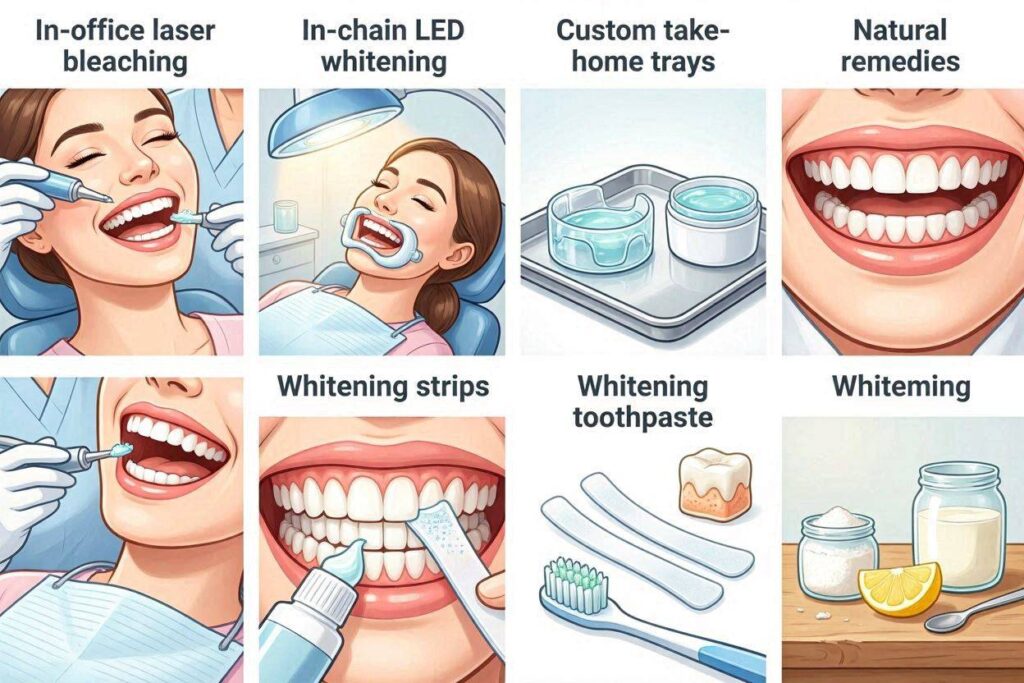
Before listing individual methods, we must establish the overarching mechanistic categories. Every whitening product or procedure operates through one, or a combination, of three fundamental physical or chemical actions:
- Chemical Oxidation (True Bleaching): The agent chemically breaks the double bonds of organic chromophore pigment molecules, transforming them into smaller, lighter-colored or colorless compounds. The active agents are hydrogen peroxide, carbamide peroxide, or, rarely, sodium perborate.
- Mechanical Abrasion (Surface Cleaning): The agent physically scrubs away the acquired pellicle, biofilm, and superficial extrinsic stains to reveal the inherently whiter, unstained enamel underneath. The enamel shade does not change chemically; it is simply cleaned.
- Optical Modification (Illusion): The agent creates a temporary optical effect—such as a blue-violet film that counteracts yellow wavelengths—making teeth appear whiter without any chemical or mechanical alteration of the tooth surface.
Type 1: In-Office Professional Power Bleaching
This category represents the highest octane, most rapid, and most tightly regulated form of whitening. It is performed exclusively by a licensed dental professional in a clinical setting.
How It Works:
The dentist applies a high-concentration hydrogen peroxide gel (typically 25% to 40%) directly to the isolated teeth. A gingival dam (a light-cured resin barrier) protects the soft tissues from chemical burns. The peroxide is often activated or accelerated by an external energy source, most commonly a high-intensity LED lamp, a plasma arc, or a dental diode laser. The energy increases the kinetic rate of the oxidation reaction via thermal or photocatalytic mechanisms. The gel remains on the teeth for 15-20 minutes per cycle, and 2-4 cycles are performed in a single appointment.
Key Characteristics:
- Speed: Fastest method; dramatic results in 60-90 minutes.
- Potency: Highest peroxide concentration legally available.
- Control: Dentist monitors and manages every step, including immediate desensitization.
- Cost: Highest per-session cost, typically $400-$800+.
Ideal Candidate:
A patient with healthy, non-restored anterior teeth who needs maximum whitening in the shortest possible timeframe for an imminent life event, and who has a budget that accommodates the premium pricing.
Type 2: Dentist-Dispensed Custom Take-Home Trays
This method combines professional supervision with the convenience of at-home application. It is widely considered the gold standard for sustained, even, long-term whitening control.
How It Works:
The dentist takes a precise alginate or digital scan impression of the dental arches. A dental laboratory fabricates thin, flexible, custom-fitted thermoplastic trays that perfectly match the patient’s dentition. The patient receives syringes of carbamide peroxide gel (typically 10% to 16%) or, less commonly, a lower-concentration hydrogen peroxide gel. The patient dispenses a small droplet of gel into each tooth chamber of the tray and wears it according to the prescribed schedule—either for a few hours during the day or, more commonly, overnight while sleeping.
Key Characteristics:
- Fit: Custom, intimate contact with enamel; minimal gel leakage onto gingiva.
- Flexibility: Patient controls wear frequency and duration; easy to perform touch-ups months later.
- Uniformity: Tray design ensures even peroxide distribution across the full arch, reaching interproximal areas effectively.
- Cost: Moderate, typically $200-$400 for the full kit including lab-fabricated trays and initial gel supply.
Ideal Candidate:
A patient committed to a 10-14 day treatment cycle who desires the most thorough, even, and professionally guided at-home outcome, and who wants the ability to economically maintain their results for years by simply purchasing replacement gel syringes.
Type 3: Over-the-Counter Whitening Strips
Whitening strips are the dominant mass-market at-home chemical whitening modality. They are pre-fabricated, one-size-fits-most, and available at virtually every pharmacy and supermarket.
How It Works:
Each strip is a thin, flexible polyethylene sheet coated on one side with a pre-measured layer of adhesive hydrogen peroxide gel, typically at a concentration of 6% to 10%. The strip is manually pressed and molded onto the facial surfaces of the anterior teeth. It adheres lightly and remains in place for the prescribed wear time, usually 30 minutes. The peroxide penetrates the enamel and oxidizes stain molecules. After removal, the strip is discarded.
Key Characteristics:
- Accessibility: No dental visit required; purchased off the shelf.
- Standardization: Consistent, factory-controlled peroxide dose per strip.
- Coverage: Primarily whitens the front six to eight teeth; limited adaptation to lingual surfaces and deep interproximal areas.
- Cost: Low to moderate, typically $30-$60 per full treatment kit.
Ideal Candidate:
A user with generally straight, well-aligned anterior teeth, mild to moderate extrinsic and intrinsic stains, a modest budget, and the discipline to complete a 10-14 day daily application cycle.
Type 4: Paint-On Whitening Pens and Gels
Whitening pens are ultra-portable, brush-tipped applicators containing a viscous peroxide gel that is painted directly onto the teeth and allowed to air-dry into a thin, adherent film.
How It Works:
The user twists or clicks the pen to saturate the brush tip and then paints a thin layer over the dry facial surfaces of the targeted teeth. The gel is formulated with film-forming polymers that create a temporary barrier intended to protect the peroxide from immediate salivary washout. The film remains in place for a variable period, typically 5 to 15 minutes, before dissolving or being mechanically disrupted.
Key Characteristics:
- Portability: Fits in a pocket or purse; can be applied anywhere.
- Precision: Allows for spot-treatment of specific dark teeth.
- Dwell Time: Relatively short effective contact time compared to sealed strips or trays, limiting maximum potency per application.
- Cost: Inexpensive, typically $10-$30 per pen.
Ideal Candidate:
A user who needs a convenient, discreet maintenance or “touch-up” tool between more intensive whitening cycles, or someone targeting a single isolated tooth that is darker than the surrounding dentition.
Type 5: Whitening Mouthwashes
Whitening mouthwashes represent an extremely low-concentration, low-contact-time method incorporated into daily hygiene.
How It Works:
The mouthwash contains a very low percentage of hydrogen peroxide (often 1.5% or less) along with surfactants and flavoring agents. The user swishes the liquid vigorously for 60 seconds and expectorates. During this brief swish, the peroxide contacts the enamel surface.
Key Characteristics:
- Convenience: Integrates seamlessly into existing brushing routine.
- Efficacy: Very low; the minimal peroxide concentration multiplied by the extremely short contact time yields a modest cumulative effect over many weeks.
- Safety: Extremely safe with negligible sensitivity risk.
- Cost: Low, similar to standard mouthwash.
Ideal Candidate:
A patient who has completed a primary whitening course and seeks the gentlest possible daily maintenance to extend the interval between more intensive touch-ups, or someone whose teeth are already quite white and wish to prevent new stain accumulation.
Type 6: Abrasive Whitening Toothpastes
These are standard toothpastes formulated with a higher concentration, larger particle size, or harder type of abrasive agent specifically to maximize stain removal through friction.
How It Works:
Instead of or in addition to standard hydrated silica, these toothpastes may contain aluminum oxide, calcium carbonate, dicalcium phosphate dihydrate, or perlite—particles with higher Mohs hardness values and sharper angular geometries. During brushing, these particles mechanically scour the enamel surface, dislodging and removing the acquired pellicle and adherent extrinsic stain molecules.
Key Characteristics:
- Mechanism: Purely mechanical; no chemical oxidation.
- Efficacy: Limited to extrinsic stain removal; cannot alter intrinsic dentin color.
- Risk: Higher RDA (Relative Dentin Abrasivity) values; prolonged aggressive use can cause irreversible enamel wear, dentin exposure, and abfraction lesions at the gum line.
- Cost: Low, comparable to standard toothpaste.
Ideal Candidate:
A heavy coffee, tea, or tobacco user with healthy, thick enamel who needs a daily product to aggressively prevent new extrinsic stain accumulation, but who also monitors for signs of sensitivity and uses a soft brush with light pressure.
Type 7: Charcoal Powders and Pastes
Activated charcoal dentifrices surged in popularity as a “natural detox” trend, despite a paucity of evidence for their safety or efficacy.
How It Works:
Activated charcoal is a fine, black, porous powder produced by high-temperature processing of carbon-rich materials (coconut shells, wood, peat). The proposed mechanism is adsorption: the porous charcoal particles supposedly bind to stain molecules and surface toxins and carry them away upon rinsing. In practice, the primary action is aggressive mechanical abrasion, as charcoal particles are hard, irregular, and sharp.
Key Characteristics:
- Efficacy: Removes superficial pellicle and loose stain effectively, creating an initial optical brightening; no chemical bleaching.
- Risk Profile: Potentially high. RDA values vary wildly and are unregulated. Documented enamel scoring, gum-line laceration from gritty particles, and adsorption of beneficial fluoride ions making subsequent fluoride treatments less effective.
- Aesthetics: Messy; black residue stains grout lines, sinks, and toothbrush bristles.
Ideal Candidate:
Given the unfavorable risk-benefit ratio, most dental professionals do not recommend charcoal as an ideal option for any candidate. If used at all, it would be an exceedingly occasional (e.g., once monthly) extrinsic stain scrub for someone with extremely thick, insensitive enamel, which is clinically rare.
Type 8: Baking Soda (Sodium Bicarbonate) Methods
As discussed extensively in a previous article, baking soda operates as a low-abrasion mechanical cleaner and alkaline buffer.
Key Characteristics:
- Mechanism: Low-grade mechanical scrubbing (Mohs 2.5 vs. enamel 5) combined with pH elevation that neutralizes plaque acids and disrupts the biofilm matrix.
- Efficacy: Effective at removing fresh extrinsic surface stains and restoring the natural clean enamel baseline; zero oxidative deep whitening.
- Safety: Safe when used as a thin, watery slurry with a soft brush at low frequency; dangerous when applied as a thick, dry paste or combined with acidic liquids.
Ideal Candidate:
A cost-conscious individual who desires a natural, non-peroxide method to periodically “reset” surface brightness and neutralize oral acidity, who has healthy gums, and who meticulously follows the correct dilution protocol.
Type 9: “Natural” Oil Pulling
Oil pulling is an ancient Ayurvedic practice that involves swishing a tablespoon of edible oil (typically coconut, sesame, or sunflower oil) in the mouth for 15-20 minutes and then expectorating.
How It Works (Proposed):
The lipid theory suggests that the oil emulsifies and solubilizes the lipid membranes of oral bacteria and the fatty components of dental plaque, reducing the bacterial load and the thickness of the stain-embedded biofilm. Some advocates claim the lauric acid in coconut oil has specific antimicrobial properties.
Key Characteristics:
- Efficacy: The evidence for genuine whitening is anecdotal and weak. Any perceived whitening is likely due to a reduction in plaque and a cleaner, smoother-feeling enamel surface, not a chemical alteration of dentin chromophores.
- Safety: Very high; edible oil is biologically compatible.
- Time Demand: Impractically long daily swishing time (15-20 minutes) for a marginal cosmetic benefit.
Ideal Candidate:
A holistic health enthusiast who values the ancillary oral health benefits (potential reduction in gingivitis and plaque index) and enjoys the ritualistic mindfulness of the practice, and who has realistic expectations that any whitening effect will be subtle and slowly cumulative.
Type 10: Blue-Light-Only and Optical “Instant” Whiteners
This category represents the purest form of optical modification, often marketed as an “instant whitening” solution without any peroxide or abrasives.
How It Works:
These products contain no oxidizing agent. Instead, they apply a thin, transparent film containing blue or violet pigment, often combined with a luminescent compound. According to the principles of color science, yellow and blue are complementary colors on the subtractive color wheel. A thin blue film superimposed over a yellowish tooth neutralizes the yellow wavelength reflection, making the tooth appear optically whiter and less chromatically saturated to the observer.
Key Characteristics:
- Speed: The effect is instantaneous upon application and drying.
- Duration: The cosmetic effect is completely temporary and lasts only until the film is mechanically brushed, rinsed, or eaten away, typically a few hours.
- Safety: Generally safe, as no oxidative chemistry or abrasion is involved. The film polymer base is similar to a cosmetic lip sealant.
Ideal Candidate:
A person seeking an immediate, temporary cosmetic enhancement for a specific photo, video call, or short social engagement, who understands that this is a cosmetic “makeup” for teeth, not a treatment that alters the teeth’s biological color.
Comparative Table: The Full Taxonomy of Whitening Types
| Type | Mechanism | Setting | Active Agent | Speed | Color Change Depth |
|---|---|---|---|---|---|
| In-Office Power Bleaching | Chemical Oxidation | Dental Clinic | 25-40% H2O2 | Immediate (1 hr) | Deep intrinsic |
| Custom Take-Home Trays | Chemical Oxidation | Home (Rx) | 10-16% Carbamide Peroxide | 7-14 days | Deep intrinsic |
| OTC Whitening Strips | Chemical Oxidation | Home | 6-10% H2O2 | 7-14 days | Moderate intrinsic |
| Whitening Pens | Chemical Oxidation | Home | 3-6% H2O2 | 14-21 days | Shallow intrinsic |
| Whitening Mouthwash | Chemical Oxidation | Home | <1.5% H2O2 | Weeks+ | Superficial extrinsic |
| Whitening Toothpaste | Mechanical Abrasion | Home | Silica, Alumina | Instant (1 brush) | Pellicle only |
| Charcoal Powder | Mechanical Abrasion | Home | Carbon particles | Instant (1 brush) | Pellicle only |
| Baking Soda | Mechanical Abrasion + pH | Home | NaHCO₃ | Instant (1 brush) | Pellicle only |
| Oil Pulling | Biofilm Disruption | Home | Lipid emulsions | Weeks | Pellicle/plaque |
| Blue-Light Optical Film | Optical Illusion | Home | Blue pigment film | Instant (seconds) | Zero (optical layer) |
Conclusion
- All teeth whitening methods fall into three mechanistic categories: chemical oxidation (peroxide-based bleaching that penetrates dentin), mechanical abrasion (scrubbing away stained pellicle to reveal clean enamel), and optical modification (temporary films that use color science to create an illusion of whiteness).
- Professional in-office power bleaching and dentist-dispensed custom trays are the most potent and effective chemical oxidation modalities, delivering deep, lasting intrinsic whitening, while over-the-counter strips and pens offer accessible, moderate-strength oxidation with varying degrees of contact efficiency.
- Mechanical methods like whitening toothpaste, charcoal, and baking soda provide only superficial extrinsic cleaning with no chemical bleaching capacity, while oil pulling and blue-light films operate on the fringes of efficacy as maintenance or temporary cosmetic aids rather than primary whitening solutions.
Frequently Asked Questions
What type of whitening is best for sensitive teeth?
Dentist-supervised custom trays using a low-concentration (10%) carbamide peroxide gel with added potassium nitrate and fluoride are the best choice. The sustained, low-dose release curve is gentler on the pulp than the rapid peak of high-concentration hydrogen peroxide strips or in-office treatments.
Is there a type of whitening that works on crowns and fillings?
No. No whitening agent, regardless of type or mechanism, can alter the intrinsic color of porcelain, zirconia, composite resin, or amalgam. Whitening only works on natural tooth structure. Restorations must be physically replaced to match a new, lighter tooth shade.
What is the difference between “whitening” and “bleaching” types?
The FDA and ADA draw a regulatory distinction. “Bleaching” products contain hydrogen peroxide or carbamide peroxide and can whiten teeth beyond their natural baseline color. “Whitening” products may simply contain abrasives or detergents that clean surface stains and restore the natural color. Many “whitening” toothpastes legally cannot be called “bleaching.”
Which type of whitening lasts the longest?
In terms of total duration before re-staining, all peroxide-based oxidation methods (in-office and take-home trays) achieve a similar stable dentin color that lasts months to a year depending on diet. The method that allows the most effective and economical long-term maintenance is the custom tray system, because you can repurchase gel inexpensively and perform single-session touch-ups whenever needed.
Are “natural” whitening types safer than peroxide types?
Not necessarily, and the reverse can be true. Abrasive natural methods like charcoal and harsh baking soda pastes can permanently wear away enamel, causing irreversible damage. Regulated, buffered peroxide gels chemically oxidize stains without mechanically abrading the tooth structure, making them structurally safer for enamel thickness when used as directed.