Which Teeth Whitening Do Dentists Use?
When you sit in the dental chair and ask about whitening, you are not being offered the same products that line the shelves of your local pharmacy. The whitening systems that dentists use and dispense exist in a separate professional ecosystem, governed by different regulatory standards, formulated at higher potencies, and designed for controlled, supervised application. The consumer who understands this professional landscape can make a more informed decision about whether to pursue in-office treatment, obtain a dentist-dispensed take-home kit, or settle for an over-the-counter alternative.
The question “Which teeth whitening do dentists use?” actually encompasses two distinct product categories: the high-concentration chairside systems used for in-office power bleaching, and the professional-grade take-home gels dispensed with custom-fabricated trays. This article opens the door to the professional whitening formulary, naming the leading brands, explaining their specific chemistries, and clarifying why these products deliver results that over-the-counter alternatives cannot match.
The Two Professional Categories: Chairside vs. Dispensed
Dentists do not have a single, universal whitening product they use for every patient. The choice is tailored to the clinical situation, the patient’s sensitivity profile, the desired speed of results, and whether the treatment is performed entirely in the office or delegated to the patient for home use.
Chairside Power Bleaching Systems:
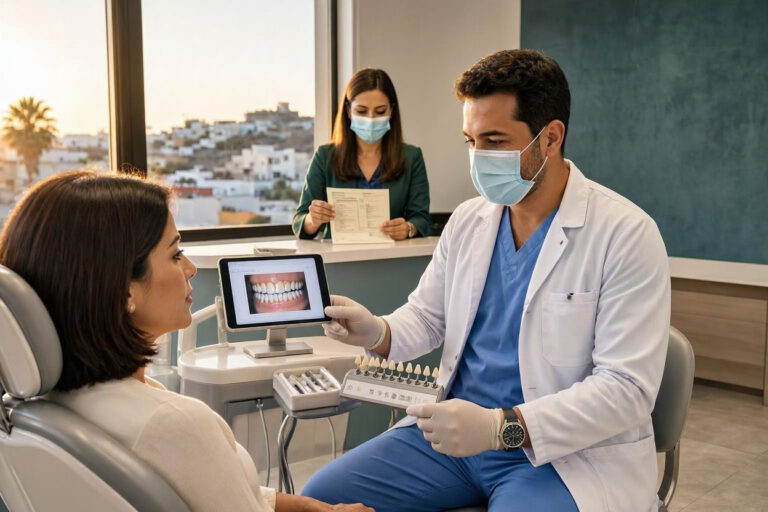
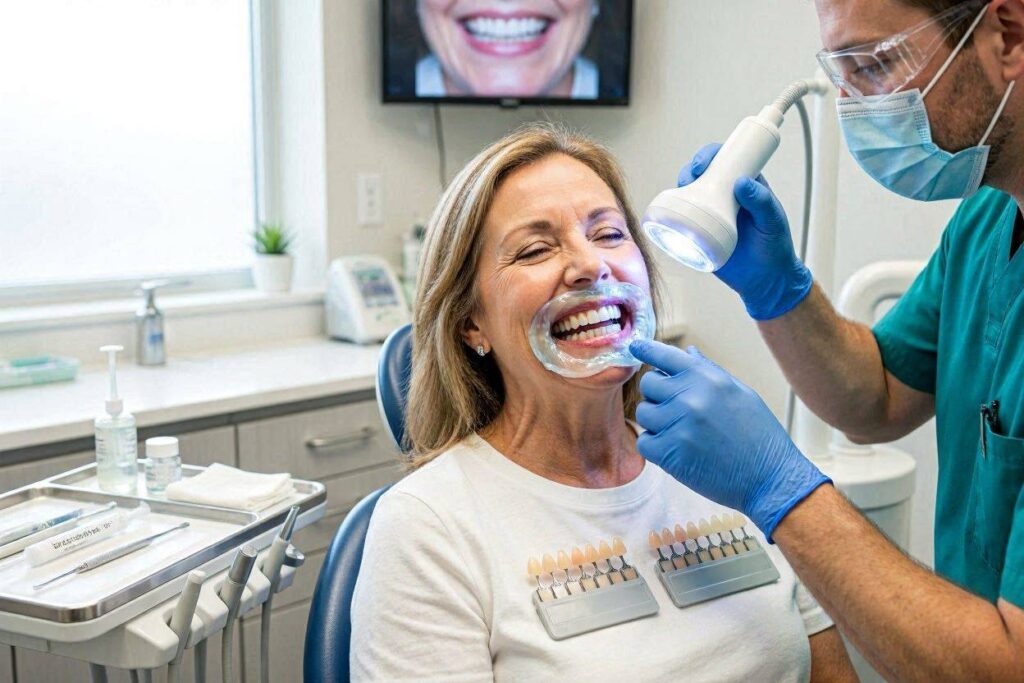
These are products applied by the dentist or a trained auxiliary in the operatory. They contain the highest legally permitted concentrations of hydrogen peroxide, typically in the range of 25% to 40%. Because of this potency, they require meticulous isolation of the gingiva with a light-cured resin dam and careful monitoring throughout the procedure. These systems are designed for speed, achieving a dramatic shade change in a single appointment of 60 to 90 minutes.
Dentist-Dispensed Take-Home Systems:
These are prescription-strength peroxide gels that the patient self-administers at home using custom-fabricated trays. The dentist takes impressions, has a laboratory fabricate thin, flexible, precisely fitting trays, and provides the patient with syringes of carbamide peroxide (typically 10% to 20%) or, less commonly, hydrogen peroxide (typically 6% to 10%). The patient wears the trays for a prescribed duration daily or overnight over a period of 7 to 14 days.
Leading Chairside In-Office Whitening Brands
The professional in-office whitening market is dominated by a handful of established dental manufacturers whose products have extensive clinical data, regulatory clearances, and a multi-decade track record of use in dental practices worldwide.
Opalescence Boost (Ultradent):
Opalescence Boost is one of the most widely recognized and researched in-office whitening systems. Its distinguishing chemical feature is that it uses a chemically activated, syringe-mixed hydrogen peroxide gel rather than a light-activated one. The gel is stored as two separate stable components that are mixed immediately before application via a dual-barrel syringe and a mixing tip. Upon mixing, a chemical reaction generates the active high-concentration hydrogen peroxide (typically around 40%). The gel transitions from a yellow to a white color as it activates, providing a visual indicator of readiness.
Because Opalescence Boost does not require an LED or laser curing light, the dentist is freed from the cost and logistical complexity of light equipment. The chemically self-activating formulation delivers a sustained oxidative release without the thermal energy of a light, which some clinicians believe reduces the incidence of post-operative sensitivity. The gel also contains potassium nitrate and fluoride, built-in desensitizing agents that help mitigate the pulpal inflammatory response during the aggressive in-office procedure.
Zoom (Philips Oral Healthcare):
Zoom is arguably the most recognizable consumer-facing brand in professional whitening, heavily marketed and associated with the signature blue LED light. The Zoom system uses a proprietary hydrogen peroxide gel at a concentration of 25% (Zoom WhiteSpeed) or a lower, sensitivity-optimized 6% hydrogen peroxide formulation (Zoom QuickPro) for a gentler, longer-wear approach.
The Zoom procedure is synonymous with the light-acceleration protocol. The gel is applied in multiple 15-minute cycles, during which the patient’s teeth are bathed in the intense blue light of the Zoom LED lamp. The light serves as a photocatalyst and a heat source, accelerating the decomposition of the hydrogen peroxide into reactive oxygen species. Philips has iterated the light technology over several generations to manage the heat output and enhance patient comfort. Zoom also offers a complementary take-home system, Zoom NiteWhite and DayWhite, which are dispensed carbamide peroxide and hydrogen peroxide gels for custom trays, allowing seamless integration between the in-office boost and home maintenance.
KöR Whitening:
KöR is a brand with a fervent following among cosmetic dentists, particularly those who treat difficult, deeply stained cases. The KöR philosophy is built around the concept of refrigeration. The company maintains that hydrogen peroxide degrades rapidly at room temperature and that the key to maximum whitening potency is continuous refrigeration of the gels from manufacture to application.
The KöR in-office system uses a proprietary, refrigerated hydrogen peroxide gel. The distinguishing feature of the broader KöR approach is its emphasis on sealing. The in-office procedure is often combined with the KöR-Seal technique, where custom trays fabricated with a special scalloped, reservoir-free, ultra-thin design are used post-operatively. The patient wears these trays overnight, filled with a low-concentration refrigerated carbamide peroxide gel, to keep the teeth bathed in a peroxide environment for extended periods, theoretically maximizing the oxidation of resistant chromophores and preventing the oxygen-inhibited layer from reforming. KöR is particularly renowned for its claimed efficacy on tetracycline-stained teeth, a notoriously difficult category of intrinsic discoloration.
Pola (SDI):
Pola is a popular in-office system from the Australian dental manufacturer SDI. It is known for its high-viscosity, non-runny gel formulation, which dentists appreciate because it stays precisely where it is placed on the facial tooth surfaces and does not migrate onto the gingiva. Pola Office+ is the light-accelerated version, using a 37.5% hydrogen peroxide gel activated by a plasma arc or LED light. The gel is formulated to be thick and stable, minimizing the messy, runny overflow that can cause soft tissue burns. SDI also offers Pola Light, Pola Night (take-home carbamide peroxide), and Pola Day (take-home hydrogen peroxide) to cover the full spectrum of professional protocols.
Venus White (Heraeus Kulzer):
Venus White Max is another well-established chairside system that offers a dual-barrel, chemically activated mixing syringe similar in concept to Opalescence Boost. The gel is 38% hydrogen peroxide. Venus White is often chosen by clinicians who want the high potency of a mixed, chemically driven peroxide without the dependence on a light, while still having the option of using a compatible curing light if they choose to add thermal acceleration.
Leading Dispensed Take-Home Whitening Gel Brands
When a dentist prescribes a take-home kit, they are selecting from a range of professional-grade gels that are simply not available on the retail shelf. These gels are formulated with high-purity ingredients, precise buffering systems, and often include desensitizing and remineralizing additives.
Opalescence PF (Ultradent):
Opalescence PF is perhaps the most prescribed professional take-home whitening gel globally. The “PF” stands for potassium nitrate and fluoride, the dual desensitizing and remineralizing agents incorporated into the formulation. The gel is available in a range of carbamide peroxide concentrations: 10% (standard overnight), 15% (3-4 hour daytime), 20% (2-hour daytime), and 35% (short, supervised wear). It is also available in various flavors (mint, melon, even unflavored) and in a hydrogen peroxide formulation (Opalescence PF H2O2 at 6% and 10%). The gel’s thick, sticky, thixotropic consistency is engineered to adhere to the custom tray and the teeth without running onto the gums.
NiteWhite and DayWhite (Philips):
These are the take-home counterparts to the Zoom in-office system. NiteWhite is a carbamide peroxide formulation (10%, 16%, 22%) designed for overnight wear. DayWhite is a hydrogen peroxide formulation (6%, 9.5%) for shorter daytime sessions. Both incorporate amorphous calcium phosphate (ACP), a remineralizing agent that releases bioavailable calcium and phosphate ions onto the enamel surface to help restore mineral content and reduce sensitivity.
Pola Night and Pola Day (SDI):
Pola Night (carbamide peroxide, 10%, 16%, 22%) and Pola Day (hydrogen peroxide, 6%, 9.5%) are the professional take-home offerings from SDI. They feature a high-viscosity formula to minimize gingival leakage and are available with potassium nitrate desensitizer built in. SDI also manufactures the custom tray materials and vacuum-forming machines that dentists use to fabricate the trays, making them a comprehensive system provider.
Why Dentists Do Not Use Over-the-Counter Brands
A logical follow-up question is: if these professional products are so effective, why do dentists not simply purchase and dispense Crest White Strips or other effective OTC brands? The answer lies in the regulatory classification, the control over the treatment, and the business model of professional dentistry.
Regulatory Classification:
In many jurisdictions, including the United States (FDA) and the European Union, products containing more than a certain threshold of hydrogen peroxide (often 0.1% hydrogen peroxide present or released) are classified as prescription-only medical devices or require professional supervision. The ADA stipulates that products with higher concentrations should only be used under the supervision of a dentist. The professional products listed above far exceed this threshold. It would be illegal for a dentist to dispense a product that is not approved for professional use, and it would be outside the scope of practice to endorse an OTC product as equivalent to a prescribed medical device.
Customization and Control:
A box of strips is static and generic. A dentist’s professional kit is dynamic and personalized. The dentist controls the tray fit, the gel concentration, the wear time, the number of syringes dispensed, and the schedule of follow-up appointments. This level of tailored control is the essence of professional supervised care and cannot be replicated by an OTC product, however well-formulated it may be.
Integration with Comprehensive Treatment:
Dentists whiten teeth often as a precursor to restorative dentistry. A patient who is about to receive expensive ceramic veneers or a full-arch rehabilitation needs their natural teeth to be whitened to the final desired shade before the restorations are fabricated and bonded. The dentist must use a system where they have complete control over the final shade outcome to match the laboratory-fabricated restorations. They cannot rely on a patient’s inconsistent use of an OTC product to achieve the precise target shade.
The Chemistry That Separates Professional from OTC Gels
The superiority of professional gels is not merely regulatory; it is chemical. Professional take-home gels are more sophisticated in several material aspects:
- Buffering Systems: Professional gels are meticulously pH-balanced and buffered to a near-neutral pH (around 6.0 to 7.0) to prevent enamel acid erosion during the extended wear periods. Budget OTC gels may be more acidic.
- Desensitizing and Remineralizing Agents: The inclusion of potassium nitrate, fluoride, and amorphous calcium phosphate (ACP) or CPP-ACP in professional gels is standard. These additives actively manage the primary side effect (sensitivity) and support the enamel’s recovery during the treatment cycle itself.
- Viscosity and Rheology: Professional carbamide peroxide gels are engineered to be thixotropic—they are thick and stationary in the tray at rest, but they flow and adapt to the tooth surface under the gentle pressure of the tray. This prevents the gel from running onto the gingiva during overnight wear, a critical safety feature.
Conclusion
- Dentists use a two-tiered system of professional-grade whitening products: high-concentration hydrogen peroxide chairside systems (Opalescence Boost, Zoom, KöR, Pola) for rapid in-office results, and dispensed carbamide peroxide or hydrogen peroxide take-home gels (Opalescence PF, NiteWhite, Pola Night) for custom tray-based home whitening.
- Professional products operate at peroxide concentrations (25-40% in-office, 10-22% carbamide peroxide take-home) that are legally and safely beyond the reach of over-the-counter regulations, justifying their prescription-only status and the requirement for professional supervision.
- The integration of desensitizing and remineralizing agents (potassium nitrate, fluoride, ACP) into professional gel formulations, combined with the precise custom tray fit, provides a safety and comfort margin that generic OTC products cannot match.
Frequently Asked Questions
Can I buy the same whitening gel my dentist uses online?
Some online retailers may offer professional-brand syringes (like Opalescence) for sale without requiring a dental license. Purchasing from these sources is risky. The product may be counterfeit, expired, improperly stored (not refrigerated), or illegally diverted. You have no guarantee of the gel’s authenticity, potency, or sterility. Genuine professional gels are sold only through licensed dental supply channels.
Do all dentists use the same brand of whitening?
No. The choice of brand is influenced by the dentist’s personal clinical experience, their assessment of which chemistry works best for their patient population, the marketing and support provided by the dental supply representative, and the integration of the whitening system with the practice’s other equipment (such as curing lights). There is no single “universal” professional whitening brand.
What concentration of peroxide do dentists use the most for take-home trays?
The most commonly prescribed concentration for overnight use is 10% carbamide peroxide, as it balances excellent efficacy with a low sensitivity profile and a wide safety margin for unsupervised wear. For daytime wear, 15-16% carbamide peroxide or 6% hydrogen peroxide are commonly dispensed.
Is professional whitening gel vegan or cruelty-free?
This varies by manufacturer and product line. Many professional gels contain glycerin, which can be derived from animal or plant sources, and the carbomer or PVP polymers are generally synthetic. Some brands actively pursue vegan certifications. Patients with specific ethical requirements should ask their dentist to inquire with the manufacturer about the specific product being dispensed.
Why does my dentist store the whitening gel in a refrigerator?
Refrigeration slows the chemical degradation of the peroxide, preserving the labeled concentration and extending the shelf life. This is particularly important for hydrogen peroxide gels, which are less stable than carbamide peroxide. A dentist who refrigerates their whitening gel stock is following best-practice storage protocols to ensure you receive a product at maximum potency.