What Is a Mini Dental Implant?
A loose, clicking denture can drain the simple joy from a meal or a conversation. The constant fear of a public slip is exhausting. Traditional dental implants are the gold standard for replacement, but their standard diameter of 3.5 to 6 millimeters requires a certain volume and density of jawbone. For many, especially those who have worn dentures for years, that bone has significantly resorbed, making a standard implant impossible without extensive, costly bone grafting. This is the space where the mini dental implant quietly and effectively shines. It is a slimmer, less invasive alternative that does not demand the same robust foundation. It offers a path to stability for those who have been told they are not candidates for implants, and it does so with a procedure that is often startlingly quick and gentle. This guide explores the precise definition of a mini implant, how it differs dramatically from a conventional one, its most life-changing applications, and what you can realistically expect from this technology.
Defining the Mini Dental Implant
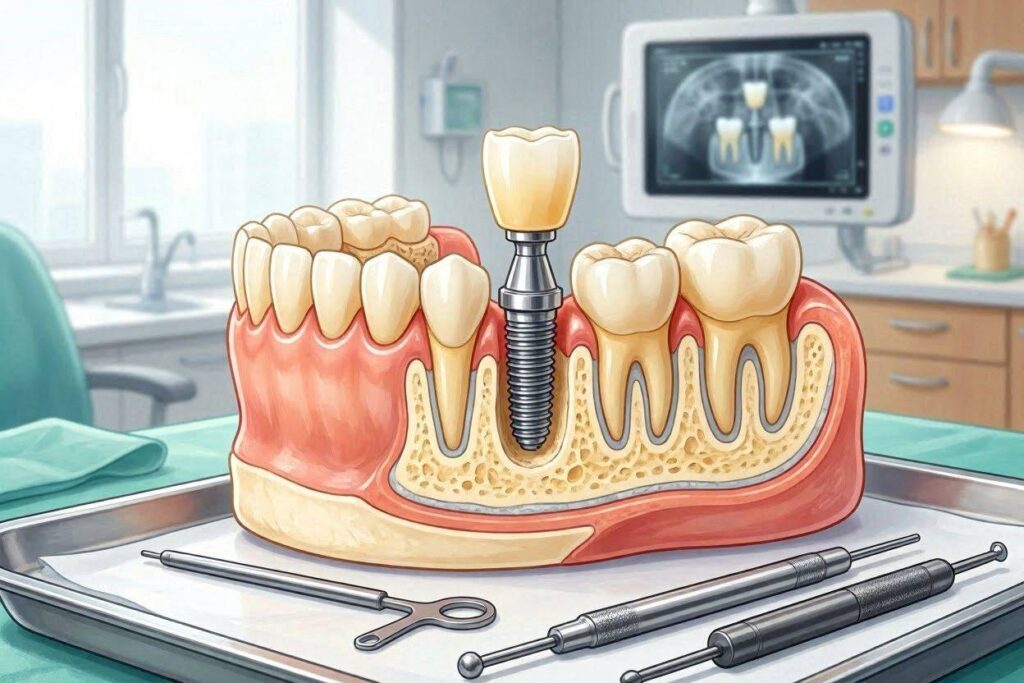
A mini dental implant, or MDI, is a titanium alloy post with a diameter of less than 3 millimeters. To be technically precise, the most common MDI system uses a diameter between 1.8 and 2.4 millimeters. Compare this to the width of a standard wooden matchstick, which is about 2 millimeters, and you have a vivid picture of its scale. The implant is not just a scaled-down version of its larger sibling. It has a distinct design philosophy. The body of the implant is a solid, one-piece construction. In a conventional implant, there is a separate implant fixture and a separate abutment piece that is screwed in later. An MDI is a monolithic unit. The implant post and a ball-shaped or square prosthetic head are made from one single piece of titanium alloy. This head protrudes above the gum line and serves as the attachment point.
The key to its immediate stability lies in its advanced thread design. The threads are very aggressive and self-tapping, much like a sharp wood screw. This allows the dentist to screw the implant directly into a very narrow ridge of bone, often without making a large incision or placing stitches. The thin diameter is not a weakness in its intended use; it is its core design principle. It is engineered to engage and compress the bone, achieving high primary stability immediately, even in dense but very narrow bone.
Mini Implants vs. Standard Implants: A Detailed Comparison
The choice between a mini and a standard implant is a clinical decision based on the available bone, the function of the tooth being replaced, and the overall treatment goal. They are not competitors; they are different tools for different problems.
Dimensional and Structural Differences
The most obvious difference is the size. A standard implant has a diameter from 3.5mm up to 6.0mm. This requires at least 1mm of healthy bone on all sides, so a minimum bone width of about 5.5 to 6mm. An MDI requires only about 3mm of bone width. The standard implant is a two-piece system. The fixture is buried under the gum to heal, and months later, an abutment is connected to it. This modular nature allows a failed crown to be replaced without touching the implant. An MDI is a one-piece system. Its prosthetic head is visible from the moment it is placed. This makes the crown or denture attachment process simpler and faster, but it also means that if the prosthetic head is damaged, the entire implant must be removed.
Surgical Procedure and Healing
Placing a standard implant is a formal surgical procedure. It often requires a full-thickness flap—an incision in the gum to fold the tissue back and expose the bone. After the implant is placed, sutures are needed. The healing period is three to six months, during which the implant must be kept entirely unloaded and submerged. The placement of an MDI is minimally invasive. In many cases, it is a flapless procedure. The dentist uses a small tissue punch to create a tiny hole through the gum directly over the bone. A precise drill creates a narrow initial channel, and the MDI is then screwed into place through the gum tissue. There are typically no sutures and minimal to no bleeding. Post-operative discomfort is dramatically less, often requiring no more than an over-the-counter pain reliever for a day.
Functional Differences and Limitations
This is the most crucial distinction. A standard implant is designed to be a stand-alone tooth replacement. It can handle the intense, focused, single-tooth chewing forces on a molar. It replaces a missing root and functions independently. A mini dental implant is primarily designed as a retaining and supporting device. Its core function is to anchor a removable denture. When a patient bites down on a denture retained by MDIs, the chewing force is distributed across a wide area of the denture base and the gum, with the implants providing grip and stability, not bearing the entire load alone. While MDIs can be used to replace a single front tooth with very low biting forces, using one to replace a molar is a high-risk application with a significantly higher chance of fracture from bending fatigue.
| Feature | Mini Dental Implant (MDI) | Standard Dental Implant |
|---|---|---|
| Diameter | 1.8 – 2.9 mm | 3.5 – 6.0 mm |
| Design | One-piece (monolithic) | Two-piece (fixture + abutment) |
| Primary Use | Denture stabilization, small incisors | Single crowns, bridges, full-arch prostheses |
| Surgical Approach | Minimally invasive, often flapless, no sutures | Surgical flap, sutures required |
| Bone Requirement | Minimal (approx. 3mm width) | Significant (approx. 6mm width) |
| Load-Bearing | Designed for load-sharing with soft tissue | Designed for independent, full load-bearing |
| Typical Healing | Immediate or early loading (within days/weeks) | Delayed loading (3-6 months of osseointegration) |
The Transformative Application: Stabilizing Lower Dentures
The most successful and life-changing application of mini dental implants is the stabilization of a loose lower denture. The lower jaw presents a unique challenge for a removable prosthesis. There is no large, suction-creating palate like in the upper jaw. The floor of the mouth constantly moves with the tongue. A lower denture is a horseshoe-shaped appliance resting on a moving floor and a gradually shrinking ridge of bone. It is a physical compromise. The result is a denture that floats, clicks, and sometimes painfully pinches.
An MDI-retained lower denture transforms this experience. The protocol is elegantly simple. Typically, four mini implants are placed in the front of the lower jaw, between the mental foramina, which are the openings where the nerves exit. This is the safest zone of the lower jawbone, typically with the most dense, slow-to-resorb bone. The implants are placed with their ball-shaped prosthetic heads protruding just above the gum. In the underside of the patient’s existing or new denture, the dentist places a housing with special nylon O-rings. The denture is then simply snapped down onto the four ball attachments. The retention is firm and tactile. The patient hears and feels a reassuring click as the denture locks into place. It will not float or shift during speech or a careful meal. Yet, the patient can still remove it easily for daily cleaning. This specific application has an extraordinarily high success rate and a profound impact on a person’s quality of life.
The Single-Tooth Replacement Consideration
Can a mini implant replace a single missing tooth? The answer is a cautious, conditional yes, but only in very specific circumstances. The narrow diameter is a structural disadvantage for a single tooth fighting alone against chewing forces. A mini implant used as a single-tooth replacement is most viable in the following limited scenarios: replacing a lower incisor, a very small upper lateral incisor, or a tooth in a congenitally narrow space where a standard implant simply cannot fit. The biting forces on these small front teeth are much lighter than on molars. The risk of metal fatigue and fracture of the one-piece implant at its thinnest point—right where the prosthetic head meets the threaded body—is the primary long-term concern. A patient with a strong bite or a grinding habit would be a poor candidate. The crown on a mini implant must be fabricated with great care to ensure the bite is perfectly balanced and light. It is a solution of last resort when a standard implant is anatomically impossible without a bone graft, and the patient cannot or will not undergo grafting.
The MDI Procedure: A Step-by-Step Walkthrough
The minimally invasive nature of the MDI procedure is its hallmark. It can often be completed in a single, relatively short appointment.
First, the dentist conducts a thorough assessment. A 3D CBCT scan is ideal to map the exact bone contour and verify there is just enough bone in the narrow zone. The dentist identifies the optimal entry points and marks them on the gum. The patient receives local anesthesia. A tiny tissue punch, a circular blade, is used to remove a 2-millimeter circle of gum tissue directly over the bone. No scalpel incision is made. Using a very narrow pilot drill under copious water irrigation, the dentist creates a starter channel through the dense outer layer of bone. The drill depth is carefully controlled to be slightly shorter than the implant length, ensuring the implant threads engage compacted bone. Then, the mini implant is removed from its sterile packaging. It is placed into the starter channel using a hand driver or a torque-controlled surgical motor. The dentist slowly screws it in, and the aggressive self-tapping threads bite into the bone. The torque is carefully monitored. A final insertion torque of 35 Ncm or higher is the desired goal, indicating excellent primary stability. The entire process for one implant takes only a few minutes. The denture is then modified, the O-ring housings are picked up using a cold-cure acrylic in the patient’s mouth, and the denture is delivered, snapping securely into place.
Cost of Mini Dental Implants in India
The cost of a mini dental implant is significantly lower than that of a standard implant, making it an accessible option for denture stabilization. In India, a single mini dental implant typically ranges from ₹15,000 to ₹25,000 INR. The cost of a full lower denture stabilization package, which includes four mini implants and the modification of the denture with the O-ring housings, generally falls between ₹60,000 and ₹1,20,000 INR. The price reflects the lower implant cost, the dramatically reduced surgical time, and the absence of a complex custom abutment and crown. The lab work involves the denture housing, not a ceramic crown. This price point brings fixed-like stability to patients on a budget, who would otherwise be priced out of a full standard implant rehabilitation.
Candidacy and Long-Term Care
The ideal candidate for MDIs is someone with a loose, well-made lower denture who cannot tolerate or cannot afford a standard implant procedure with bone grafting. They must have a minimal but sufficient ridge of bone in the front of the jaw, a height of at least 10mm, and a width of at least 3mm. Patients with uncontrolled diabetes, heavy smokers, or those with severe bruxism are high-risk.
Caring for MDI-retained dentures is a hybrid of implant care and denture care. The implants themselves must be cleaned daily with a soft toothbrush, gently brushing around the ball attachments. The O-rings inside the denture are a consumable component. They wear out and lose their grip over time, typically every 12 to 18 months. Replacing them is a simple, quick, and inexpensive in-office procedure. The denture must be removed at night and soaked in water or a cleansing solution, just like any other removable prosthesis. This gives the gum tissue a chance to rest and be exposed to the natural cleansing action of saliva.
Conclusion
A mini dental implant is a one-piece, ultra-thin titanium post, less than 3mm wide, designed primarily to securely stabilize a loose removable denture with a minimally invasive, often flapless procedure. It provides a life-changing, affordable solution for patients with insufficient bone for standard implants, delivering immediate stability and a dramatic improvement in comfort and confidence. While not a replacement for a standard implant in high-load areas, its role as a denture anchor is a proven, transformative application in modern dentistry.
Frequently Asked Questions
Are mini dental implants FDA-approved for long-term use?
Yes. The major mini dental implant systems have received clearance from the U.S. Food and Drug Administration (FDA) for long-term use in denture stabilization. They have been used successfully for decades. The key to longevity is proper case selection and a controlled bite.
How long do mini dental implants last?
With proper placement in a well-selected case, good oral hygiene, and regular maintenance, mini dental implants can last for many years, often decades. The most common point of failure is not the implant-to-bone connection, but the mechanical fatigue and fracture of the one-piece implant itself, or wear of the O-ring housings, which are easily replaceable.
Can mini implants be used to support a fixed bridge?
No. This is a critical limitation. Mini implants are not designed to support a fixed, non-removable bridge of teeth. The forces on a fixed bridge are entirely borne by the implants, which can quickly fatigue and fracture a narrow one-piece design. They are for removable denture stabilization only.
Is the procedure painful?
The procedure is remarkably gentle. The flapless technique means no scalpel cuts and no stitches. Most patients report a sensation of pressure during the screwing-in process, not pain. Post-operative discomfort is usually mild and can be managed with ibuprofen or a similar analgesic for a day.
Additional Resource:
For detailed technical specifications and clinical research, visit the IMTEC MDI website, a pioneer in mini dental implant systems: www.3m.com
Disclaimer: This article provides general educational information. A thorough clinical and radiographic examination by a qualified dental professional is the only way to determine the best treatment option for your individual oral health condition.