How Much Is Dental Implant in India
A missing tooth is a quiet thief. It steals the confidence to smile openly, the simple pleasure of biting into a crisp apple, and over time, it steals the very bone that once supported it. For decades, the solution was a removable partial denture or a fixed bridge that required grinding down healthy neighboring teeth. The dental implant changed everything. It is the only tooth replacement option that replaces the root, preserving the jawbone and providing a stand-alone, permanent new tooth. But the first question on almost every mind is the cost. In many Western nations, the price of a single implant is a staggering financial hurdle, often exceeding several thousand dollars. This reality has given rise to a global shift in healthcare, with India standing at the forefront as a premier destination for dental tourism. The question “How much is a dental implant in India?” has a nuanced answer that reveals a story of world-class skill, advanced technology, and an economic advantage that makes a full smile restoration accessible. This comprehensive guide dissects the exact cost components, explains the dramatic price differentials, and equips you with the knowledge to make a safe, informed decision.
The Economic Landscape of Implant Dentistry in India
India offers a unique value proposition in dental implantology. It is not simply about cheap dentistry. It is about affordable excellence. The country boasts a vast pool of highly trained dental surgeons, many of whom have international fellowships and certifications. The cost of living, real estate, and labor in India is significantly lower than in North America, Europe, or Australia. This fundamental economic difference allows a private dental practice in Mumbai, Delhi, or Bangalore to operate with a dramatically lower overhead. The savings are passed on to the patient, not as a discount on quality, but as a genuine reduction in operational costs. Furthermore, the sheer volume of patients in India allows clinics to operate on a high-turnover, lower-margin-per-case model, which is sustainable and profitable. This creates a market where a single-tooth dental implant, using an internationally recognized brand, can cost a fraction of what it would in San Francisco or London, without any compromise on the strict standards of sterilization, implant quality, or surgical expertise.
The All-Inclusive Cost: A Realistic Range
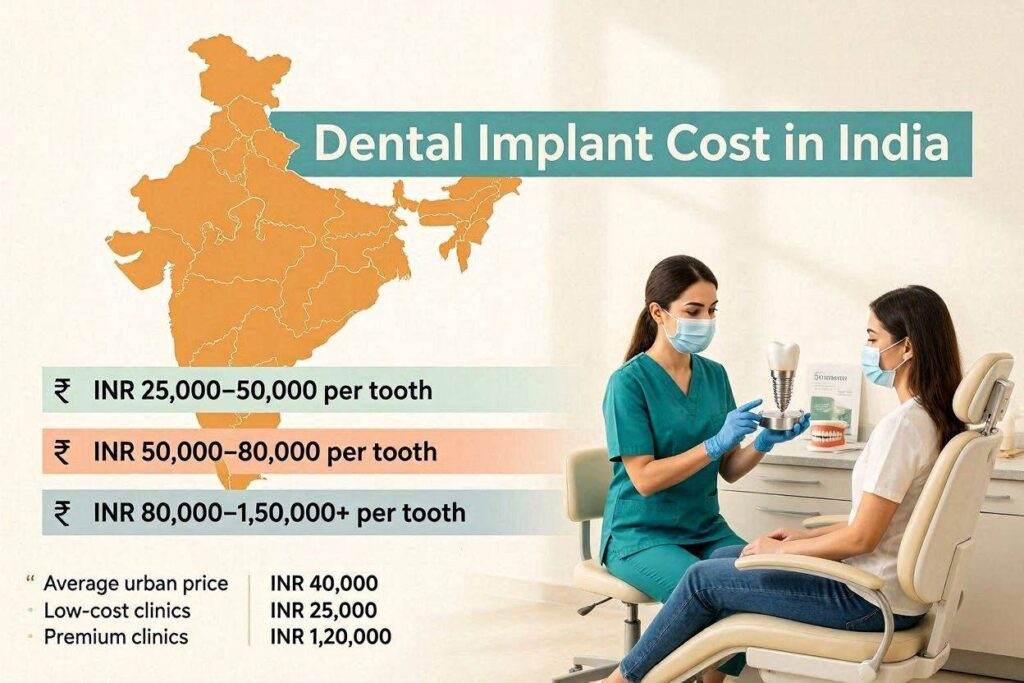
When you search for a price, you will find a bewildering range from extremely low figures to more moderate ones. A realistic, safe, and high-quality single-tooth dental implant in a reputable Indian clinic will typically range from ₹25,000 to ₹60,000 INR. This translates to approximately $300 to $700 USD, depending on the exchange rate. This price is almost always an all-inclusive package for the standard procedure. It represents the complete journey from consultation to crown placement. Be wary of prices advertised significantly below ₹20,000 INR. Such a low price point forces the clinic to cut corners—using non-branded or copycat implant systems, skipping a necessary bone graft, using substandard laboratory work for the crown, or compromising on the sterilization protocols that are invisible but vitally important. The mid-to-high end of this range reflects the use of a premium implant brand, a skilled prosthodontist or oral surgeon, and a high-quality zirconia or porcelain-fused-to-metal crown fabricated in a top-tier dental laboratory.
Detailed Breakdown of the Total Cost Components
The single price you are quoted is the sum of several distinct, sequential stages. Understanding each component empowers you to ask the right questions and compare quotes intelligently.
Stage 1: Diagnosis and Treatment Planning
This is the intellectual foundation of the implant. It includes the initial consultation, a thorough oral examination, and essential 3D imaging with a Cone Beam Computed Tomography (CBCT) scan. A standard two-dimensional panoramic X-ray is insufficient for truly safe implant planning. A CBCT scan allows the surgeon to visualize the bone in three dimensions, measure its width and height precisely, and map the path of the inferior alveolar nerve. This stage may cost between ₹3,000 and ₹8,000 INR. A clinic that waives this fee or skips a 3D scan to save you money is taking an unacceptable risk.
Stage 2: The Implant Surgery
This fee covers the surgical placement of the titanium or zirconia implant fixture into the jawbone. It includes the surgeon’s professional fee, the cost of the operating room or surgical suite, all sterile drapes and disposables, the local anesthesia, and the implant fixture itself. This is the largest single line item.
Stage 3: The Implant Fixture (The Brand)
The choice of implant brand is the single most significant variable in your total cost. Implant systems are divided into premium, value, and generic tiers.
- Premium Brands (Straumann, Nobel Biocare): These are Swiss and Swedish companies with decades of research, thousands of peer-reviewed studies, and a proven track record of 95-98% success over 20+ years. They invest heavily in surface technology for faster osseointegration. The cost of the fixture alone is high, pushing a single implant package to the ₹50,000-₹60,000+ range.
- Value Brands (Osstem, Dentium, MIS): These are South Korean and Israeli companies that dominate the global implant market by volume. They are not inferior; they are clinically excellent, well-researched, and offer an outstanding balance of performance and cost. An Osstem or Dentium implant is a workhorse of modern dentistry and forms the backbone of the affordable Indian market. Packages with these brands typically fall in the ₹30,000 to ₹45,000 INR range.
- Generic/Copycat Systems: These are unbranded, locally manufactured implants with no independent research, no ISO certification, and no long-term data. They cost the clinic next to nothing. The risk of fracture, poor osseointegration, and long-term failure is exponentially higher. Avoid any clinic that refuses to name and warranty the implant brand they are placing.
Stage 4: The Abutment and Crown
The abutment is the connector piece that is screwed into the implant. The crown is the custom-made false tooth. The cost here reflects the material and the skill of the dental laboratory technician.
- PFM Crown (Porcelain Fused to Metal): A time-tested, strong option. It has a metal base covered with tooth-colored porcelain. Over time, a dark line may appear at the gum edge. This is the most economical crown, with an implant package in the ₹25,000-₹30,000 range.
- Full Zirconia Crown: A modern, monolithic block of highly aesthetic, incredibly strong ceramic. It has no metal, so it looks the most natural with a vital translucency. It is the premium choice, adding a significant amount to the final bill, pushing a value-brand implant package to ₹45,000+.
- Zirconia Abutment with Porcelain Crown: This is the aesthetic gold standard for front teeth, where a metal abutment might show through as a gray hue. It adds further to the cost.
Stage 5: Additional Procedures
Often, the price quoted is for a “straightforward” case. If your X-ray reveals insufficient bone, you will need an additional procedure that changes the timeline and cost.
- Bone Grafting: If the jawbone is too thin or shallow, the surgeon must fill the site with bone graft material. This adds ₹8,000 to ₹25,000 INR to the total, depending on the volume and type of graft.
- Sinus Lift: For upper back teeth, the maxillary sinus may be too low, intruding on the space needed for the implant. A sinus lift surgery elegantly raises the sinus floor. This is a more skilled procedure, adding ₹20,000 to ₹40,000 INR.
| Cost Component | Price Range (INR) | Key Variable |
|---|---|---|
| Diagnostics & CBCT Scan | ₹3,000 – ₹8,000 | Quality of imaging center |
| Implant Fixture | ₹10,000 – ₹30,000 | Brand tier (Generic vs. Nobel Biocare) |
| Surgical Placement Fee | ₹10,000 – ₹20,000 | Surgeon’s expertise and clinic location |
| Abutment & Crown | ₹10,000 – ₹25,000 | Material (PFM vs. Full Zirconia) |
| Bone Grafting (if needed) | ₹8,000 – ₹25,000 | Volume and type of graft material |
| Sinus Lift (if needed) | ₹20,000 – ₹40,000 | Complexity of the procedure |
Why the Price is a Fraction of the West
The price gap is not a reflection of inferior care. It is a result of hard economic realities. A dentist in the US graduates with an average student loan debt of over $300,000. Their Indian counterpart graduates with a fraction of that debt. Malpractice insurance for a US dentist can cost $10,000 to $20,000 per year; in India, it is negligible in comparison. The monthly rent for a high-end clinic on Park Avenue is astronomically higher than on a premium street in South Delhi or Bandra, Mumbai. The dental laboratory technician who hand-crafts your crown earns a salary aligned with the Indian cost of living. The dental implant companies themselves sell their identical titanium fixtures at different price points to different global markets, a tiered pricing strategy based on what each market can bear. The Straumann implant placed in India is the exact same sterile-packaged device from Switzerland that is placed in Germany, but the clinic pays less for it and charges you accordingly. You are, essentially, buying a luxury good at a market-appropriate price.
The Dental Tourism Ecosystem in India
The Indian dental tourism industry is mature, sophisticated, and geared toward the international patient. The largest hubs are Delhi NCR, Mumbai, Bangalore, Chennai, and Hyderabad. A well-organized dental tourism experience goes far beyond the dental chair. It is a full-service package. A typical patient flies in, is met at the airport by a clinic concierge, and is transported to a partner hotel or a clinic-owned guest suite. The treatment plan is meticulously scheduled to fit within a compressed timeframe. For a single implant with a bone graft, you need two trips. The first trip is for the surgery and implant placement. The second trip, four to six months later, is to expose the implant and place the healing abutment and final crown. During the healing period between trips, the patient returns home. For a full-mouth rehabilitation with techniques like All-on-4, the surgery and a fixed temporary bridge of teeth are completed in a single trip of 5-7 days, and the final bridge is placed months later. The total cost, even with flights and a modest hotel stay, is consistently 60-75% less than the implant cost alone in many Western countries.
A Critical Warning: The Danger of Unrealistically Low Prices
A search online will yield prices as low as ₹15,000 or ₹10,000 for a single implant. This should not be seen as a great deal. It is a red alert. A clinic operating at this price point is driven to a corner where quality is the only variable left to slash. The most common and dangerous shortcut is the use of counterfeit or non-certified implants. These may be made of impure titanium alloy, surgical-grade stainless steel, or have poorly machined surfaces that create a breeding ground for bacteria. A failed implant from a cheap system not only fails but often destroys the surrounding bone, turning a simple implant case into a complex, costly salvage reconstruction. These clinics may not invest in a modern autoclave sterilization system. They may reuse drills meant for single use to save money. They may not have a CBCT machine, relying instead on guesswork, which can lead to permanent nerve damage—a numb lip for life. The choice to pay for a branded implant is not a luxury; it is the single most important safety decision you make.
A Surgeon’s Honest Advice: “I can always tell a failed cheap implant. The bone loss pattern is aggressive, and the components don’t fit any known system. Saving a few thousand rupees in the beginning condemns the patient to a far more expensive, bone-and-gum reconstruction that could have been entirely avoided with one well-placed, branded implant.” — A practicing Implantologist in New Delhi.
The Step-by-Step Patient Journey and Timeline
Understanding the timeline clarifies why the process is staged. For a straightforward case, the sequence is methodical.
- Day 1 (First Trip): Consultation, CBCT scan, and treatment plan confirmation. If all is ready, the implant surgery is performed.
- Day 2-7 (First Trip): A brief healing period. The sutures are checked. Any post-operative discomfort is managed. You can fly home.
- Month 3-6 (Healing at Home): Osseointegration occurs. The implant fuses silently with your jawbone.
- Month 4-6 (Second Trip): You return for a short visit. The implant is uncovered, a healing abutment is placed, and digital or physical impressions are taken for the crown.
- Day After/Within One Week: The final crown is tried in, adjusted for perfect bite and aesthetics, and torqued permanently into place. Your new tooth is functional.
Financing and Payment for International Patients
Most Indian dental clinics catering to international patients accept major credit cards, international wire transfers, and often have tie-ups with medical financing firms. The payment is usually structured in stages: a deposit to book the surgical slot and the flights, the surgical fee due on the day of the implant placement, and the prosthetic fee due at the final delivery. Always obtain a detailed, written treatment plan with a full cost breakdown before you arrive, clarifying exactly what is included and what is not.
Conclusion
The cost of a dental implant in India ranges from a realistic ₹25,000 to ₹60,000 INR ($300-$700 USD) for a complete, high-quality single tooth, driven by the country’s economic advantages and competitive healthcare market. This all-inclusive price reflects the diagnostic rigor, the brand tier of the implant, the skill of the surgeon, and the material of the final crown. The key to a safe, successful, and lasting outcome is to choose your clinic based on the surgeon’s qualifications, the implant brand’s warranty, and the transparency of their sterilization protocols, not on the lowest advertised price.
Frequently Asked Questions
Is the quality of dental implants in India as good as in the US or UK?
Yes, absolutely. In a top-tier, reputable clinic, the implants used are the exact same globally recognized premium brands (like Straumann or Nobel Biocare) and value brands (like Osstem) used in the West. The sterilization, surgical protocol, and CBCT diagnostic technology are on par with international standards. You are receiving the same standard of care at a different economic price point.
How many trips to India will I need for a single implant?
For a standard protocol, you will need two trips. The first trip is for the surgical placement. The second trip, usually 3 to 6 months later after osseointegration, is for the impressions and final delivery of the crown. Some clinics offer an immediate-loading protocol in specific cases, but a two-trip approach is the most predictable and safe.
What if my implant fails after I return home?
A reputable Indian clinic provides an international warranty on the implant and its work. Discuss this explicitly before treatment. For implant fixture failure, the implant brand’s warranty typically covers a free replacement. The clinic should have a defined policy for managing complications for international patients, often involving a guarantee and coordination with a local dentist in your home country for assessment.
How can I verify the credentials of my dentist in India?
Use the website of the Dental Council of India and the Indian Dental Association. Ask the dentist directly for their registration number. Look for additional qualifications, such as a Master’s degree (MDS) in Prosthodontics, Periodontics, or Oral Surgery, and any international fellowships. A transparent professional will welcome these questions.
Additional Resource:
Visit the official website of the Indian Society of Oral Implantologists (ISOI) for guidelines and to find member specialists: www.isoi.org.in
Disclaimer: The prices mentioned in this article are approximate ranges based on the market at the time of writing and are subject to change. This article does not constitute medical or financial advice. Always seek a personalized consultation with a qualified dental professional for an accurate diagnosis and treatment plan.