Can You Do an Immediate Implant After a Bone Graft?
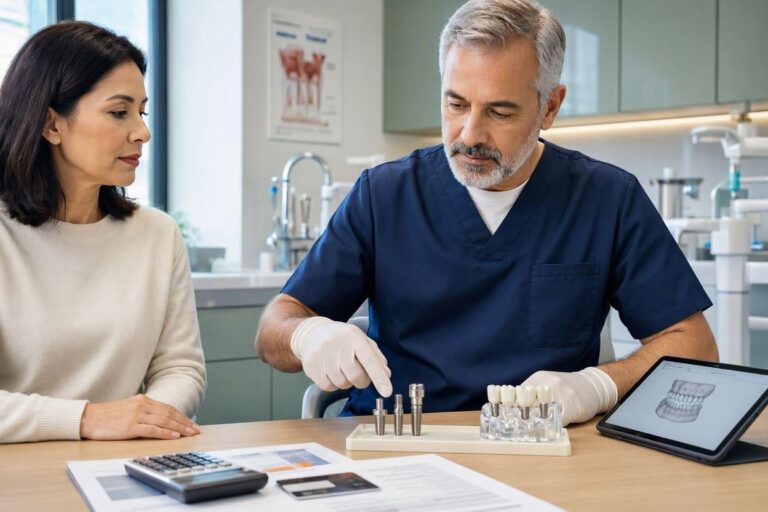
The relationship between a bone graft and a dental implant is a question of timing, biology, and surgical strategy. The patient’s hope is always for speed: extract the tooth, place the graft, and immediately put in the implant, all in one appointment. In certain, very specific clinical scenarios, this is precisely what happens. The graft is placed, and the implant is screwed into position during the same surgery. In other scenarios, the surgeon must graft the site, close the gum, and wait for the graft to fully heal and mature into living, vascularized bone before returning months later to place the implant. The question “Can you do an immediate implant after a bone graft?” requires a precise, anatomically driven answer. This guide clarifies the confusion by dissecting the different types of bone grafts, the biological requirements for each healing phase, and the exact conditions under which an implant can be placed simultaneously with a graft versus when a staged, delayed approach is mandatory. The answer is not a simple yes or no. It is a decision tree rooted in the quality of the bone and the nature of the defect.
The Fundamental Distinction: Simultaneous vs. Staged Grafting
The core of the confusion lies in conflating two completely different surgical protocols.
- Simultaneous Grafting with Immediate Implant Placement: The bone graft material is placed at the same time as the dental implant, during the same surgical appointment. The graft fills a small gap or void around the implant, or it is packed into the socket of a freshly extracted tooth that is receiving the implant immediately. This is routine, predictable, and successful for specific, contained defects.
- Staged Grafting with Delayed Implant Placement: The bone graft is placed in a separate, dedicated reconstructive surgery. The site is closed and allowed to heal and mature for a period of 3 to 6 months, sometimes longer. The patient returns for a second surgery to place the implant into the now-solid, vascularized, newly regenerated bone. This is required for large, complex, or non-contained bone defects.
The “immediate implant after a bone graft” in the patient’s mind is usually the simultaneous protocol. The “you must wait” is the staged protocol.
Scenario One: The Immediate Implant with Simultaneous Graft (The Socket Graft)
This is the most common bone graft scenario in implant dentistry, and it allows for an immediate implant. A tooth is failing and must be extracted. The surgeon performs an atraumatic extraction, carefully preserving the four bony walls of the socket. The socket is a contained, five-walled defect (four walls and an apical floor). The implant is not placed into the graft. It is placed into the solid, native bone 3 to 4 millimeters beyond the apex of the socket. This anchorage in the palatal or apical bone provides the primary stability—an insertion torque of at least 35 Ncm—that is absolutely non-negotiable for implant survival.
Once the implant is securely seated, a gap, or “jumping distance,” exists between the implant body and the buccal wall of the socket. This gap is filled with particulate bone graft material, typically a xenograft or allograft. A collagen membrane is placed over the graft, and the gum is sutured. The implant is stable, and the graft is protected. The graft’s job is to preserve the ridge contour and prevent the buccal bone plate from resorbing. The implant is osseointegrating in the native bone. This is a simultaneous protocol. It is one surgery. It is the “immediate implant after a bone graft” that is successfully performed every day.
Scenario Two: The Staged Graft for a Non-Contained Defect (You Must Wait)
If the extraction socket has a missing or severely damaged wall, for example, the buccal bone plate is completely gone, the defect is no longer contained. The graft material has no wall to hold it in place. If you attempted to place an implant immediately into this defect, you would have no bone to achieve primary stability, and the graft would wash away into the soft tissue. This requires a staged approach.
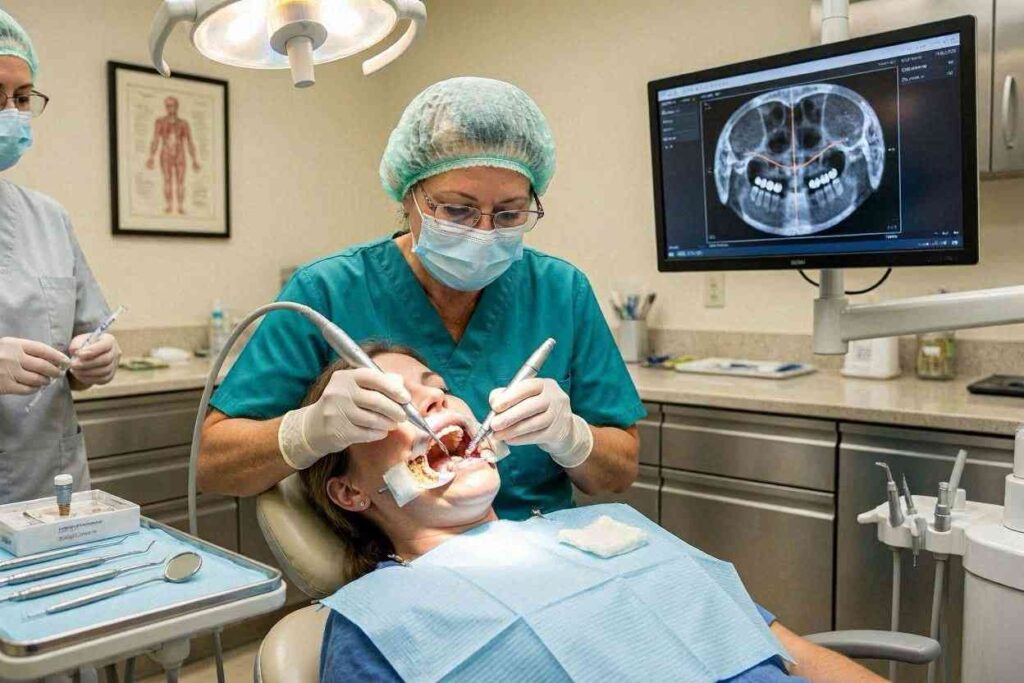
The surgeon will extract any remaining tooth fragments and thoroughly debride the site. A block bone graft or a large volume of particulate graft, reinforced with a titanium mesh or a dense collagen membrane, is placed. The gum is closed over the graft with primary closure. This graft must now heal. Over the next 4 to 6 months, the patient’s own blood vessels grow into the graft material (revascularization), and the body slowly remodels the graft into living bone. A CBCT scan is taken after the healing period. If the scan shows a dense, mature, vascularized bone ridge of adequate width and height, the patient returns for the implant placement surgery. This is a staged, two-surgery protocol. The “immediate implant” is biologically impossible.
Scenario Three: The Major Sinus Lift with Simultaneous Implant
The maxillary sinus lift is a specialized form of bone grafting. The surgeon enters the sinus, elevates the Schneiderian membrane, and packs bone graft material into the newly created space. If there is enough residual native bone below the sinus—typically a minimum of 3 to 5 millimeters of vertical bone height—the surgeon can often place the implant simultaneously. The implant is driven into the residual crestal bone, achieving the required primary stability, while the graft fills the elevated sinus space around the implant apex. If the residual bone is less than 3mm, the implant has nothing to grip. The surgeon must perform the sinus graft and close the site. The implant is placed 6 to 9 months later, after the graft has matured. This is a staged sinus lift.
Scenario Four: The Major Ridge Augmentation (Block Graft)
A patient who has been edentulous for many years has a severely atrophic, knife-edge ridge. The bone width is 2mm. No implant can be placed. The surgeon harvests a block of bone from the patient’s chin or jaw ramus, or uses a sterile allograft block. This block is shaped and secured to the atrophic ridge with tiny titanium screws. The site is closed. This is a major reconstructive surgery. The block graft must heal and integrate for 4 to 6 months. The patient must wait. After healing, a CBCT confirms the new ridge width, and the implant surgery is scheduled. This is the absolute opposite of an immediate implant.
The Critical Role of Primary Stability
The single, unifying factor that determines whether an implant can be placed simultaneously with a graft is primary stability. The implant must have a rigid, immobile, mechanical lock in solid, native bone at the moment of placement. If the surgeon can achieve an insertion torque of 35 Ncm or higher, the implant is stable. If the implant is surrounded by granular graft material and has no native bone to grip, it is loose. A loose implant with a graft will fail. The surgeon’s intra-operative judgment is final. They will test the implant. If it is not stable, they will remove it, fill the site with graft, and convert the case to a staged protocol. This is not a failure. It is a prudent, mature surgical decision.
The Healing of a Simultaneous Graft and Implant
When an implant is placed with a simultaneous socket graft, the healing is a race between two biological processes. The implant is osseointegrating with the native bone. The graft is being revascularized and slowly remodeled. The implant must remain absolutely still during this period. The healing time is often extended by one to two months compared to an implant placed in pristine, ungrafted bone. The surgeon will typically wait 4 to 6 months before uncovering the implant, to ensure both the osseointegration and the graft maturation are complete.
Conclusion
An immediate dental implant can be placed simultaneously with a bone graft in a single surgery when the graft is used to fill a contained socket defect or a small void around an implant that has achieved rigid primary stability of at least 35 Ncm in solid, native bone beyond the defect. For a large, non-contained bone loss, a missing buccal wall, a severely atrophic ridge requiring a block graft, or a sinus with less than 3mm of residual bone, a staged approach is mandatory, with the graft needing 4 to 6 months of healing before the implant can be placed in a second surgery. The surgeon’s intra-operative assessment of primary stability is the final, non-negotiable determinant.
Frequently Asked Questions
Why can’t the implant just hold the bone graft in place?
The implant provides no structural containment for the graft. If the bony walls are missing, the particulate graft material will simply disperse into the soft tissue. The implant cannot be stable in a pool of loose granules. The graft needs a rigid, contained space to heal, which is provided by the natural socket walls or a titanium mesh.
What if my dentist says I need a graft and I want the implant right away?
You must listen to the clinical rationale. If the defect is large and non-contained, an immediate implant placed without a staged graft is almost certain to fail, resulting in the loss of the implant and further bone destruction. A staged approach is the safe, predictable, and bone-preserving protocol.
Does a simultaneous graft make the implant healing take longer?
Often, yes. The surgeon will typically extend the osseointegration period from the standard 3-4 months to 4-6 months to allow the simultaneous graft to mature and consolidate around the implant. This is a protective measure, not a complication.
Can I wear my denture during the graft healing period?
You must not put pressure on the graft site. A temporary removable denture can be worn if it is heavily relieved and lined with a soft, cushioning material, ensuring absolutely no direct pressure on the healing graft. Your surgeon will provide specific instructions.
Additional Resource:
For further reading on bone grafting and implant timing, visit the American Academy of Periodontology’s patient education page at www.perio.org.
Disclaimer: This article explains general surgical principles. The specific decision regarding simultaneous versus staged grafting for your individual oral anatomy is a professional judgment made by your implant surgeon after a thorough clinical and 3D radiographic examination. This is not a substitute for a personal consultation.