Can You Over Tighten A Dental Implant?
The precise application of torque is a fundamental principle in implant dentistry. Every screw in the implant system—the abutment screw, the prosthetic screw, and the healing abutment screw—has a manufacturer-specified torque value measured in Newton-centimeters (Ncm). The answer to whether you can over tighten a dental implant is an unequivocal yes. Exceeding the recommended torque can cause immediate and catastrophic damage to the implant and its components. This guide explains the biomechanics of screw tightening, the consequences of over-torquing, the specific failures that occur, and how proper torque protocols prevent these complications.
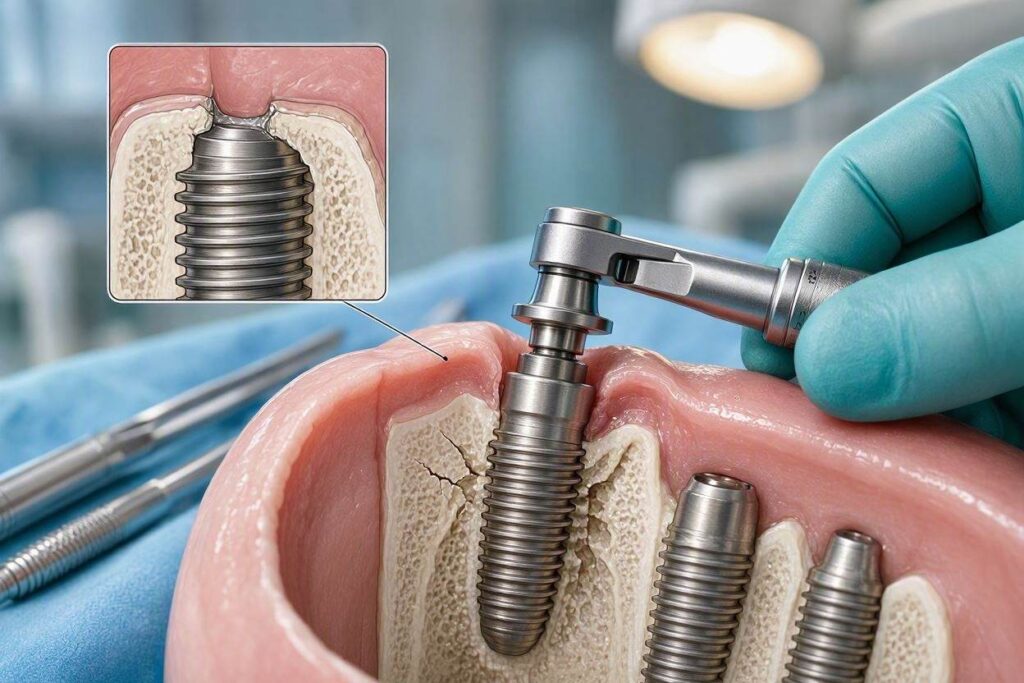
The Biomechanics of a Screw Joint
A dental implant screw joint is a precision-engineered connection. When a screw is tightened, it stretches slightly along its long axis. This elastic deformation generates a clamping force, called preload, that holds the abutment or crown firmly against the implant platform. The preload creates friction at the mating surfaces, which resists the functional forces of chewing.
The manufacturer designs the screw to achieve its optimal preload at a specific torque value. For a typical abutment screw, this is 15 to 35 Ncm. For a prosthetic screw retaining a crown, it is typically 15 to 25 Ncm. The screw material—titanium alloy or gold-plated titanium—the screw diameter, and the thread design all factor into the recommended torque.
When the screw is tightened to the correct torque, it is within its elastic limit. It stretches and generates the designed clamping force. When the screw is tightened beyond the recommended torque, it exceeds its elastic limit and enters the plastic deformation zone. At this point, the screw is permanently stretched and structurally compromised.
The Consequences of Over Tightening
Exceeding the manufacturer’s torque specification can cause a cascade of component failures, some immediate and some delayed.
Screw Fracture
The most common acute failure from over tightening is screw fracture. As the screw is turned past its elastic limit, the metal elongates and eventually snaps. The screw typically fractures at the weakest point, often at the first thread where the diameter is narrowest or at the head-neck junction.
A fractured abutment screw leaves a fragment deep inside the implant body. Retrieving this fragment requires specialized retrieval kits, magnification, and significant clinical time. If the fragment cannot be retrieved, the implant is non-restorable. The entire implant must be surgically removed and replaced. Over tightening a single screw can thus result in the loss of the entire implant.
Implant Platform and Thread Damage
The implant body is made of commercially pure titanium or a titanium alloy. While strong, it is not indestructible. Excessive torque can strip the internal threads of the implant body. The female threads inside the implant are deformed or sheared off. The screw spins freely without engaging. The implant can no longer retain an abutment or a prosthetic screw. This is a terminal, non-restorable failure of the implant.
Less catastrophic but still significant is damage to the implant platform. Over tightening can distort the precise machined mating surface between the implant and the abutment. The connection loses its passive fit. A micro-gap forms, which becomes a reservoir for bacteria, leading to biological complications, and a stress concentrator, leading to mechanical complications.
Abutment Distortion and Fracture
The abutment itself can be damaged by excessive torque. The abutment base can distort, altering the fit of the crown. The abutment can fracture, particularly at the margin or at the anti-rotational indexing feature. A fractured abutment must be replaced, and the damaged portion must be carefully removed from the implant connection.
Soft Tissue and Bone Damage
Over tightening that occurs while the implant is in the bone (as opposed to on a laboratory model) can transmit excessive force to the bone-implant interface. The micro-strain generated by the clamping force can exceed the physiologic tolerance of the bone. This can cause localized bone necrosis and compromise osseointegration. The patient may feel a sharp pain during over tightening, which is a warning sign of excessive pressure on the bone.
How Implant Dentists Control Torque
The prevention of over tightening is achieved through specific instruments and protocols. Every implant dentist is trained in torque control.
Torque Wrenches
A torque wrench is a calibrated mechanical instrument that limits the applied force to a set value. The dentist sets the desired torque on the wrench, typically by adjusting a dial or a sliding scale. When the set torque is reached, the wrench head deflects or clicks, indicating that the operator should stop applying force. Torque wrenches are used for final tightening of all critical implant screws.
Implant systems have dedicated, system-specific torque wrenches. A universal torque wrench with interchangeable driver bits is also commonly used. Torque wrenches must be periodically recalibrated to ensure accuracy. A wrench that is out of calibration can under-torque or over-torque, even when used correctly.
Torque-Controlled Handpieces
Some surgical motors used for implant placement have torque control settings. The surgeon sets the maximum insertion torque on the motor console. The motor drives the implant into the osteotomy and stops when the set torque is reached. This prevents over-torquing during implant placement, which could strip the bone threads and compromise primary stability.
Manufacturer-Specific Drivers
The driver tips—the small bits that engage the screw head—are precisely matched to the screw head design. A driver that is worn, of the incorrect size, or poorly seated can cam out of the screw head under torque, stripping the screw head’s internal hex, Torx, or slot. The dentist uses the correct, manufacturer-specified driver in good condition.
Clinical Scenarios of Over Tightening
Over tightening is not intentional. It occurs through clinical errors or equipment failure.
The Calibration Error
A torque wrench that has not been calibrated may indicate a lower torque than is actually being applied. A wrench set to 25 Ncm that is delivering 40 Ncm will over tighten every screw. Regular calibration and careful handling of torque wrenches are essential practice protocols.
The Inexperienced Clinician
A clinician who is not adequately trained in implant prosthetics may rely on “feel” rather than a torque wrench. The human hand can generate far more torque than the delicate screws are designed to withstand. Attempting to “just give it a little extra” for security is a direct path to screw fracture.
The Stripped Screw Head Emergency
If a screw head is partially stripped from a previous removal attempt, the clinician may apply excessive downward force and torque in an effort to engage the remaining metal. This can easily exceed the safe torque limit.
The Cross-Threading Scenario
If the screw is not properly aligned with the implant’s internal threads and is forced, it can cross-thread. The screw binds and requires excessive torque to turn. The threads are damaged, and the screw may shear. Proper alignment and the initial counterclockwise turn to “drop” the screw into the threads before tightening prevent cross-threading.
What to Do If You Suspect Over Tightening
As a patient, you are not tightening your own implant screws. However, you may experience the consequences of over tightening performed during a dental visit. The signs include a sharp, sudden pain during the tightening procedure (if the implant is in the bone), a screw that feels tight and then suddenly becomes loose (fracture), or a crown that feels tight at delivery but becomes loose or falls off days or weeks later (delayed screw fracture).
If you experience any of these signs, return to your implant dentist immediately. Do not attempt to tighten the crown yourself. The dentist will remove the restoration, inspect the implant connection and screw fragments, and determine the appropriate management.
Conclusion
Dental implants can absolutely be over tightened, and exceeding the manufacturer’s specified torque value—typically 15 to 35 Ncm for abutment and prosthetic screws—can cause screw fracture, stripping of the implant’s internal threads, abutment distortion, and even damage to the bone-implant interface. Implant dentists prevent this by using calibrated torque wrenches and torque-controlled handpieces that precisely limit the applied force. A fractured screw from over tightening is a serious but manageable complication when addressed promptly, while a stripped implant thread is a terminal implant failure.
Frequently Asked Questions
Can my implant crown be over tightened by the dentist?
Yes, if the dentist does not use a calibrated torque wrench and relies on manual feel, the prosthetic screw can be over tightened. A responsible dentist always uses a torque wrench for final tightening of implant screws. You are entitled to ask your dentist about their torque protocol.
If I feel my implant crown is loose, can I tighten it myself?
No. Do not attempt to tighten an implant crown. You do not have the correct driver, you cannot see the internal connection, and you cannot control the torque. You will likely damage the screw head or over-tighten and fracture the screw. See your dentist. A loose implant crown is a routine, manageable appointment, not a do-it-yourself emergency.
Is a clicking sound when I bite a sign of a loose screw?
Often yes. A clicking or slight movement when biting is a classic sign of abutment or prosthetic screw loosening. The components are moving slightly at the implant-abutment or abutment-crown interface. Schedule an appointment with your implant dentist. Do not delay, as the micro-movement can fatigue and fracture the screw.
Does over tightening cause pain?
During the tightening procedure, if the implant is in the bone and excessive torque is applied, the compression of the bone around the implant can cause acute, sharp pain. This is a warning sign. The clinician should stop immediately. A correctly torqued screw should not cause pain because the clamping force is within the bone’s physiologic tolerance.
Additional Resource
The Academy of Osseointegration provides detailed professional and patient educational resources at aoinfo.net. Their literature explains the biomechanics of the implant-abutment connection, the importance of precise torque, and the consequences of mechanical complications. Understanding the precision engineering behind your implant restoration reinforces the importance of seeking care from clinicians who adhere to manufacturer protocols.