What Is An Arch For Dental Implants?
When exploring tooth replacement options, you may encounter the term “arch” in relation to dental implants. This concept is central to understanding full-mouth restoration procedures like All-on-4 or implant-supported dentures. But what exactly is an arch, and how does it work?
This guide explains everything you need to know about dental implant arches. You will learn what an arch is, the different types available, the procedures involved, costs, and who makes a good candidate for this transformative treatment.
Understanding the Dental Arch
Before diving into implant-supported arches, it helps to understand the basic anatomy of your mouth.
What Is a Dental Arch?
A dental arch refers to the curved structure of teeth in either the upper or lower jaw. Humans have two dental arches:
- Maxillary Arch: The upper row of teeth
- Mandibular Arch: The lower row of teeth
Each arch typically contains 14 to 16 teeth when complete.
What Is an Implant-Supported Arch?
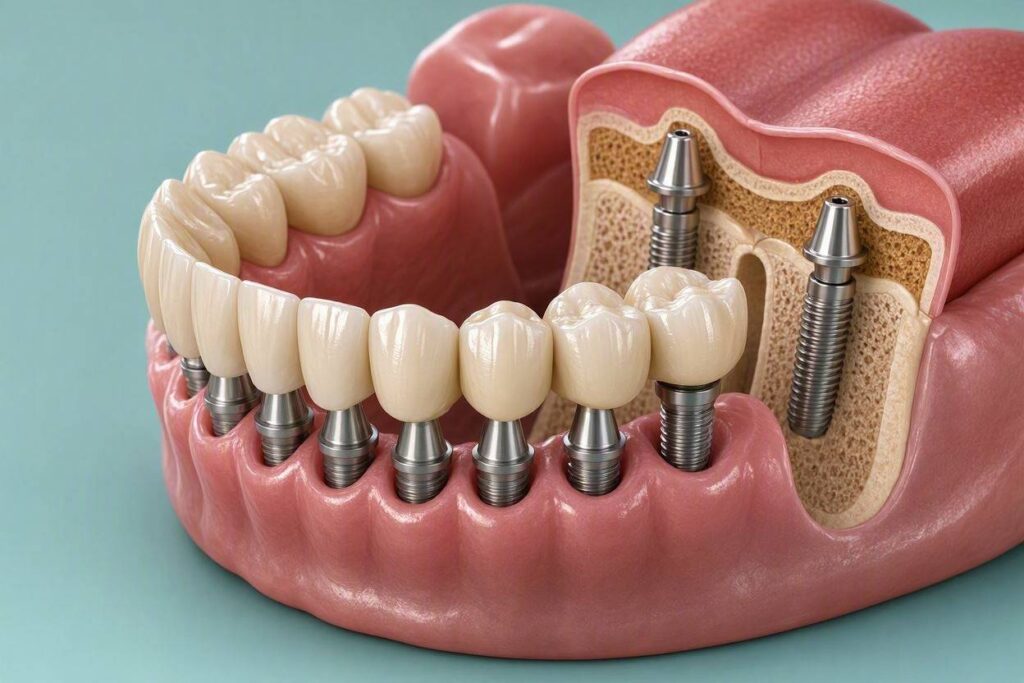
An implant-supported arch is a full set of replacement teeth—either fixed or removable—that is anchored by dental implants. Instead of replacing individual teeth with individual implants, the entire arch of teeth is supported by a strategic number of implants.
Key Point: An implant-supported arch replaces all teeth in one jaw using fewer implants than the number of teeth being replaced.
Types of Implant-Supported Arches
Several types of implant-supported arches exist, each with unique characteristics.
Fixed Implant-Supported Bridges
A fixed implant-supported bridge is permanently attached to implants and cannot be removed by the patient.
How It Works:
- 4 to 8 implants are placed in the jaw
- A custom-made bridge is attached to the implants
- The bridge spans the entire arch
- Only a dentist can remove it
Advantages:
- Most stable and natural-feeling option
- No movement or slipping
- Functions like natural teeth
- Preserves bone
Disadvantages:
- Highest cost
- Requires adequate bone
- More complex surgery
Removable Implant-Supported Overdentures
A removable overdenture snaps onto implants but can be removed by the patient for cleaning.
How It Works:
- 2 to 4 implants are placed in the jaw
- A denture with attachments snaps onto the implants
- The patient can remove it for cleaning
- Provides more stability than traditional dentures
Advantages:
- Lower cost than fixed bridges
- Easier to clean
- Fewer implants required
- Can be removed for comfort
Disadvantages:
- Less stable than fixed bridges
- May still move slightly
- Requires removal for cleaning
All-on-4 and All-on-6 Systems
These are specific branded techniques for full-arch restoration.
All-on-4:
- Four implants support the entire arch
- Two implants placed vertically in the front
- Two implants placed at an angle in the back
- Often allows for same-day teeth
All-on-6:
- Six implants support the entire arch
- Provides additional stability
- May be recommended for patients with more bone
Advantages:
- Fewer implants needed
- Often avoids bone grafting
- Immediate loading possible
- Cost-effective compared to individual implants
Disadvantages:
- Requires precise surgical planning
- Not suitable for all patients
- May require specialized training
The Implant Arch Procedure
Understanding the process helps you know what to expect.
Step 1: Consultation and Planning
Your dentist evaluates your oral health and develops a treatment plan.
What Happens:
- Comprehensive examination
- X-rays and CT scans
- Impressions of your mouth
- Discussion of options and costs
- Treatment planning
Step 2: Preparatory Procedures
Some patients require additional procedures before implant placement.
Possible Procedures:
- Tooth extractions
- Bone grafting
- Sinus lift
- Treatment of gum disease
Step 3: Implant Placement
The implants are surgically placed into the jawbone.
What Happens:
- Anesthesia is administered
- Incisions are made in the gum
- Holes are drilled into the bone
- Implants are placed
- The gum is closed
Step 4: Healing Period
The implants need time to fuse with the bone through osseointegration.
Timeline:
- 3 to 6 months for lower jaw
- 4 to 6 months for upper jaw
- Temporary denture may be worn during healing
Step 5: Abutment Placement
After healing, abutments are attached to the implants.
What Happens:
- Small incision to expose the implant
- Abutment is attached
- Gum is allowed to heal around the abutment
Step 6: Final Prosthesis Placement
The custom-made arch is attached to the abutments.
What Happens:
- Impressions are taken
- The prosthesis is fabricated
- Fitting and adjustments
- Final attachment
Immediate Load Arches (Same-Day Teeth)
Some protocols allow for placement of a temporary arch on the same day as implant surgery.
How It Works:
- Implants are placed
- A temporary arch is attached immediately
- You leave with teeth the same day
- The permanent arch is placed after healing
Number of Implants Needed
The number of implants required depends on the type of restoration.
Removable Overdenture
- Upper Jaw: 4 implants typically recommended
- Lower Jaw: 2 to 4 implants
Fixed Bridge
- Upper Jaw: 6 to 8 implants
- Lower Jaw: 4 to 6 implants
All-on-4
- Both Jaws: 4 implants per arch
All-on-6
- Both Jaws: 6 implants per arch
Costs of Implant-Supported Arches
Full-arch restoration is a significant investment.
Average Costs per Arch
| Type | Average Cost per Arch |
|---|---|
| Removable Overdenture (2 implants) | $3,000 – $8,000 |
| Removable Overdenture (4 implants) | $6,000 – $15,000 |
| Fixed Bridge (4-6 implants) | $15,000 – $30,000 |
| All-on-4 (per arch) | $15,000 – $25,000 |
| All-on-6 (per arch) | $20,000 – $35,000 |
Cost Comparison Table
| Option | Implants | Prosthesis | Total per Arch |
|---|---|---|---|
| Traditional Denture | 0 | $1,000 – $3,000 | $1,000 – $3,000 |
| Implant Overdenture (2) | $3,000 – $6,000 | $2,000 – $4,000 | $5,000 – $10,000 |
| Implant Overdenture (4) | $6,000 – $12,000 | $3,000 – $5,000 | $9,000 – $17,000 |
| All-on-4 | $8,000 – $12,000 | $7,000 – $13,000 | $15,000 – $25,000 |
| All-on-6 | $12,000 – $18,000 | $8,000 – $17,000 | $20,000 – $35,000 |
Additional Costs
- Consultation: $100 – $300
- CT Scan: $200 – $500
- Extractions: $150 – $600 per tooth
- Bone Grafting: $500 – $3,000 per site
- Sedation: $300 – $1,000
- Temporary Prosthesis: $500 – $2,000
Insurance Coverage for Implant Arches
Insurance coverage for full-arch restoration varies.
Dental Insurance
- May cover a portion of the prosthesis
- May cover extractions and preparatory procedures
- Annual maximums often limit coverage
- Implants themselves may not be covered
Medical Insurance
- May cover implant surgery if medically necessary
- May cover hospital fees
- Coverage for reconstructive cases
Financing Options
- CareCredit healthcare financing
- In-house payment plans
- Personal loans
- Dental tourism
Who Is a Good Candidate?
Not everyone is a candidate for implant-supported arches.
Good Candidates
- Patients with multiple missing teeth
- Those with adequate bone density
- Non-smokers or those willing to quit
- Patients with good overall health
- Those committed to oral hygiene
Poor Candidates
- Patients with insufficient bone who cannot undergo grafting
- Heavy smokers
- Those with uncontrolled medical conditions
- Patients with active gum disease
- Those who grind their teeth severely
Advantages of Implant-Supported Arches
Compared to traditional dentures, implant arches offer significant benefits.
Stability
Implant arches do not slip or move. You can eat, speak, and laugh with confidence.
Bone Preservation
Implants stimulate the jawbone, preventing the bone loss that occurs with traditional dentures.
Improved Function
Implant arches restore nearly full chewing ability, allowing you to enjoy a varied diet.
Aesthetics
Modern implant arches look natural and restore facial structure.
Longevity
With proper care, implant-supported arches can last decades or even a lifetime.
Disadvantages and Risks
Understanding the drawbacks helps you make an informed decision.
Cost
Implant arches are expensive, often costing $15,000 to $35,000 per arch.
Surgery
The procedure is surgical and requires healing time.
Potential Complications
- Infection
- Implant failure
- Nerve damage
- Sinus problems
- Prosthesis complications
Maintenance
Implant arches require regular professional maintenance and excellent home care.
Alternatives to Implant Arches
If implant arches are not right for you, alternatives exist.
Traditional Dentures
Complete dentures replace all teeth without implants.
Cost: $1,000 – $3,000 per arch.
Implant-Retained Dentures
A hybrid option using fewer implants for stability.
Cost: $5,000 – $15,000 per arch.
Individual Implants
Replacing each missing tooth with an individual implant.
Cost: $2,300 – $6,700 per tooth.
Conclusion
An arch for dental implants is a full set of replacement teeth supported by strategically placed implants. Options range from removable overdentures with 2 to 4 implants to fixed bridges and All-on-4 or All-on-6 systems. Costs vary from $5,000 to $35,000 per arch depending on the type. Implant-supported arches offer superior stability, function, and bone preservation compared to traditional dentures, making them a worthwhile investment for many patients.
Frequently Asked Questions (FAQ)
Q: What is a dental arch?
A: A dental arch is the curved structure of teeth in either the upper or lower jaw.
Q: How many implants are needed for a full arch?
A: Typically 2 to 8 implants per arch, depending on the type of restoration. All-on-4 uses four implants, while fixed bridges may use six to eight.
Q: How much does a full arch of implants cost?
A: Costs range from $5,000 to $35,000 per arch depending on the type and number of implants.
Q: What is the difference between All-on-4 and All-on-6?
A: All-on-4 uses four implants per arch, while All-on-6 uses six implants for additional stability.
Q: Can I get same-day teeth with an implant arch?
A: Yes, immediate load protocols like All-on-4 often allow for placement of a temporary arch on the same day as surgery.
Q: How long do implant-supported arches last?
A: With proper care, implant arches can last 20 years or more. The prosthesis may need replacement every 10 to 15 years.
Additional Resource
For more information on full-arch dental implants, visit the American Academy of Implant Dentistry (AAID) at www.aaid.com. They provide educational resources and a directory of implant dentists.