How to Avoid Dental Implants?
You have arrived at this article with a specific goal: you do not want a dental implant. Perhaps the cost terrifies you. Perhaps the surgery gives you nightmares. Perhaps you have a medical condition that makes implants risky. Whatever your reason, you want to know how to keep your natural teeth and avoid ever needing a titanium post in your jaw.
The most effective way to avoid a dental implant is to prevent the tooth loss that makes one necessary. This means mastering prevention, intercepting problems early, and making smart treatment decisions when teeth do fail. It also means understanding the legitimate alternatives to implants when a tooth cannot be saved.
This guide is a practical, proactive roadmap. It will walk you through the entire spectrum of avoidance: daily habits, professional care, early intervention, and alternative tooth replacement options. Your goal is achievable. Let us build your strategy.
The Root Cause: Understanding Why Teeth Are Lost
To avoid an implant, you must understand why teeth fail. The vast majority of tooth loss stems from three main causes. Target these, and you target the implant’s reason for existing.
- Dental Caries (Tooth Decay): Cavities that grow unchecked eventually reach the pulp (nerve), causing infection and structural destruction. A tooth that is too broken down to support a crown must be extracted.
- Periodontal Disease (Gum Disease): This is the leading cause of tooth loss in adults. Chronic inflammation destroys the gum attachment and the supporting bone. The tooth becomes loose, and eventually, it falls out or must be pulled.
- Trauma and Fracture: Accidents, sports injuries, and biting on hard objects can crack or fracture teeth. A vertical root fracture, where the crack extends down the root, is almost always a terminal diagnosis for the tooth.
Additionally, failed previous dentistry (a failing root canal, a bridge that caused decay on abutment teeth) is a major contributor.
Phase 1: The Daily Defense, Preventing Decay and Gum Disease
Your daily habits are the first and most powerful line of defense. You cannot delegate this. It happens in your bathroom, twice a day.
Master Oral Hygiene
This goes beyond a quick brush. The enemy is biofilm, a sticky, organized layer of bacteria.
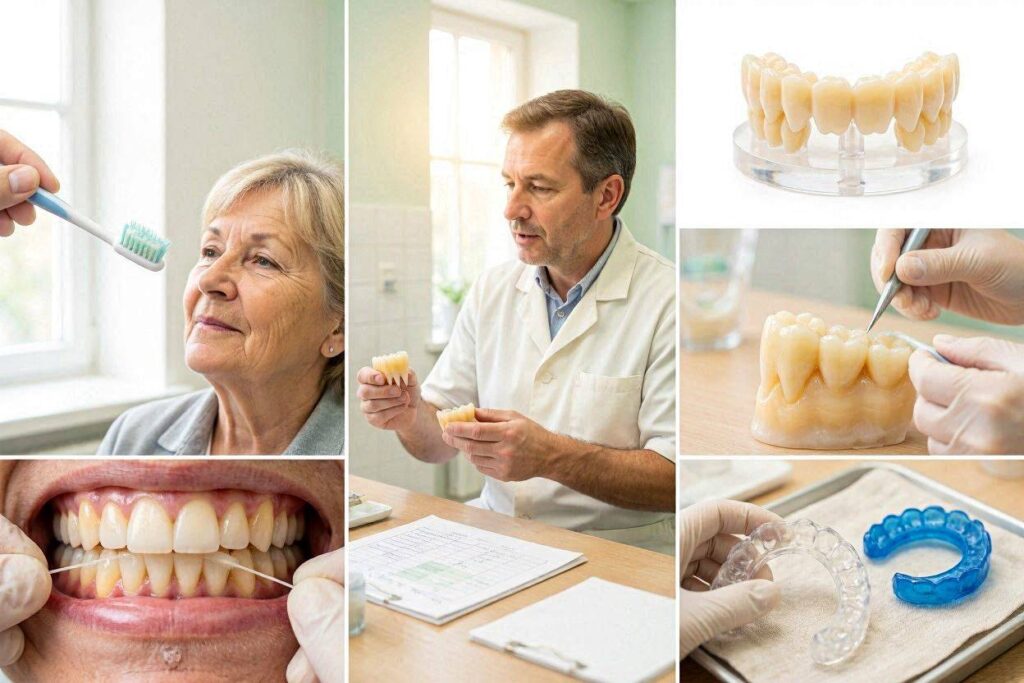
- Brushing: Use a soft-bristled electric toothbrush. Brush for two full minutes. The brush head must be angled at 45 degrees into the gumline, where the biofilm hides. Do not just scrub the biting surfaces.
- Interdental Cleaning: This is non-negotiable. Brushing cleans only 60% of the tooth surface. You must clean the sides. Floss, interdental brushes, or a water flosser must be used daily. A water flosser is particularly effective for flushing out bacteria from gum pockets.
- Fluoride: Use a fluoride toothpaste. Fluoride strengthens enamel and makes it more resistant to acid attack. If you are cavity-prone, ask your dentist about a prescription-strength fluoride gel.
- Tongue Cleaning: Bacteria live on the tongue. Clean it with a tongue scraper or your brush.
Perfect Your Diet for Teeth
You are not just eating; you are feeding or starving the bacteria in your mouth. Every time you eat sugar or refined carbohydrates, the bacteria produce acid that attacks your enamel for 20 to 40 minutes.
- Reduce Frequency: The number of sugar exposures per day matters more than the total amount. Sipping on a soda for two hours is far worse than drinking it in five minutes. Limit sugary snacks and drinks to meal times.
- Beware of Hidden Sugars: Processed foods, flavored yogurts, granola bars, and even savory sauces are packed with sugar.
- Eat Protective Foods: Crunchy vegetables and fruits stimulate saliva flow. Cheese and dairy neutralize acid and provide calcium and phosphate for remineralization.
- Hydrate with Water: Water dilutes acids and washes away food debris. If you drink fluoridated water, you get a constant, low-level fluoride treatment.
Manage Destructive Habits
- Teeth Are Not Tools: Do not use your teeth to open bottles, tear tags off clothing, or crack nuts. You risk a catastrophic fracture.
- No Ice Chewing: Chewing ice is a common cause of microscopic cracks and catastrophic fractures.
- Night Guard for Bruxism: If you grind or clench your teeth at night, you are wearing them down and creating cracks. A custom-made night guard from your dentist absorbs the forces and protects your teeth from themselves.
Phase 2: The Professional Safety Net, Early Detection and Intervention
Your dentist is your strategic partner. Regular visits are not just about cleaning; they are about surveillance and early interception.
Regular Recare Visits (Every 6 Months, or More)
- Professional Cleaning: A hygienist can remove calcified tartar that your brush cannot touch. Tartar is a haven for bacteria.
- Periodontal Probing: The dentist measures the depth of the gum pockets around every tooth. A pocket deeper than 3 mm with bleeding is an early warning sign of gum disease.
- Caries Detection: X-rays and clinical exam catch cavities when they are small and easily fillable, not when they are deep and threatening the nerve.
- Occlusal Analysis: The dentist checks your bite for destructive interferences that cause fractures and wear.
Treat Small Problems Before They Become Big
- Fill Cavities Immediately: A small filling is a minor, low-cost procedure. Ignoring it leads to a root canal or extraction.
- Treat Gum Disease Aggressively: If you are diagnosed with periodontitis, commit to the treatment. Scaling and root planing (deep cleaning) is the first line. Periodontal surgery may be needed. The goal is to arrest bone loss before teeth become mobile. A tooth with a wobbly, hopeless prognosis sets you on the path to an implant.
- Crown Cracked Teeth: A tooth with a crack does not heal on its own. A full-coverage crown can hold the tooth together and prevent the crack from propagating into a catastrophic root fracture.
Phase 3: The Decision Point, When a Tooth Fails
Sometimes, despite all best efforts, a tooth becomes non-restorable. Deep decay has reached the furcation, a vertical root fracture has occurred, or advanced gum disease has left too little supporting bone. The tooth must be extracted.
At this point, you face a choice: implant, bridge, partial denture, or nothing. If you are determined to avoid an implant, you must weigh the alternatives.
Alternative 1: The Fixed Bridge (Resin-Bonded or Traditional)
A bridge uses adjacent teeth to support a false tooth. As discussed in the previous article, a traditional bridge requires grinding down healthy adjacent teeth. A Maryland bridge or resin-bonded bridge is a more conservative option for front teeth, where the false tooth has metal wings that are bonded to the back of the adjacent teeth with minimal preparation. Bridges avoid surgery but have a finite lifespan and create hygiene challenges.
Alternative 2: The Removable Partial Denture
This is a plate with a false tooth that clasps onto your remaining teeth. It is the least expensive option and requires no surgery and no drilling of healthy teeth. The downsides are bulk, potential discomfort, metal clasps that may show, and the fact that it does nothing to preserve the underlying bone, which will continue to resorb.
Alternative 3: The Space Maintainer (Orthodontic Closure)
If the missing tooth is a front tooth or a premolar, and you have existing crowding, it may be possible to close the space orthodontically with braces or clear aligners. You literally move your other teeth together to fill the gap. This requires a comprehensive orthodontic assessment but is a brilliant way to avoid any prosthesis at all.
Alternative 4: Intentional Replantation
In very rare, select cases of a failed root canal, an endodontist may extract the tooth, perform a root-end resection and filling on a bench top, and replant the tooth back into the socket. This is a last-ditch effort to save a tooth that would otherwise be extracted. Success rates vary, and it is not a common or guaranteed procedure.
Alternative 5: Autotransplantation
If you have a wisdom tooth or another tooth that is not essential (like a premolar extracted for orthodontics), it is possible in a young, healthy patient to transplant that tooth into the extraction socket of a failed tooth. The tooth is extracted, placed in the new socket, and stabilized. If the tooth’s root is still developing, the success rate is surprisingly high. This is a highly specialized procedure.
Phase 4: If You Accept an Extraction but Refuse Replacement
You could simply do nothing and leave the gap. This is an option, but you must understand the consequences.
- Bone Resorption: The jawbone under the missing tooth will resorb over time.
- Tooth Drifting and Supraeruption: Adjacent teeth will tip into the space. The opposing tooth will over-erupt. This can destabilize your entire bite.
- Chewing Difficulty: You lose chewing efficiency on that side.
- Esthetics: The gap may show when you smile.
Choosing to do nothing is not cost-free. It can create a cascade of bite problems that are far more expensive to fix later.
The Mindset Shift: Your Teeth Are Organs, Not Disposable Parts
The most powerful tool for avoiding dental implants is a philosophical shift. In many cultures, teeth are viewed as disposable; they break, you pull them, you get a denture. To avoid implants, you must adopt the view that your natural teeth are precious, non-regenerative organs. Each tooth is worth fighting for with every tool at your disposal.
This means prioritizing dental health in your budget and your schedule. It means seeing your dentist not as a repairman for when things break, but as a primary care physician for your mouth. It means the daily two minutes of flossing is not a chore but an act of self-preservation.
Conclusion
You avoid a dental implant by preventing the tooth loss that necessitates one. This requires a three-part strategy: a rigorous daily home care routine to prevent decay and gum disease, consistent professional care for early detection and interception of problems, and careful consideration of tooth-preserving procedures when teeth fail. Should extraction become unavoidable, alternatives like bridges, partial dentures, or even orthodontic space closure exist, though each carries its own compromises. The ultimate avoidance strategy is a lifelong commitment to treating your natural teeth as irreplaceable organs.
FAQ
1. Can a tooth with a failed root canal be saved without an implant?
Sometimes, yes. An apicoectomy (root-end surgery) can remove the infected tip of the root and seal the canal from the bottom. Endodontic retreatment by a specialist can address canals that were missed or inadequately cleaned. However, a vertical root fracture cannot be repaired and requires extraction.
2. Is it really possible to close a gap with braces and avoid an implant?
Yes, in carefully selected cases. If you have a missing lower first molar and a healthy wisdom tooth, or if you have generalized spacing or crowding, an orthodontist can move teeth into the space. This requires a comprehensive orthodontic treatment plan and is not possible for every situation.
3. If I refuse an implant, will a bridge or partial denture preserve the bone?
No. Neither a traditional bridge nor a removable partial denture transmits functional forces to the underlying bone. The bone under a bridge pontic or a partial denture saddle will continue to resorb over time. Only an implant replaces the tooth root and stimulates the bone.
4. Is it safe to just leave a missing tooth gap alone?
Leaving a gap alone carries risks. Adjacent teeth can drift and tip, opposing teeth can over-erupt, and the bone will resorb. These changes can create a more complex, expensive dental problem down the road. A thorough discussion with your dentist about the specific risks for your gap is essential.
Additional Resource
For more information on preventing tooth loss through gum disease treatment, visit the American Academy of Periodontology: https://www.perio.org/