What Is the Lifespan of Dental Implants?
You are considering a dental implant, and the most pressing question on your mind is simple: how long will it last? You want a solution that is permanent. You do not want to go through this again in ten or fifteen years. You want to know if the investment of time, money, and surgery is truly a lifetime solution.
The answer is both reassuring and demanding. A well-placed, well-maintained dental implant can absolutely last a lifetime. The implant fixture itself, the titanium or zirconia post in the bone, has the potential to remain functional and healthy for the rest of your life. However, the crown on top, the visible tooth, has a more limited lifespan and will likely need replacement at some point. And the entire system’s longevity depends overwhelmingly on one factor: you.
This guide will explore the realistic lifespan of each component of a dental implant, the factors that determine longevity, the long-term success data from scientific studies, and the essential maintenance protocols that separate a 10-year implant from a 40-year implant.
The Three Components, Three Different Lifespans
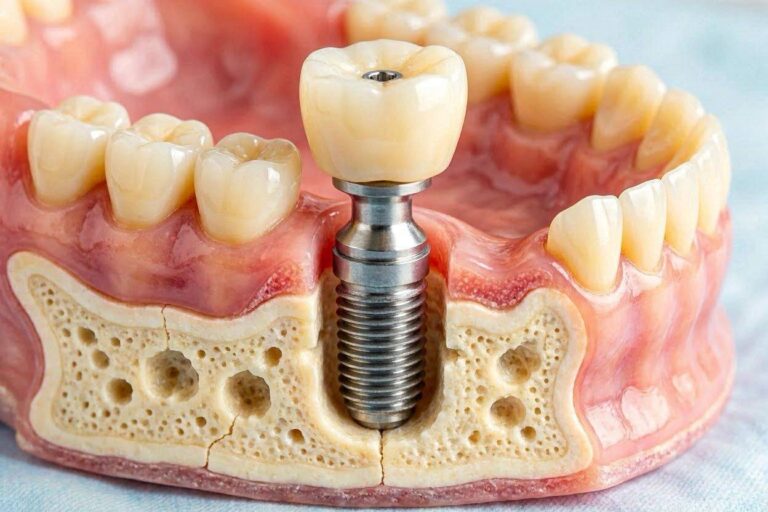
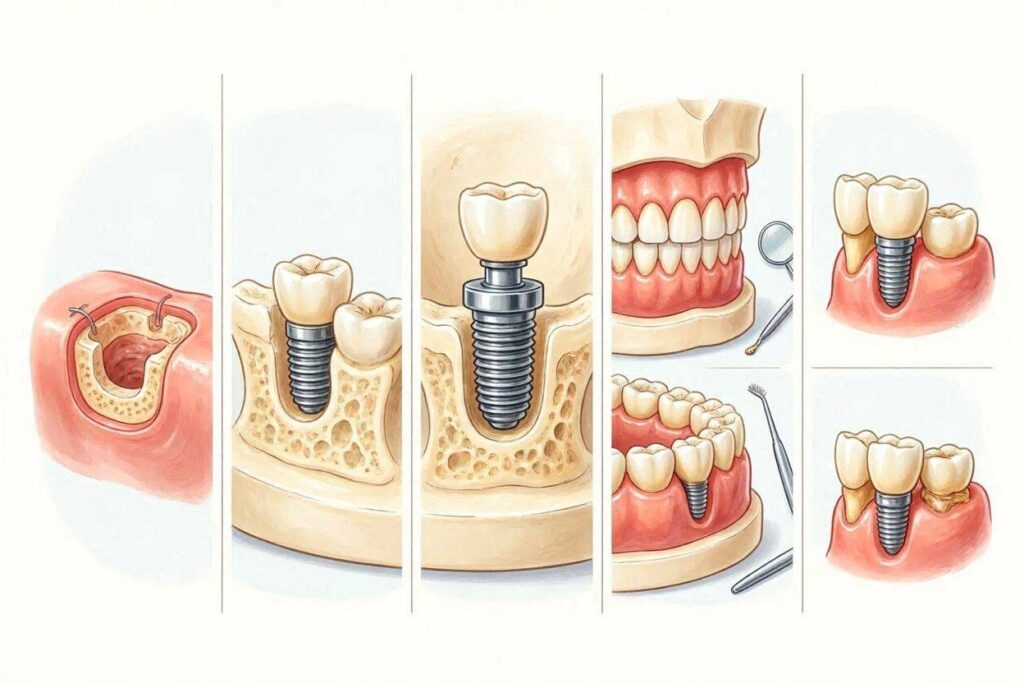
A dental implant is not a single unit. It is a system of three distinct parts, each with its own longevity profile.
1. The Implant Fixture: Potentially a Lifetime
The implant fixture is the titanium or zirconia post surgically embedded in your jawbone. Once osseointegration is complete, this post becomes a functional part of your skeleton. The materials are biocompatible, corrosion-resistant, and incredibly strong. The fixture itself does not decay, does not wear out, and does not have a finite fatigue life under normal physiological loading.
The primary threat to the fixture is not material failure but biological failure: peri-implantitis and loss of osseointegration. If you can prevent bone loss around the implant, the fixture itself can theoretically last forever. There are patients today who have had the same Brånemark implants functioning in their mouths for over 50 years.
2. The Abutment: 15 to 25+ Years
The abutment is the connector that screws into the implant fixture and supports the crown. It is typically made of titanium or zirconia. The abutment is a robust component. The abutment screw is the most likely part to loosen or, rarely, fracture. With proper torque and occlusal management, the abutment can last for decades, often the lifetime of the implant. However, if the crown needs replacement due to wear, the abutment may also be replaced at that time for optimal fit and esthetics.
3. The Crown: 10 to 20 Years, Sometimes Longer
The crown is the visible, functional tooth. It is subject to the same forces as natural teeth: chewing, grinding, and acid exposure. Porcelain and zirconia crowns are extremely durable, but they can chip, fracture, or wear down over time. The cement seal, if cemented, can degrade. The esthetics can fade as gums naturally recede with age, exposing the margin.
A well-made implant crown on a patient with a stable bite and good care can easily last 15 to 20 years. Some last much longer. But it is realistic to expect that the crown will be the first component to need replacement, not because of failure, but because of normal material fatigue and the cumulative effects of millions of chewing cycles.
The Scientific Evidence: What the Long-Term Studies Show
The marketing claim of “implants last a lifetime” is grounded in data, but the data must be interpreted honestly.
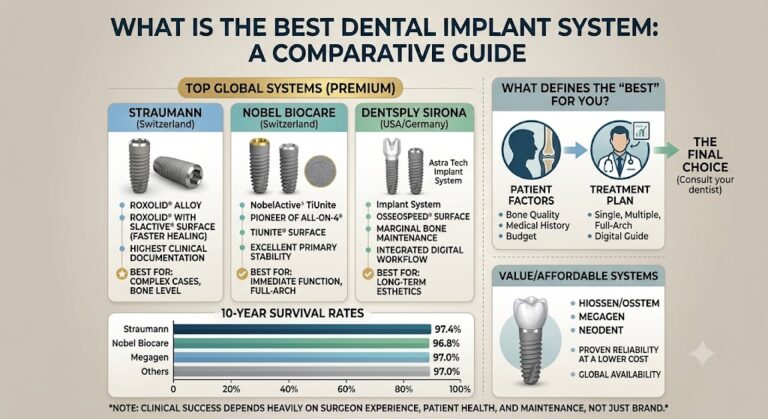
Longitudinal studies with 10, 15, and 20-year follow-up periods consistently report implant survival rates of 90% to 95% or higher. A landmark systematic review published in the Journal of Dental Research found a 10-year implant survival rate of approximately 95% for single crowns and 93% for fixed bridges. Another long-term study from the University of Gothenburg reported a 20-year survival rate of over 90%.
However, survival and success are different. Survival means the implant is still in the mouth. Success means it is in the mouth, without bone loss, without bleeding, without pathology. The success rates, as opposed to survival rates, are somewhat lower, around 80% to 85% at 10 years. This means a percentage of “surviving” implants have some degree of peri-implant mucositis or early peri-implantitis. They are present, but they are not perfectly healthy.
The key takeaway: the vast majority of implants survive for decades. But a meaningful minority develop biological complications that require treatment. Lifelong maintenance is the price of admission.
Factors That Shorten Implant Lifespan
Understanding what causes implants to fail or require early replacement is critical.
1. Poor Oral Hygiene and Peri-implantitis
This is the number one long-term killer of dental implants. Plaque biofilm accumulates around the implant. If not removed daily, it triggers an inflammatory response. Unlike natural teeth with their ligament defense, implants have a direct inflammatory pathway to the bone. Peri-implantitis causes progressive, often rapid bone loss. Without treatment, the implant loses support and either falls out or must be removed. A patient who brushes and flosses perfectly gets a lifetime implant. A patient who neglects hygiene loses it in five years.
2. Uncontrolled Systemic Disease
Conditions like uncontrolled diabetes or autoimmune diseases impair the body’s ability to maintain the bone-implant interface and fight off bacterial invasion. A well-controlled diabetic can have excellent longevity. A poorly controlled diabetic is at very high risk for late failure.
3. Smoking
Smoking is a devastating risk factor. It impairs blood flow, suppresses immune function, and is one of the strongest predictors of peri-implantitis. Smokers consistently show higher implant failure rates in long-term studies. Quitting smoking is the single best thing a smoker can do to extend the life of their implant.
4. Bruxism and Mechanical Overload
The implant-bone interface lacks a shock absorber. Excessive forces from grinding, clenching, or a poorly designed bite can cause microfractures in the bone, screw loosening, and crown fracture. A night guard is non-negotiable for bruxers.
5. Poor Prosthetic Design
A crown that does not fit precisely, has open margins, or creates an unhygienic contour is a plaque trap and a mechanical problem. The skill of the restoring dentist and the laboratory technician directly affects how long the crown and the underlying bone will last.
The Maintenance Protocol for Maximum Lifespan
You want your implant to last a lifetime. Here is the prescription.
Daily Home Care
- Soft Brush, Angled at 45 Degrees: Gently clean the gumline around the implant crown.
- Interdental Brushes and Implant Floss: Clean the sides and the critical under-surface of the crown. Use plastic-coated brushes to avoid scratching.
- Water Flosser: A gentle setting with a non-metal tip to flush the sulcus.
- Non-Abrasive Toothpaste: Avoid scratching the polished crown surface.
Professional Maintenance
- Recall Interval of 3 to 4 Months: Not six. The implant patient needs more frequent monitoring. The hygienist will use plastic or titanium scalers to clean without scratching.
- Annual Radiographs: A periapical X-ray once a year to monitor bone levels.
- Occlusal Check: The dentist checks the bite at every visit to ensure no heavy contacts have developed.
- Abutment Screw Torque Check: For screw-retained restorations, periodic torque testing may be recommended.
Lifestyle Choices
- Do Not Smoke.
- Control Your Blood Sugar.
- Wear a Night Guard if Prescribed.
- Avoid Using Implants as Tools: Do not open bottles, tear packages, or chew ice.
The Curve of Cumulative Survival: A Visual Concept
Imagine a graph. On the vertical axis is the percentage of implants still functioning. On the horizontal axis is time in years.
- Year 0-5: A slight dip. This is the early failure zone, where implants that fail to osseointegrate or develop early infection are lost. The survival curve drops from 100% to about 96-98%.
- Year 5-15: The curve is relatively flat and stable. The implants that survived the early phase are well-integrated. A small, steady trickle of late failures begins due to peri-implantitis and overload.
- Year 15-30+: The curve gradually slopes downward. More implants are lost to cumulative biological and mechanical complications. The survivors are the impeccably maintained implants in healthy, non-smoking patients with good bite control.
A well-maintained implant in a healthy patient has an excellent chance of being on the flat part of that curve for decades. Your behavior determines where your personal data point lands on the graph.
When to Expect Crown Replacement
Even if the implant fixture is perfect, the crown will show its age.
Signs Your Crown May Need Replacement:
- Chipped or fractured porcelain.
- Significant wear, flattening of the biting surface.
- A gap developing between the crown and the gum as the gum recedes.
- Persistent bad taste or odor, indicating a failed cement seal.
- Looseness of a cemented crown.
A crown replacement on an implant is a relatively simple procedure. The old crown is removed, a new impression is taken, and a new crown is fabricated. The abutment may be reused or replaced. This is a maintenance event, not a failure of the implant system. Budget for a crown replacement in your long-term financial planning, perhaps 15 to 20 years out.
Conclusion
A dental implant fixture, embedded in healthy bone and protected from peri-implantitis, can last a lifetime. The implant crown, subject to normal wear and tear, has a realistic lifespan of 15 to 20 years before it may need replacement. The overriding determinant of longevity is not the manufacturer or the material, but the patient’s daily hygiene, professional maintenance schedule, and systemic health. An implant is a permanent investment, but it requires a lifetime commitment to care.
FAQ
1. Can an implant really last 50 years?
Yes, it is possible. The earliest modern dental implants were placed in the 1960s and 1970s, and some of those original implants are still functioning in patients today. The materials and techniques have only improved since then. A 50-year lifespan requires excellent health, impeccable care, and a bit of luck.
2. How will I know if my implant is starting to fail years later?
Warning signs include bleeding when you brush around the implant, a bad taste, gum swelling, a feeling of looseness, or a change in the way the implant tooth feels when you bite. Any of these signs warrant an immediate visit to your dentist, not a wait-and-see approach.
3. Is the implant crown guaranteed by the dentist?
Many dentists offer a warranty on the crown for a certain period, typically 5 to 10 years, against manufacturing defects. This does not cover wear and tear, damage from trauma or neglect, or failure due to peri-implantitis. Discuss the warranty terms before treatment.
4. Do full-arch implant prostheses (All-on-4) last as long as single implants?
The implants themselves have similar survival rates. However, the full-arch prosthesis is a complex mechanical structure that is subject to more forces and potential for wear, chipping, and fracture of the teeth and framework. A full-arch prosthesis typically needs more maintenance and has a higher likelihood of needing replacement of the teeth or the entire prosthesis within 15 to 20 years compared to a single crown.
Additional Resource
For more on the long-term management and success of dental implants, visit the Academy of Osseointegration: https://www.osseo.org/